
Here are all 205 Surveying and Transportation Engineering questions asked in UPSC Civil Engineering Optional Paper II from 2004 to 2026, arranged under the 13 topics of the official syllabus. Within each topic the latest questions come first.
Each question ends with a code such as [2024/15m/3b] – the year, the marks, the word limit (where UPSC set one) and the question number in the paper.
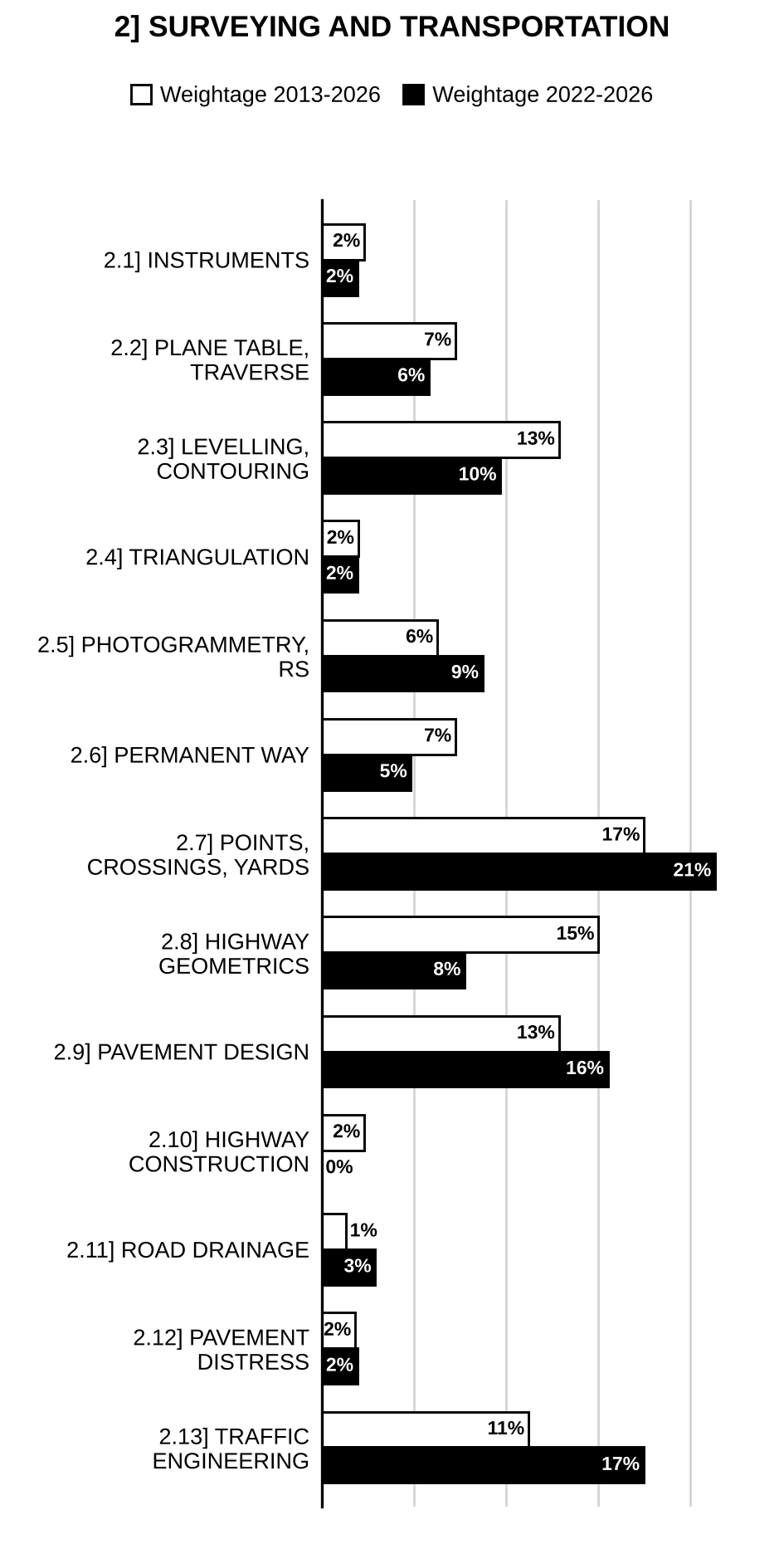
2.1] Surveying instruments and measurements
9 questions
The Fore Bearing of side AB of regular hexagonal polygon ABCDEFA in whole circle bearing system is 120°. Find the Fore Bearings and Back Bearings of all the other sides. Also find the bearings of line BE and BF. [2023/10m/1e]
What is normal tension? Determine the normal tension for a steel tape supported between two supports 10 m apart if the standard tension is 65 N and the weight of the tape per metre is 0.62 N. Take GPa and the area of cross-section as . [2020/10m/1c]
Differentiate between systematic errors and accidental errors in survey work. [2016/5m/1c(i)]
A steel tape 20 m long of standard length at 90 °F was used for measuring a line, the mean temperature during measurement being 60 °F. The measured distance was 1550 m, the following being the slopes: 1° 50′ for 100 m; 2° 30′ for 200 m; 3° 10′ for 300 m; 4° 00′ for 200 m; 5° 30′ for 400 m; 6° 20′ for 350 m. Compute the true length of the line, if the coefficient of expansion is per 1 °F. [2016/10m/2c]
List the fundamental lines of a theodolite and explain briefly the desired relationships between these lines and the effects if such relationships are not maintained. Also describe the checks need to be applied on an open traverse. [2011/8m/4c(ii)]
The following bearings were taken while running a compass traverse. At what stations do you suspect local attraction? Find the corrected bearings.
| Line | Observed bearings |
| AB | N46°10′E |
| BA | S46°10′W |
| BC | S60°40′E |
| CB | N61°20′W |
| CD | S10°30′E |
| DC | N8°50′W |
| DA | N79°40′W |
| AD | S80°40′E |
[2010/6m/1e(i)]
List the ten precautions to be taken in Theodolite observations. [2009/5m/1f(i)]
In the year 1940, a certain line had a magnetic bearing of S 67°30′E and then the magnetic declination at that place was 8°E. In 2007, the magnetic declination was 4°W. Find the magnetic bearing of the line in 2007. [2009/4m/4c(ii)]
Describe the common mistakes in linear measurements using chains and the measures to be adopted to eliminate these mistakes. [2004/12m/1d]
2.2] Plane table and traverse surveying
15 questions
Explain the process of orientation in Plane Table Surveying. Discuss the various methods of orientation highlighting suitability, advantages and disadvantages of each. [2026/10m/4b(ii)]
The lengths, latitudes and departures of a closed traverse ABCD are as follows:
| Line | Length (m) | Latitude | Departure |
| AB | 350.8 | + 303.03 | + 176.6 |
| BC | 408.5 | − 336.7 | + 231.4 |
| CD | 285.4 | − 211.3 | − 191.9 |
Calculate the length and bearing of the line DA. [2024/10m/3b(ii)]
What do you understand by orientation of Plane table? Discuss various methods of orienting the Plane table. [2022/10m/1e]
Enumerate the methods of adjustments of a closed traverse. A straight line AC of length 2000 m is required to be set out at right angle to a given line AB. This is done by traversing from A towards C. The observations are as follows:
| Line | Length (m) | Bearing |
| AB | — | 360°00′00″ |
| AD | 731 | 113°48′00″ |
| DE | 467 | 81°18′00″ |
| EF | 583 | 105°57′00″ |
Compute the necessary length and bearing of FC. [2020/15m/3b]
With the help of a neat sketch, explain the traversing method of Plane Table Survey. [2018/5m/1c(i)]
A traverse was run and observations are given below. Find out the error of closure and compute the corrected latitude and departure:
| Side | Distance (m) | Azimuth |
| 350.10 | 152°46′12″ | |
| 579.03 | 64°50′54″ | |
| 368.28 | 01°10′06″ | |
| 382.20 | 262°08′48″ | |
| 401.58 | 231°22′00″ |
[2018/20m/4c]
A straight tunnel is to run between two points and , whose net coordinates are given in the table below:
| Point | Independent coordinates N | Independent coordinates E |
| 0 | 0 | |
| 3014 | 256 | |
| 1764 | 1398 |
It is desired to sink a shaft at , the middle point of , but it is impossible to measure along directly, so is to be fixed from , a third known point. Calculate– (i) the net coordinates of ; (ii) the length and bearing of ; (iii) the angle , given that the whole circle bearing of is 38°24′. [2017/10m/4b]
From the following data of a traverse, compute the length CD, if traverse stations A, D and E are in a straight line:
| Line | Length (in m) | Bearing |
| AB | 110 | 83° 12′ |
| BC | 165 | 30° 41′ |
| CD | — | 346° 06′ |
| DE | 212 | 16° 18′ |
[2015/15m/3b]
The length and Bearings of a four sided traverse are as follows: AB = 320 m, BC = 440 m, CD = 390 m, DA = 513.8 m AB = N 45°15′ E, BC = S 71°30′ E, CD = S 30°15′ W, DA = N 66°44′ W Calculate the Area of the Traverse. [2014/15m/3b]
List the fundamental lines of a theodolite and explain briefly the desired relationships between these lines and the effects if such relationships are not maintained. Also describe the checks need to be applied on an open traverse. [2011/8m/4c(ii)]
The following deflection angles were measured in running a traverse A-B-C-D-E-F-G.
| Station | Deflection Angle |
| A | |
| B | 23°47′R |
| C | 18°19′L |
| D | 37°20′R |
| E | 15°38′R |
| F | 10°12′L |
| G |
If the true bearing of AB is N62°18′E, calculate the true bearings of the remaining sides. [2010/6m/1e(ii)]
Write the procedure of construction of simple curve when both the points of commencement and tangency are inaccessible. [2009/10m/3b(ii)]
With a neat labelled sketch define I. Angle of deflection II. Point of commencement. III. Long chord IV. Tangent distance. [2009/5m/3b(iii)]
Describe the methods commonly adopted to check the accuracy of an open traverse. [2004/10m/3b(i)]
List the major disadvantages of Plane Tabling. [2004/10m/3b(ii)]
2.3] Levelling and contouring
19 questions
In running fly levels from a benchmark of RL 381.605, the following readings were obtained: Backsight 2.215, 1.030, 1.595, 1.655 Foresight 1.025, 3.290, 2.385 From the last position of the instrument, four pegs at 50-metre intervals are to be set out on a uniformly falling gradient of 1 in 100; the first peg is to have an RL of 380.500. Work out the staff readings required for setting the tops of the pegs on the given gradient. [2026/15m/2b]
A ship is 55 km away from a lighthouse of height 62 m above mean sea level. An observer standing on the deck of the ship tries to see the lighthouse top. The height of the observer’s eye above mean sea level is 10 m. Determine whether the lighthouse top will be visible to the observer or not. If not visible, find out the distance by which the ship has to travel towards the lighthouse so that it becomes visible to the observer. [2024/10m/1d]
Starting from ground point A having elevation of 100.500 m, levels from points B to F were taken inside a tunnel. The points B to F were marked in the ceiling of the tunnel keeping the staff inverted. Above staff readings were observed during the survey. Calculate the levels of all the points marked inside the tunnel. Also apply the regular checks for calculations.
| Staff at | A | B | C | D | E | F |
| Back sight | 1.234 | 1.345 | 1.730 | 2.056 | 2.156 | – |
| Foresight | – | 1.782 | 1.830 | 2.000 | 2.340 | 2.780 |
[2023/15m/3b]
The following consecutive readings were observed, on a continuously sloping ground, with the help of a 4.0 m staff and a dumpy level. If the reduced level of first point is 99.000 m, calculate the level of last point by entering the readings in level book. Also apply the usual checks. 3.815, 2.500, 1.335, 2.980 and 0.800 m. [2022/10m/3b(i)]
The staff reading taken on a staff held at a distance of 80 m from the instrument when the bubble central was 1.455 m. When the bubble is moved 6 divisions out of centre, the staff reading observed is 1.487 m. If the length of one division is 2 mm, find the radius of curvature and the sensitivity of the tube. [2021/10m/1c]
A dumpy level was set up at exactly between and , 50 m apart. The readings on staff held at and were 2.4 m and 1.4 m respectively. The instrument was then shifted and set up at on the line produced at 10 m from . The readings on staff held at and were respectively 2.50 m and 1.4 m. Determine the staff reading on and to give a horizontal line of sight. Determine R.L. of if that of is 200.00 m. [2021/15m/2c]
The following consecutive readings were taken with a dumpy level and a 4 m levelling staff on continuously sloping ground at 30 m intervals: 0.680, 1.455, 1.855, 2.330, 2.885, 3.380, 1.055 1.860, 2.265, 3.540, 0.835, 0.945, 1.530, 2.250 The RL of the starting point was 80.750 m. (i) Rule out a page of level book and enter the above readings. (ii) Carry out reductions of heights by collimation method. (iii) Determine the gradient of line joining the first and last point. Apply arithmetic check. [2020/15m/2c]
While carrying out the permanent adjustment of a dumpy level by two-peg method, the following observations were made: Instrument at peg E, midway between the points C and D, 100 m apart Reading at point C = 2.0 m Reading at point D = 3.0 m Instrument at peg F, inline of C and D, such that CF = 120 m and DF = 20 m Reading at point C = 1.50 m Reading at point D = 2.75 m Check whether the instrument needs permanent adjustment or not, and whether the line of sight is inclined upwards. What should be the correct reading at point C if the instrument is to be adjusted? [2019/10m/1c]
(i) Classify spirit levelling and briefly explain the different types of them. (ii) Compute the missing data in the following level book page:
| Station | BS | IS | FS | Rise | Fall | HI | RL |
| 1 | ? | 23.18 | 20.00 | ||||
| 2 | 1.59 | ? | ? | ||||
| 3 | 1.28 | ? | 1.08 | ? | ? | ||
| 4 | ? | 4.0 | ? | 18.33 | ? | ||
| 5 | ? | 2.19 | ? | ||||
| 6 | ? | ? | 15.72 | ||||
| 7 | 2.95 | ? | ? |
[2019/15m/3c]
Levelling was done from to and continued to a benchmark (BM) of elevation 88.500 m. The readings obtained in metre are given below. Find the reduced level (RL) of and , and apply checks:
| BS | IS | FS | RL | Remarks |
| 1.622 | ||||
| 1.874 | 0.354 | |||
| 2.032 | 1.780 | |||
| 2.362 | ||||
| 0.984 | 1.122 | |||
| 1.906 | 2.824 | |||
| 2.036 | 88.500 | BM |
[2018/15m/3b]
Describe the characteristics of contours. The areas within contour lines at the site of a reservoir and the face of a proposed dam are as follows:
| Contour (in m) | Area (in ) |
| 441 | 270 |
| 444 | 10440 |
| 447 | 75600 |
| 450 | 144000 |
| 453 | 270000 |
| 456 | 414500 |
| 459 | 460800 |
| 462 | 586800 |
| 465 | 639900 |
Assuming 441 m as the bottom level of the reservoir and 465 m as the water level, find the volume of water in the reservoir in cubic metres. [2017/10m/3b]
The following staff readings are observed successively with a levelling instrument. The levelling instrument has been moved after third, seventh and ninth readings: 1.568, 1.964, 0.898, 2.124, 2.986, 1.148, 0.746, 2.118, 1.444, 2.648, 2.248, 1.876. Calculate the RL of points, if the first reading is taken with a staff held on a BM of 842.248 m. [2016/10m/3c]
Explain various uses of a contour map in Civil Engineering projects. [2015/5m/1c(i)]
The following data were entered in a level book, where some entries were omitted (marked with ×). Find out the missing data and apply checks:
| Station | BS (in m) | IS (in m) | FS (in m) | Rise (in m) | Fall (in m) | RL (in m) | Remarks |
| 1 | 2.285 | 232.460 | BM 1 | ||||
| 2 | 1.650 | × | 0.020 | ||||
| 3 | 2.105 | × | |||||
| 4 | × | 1.960 | × | ||||
| 5 | 2.050 | 1.925 | 0.300 | ||||
| 6 | × | × | 232.255 | BM 2 | |||
| 7 | 1.690 | × | 0.340 | ||||
| 8 | 2.865 | 2.100 | × | ||||
| 9 | × | × | 233.425 | BM 3 |
[2015/20m/4c]
How an area is measured using Planimeter? A rectangle has sides approximately 400 m and 250 m. If the Area is to be determined to the nearest , what will be the maximum error permitted in each line and to what accuracy should the lines be measured? Assume equal precision ratio for each length. [2014/10m/1c]
The following consecutive readings, in metres, were taken by a dumpy level: 0.860, 0.785, 0.660, 1.760, 1.990, 0.665, 0.650 and 0.620 The instrument was shifted after 3 and 5 readings. The last reading was on the bench mark whose reduced level was 130.00 metres. Book the above data in a proper tabular form and compute the reduced levels of other points using rise and fall method. Apply the usual arithmetic check. [2013/10m/1d]
Draw neat sketches of pattern of contours that show (i) Vertical cliff, (ii) Ridge line, (iii) A pond, (iv) Area having uniform steep slope, (v) A Hillock. Also explain with suitable sketch how the contour map will help in canal alignment. [2011/10m/1d]
Explain the natural errors in the levelling. A page of level book is reproduced below in which some readings marked of ‘X’ are missing. Complete the page with all arithmetic checks:
| Station | B.S. | I.S. | F.S. | RISE | FALL | R.L. | Remarks |
| 1 | 3.150 | X | |||||
| 2 | 1.770 | X | 0.700 | X | C.P. | ||
| 3 | 2.2 | X | X | ||||
| 4 | X | 1.850 | X | X | C.P. | ||
| 5 | 2.440 | 0.010 | X | ||||
| 6 | X | X | 1.100 | X | C.P. | ||
| 7 | 1.185 | 2.010 | X | 222.00 | C.P. | ||
| 8 | –2.735 | X | X | Staff held inverted | |||
| 9 | X | 1.685 | 4.420 | X | C.P. | ||
| 10 | 1.525 | 0.805 | X | ||||
| Σ | 12.055 | X | X | X |
[2011/12m/2c(i)]
Two pegs and were 750 m apart across a wide river. The following readings were taken with the same levelling instrument:
| Level Station | Readings on | Readings on |
| 1.543 | 2.847 | |
| 1.422 | 2.622 |
The error in the collimation adjustment of the level was + 0.002 m per 100 m. Determine the true difference of level between and and the extent of refraction correction. [2010/10m/3c(ii)]
2.4] Triangulation
5 questions
Observations were made with a theodolite from the points A and B of baseline AB having horizontal length of 200 m to the two inaccessible points P and Q at the same side of the line AB. The following observations are done: , , , The angle of elevation of P from A = 20° The angle of elevation of Q from A = 12° Calculate the horizontal distance PQ and difference in elevation between P and Q. [2025/10m/3a(i)]
The altitude of two proposed stations and 130 km apart are respectively 225 m and 1160 m. The altitude of two peaks and on the profile between them are respectively 308 m and 632 m, the distance being km and km. Determine whether and are intervisible, and if necessary find the minimum height of a scaffolding at , assuming as the ground station, to make them intervisible. [2021/15m/3b]
Explain the principles of triangulation. Write the factors to be considered for the selection of baseline for triangulation. [2017/5m/1c(ii)]
Explain the objectives of triangulation surveys and explain the criteria for selection of the layout of triangles. Also explain the term well conditioned triangles, and strength of figure. [2011/10m/4c(i)]
Determine the elevation of the top of a chimney from the observations given below:
| Station | Reading on BM | Angle of elevation |
| A | 2.870 | 28°42′ |
| B | 3.750 | 18°06′ |
The top of chimney and the stations A and B are in the same vertical plane. AB is 100 m. If the RL of the BM is 100.000, determine the elevation of the top of the chimney. [2009/5m/3b(i)]
2.5] Photogrammetry and remote sensing
16 questions
Define remote sensing. State how it differs from photogrammetry. [2026/5m/3c(ii)]
Explain the different types of resolutions in remote sensing with suitable examples. [2025/10m/1e]
A pair of overlapping vertical photographs was taken with an aerial camera of focal length 150 mm from an altitude of 3000 m above datum. The mean principal base measured is equal to 80 mm. In the common overlap, a flagpole with its base 100 m above datum is observed. What will be the height of the flagpole if the parallax difference between the top and bottom point of the flagpole is 4.6 mm? Also, find the scale of photograph at datum and the distance covered by the aircraft between two successive exposures. [2025/10m/3a(ii)]
Two points A and B having elevations of 585 m and 250 m respectively, above datum, appear on a vertical photograph obtained with a camera of focal length of 250 mm and flying altitude of 2300 m above datum. Their correlated photographic coordinates are as follows:
| Point | Photographic Coordinates x (cm) | Photographic Coordinates y (cm) |
| A | + 5.65 | + 3.75 |
| B | − 3.45 | + 8.55 |
Determine the ground coordinates of points A and B and calculate the horizontal distance between points A and B. [2024/5m/3b(i)]
An aircraft flew at the altitude of 5000 m above the mean sea level. Two consecutive photographs were taken with the camera of focal length 300 mm on the flat ground having elevation of 2000 m above mean sea level. The longitudinal overlap is 65% and photograph print size is 300 mm × 300 mm. Calculate the scale of the photograph and distance between the two consecutive exposure stations. [2023/5m/2c(i)]
What is spectral reflectance curve? Explain its significance in Remote Sensing. [2023/10m/2c(ii)]
A line on a topographical map at 1 : 50000 scale measures 12 cm. The same line on an aerial photograph taken from an aircraft of flying height 2.7 km measures 10 cm. Assuming the terrain to be flat, compute the focal length of the camera lens used for taking this photograph. [2018/5m/1c(ii)]
Explain remote sensing method of surveying. List the various uses of IRS data. [2017/5m/1c(i)]
A line AB measures 10 cm on a photograph taken with a camera having a focal length of 22 cm. The same line measures 4 cm on a map drawn to a scale of 1/40000. Calculate the flying height of the aircraft, if the average altitude is 400 m. [2016/5m/1c(ii)]
An aerial photograph was taken from a flying height of 15 km above m.s.l. A straight portion of a canal measures 20 cm on this photograph, whereas it is 10 km on the ground. If the height of the terrain is 5000 m above m.s.l., compute the focal length of camera lens used for taking the photograph. [2015/5m/1c(ii)]
Two points A and B having elevation of 650 m and 250 m respectively above datum, appear on a vertical photograph obtained with a camera of focal length of 250 mm and flying altitude of 2700 m above datum. Their correlated photographic coordinates are as follows:
| Point | Photographic Coordinates – X (cm) | Photographic Coordinates – Y (cm) |
| A | + 3.65 | + 2.54 |
| B | – 2.25 | + 5.59 |
Determine the length of the ground line AB. [2014/15m/4c]
A section line AB 300 m long on a flat terrain measures 102.3 mm on the vertical photograph. A Radio tower also appears on the photograph. The distance measured from the principal points to the image of the bottom and top of the Radio tower are found to be 70 mm and 80 mm respectively. The average elevation of the terrain was 553 m. Determine the height of the tower. Take . [2013/15m/4c(i)]
An area 40 km in the north-south direction and 36 km in the east-west direction, is to be photogrammetrically surveyed. For this aerial photography is to be made with following data:
| Average scale of photograph | 1 : 15000 |
| Average elevation of terrain | 450 m |
| Photograph size | 20 cm × 20 cm |
| End lap | 60% |
| Side lap | 30% |
| Ground speed of Aircraft | 200 km/hr |
| Focal length of camera lens | 30 cm |
Calculate the flying height of the aircraft, number of photographs in each flight, number of flights, total number of photographs, spacing of flight lines, ground distance between exposures and exposure interval. [2011/12m/3c(i)]
The scale of a photograph is 1.0 cm to 100 m. The photograph size is 23 cm × 23 cm. Determine the number of photographs required to cover an area of 15 km × 10 km, if longitudinal overlap is 60% and the side overlap is 30%, other conditions remaining same. [2010/10m/4c(ii)]
With a neat labelled diagram, classify the satellites depending upon the inclination of the orbital plane with the earth’s equatorial plane. [2009/7m/1f(ii)]
Compare the capabilities of terrain features interpretation through aerial photographs vis-a-vis topographic maps. [2004/20m/4c]
2.6] Railway permanent way
20 questions
Explain the required properties of a good ballast material for railway track. Explain with reasons which ballast material is best suitable for high-speed railway track. [2025/10m/3b(i)]
Calculate the minimum depth of ballast required for a broad gauge railway track having sleeper density of , length of rail of 13.0 m and width of sleeper of 25 cm. [2025/5m/3b(ii)]
A 100 km length railway line is to be constructed for doubling the existing track. Calculate the quantity of track material required to construct the track. Consider the length of rail as 13 m, density of sleepers as and width of sleeper as 250 mm. [2023/10m/1d]
Explain with neat sketches, how surface and sub-surface water can be removed from a railway track. [2021/10m/3a(i)]
What are the components of a permanent way? Draw the cross-section of a single-line BG track on embankment and show therein all the components. [2019/10m/1e]
List different types of gauges along with their width specifications. List the factors affecting the choice of a gauge. [2018/5m/1d(i)]
What are the requirements for an ideal rail section? Explain, with a neat sketch, standard flat-footed broad-gauge rail section of 60 kg type. Mark approximate dimensions of each part. [2017/10m/1d]
List the advantages and disadvantages of concrete sleepers. Mention the requirements of an ideal sleeper. [2017/5m/3c(i)]
Briefly explain the relevance of coning of wheels of a railway vehicle. [2016/5m/1d(i)]
Differentiate between wooden and concrete sleepers. [2016/5m/1d(ii)]
What are the basic requirements to be considered for construction of a railway track to achieve higher speeds and better riding quality? Sketch a typical cross-section of a BG railway track for double line on curve in cutting section. [2015/10m/1d]
State the functions of sleepers in a Railway Track. Enlist the materials used for sleepers. For a Broad Gauge (B.G.) track in Transition zone, in order to allow locomotives with a maximum permissible speed of 100 km/hr, calculate: (i) Radius of curvature (ii) Degrees of curvature (iii) Super-elevation (iv) Length of Transition. [2014/20m/4b]
Write short explanatory notes giving sketch, if necessary, with respect to Railway track: (i) Marshalling yard (ii) Turn-table (iii) Fish plates and fish bolts (iv) Check rails and guard rails. [2013/10m/1c]
What is ballast? Why is ballast used in Railway track? Write briefly on different types of ballast used. Why is it necessary to replace stone ballast from time to time? [2013/10m/4b]
Explain the requirements of rail section. What factors are considered in determining the maximum limit of vertical rail wear? What is the most common cause of failure of rail and also give its explanation. [2011/10m/1e]
The following defects were recorded upon inspection of a railway track: (a) Battered ends of rail joints (b) Angular cracking of rails (c) Excessive closing and opening of spaces at rail joints. Give reasons for these defects and suggest any remedial measures. [2011/8m/2c(iii)]
Define sleeper density. Calculate the number of sleepers required for constructing a B. G. Railway track of 10.0 km length, given the sleeper density as . Length of each rail is 12.8 m. [2010/6m/1f(i)]
Mention the relative merits and demerits of F. F. and B. H. rails. [2010/6m/1f(ii)]
Draw a neat labelled sketch with dimensions showing the cross-section of a Broad gauge track for double line with electric-traction. [2009/6m/1d(i)]
What is the intended purpose of rail? List any ten requirements to serve the intended purpose of a rail. [2009/6m/1d(ii)]

Preparing for Prelims too?
Our UPSC Prelims Topic-wise PYQ eBook covers every Prelims question with detailed explanations, so you can see exactly where UPSC asks from.
View the BookDownload Free Sample2.7] Railway points, crossings, track geometry and yards
30 questions
What is the purpose of providing a Marshalling Yard? Discuss various types of Marshalling Yards. [2026/10m/1d]
A BG track comes across a curve of radius 1000 m. The equilibrium cant is provided considering a speed of 90 km/hr. Calculate the maximum and minimum permissible speeds on the track if the limiting values of cant deficiency and cant excess are 75 mm each. [2026/15m/3c(i)]
Calculate the maximum number of wagons of weight 80 tonnes each that can be pulled by a locomotive having hauling capacity of 16 tonnes. The weight of the locomotive is 100 tonnes and the train has to run at a speed of 60 kmph on a straight level BG track. Assume rolling resistance of wagon and locomotive as 1.6 kg/tonne and 2.0 kg/tonne respectively. Also, calculate the hauling capacity of the locomotive required if the train has to climb a gradient of 1 in 150 in 1° curve. [2025/15m/2c]
A high speed B.G. section with a maximum sanctioned speed of 130 kmph is proposed. The section is passing through a transition length with a 2° curve. Calculate the superelevation, maximum permissible speed and transition length for this section at curve. Assume the equilibrium speed as 90 kmph and the booked speed of the goods train to be 60 kmph. Rate of change of Cant or Cant deficiency is 35 mm/sec. Assume any other data suitably. [2024/15m/2c]
Sketch a typical diamond crossing and label all its components. Design a diamond crossing between two B.G. tracks crossing each other at an angle of 1 in 8.5. [2024/15m/4c]
Trains of different speeds are to be run on a 2° curve on a broad gauge. The average speed of trains to be run on the track is 80 kmph. Calculate the value of equilibrium cant. Also calculate the maximum permissible speed on the track allowing the maximum cant deficiency. [2023/15m/2b]
What would be the gradient for a M.G. track when a grade resistance together with curve resistance due to a curve of 6° shall be equal to the resistance due to ruling gradient of 1 in 200? [2022/10m/1d]
In a layout of B.G. Yard, an 8° curve branches off from a 4° main curve in an opposite direction. If speed is restricted to 28.90 km/hr and permissible value of cant deficiency is 7.61 cm, determine the speed restriction on the main line. [2022/15m/4a]
A locomotive on M. G. Track has three pairs of driving wheels each carrying 20 tonnes. What maximum load can it pull on level track with curvature of 2° at 50 km/hr? Take coefficient of friction = 0.166. [2021/10m/1e]
Two high level platforms are to be provided on the inside as well as the outside of a 2° curve on a BG track with a super-elevation of 100 mm. What should be the required extra clearances for these platforms, both on the inside and the outside of the curve (length of bogie = 21.34 m, C/C bogie distance = 14.785 m, height of platform = 840 mm). [2021/10m/3a(ii)]
If an 8° curve track diverges from a main curve of 5° in an opposite direction in the layout of a BG yard, calculate the superelevation and the speed on the branch line if the maximum speed permitted on the main line is 45 km/hr. [2020/10m/1e]
Enumerate various types of track junctions. Calculate all the elements required to set out a 1 in 12 turnout taking off from a straight BG track with its curve starting from the toe of the switch, i.e., tangential to the gauge face of the outer main rail and passes through theoretical nose of crossing (TNC). The heel divergence is given as 11.4 cm. [2020/20m/3a]
Find out the steepest gradient on a straight track using the following data for a train having 20 wagons: Weight of each wagon = 18 tonnes Rolling resistance of wagon = 2.5 kg/tonne Speed of the train = 50 km/hr Weight of locomotive with tender = 120 tonnes Tractive effort of locomotive = 12 tonnes Rolling resistance of locomotive = 3.5 kg/tonne. [2020/15m/4b]
Calculate the maximum permissible load of a BG locomotive with 3 pairs of driving wheels with axle load of 22 tonnes each on a straight level track at a speed of 80 kmph. Also calculate the reduction in speed if the train has to run a rising gradient of 1 in 200. What would be the further reduction in speed if the train has to negotiate a 4° curve on a rising gradient of 1 in 200, assuming coefficient of friction as 0.2? [2019/15m/4c]
A 6 degree curve branches off from a 3 degree main curve in an opposite direction in the layout of a BG yard. If the speed of train on the branch-line is restricted to 35 kmph, determine the speed restriction on the main line. Assume permissible deficiency in cant as 75 mm. [2018/5m/1d(ii)]
Why are signals used in railway tracks? Draw the neat sketch of a semaphore signal and write the names of the different parts. [2017/5m/3c(ii)]
Enumerate the different resistances which a locomotive has to overcome before hauling a train. A BG track locomotive having four pairs of driving wheels runs on a straight level track at a speed of 86 kmph. The maximum axle load is 28.5 tonnes. (i) Find the maximum permissible train load that can be pulled by the locomotive. (ii) Also calculate the reduction in speed if the train climbs a gradient of 1 in 200. (iii) If the train climbs a 1 in 200 gradient with a 3° curve, what would be the reduced speed of the train? Given, the coefficient of friction is 0.166. [2017/10m/4c]
What are the merits of CMS crossings over cast steel crossings? [2016/5m/2d(i)]
What would be the equilibrium cant on a curved BG track with a 2° curve for an average speed of 70 kmph? Calculate the minimum permissible speed after allowing a maximum cant deficiency of 2.0 cm. [2016/10m/2d(ii)]
Using the following details of trains running on a 3° main BG curve track, determine (i) equilibrium cant for equilibrium speed and (ii) length of transition curve to be adopted:
| Speed (in km/hr) | No. of trains | Speed (in km/hr) | No. of trains |
| 75 | 3 | 55 | 12 |
| 65 | 6 | 45 | 18 |
Assume— (1) maximum permissible speed on the curve as 80 km/hr; (2) allowable cant deficiency as 7.5 cm; (3) weighted average may be used as the equilibrium speed of trains. [2015/15m/4b]
Differentiate between Single Slip and Double Slip in Rails. If the tread diameter on both the rails is the same, then show that the slip is about 0.029 m. per degree of Central angle for Broad Gauge (B.G.). [2014/10m/1d]
State the functions of sleepers in a Railway Track. Enlist the materials used for sleepers. For a Broad Gauge (B.G.) track in Transition zone, in order to allow locomotives with a maximum permissible speed of 100 km/hr, calculate: (i) Radius of curvature (ii) Degrees of curvature (iii) Super-elevation (iv) Length of Transition. [2014/20m/4b]
Write short explanatory notes giving sketch, if necessary, with respect to Railway track: (i) Marshalling yard (ii) Turn-table (iii) Fish plates and fish bolts (iv) Check rails and guard rails. [2013/10m/1c]
Write short notes on cant deficiency and negative superelevation in Railway track. [2012/8m/8a(i)]
The rulling gradient has been fixed as 1 in 250 on a section of a B.G. track. What should be compensated gradient when 500 m radius horizontal curve is also to be introduced on a rulling gradient? [2012/8m/8a(ii)]
Draw a neat sketch of diamond crossing and list its important features. [2011/6m/3c(iii)]
Differentiate between the two items in each of (a) and (b): (a) Junction, Terminal Station (b) Gravity yard, Hump yard. [2010/10m/2c(iii)]
What would be the permissible speed on the curve, on a 8° broad gauge track? The average speed of different trains is 60 km/h and the allowable cant deficiency is half that of maximum cant deficiency. Comment on the speed limit. Assume suitable data as per Railway Board if required. [2009/10m/3c(i)]
Write step by step procedure of measuring mid-ordinates or versines for starting lining the curves. [2009/10m/3c(ii)]
What are the functions of a marshalling yard? List the factors to be considered in developing an efficient marshalling yard. [2004/20m/2c]
2.8] Highway alignment and geometric design
28 questions
A vertical curve is formed when a descending gradient of 0.5% meets another descending gradient of 3.0%. Find the length of the vertical curve to provide the required (i) stopping sight distance, and (ii) overtaking sight distance, for a design speed of 65 km/hr. Assume the coefficient of longitudinal friction as 0.35 and the acceleration as 3.6 km/hr/sec. Assume other necessary data suitably. [2026/15m/2a]
An alert driver with a reaction time of 0.75 seconds is driving downhill on a 2.5% grade at 60 kmph on a dry pavement when suddenly a person comes in the path of the driver at a distance of 55 m. Can the driver stop in time with emergency braking? Can the driver stop in time when it is a rainy day? Assume: , (dry pavement), (wet pavement) [2024/10m/1e]
A two-lane State Highway in plain terrain, with cutting section having camber of 2.0%, negotiates a curve of radius 480 m. Design superelevation and explain the process of attaining designed superelevation with the help of neat sketches. [2022/15m/3a]
What is vertical curve and its significance? Draw summit as well as valley curve for the following conditions: (i) Upward gradient () followed by another upward gradient () (ii) Downward gradient () followed by another downward gradient () [2021/10m/1d]
There is a horizontal curve of radius 400 m and length 200 m on a highway. Compute the set-back distances required from the centre line on the inner side of the curve so as to provide for: (i) stopping sight distance of 100 m (ii) safe overtaking sight distance of 320 m The distance between the centre lines of the road and the inner lane is 1.9 m. [2021/15m/2b]
A two-lane pavement (7 m) on a National Highway in hilly terrain (snow-bound) has a curve of radius 60 m. The design speed is 40 km/hr. Determine the length of the transition curve. Determine the total length of the curve and the tangent length if the deflection angle is 60°. Assume ; the rate of attainment of superelevation = 1 in 60; , subject to maximum of 0.8 and a minimum of 0.5; rotation of superelevation about pavement centreline. [2020/15m/2b]
What factors influence the geometric design of a highway? What are the objects and elements need to be considered while designing a highway? Calculate the minimum sight distance required to avoid head-on collision of two cars approaching from the opposite direction at 90 kmph and 60 kmph. Assume a reaction time of 2.5 seconds, coefficient of friction of 0.7 and brake efficiency of 50% in either case. [2019/15m/2b]
Write short notes on the following: (i) Hairpin bend (ii) Retaining and breast walls (iii) Scupper While aligning a highway in a built-up area, it was necessary to provide a horizontal circular curve of radius 400 m. Design the following geometric features as per IRC formula: (1) Superelevation (2) Extra widening of pavement (3) Length of the transition curve The data available are: Design speed = 75 kmph Length of the wheelbase of the longest truck = 6 m Pavement width = 10.5 m. [2019/15m/3a]
Two cars are approaching from the opposite directions at 100 kmph and 70 kmph. Compute the minimum sight distance required to avoid head-on collision of the cars, if reaction time of 2.5 seconds, coefficient of friction of 0.7 and brake efficiency of 50% are assumed. [2018/10m/1b]
Define kerbs in roads. Discuss the important factors which control the geometric design of a highway. [2018/15m/2b]
A horizontal circular curve is provided with a radius of 325 m for aligning a highway. Determine the following geometric features: (i) Superelevation (ii) Extra widening of pavement (iii) Length of transition curve Given the following data: Design speed = 70 kmph Length of wheel base of the largest truck = 6 m Pavement width = 10.5 m. [2018/15m/4b]
What are the objects of geometric design of highway? What are the different elements which need consideration while designing a highway? [2017/5m/3d(i)]
While aligning a highway in a built-up area, it was necessary to provide a horizontal circular curve of radius 325 m. Design the following geometric features: (1) Superelevation (2) Extra widening of pavement (3) Length of transition curve Data available are: Design speed = 65 kmph Length of wheelbase of the largest truck = 6 m Pavement width = 10.5 m. [2017/10m/3d(ii)]
What are the points to be kept in mind while executing the work of mechanically stabilized soil highway? An NH passes through a rolling terrain having a horizontal curve of radius 600 m. Design the length of the transition curve and compute the shift using the following data: (i) Design speed, kmph (ii) Normal pavement width, m (iii) Number of lanes, (iv) Wheelbase width, m (v) Allowable rate of superelevation = 1 in 150 (vi) Allowable rate of change of centrifugal acceleration, [2017/15m/4d]
Explain with sketches the various factors controlling the highway alignment. What are their impacts on requirements of an ideal alignment? [2016/10m/1e]
A NH, passing through a plain terrain with light rainfall intensity, has to be constructed with bituminous concrete surface. What should be the minimum radius of horizontal curve, when normal camber section is permitted? [2016/10m/4c]
Explain the significance of Stopping Sight Distance and overtaking Sight Distance. Calculate the values of Head Light Sight Distance and Intermediate Sight Distance for a Highway with a Design Speed of 65 km/hr. Assume coefficient of friction as 0.36 and Reaction Time as 2.5 sec. [2014/10m/1b]
Explain with sketches the salient factors controlling the alignment of a road. [2013/10m/1e]
The driver of a vehicle travelling at an initial speed of 60 kmph up a grade requires 9 m less to stop after he applies the brakes than a driver travelling at the same initial speed down the same grade. If the coefficient of friction, between the tyres and the pavement is 0.4, what is the percent grade? [2013/15m/4c(ii)]
Explain road camber and its necessity. Which road surface would need sleeper cross slope – concrete or bituminous? [2012/4m/8a(iii)]
What are conditions which necessitate taking up of a realignment project of the highway? Discuss the general principles in the re-alignment of a highway and explain how the work is carried out. [2011/10m/2c(ii)]
Explain sight distance and factors causing restrictions to sight distance. Explain the significance of stopping sight distances. Also derive an expression for finding the stopping sight distance at level. Making necessary assumptions, calculate the minimum sight distance required to avoid a collision of two cars approaching from opposite directions at 90 and 60 kmph. [2011/12m/3c(ii)]
A 4-lane National Highway is passing through a built-up area. Design the following geometric features for a horizontal circular curve of radius 350.0 m for this Highway. Consider design speed as 80 kmph and length of wheel base of largest truck as 6.0 m. (i) Superelevation (ii) Extra widening of pavement (iii) Length of Transition curve Also suggest the most suitable shape of curve. [2010/12m/1d]
Explain any six salient features of Nagpur Road Plan. [2009/6m/1e(i)]
List the eight factors which control the conventional methods of preliminary survey. Explain any two in detail. [2009/6m/1e(ii)]
The speed of overtaking and overtaken vehicles are 80 km/h and 40 km/h respectively on a two way traffic road. If the acceleration of overtaking vehicle is I. calculate safe overtaking sight distance. II. mention the minimum length of overtaking zone and III. draw a neat labelled sketch of the overtaking zone and show the positions of the sign posts. • (Overtaking zone ahead) • (End of overtaking zone ahead) Assume reaction time of driver as 2 sec. [2009/10m/2c(i)]
A vertical summit curve is to be designed when two grades and meet on a highway. The stopping sight distance and overtaking sight distance required are 200 m and 650 m respectively. But due to site conditions the length of vertical curve has to be restricted to a maximum value of 500 m if possible. Calculate the length of summit curve needed to fulfil the requirements of I. Stopping sight distance II. Overtaking sight distance or at least intermediate sight distance and discuss the results. [2009/10m/2c(ii)]
Enumerate the major policies and objectives of the Third Twenty-Year Road Development Plan (1981-2001) of India. [2004/12m/1e]
2.9] Pavement design
24 questions
What do you understand by the effective CBR value? Discuss its significance. How is it calculated as per the latest IRC guidelines? [2026/10m/4a]
The laying temperature during the construction of plain cement concrete pavement of slab thickness 20 cm is 15 °C and the maximum slab temperature during the summer is used to be 45 °C. If the width of expansion joint gap is 2.5 cm, calculate the spacing between the expansion and contraction joints. Assume the following data: Coefficient of thermal expansion of concrete = per °C Unit weight of concrete = Allowable stress in cement concrete in tension = Coefficient of friction of the interface = 1.5. [2025/10m/1d]
What are the functions of tie bars in rigid pavements? A cement concrete pavement has a thickness of 30 cm and lane width 3.75 m. Design the tie bars along the longitudinal joints using the data given below: Allowable working stress in steel tie bars = 1250 kg/cm²; Allowable tensile stress in deformed bars () = 2000 kg/cm²; Allowable bond stress in plain bars () = 17.5 kg/cm²; Allowable bond stress in deformed bars () = 24.6 kg/cm²; Unit weight of concrete pavement (W) = 2400 kg/m³; Maximum value of friction coefficient (f) = 1.35. [2024/15m/2b]
A flexible pavement has been designed for two lane single carriageway of width 7 m with the following data: (i) Commercial vehicle per day in each direction = 750 (as on 31.03.2018) (ii) Date of completion of construction = 31.03.2020 (iii) Rate of traffic growth = 10% per annum (iv) Design life = 10 years (v) Vehicle damage factor = 2.0 (vi) Lane distribution factor (LDF) for 2-lane single carriageway road = 0.75 (vii) LDF of 4-lane dual carriageway road = 0.75 in each direction Due to some issues, starting of construction got delayed and work started on 01.04.2023. In the meantime government has decided to develop the road as four lane dual carriageway. Considering the same design data as planned earlier, calculate the new design life of the project. Assume any additional data required for the design suitably. [2023/15m/4c]
A cement concrete pavement of thickness 20 cm, has two lanes of 7.2 m with a longitudinal joint. Design the tie bar. Assume allowable working stress in tension for steel as and bond strength with concrete as . [2022/10m/1c]
Design a flexible pavement for a two-lane undivided carriageway using the following data: Subgrade CBR value = 8% Lane distribution factor = 0.5 Design Life = 15 years Planning and Construction period = 1.5 years Present commercial traffic is as under:
| Vehicle Type | Gross Wt. (T) | No. of vehicles per day | Wheel Configuration | Growth Rate |
| Bus | 15 | 200 | Front Axle – Single, Rear Axle – Dual | 4% |
| Truck | 20 | 1512 | Front Axle – Single, Rear Axle – Tandem | 8% |
As per IRC 37, 2018 the following pavement composition is desired for CBR of 8% subgrade corresponding to different Design traffic:
| Design Traffic (msa) | BC Wearing Course (mm) | DBM Binder Course (mm) | WMM Base Course (mm) | GSB Sub-base Course (mm) |
| 5 | 30 | 50 | 250 | 150 |
| 10 | 30 | 60 | 250 | 200 |
| 20 | 30 | 90 | 250 | 200 |
| 30 | 40 | 95 | 250 | 200 |
| 40 | 40 | 105 | 250 | 200 |
| 50 | 40 | 115 | 250 | 200 |
[2022/20m/2b]
Design the size and spacing of dowel bars at the expansion joints of a cement concrete pavement of thickness 25 cm with radius of relative stiffness 80 cm, for a design wheel load of 5000 kg. Assume load capacity of dowel system as 40% of the design wheel load. Joint width is 2.0 cm, permissible shear and flexural stresses in dowel bar are and respectively and permissible bearing stress in cement concrete is . [2021/20m/4a]
What are different types of joints in rigid pavements? Design a dowel bar system for a cement concrete slab for the following conditions: Design wheel load = 4100 kg Design load transfer = 40% Slab thickness = 20 cm Joint width = 2 cm Permissible flexural stress in dowel bar = Permissible shear stress in dowel bar = Permissible bearing stress in concrete = value of subgrade = [2020/20m/4a]
Distinguish between flexible and rigid pavements. With the help of neat sketches of cross-sections of pavements, enumerate the functions of their components. What are the causes of failures of flexible and rigid pavements? [2019/15m/4a]
Analyze relative damage caused by axle loads of 4080 kg and 16320 kg to the flexible pavement. [2016/5m/3d(i)]
A four-lane divided NH need to be constructed for the following traffic volumes observed in 2014:
| Vehicle type | Volume (vehicles/day) | Annual growth rate | VDF |
| Light CV | 4500 | 8% | 0.5 |
| Medium CV | 3000 | 6% | 1.5 |
| Heavy CV | 1500 | 4% | 3.5 |
Construction period: 2 years. Design life: 20 years. Determine the design traffic in terms of cumulative standard axles (CSA). [2016/10m/3d(ii)]
A national highway with dual 2-lane carriageway is to be constructed in the year 2017 for a design life of 25 years. However, traffic count reveals that only 2000 commercial vehicles (summation of both directions) are plying per day in the year 2015 and annual rate of increase in commercial vehicles is 5%. Hence, from economical reasons, it was decided to construct new flexible pavement for this national highway in stages initially for a period of 15 years. Determine the traffic for which this new flexible pavement is to be designed assuming vehicle damage factor as 4.8. Assume any other data suitably, if required. [2015/10m/1b]
Answer the following:
(i) Differentiate between open-graded and dense-graded bituminous construction. [2015/5m/2b(i)]
(ii) What are the general requirements of a bituminous mix? [2015/5m/2b(ii)]
(iii) Write the purpose of tie bars and dowel bars in joints of cement concrete pavement. [2015/5m/2b(iii)]
Compute the Radius of Relative Stiffness of 15 cm thick cement concrete pavement from the following data: (i) Modulus of Elasticity of Cement Concrete : (ii) Poisson’s Ratio for Cement Concrete : 0.13 (iii) Modulus of Subgrade Reaction : and . [2014/15m/2b]
Differentiate between Flexible Pavement and Rigid Pavement. Calculate the equivalent C-value of a three layered Flexible Pavement Section having individual C-values as given below:
| Materials | Thickness (cm) | C-value |
| Bituminous Concrete | 10 | 60 |
| Cement Treated Base | 20 | 225 |
| Gravel Sub-base | 10 | 15 |
[2014/20m/3c]
Describe the Boussinesq approach of stress distribution for one layer theory and Burminster approach of stress distribution for two layer theory in a flexible pavement. [2012/12m/5a]
Design the spacing and size of the dowel bars at an expansion joint of concrete pavement of thickness 20 cm. Given the radius of relative stiffness of 90 cm, design wheel load 4000 kg, load capacity of dowel system is 40 per cent of design wheel load. Joint width is 3.0 cm and the permissible stress in shear, bending and the bearing stress in dowel bars are 1000, 1500 and respectively. [2012/10m/6c(i)]
Design the length and spacing of tie bars given the pavement thickness is 20 cm and the width of the road is 7.0 m with one longitudinal joint. The unit weight of concrete is , the coefficient of friction is 1.5, allowable working tensile stress in steel is , and the bond stress of deformed bars is . [2012/10m/6c(ii)]
Discuss the importance of gross wheel load and contact pressure in stress distribution pattern and in pavement design. [2011/6m/4c(iii)]
Explain how the elastic modulii of subgrade and base course are estimated using plate bearing test data. [2011/6m/4c(iv)]
Design and sketch the tie bars for a cement concrete pavement for a longitudinal joint using following data: Slab Thickness = 33 cm Lane width = 3.5 m Coefficient of friction = 1.5 Density of concrete = Allowable tensile stress in plain bars = Allowable tensile stress in deformed bars = Allowable bond stress for plain bars = Allowable bond stress for deformed bars = [2010/10m/2b(i)]
It is proposed to widen an existing 2-lane State Highway Section to a 4-lane divided road. Calculate the cumulative number of standard axles to be carried during the design life of (i) 15 years and (ii) 10 years in terms of msa taking the following data: Initial traffic in each direction = 5600 cv/day Design CBR of subgrade soil = 6.0% Traffic Growth rate = 8.0% V. D. F. = 4.5 Lane Distribution factor = 0.75. [2010/10m/2b(ii)]
Calculate the load stresses at interior, edge, and corner regions of a cement concrete pavement using Westergaard’s stress equations using the following data: Design wheel load = 5100 kg Modulus of Elasticity of concrete = Pavement thickness = 180 mm Poisson’s ratio = 0.15 Modulus of subgrade reaction = Radius of contact area = 15 cm. [2010/10m/4b(i)]
A cement concrete (cc) pavement slab of thickness 200 mm is constructed over a granular sub-base having modulus of reaction . The maximum temperature difference between the top and bottom of the slab during summer days and night is found to be 18°C. The spacing between the transverse contraction joint is 4.5 m and that between longitudinal joints is 3.5 m. The design wheel load is 5100 kg, radius of contact area is 15 cm, E-value of cc is , Poissons ratio is 0.15, and the coefficient of thermal expansion of cc is per °C and friction coefficient is 1.5. Using the edge and corner load stress charts given by the IRC and the chart for the warping stress coefficient find the worst combination of stresses at the edges.
[Figure: Edge Load Stress Chart (IRC) – graph of edge load stress, Se (vertical axis, 0 to 50 in steps of 5) against slab thickness, h cm (horizontal axis, 14 to 25, labelled 14, 16, 18, 20, 22, 24); chart note: P = 5100 kg, a = 15 cm, , ; five falling curves for K = 30 , 15, 10, 8 and 6 (K = 6 the highest curve, K = 30 the lowest), approximate readings: at h = 14 cm about 39.5 (K = 30), 44 (K = 15), 47 (K = 10), 50 (K = 8) and above 50 (K = 6); at h = 20 cm roughly 24.5 (K = 30) to 28.5 (K = 6); at h = 25 cm about 14 to 17]
[Figure: Corner Load Stress Chart (IRC) – graph of corner load stress, Sc (vertical axis, 0 to 50 in steps of 5) against slab thickness, h cm (horizontal axis, 14 to 25); chart note: P = 5100 kg, a = 15 cm, , ; five falling curves for K = 30 , 15, 10, 8 and 6 (K = 6 the highest, K = 30 the lowest), approximate readings: at h = 14 cm about 41.5 (K = 30), 47.5 (K = 15) and above 50 for K = 10, 8 and 6; at h = 20 cm roughly 25.5 (K = 30) to 30 (K = 6); at h = 25 cm about 18.5 to 20]
[Figure: Warping Stress Coefficient – graph of VALUES OF AND (vertical axis, 0 to 1.2 in steps of 0.2) against VALUES OF AND (horizontal axis, 0 to 14 in steps of 2); single S-shaped curve: about 0 up to , rising steeply between 3 and 4 (about 0.5 at 3.7), about 0.9 at 6, reaching 1.0 near 7.5, a peak of about 1.05 near 9, then about 1.02–1.03 from 10 to 14] [2009/10m/4a(i)]
2.10] Highway construction and materials
5 questions
What are the points to be kept in mind while executing the work of mechanically stabilized soil highway? An NH passes through a rolling terrain having a horizontal curve of radius 600 m. Design the length of the transition curve and compute the shift using the following data: (i) Design speed, kmph (ii) Normal pavement width, m (iii) Number of lanes, (iv) Wheelbase width, m (v) Allowable rate of superelevation = 1 in 150 (vi) Allowable rate of change of centrifugal acceleration, [2017/15m/4d]
Answer the following:
(i) Differentiate between open-graded and dense-graded bituminous construction. [2015/5m/2b(i)]
(ii) What are the general requirements of a bituminous mix? [2015/5m/2b(ii)]
(iii) Write the purpose of tie bars and dowel bars in joints of cement concrete pavement. [2015/5m/2b(iii)]
Explain briefly the various tests for judging the suitability of Road stones giving objectives of each test. [2013/10m/3c]
Describe the various steps in the construction of a cement concrete pavement. Show the general layout of joints in concrete pavement. [2013/10m/4a]
Discuss the requirements of materials, plants and equipment and the adoptable construction steps for Built-up spray Grout. [2010/10m/4b(ii)]
2.11] Road drainage and culverts
4 questions
Explain with sketches how the subsurface drainage system is provided to lower the water table in road. [2025/5m/2b(ii)]
The maximum quantity of water to be discharged by the side drains on both sides of a highway section is . Design rectangular side drains for the following conditions. Both drains carry equal discharge. Maximum permissible velocity of flow = 0.8 m/s Roughness coefficient = 0.03. [2022/10m/3b(ii)]
Discuss the importance of drainage in highways. Describe the surface and subsurface drainage arrangements for a national highway in coastal area. [2017/5m/1e(i)]
Explain, with sketches, the commonly adopted sub-surface drainage systems provided in national highways to lower the water table and to control seepage. [2004/20m/3c]
2.12] Pavement distresses and overlays
3 questions
Discuss the key steps involved in flexible overlay design over flexible pavement using the Benkelman Beam Deflection method. Explain why, when and how, various corrections are applied in the process of overlay design. [2026/10m/1e]
Distinguish between flexible and rigid pavements. With the help of neat sketches of cross-sections of pavements, enumerate the functions of their components. What are the causes of failures of flexible and rigid pavements? [2019/15m/4a]
Discuss typical pavement failures along with their causes. [2018/10m/3c(i)]
2.13] Traffic engineering
27 questions
List the various applications of Origin and Destination (O&D) Studies. [2026/10m/4b(i)]
A taxi driver was fined for crossing the traffic signal at right-angled road intersection. He claimed that the signal was faultily designed and the duration of amber light is not sufficient. Using the following data, verify the correctness of the driver’s claim: Road width at intersection = 20 m Speed limit at road = 60 kmph Amber light duration = 4.0 s Comfortable deceleration = Car length = 4.0 m Perception reaction time = 1.2 s. [2025/10m/2b(i)]
The speed and delay study was conducted by floating car method during different round trips on a stretch of 3 km State highway. The data of the study is given below:
| Trip Number | Number of Vehicles: In Opposite Direction | Number of Vehicles: Overtaking | Number of Vehicles: Overtaken |
| 1 | 140 | 30 | 16 |
| 2 | 130 | 22 | 17 |
| 3 | 180 | 18 | 19 |
Given that the floating car is moving at a constant speed of 30 kmph, calculate the following: (i) Traffic stream variables for different trips (ii) Speed-density and volume-density relationship [2025/15m/4c]
Explain spot speed, running speed, space-mean speed, time-mean speed and average speed. [2024/10m/3a(i)]
The consolidated data collected from speed and delay studies by floating car method on a stretch of urban road of length 2.5 km, running East-West are given below in the table. Determine the average values of volume, journey speed and running speed of the traffic stream, along either direction.
Mean Values of Speed and Delay
| Direction | Mean Journey Time (Minutes) | Mean Stopped Delay (Minutes) | Number of Vehicles (Mean Value): Overtaking | Number of Vehicles (Mean Value): Overtaken | Number of Vehicles (Mean Value): In Opposite Direction |
| East-West | 4.85 | 1.60 | 4.5 | 6.5 | 376 |
| West-East | 8.36 | 1.90 | 4.0 | 5.5 | 280 |
[2024/10m/3a(ii)]
Explain any two traffic surveys carried out to decide the geometric design features of a road. [2023/5m/3a(i)]
The relationship between speed and density for a given section of road was found to be , where is speed in kmph and is the density in vehicles per km. Calculate the speed and density in which maximum flow could occur. Also draw the speed-density, speed-flow and flow-density diagrams indicating critical values. [2023/15m/3a(ii)]
The following data were obtained from the spot speed study carried out at a city road. Suggest (i) Speed limit for regulation (ii) Speed to check geometric design elements (iii) Lower speed group causing congestion.
| Speed Range (km/hr) | No. of Vehicles | Speed Range (km/hr) | No. of Vehicles |
| 0 – 10 | 0 | 50 – 60 | 216 |
| 10 – 20 | 11 | 60 – 65 | 68 |
| 20 – 30 | 30 | 65 – 70 | 24 |
| 30 – 40 | 105 | 70 – 75 | 10 |
| 40 – 50 | 233 | > 75 | 6 |
[2022/15m/2c]
What is rotary intersection? Sketch rotary showing its various elements. What are the guidelines for selecting a rotary type of intersection? [2020/10m/1d]
Describe the purpose of traffic signals. Explain various methods of coordination of traffic signals. [2018/10m/3c(ii)]
List the factors affecting the design of a rotary intersection. [2017/5m/1e(ii)]
Briefly explain the role of ‘desire line diagram’ in highway network planning. [2016/5m/4d(i)]
Design details of a rotary intersection are given below: Design speed = 40 kmph; Width of weaving section = 9.0 m; Average width of entry and non-weaving section = 7.0 m; Length of weaving section = 36 m; Proportion of weaving traffic = 40%. What is the practical capacity of the weaving section? What measures would you suggest to enhance the practical capacity? [2016/10m/4d(ii)]
Answer the following:
(i) Briefly explain the weaving angle and weaving length with reference to traffic rotary. [2015/10m/3c(i)]
(ii) What are the various factors to be considered in the design of traffic islands for channelized intersections? Briefly explain, with the help of sketch, how speed of vehicles can be controlled by using traffic islands at intersections. [2015/10m/3c(ii)]
Traffic signals are to be installed on a right angled intersection with Road A, 18 m wide and Road B, 12 m wide. The heaviest volumes of traffic per hour for each lane of Road A and Road B are 275 and 225 respectively. The approach speeds are 55 and 40 kmph for Road A and Road B respectively. Design the timings of traffic signals. Take amber period for Road A as 4 seconds and for Road B as 3 seconds. [2013/20m/3d]
List human factors governing road user behaviour. Discuss briefly. [2012/12m/5b]
A fixed time 2-phase signal is to be provided at an intersection having a North-South and an East-West road where only straight ahead traffic is permitted. The design hour flows from various arms and the saturation flows for these arms are given in the following Table:
| North | South | East | West | |
| Design hour flow (q) in PCU’s/hour | 800 | 400 | 750 | 1000 |
| Saturation flow (s) in PCU’s/hour | 2400 | 2000 | 3000 | 3000 |
Calculate the optimum cycle time and green times for the minimum overall delay. The inter-green time should be minimum necessary for efficient operation. The time lost per phase due to starting delay can be assumed to be 2 seconds. The value of amber period is 2 seconds. Sketch the timing diagram for each phase. [2012/12m/5c]
Define probability density function (pdf) and cumulative density function (cdf). Draw pdf and cdf for a Normal Distribution. [2012/10m/6a(i)]
Define Running speed, Time Mean speed and Space Mean speed. Explain method of measuring spot speed using Enoscope. [2012/10m/6a(ii)]
Explain different types of road signs with examples and sketches. [2012/12m/6b(i)]
Explain sequential transportation planning process. [2012/8m/6b(ii)]
Explain the terms traffic density, traffic flow and mean free speed and describe their inter-relationships using appropriate sketches/diagrams. [2011/10m/1f]
Enlist and sketch different types of pavement markings and explain their significance for safe traffic operation. [2010/10m/3b(i)]
Speed observations from a radar speed meter are given below, giving data on speeds of subsidiary streams with the volume of traffic on each subsidiary stream. Calculate time-mean speed and space-mean speed.
| Speed in km/hour | Volume of subsidiary stream in vehicle/hour |
| 2-5 | 01 |
| 6-9 | 04 |
| 10-13 | 00 |
| 14-17 | 07 |
| 18-21 | 20 |
| 22-25 | 44 |
| 26-29 | 80 |
| 30-33 | 82 |
| 34-37 | 79 |
| 38-41 | 49 |
| 42-45 | 36 |
| 46-49 | 26 |
| 50-53 | 09 |
| 54-57 | 10 |
| 58-61 | 03 |
[2010/10m/3b(ii)]
The consolidated data collected from speed and delay studies by floating car method on a stretch of urban road of length 4 km, running North-South are given below. Determine the average values of volume, journey speed and running speed of traffic stream along either direction.
| Trip No. | Direction | Journey time (min, sec) | Total stopped delay (min, sec) | No. of vehicles overtaking | No. of vehicles overtaken | No. of vehicles from opposite direction |
| 1 | N – S | 6, 30 | 1, 40 | 4 | 6 | 270 |
| 2 | S – N | 7, 20 | 1, 50 | 5 | 3 | 180 |
| 3 | N – S | 6, 50 | 1, 20 | 4 | 3 | 280 |
| 4 | S – N | 7, 50 | 2, 10 | 3 | 2 | 200 |
| 5 | N – S | 6, 10 | 1, 20 | 2 | 5 | 240 |
| 6 | S – N | 8, 10 | 2, 20 | 6 | 2 | 180 |
| 7 | N – S | 6, 30 | 1, 40 | 4 | 4 | 300 |
| 8 | S – N | 7, 40 | 1, 50 | 1 | 2 | 160 |
[2009/10m/4a(ii)]
How are speed, travel time, volume and density of traffic on a road mutually related? Illustrate with sketches as appropriate. [2004/12m/1f]
Describe, along with their functions, the major types of road markings commonly used in India. [2004/10m/4b(ii)]

Strengthen your GS papers
Our UPSC Mains Topic-wise & Year-wise PYQ eBook (2013–2026) maps every GS question to the syllabus, so you know what UPSC asks and how often.
View the BookDownload Free Sample« Previous: Construction Technology, Equipment, Planning and Management | Next: Hydrology, Water Resources and Engineering »
Back to: Civil Engineering Optional PYQs – Topic-wise
Last updated: 30 October 2026