
Here are all 174 Construction Technology, Equipment, Planning and Management questions asked in UPSC Civil Engineering Optional Paper II from 2004 to 2026, arranged under the 12 topics of the official syllabus. Within each topic the latest questions come first.
Each question ends with a code such as [2024/15m/3b] – the year, the marks, the word limit (where UPSC set one) and the question number in the paper.
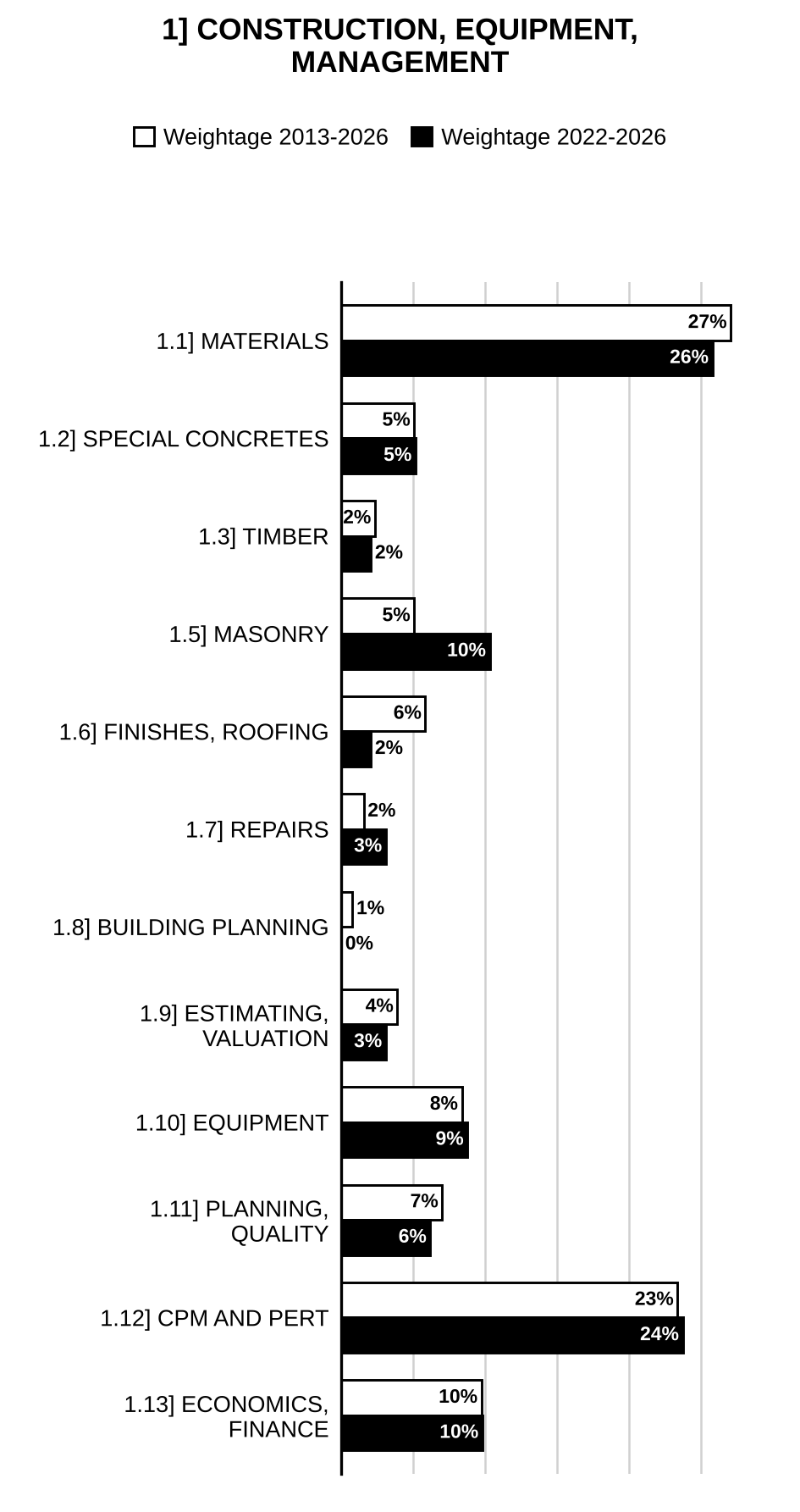
1.1] Construction materials
43 questions
State the conditions under which one would best recommend the following types of cements. Also, state the reasons behind them. (i) Portland Pozzolana Cement (ii) Rapid Hardening Cement (iii) Quick Setting Cement (iv) Low Heat Portland Cement (v) Air-entraining Cement. [2026/10m/1b]
Explain with a neat sketch how vibration during the placement of concrete affects the compressive strength development of concrete, which is inversely dependent on the water-cement ratio. Also, state the advantages of inducing vibration to fresh concrete. [2026/10m/3b]
With respect to the chemical admixtures that are added to concrete, briefly differentiate ‘Accelerators’ from ‘Retarders’, and also explain how they modify the properties of concrete. [2026/10m/4c(i)]
What is the creep for hardened concrete? With a neat sketch, draw the time-versus-deformation diagram of hardened concrete. [2026/10m/4c(ii)]
Briefly discuss the effect of the following on the properties of mortar used for construction work: (i) Alkali water and seawater (ii) Low temperature (iii) Sand and water. [2025/15m/3c]
Describe various defects in clay bricks giving sources/causes of defects. [2024/10m/1a]
What are the approximate limits of chemical (oxide) composition in hydraulic cement? Also state the function of oxides in brief. [2023/10m/1a]
What do you understand by workability of concrete? Write the procedure for any one measurement method available to check the workability of concrete. [2023/10m/1c]
Explain in brief (with neat sketches), the Phenomenon of Bulking of Sand. How does bulking of sand affect the concrete mix? [2023/15m/3c]
Briefly explain the deterioration of concrete caused by (i) leaching action, and (ii) chemical interaction. [2022/10m/1a]
Differentiate between overburnt and underburnt bricks. Why are these bricks not recommended for construction works? [2022/5m/4b(i)]
List the general factors governing the selection of stone for construction purposes. What considerations would guide in selecting stone for the following use: (I) Face work of a building, and (II) Buildings facing the sea? [2022/10m/4b(ii)]
Specify the laboratory tests conducted on cement. Also indicate the permissible values of the cement for corresponding tests (for ordinary Portland cement). [2020/15m/3c]
(i) Why is cube strength different from cylinder strength for the same grade of concrete? (ii) What is Bauschinger effect? Where is it relevant? [2019/10m/1a]
What does creep of concrete mean? Is creep harmful or beneficial? What factors influence creep? [2019/10m/1b]
(i) What are the materials used for thermal insulation over roof? Describe the three types of membrane used for roof waterproofing. (ii) What are the most effective ways of providing durability to concrete against chemical attack in a known adverse environment? [2019/20m/3b]
What are artificial stones? Describe the process of preparing artificial marble. [2018/5m/1a(i)]
Enumerate the characteristics of good building stone. [2018/5m/1a(ii)]
Explain the following: (i) Bulking of sand (ii) Fineness modulus (iii) Water-cement ratio (iv) Slump test. [2018/15m/2a]
What do you mean by cement mortar? Explain the theory of proportioning of cement mortar and also explain the relation between solidity and strength of cement mortar. [2017/10m/1b]
Describe in brief the various methods of proportioning concrete. [2017/5m/4a(i)]
Differentiate between plain cement concrete and reinforced cement concrete. Why is reinforcement necessary? Discuss. [2017/10m/4a(ii)]
Indian codes give specifications for a minimum IST and a maximum FST for cements. Why? (Not exceeding 100 words) [2016/10m/100w/1b]
From workability and strength considerations, it is found that a concrete should have a unit water content and water-cement ratio of 180 and 0.50, respectively. Also, from a durability point of view, the maximum water-cement ratio allowed is 0.45. Now, assuming that the mortar content of the mix should be 60% (by volume), determine the content of cement, sand and coarse aggregate in of concrete. Take specific gravity of cement, sand and coarse aggregate to be 3.14, 2.65 and 2.71, respectively, and ignore air content. [2016/10m/2a]
Answer the following questions briefly: (i) What tests are carried out to determine the mechanical properties of coarse aggregates used in concrete? (Not exceeding 50 words) (ii) What is the purpose of the ‘frog’ provided in a brick used in masonry construction? (Not exceeding 50 words) (iii) An equipment purchased for ₹ 5,00,000 has a useful life of 3 years and a salvage value of ₹ 50,000. Compare the book value of the equipment at the end of 2 years, determined using ‘linear’ depreciation and ‘sum of digits’ depreciation. [2016/15m/50w/2b]
Discuss briefly the provisions in IS 456–2000 to ensure durability of reinforced concrete structures. [2016/10m/4a]
What are the constituents of a good brick earth? Discuss the properties of a first class brick. Describe the tests to be performed to check the quality of bricks. [2015/10m/1a]
What is meant by proportioning of concrete? Discuss its properties. Describe different methods of proportioning concrete. [2015/15m/2a]
Enumerate the tests to which a stone should be subjected for making it fit for building construction purposes. What is meant by dressing of stone? What are the advantages of quarry dressing? [2015/15m/3a]
What are the standards given in IS : 456–2000 to produce good quality concrete? Distinguish between Repair, Restoration and Rehabilitation. [2014/10m/1a]
Write short notes on the following: (i) Acid Attack (ii) Sulphate Attack (iii) Alkali Attack on cement concrete. [2014/15m/2a]
What are the qualities of a good Brick? Explain the tests to be conducted to judge the quality of a Brick as per I.S. Code. [2014/15m/3a]
What kind of special attention is necessary for maturing concrete made with fly ash cement as per BIS codal provision? [2013/5m/1a(ii)]
Name and discuss at least three advantages of adding appropriate polymer as admixture in cement concrete. [2013/10m/3b]
Which building block/s you will like to use for a sound and thermal proofing of a studio and why? [2012/3m/1a(i)]
Which cement will you recommend for – mass concrete – low permeability concrete – high strength concrete? [2012/3m/1b(i)]
List the different ingredients of a brick making clay and function of each part. [2012/10m/4a(ii)]
Classify the sedimentary rock on the basis of types of deposits. Give examples. [2011/5m/1a(i)]
Explain the soundness test on cement. [2011/5m/1a(ii)]
What are the functions of cement ingredients? [2011/10m/3b]
What are the qualities of a good building stone? [2010/5m/3a(iii)]
How does the water cement ratio affect the strength of concrete? [2010/5m/3c(i)(a)]
Explain in detail the need and procedure for conducting water absorption test for coarse aggregate to be used in cement concrete. [2009/6m/1a(ii)]
1.2] Special concretes
7 questions
Briefly discuss why it is more advantageous to use high strength concrete for construction of high-rise buildings and large-span bridges as compared to normal strength concrete. [2025/10m/1a]
Answer the following in brief: (i) Why is it advantageous to use ferrocement when the structural member is in tension? (ii) What are the advantages of using ferrocement over reinforced concrete? (iii) What are the advantages of using ferrocement in marine structures? [2025/15m/4b]
Indicate (in bulleted form) the advantages of ferro-cement over the conventional RCC. Can we use the ferro-cement tanks for high capacity like 25000 litres or above? Justify your answer. [2021/10m/4c(i)]
Explain the following: (i) High performance concrete (ii) Self-compacting concrete (iii) Fibre-reinforced concrete (iv) Polymer concrete (v) Ferro-cement. [2019/15m/2a]
Define fibre reinforced concrete. Briefly explain how the presence of fibres in the matrix affects the properties of concrete. [2016/15m/3b]
Which type of cement concrete you will recommend for ‘blast resistance purpose’ and why? [2012/2m/1b(ii)]
Compare and contrast the – self compacting concrete and – harsh concrete. Where each is used? Comment on the workability. [2012/10m/3a(i)]
1.3] Timber
4 questions
Describe the important features of Type 1, Type 2 and Type 3 preservatives used for timber. [2024/10m/1c]
List the different defects in timber. [2020/5m/4c(ii)]
What is ‘Seasoning of Timber’? Discuss the different methods of seasoning of timber. [2014/15m/4a]
Which tests on timber are carried out, both along the grains and across the grains. List the normal defects in timber with sketches. [2012/10m/4b(i)]
1.5] Masonry construction
15 questions
Explain with a neat sketch the essential features of English bond in brick masonry construction. [2026/10m/1a]
Briefly discuss the advantages of using hollow concrete blocks for masonry works of a building as compared to stone or brick masonry works. [2025/10m/1b]
Draw neat sketches, showing complete details of plans of alternate courses of a brick thick masonry wall in English Bond having a right-angled corner. [2024/10m/1b]
What are the general precautions to be observed while constructing a brick masonry work? Briefly explain with the help of neat sketches where possible. [2022/10m/1b]
Sketch a cross-section of a masonry wall and show coping, cornice, lintel, jamb and parapet wall in the sketch. Also briefly explain the use of the above parts of a building. [2022/10m/4c(i)]
What do you understand by rubble masonry block? Show a cross-section. [2013/5m/1a(i)]
What are the factors affecting design of brick masonry walls? Give a brief account of the method of design as per I.S. codes. [2013/10m/3a]
List different type of stone masonry. Explain the purpose of through stones in random rubble masonry. What is the stiching of distressed big stone blocks? Discuss. [2012/10m/3a(ii)]
Draw the neat sketches of the strip footing in black cotton soil. [2011/5m/1b(i)]
Draw the plan of Double Flemish bond for various wall thicknesses with pier of same thickness. [2011/5m/1c(ii)]
Give the classification of Arches according to number of centres. Explain them with sketch only. [2011/5m/2b(i)]
Describe in brief the advantage of hollow concrete masonry. [2011/5m/2b(ii)]
What is the purpose of dressing of stones? Mention the different types of surface finishes employed in stone masonry construction and illustrate by figures any two finishes. [2010/6m/1a(i)]
Mention the different bonds used in brick masonry and discuss in detail any two of them with figures. [2010/6m/1b(ii)]
What is masonry work? Name different kinds of masonry and mention the principles to be observed in stone masonry exposed walls construction. [2010/10m/4c(i)]
1.6] Plastering, pointing, flooring and roofing
15 questions
Explain the terms eaves, eaves board, common rafters and tie beam with the help of a sketch of cross-section of a slopy roof. Also explain the purpose of tie beam. [2022/10m/4c(ii)]
(i) What is the purpose of first coat of plastering? (ii) What loads are taken by the formwork apart from its self-weight? (iii) Label the components (1, 2, 3 & 4) of pitched roof shown in the figure.
[Figure: Plan of a pitched roof: a rectangular main roof with a horizontal central line running along its length and sloping lines from each end of that line to the four corners; a small hipped projection at each end of the main roof and a gabled wing projecting from the front (lower) side; arrows show the directions of slope of the roof surfaces; dotted lines show the outline of the walls below. Label 1 points to the central horizontal line along the top of the main roof; label 2 points to the sloping line from the right end of line 1 to the top right corner of the main roof; label 3 points to the inclined line where the roof of the front wing meets the slope of the main roof; label 4 points to the lower outer edge of the main roof.] [2021/10m/1a]
Label the terms (technical) that applies to the door (shown in figure) parts.
[Figure: Elevation of a two-leaf panelled door in its frame, with the floor level marked at the bottom and holdfasts (L-shaped anchors) projecting from both sides of the frame. Each leaf has three panels. Numbered labels with arrows: 10 – the horizontal top member of the frame, which projects beyond the frame on both sides; 9 – the projecting end of that top member beyond the frame (marked with a double-headed arrow at the right); 8 – the upper holdfast at the right; 7 – a vertical member of the right leaf; 6 – the bottom horizontal member of the right leaf near floor level; 1 – the top horizontal member of the left leaf; 2 – the outer vertical member of the left leaf; 3 – the vertical member of the frame on the left; 4 – the top panel of the left leaf; 5 – the horizontal member between the top and middle panels of the left leaf. Two further arrows without numbers point to the horizontal member below the middle panel and into the middle panel of the left leaf.] [2021/5m/4c(ii)]
(i) What are the materials used for thermal insulation over roof? Describe the three types of membrane used for roof waterproofing. (ii) What are the most effective ways of providing durability to concrete against chemical attack in a known adverse environment? [2019/20m/3b]
What are the advantages of pointing? Discuss the commonly employed types of pointing. [2018/10m/1e]
What are the governing factors in selection of suitable roof-covering materials? Discuss various types of pitched roof. [2018/15m/4a]
Explain the objects of plastering and pointing. Discuss the various types of pointing with the help of neat sketches. [2017/15m/2b]
Explain with reasons the defects in Plastering. [2011/10m/4b]
What are the factors affecting the design and specifications of floor finish for residential rooms in a students’ hostel. [2010/6m/1a(ii)]
Describe in detail the procedure for carrying out plastering in cement mortar on new and also old wall; discuss separately. [2010/10m/3a(i)]
Briefly illustrate the details of (a) lean-to-roof, (b) coupled roof, and (c) collar roof. [2010/5m/3a(ii)]
What is ‘pointing’? Mention any four methods of pointing. [2009/6m/1a(i)]
Discuss any five basic parts of paint used in building construction. [2009/10m/2a(ii)]
What are the five different types of plasters and indicate the purpose(s) of plastering for Civil Engineering structures? [2009/10m/2b(i)]
Describe in sequential detail the operations involved in laying and finishing Terrazzo flooring of 40 mm thickness. [2004/20m/2b]
1.7] Common repairs in buildings
4 questions
What is dampness in a building? What are the main causes of dampness and what are the remedies being suggested for making a building damp-proof? [2023/15m/4b]
What are the standards given in IS : 456–2000 to produce good quality concrete? Distinguish between Repair, Restoration and Rehabilitation. [2014/10m/1a]
Mention the causes of failures of reinforced concrete structures. [2010/5m/3c(i)(b)]
What are the several activities that can be taken as protective and restorative measures as part of post-construction termite-proofing? [2004/12m/1c]

Preparing for Prelims too?
Our UPSC Prelims Topic-wise PYQ eBook covers every Prelims question with detailed explanations, so you can see exactly where UPSC asks from.
View the BookDownload Free Sample1.8] Functional planning of buildings and building codes
4 questions
What do you understand by the orientation of the building? What factors will you consider with respect to building orientation? Justify with an example if you have to decide the orientation in cold climate zone. Will it be different in India and Australia for same season? [2020/10m/4c(i)]
Natural/Mechanical/A.C. – Which circulation and cooling system is best suited for our country and why? [2012/3m/1a(ii)]
What are the objectives of building bye-laws? [2010/5m/2c(i)]
Mention the factors affecting the selection of site for any general type of building. [2010/5m/2c(ii)]
1.9] Estimating, specifications, rate analysis and valuation
4 questions
Prepare a detailed analysis of rate (₹ per sq. m) for a 25 mm thick cement concrete (1 : 2 : 4) floor with cement finishing coat. [2024/15m/4b]
Explain the term ‘specification’ with reference to civil construction. What are the various objectives of specification? Prepare a detailed specification of reinforced cement concrete. [2017/15m/3a]
State the significance of ‘Rate Analysis’ in Estimating and Costing of Buildings. Calculate the quantities of Cement, Sand and Coarse Aggregate for preparing 1 cu.m of concrete of 1 : 2 : 4 proportion. Also calculate the no. of bricks required of size 20 × 10 × 10 for constructing of Brick Masonry wall. Explain any one method of Building Valuation. [2014/20m/2c]
Illustrate briefly one estimation method for one bedroom house. [2012/5m/1b(iii)]
1.10] Construction equipment
21 questions
Compare the application of ‘straight blade’ and ‘angle blade’ of bulldozers for earthwork in a construction project. Determine the unit cost (₹/) for pushing the soil by a bulldozer for a canal construction project using the following data: (i) Bulldozer cost = ₹ 4,000 per hour (ii) Wages of operator = ₹ 150 per hour (iii) Rated moldboard capacity in loose volume (blade load) = 4 cum (iv) Swell factor for the soil = 1.25 (v) Hauling distance = 50 m (vi) Operating time per hour for the bulldozer = 50 minutes (vii) Forward speed of the bulldozer = 3 kmph (viii) Reverse speed of the bulldozer = 6 kmph (ix) Gear shifting time = 0.3 minute. [2025/20m/4a]
For what specific operations are the following equipment used at construction sites? (i) Sheep foot roller (ii) Bulldozer (iii) Dragline excavator (iv) Tower crane (v) Hoe. [2024/15m/3c]
A construction company is planning to purchase an excavation equipment for operating a borrow soil pit that will last 5 years. The soil can be excavated by equipment ‘A’ or equipment ‘B’. Equipment ‘A’ has an initial cost of ₹ 1.32 lakh and will have no salvage value at the end of the project. Equipment ‘B’ has an initial cost of ₹ 0.21 lakh. However, to provide the same capacity, 2 numbers of equipment ‘B’ are required and their operating cost per year together (for 2 numbers of equipment ‘B’) will be ₹ 0.18 lakh more than the equipment ‘A’. Normal service life for equipment ‘B’ is 3 years with zero salvage value but a 2-year-old equipment ‘B’ can likely be sold for ₹ 0.05 lakh. If the interest rate is 15%, which equipment (equipment ‘A’ or 2 numbers of equipment ‘B’) should be preferred to purchase from the present worth point of view? The estimated salvage value for equipment ‘B’ must be included as a cash inflow at the end of year 5. [2022/15m/2a]
What do you understand by percent swell and load factor? How is the load factor related to swelling of the material? How does it affect the transporting of material? [2020/10m/1a]
List down the factors which affect the selection of a construction equipment. How will you determine the economic life of an equipment? Explain with the help of a suitable example. [2017/15m/2c]
What are the different types of machinery required at civil construction project? Discuss the factors which influence the performance of an earth-moving machinery. [2015/20m/2c]
What are the advantages of Hydraulic Excavators over other types of excavators? Under what conditions should a HOE be preferred over a front shovel? Draw a schematic sketch illustrating various parts of a typical HOE. List the factors affecting the economical choice of a HOE. [2013/20m/2b]
Which compaction and consolidation equipment you recommend for quick construction of a high rise building and why? [2012/2m/1b(iv)]
Briefly discuss factors contributing to the ownership cost of a heavy construction equipment. [2012/3m/1c(i)]
Briefly elaborate the factors contributing to the rental value of a heavy construction equipment. [2012/3m/1c(ii)]
Sketch a drag line and explain function of each part. [2012/10m/4a(i)]
Explain the ‘Rippers’. Draw line diagrams. [2011/5m/1b(ii)]
Draw a line diagram of a trenching machine and explain briefly. [2011/5m/1c(i)]
With line diagram explain the operation of a drag line. [2011/10m/2a(ii)]
Differentiate between standard equipments and special equipments. [2011/5m/4a(i)]
Explain the economic life of an equipment. [2011/5m/4a(ii)]
Mention the functions of each of bulldozer, scraper and hoe, and the site and job specifics for their use in the construction sector. [2010/6m/1b(i)]
Name the principal varieties of earth-moving machinery; and discuss the specific uses of any two of them. [2010/10m/4a(ii)]
Write short notes on any three of the following construction equipment: (i) Clamshell (ii) Hoe (iii) Tower Crane (iv) Trenching machine. [2009/12m/1b]
List the factors which affect the selection and use of crane in construction activity. [2009/10m/2b(ii)]
Materials required per cu.m. of freshly mixed cement concrete are: 312 kg of dry cement, 855 kg of sand, 1010 kg of gravel and 145 kg of fresh water. Bulking, when mixing in the mixer, is 5%. What would be the density of the freshly mixed and poured cement concrete? What would be the total volume of fresh concrete that can be produced in a nominal 6 cu.m. mixer, in which loading during mixing can be only 65% of nominal capacity, per hour if its working cycle is: charging – 35 seconds, mixing – 170 seconds, discharging – 30 seconds and lost time – 18 seconds. [2004/12m/1b]
1.11] Construction planning and quality
10 questions
What do you understand by a Gantt or Bar chart with respect to construction project management? Explain it with a neat sketch and discuss the limitations of Bar chart with suitable examples. [2026/20m/3a]
(i) Explain with neat sketches, how Work Breakdown Structure can be defined with respect to Construction Project Management. (ii) With an example, explain how the work breakdown structure can be classified. [2023/10m/1b]
What are the various distinct stages in any construction project? Differentiate between briefing stage and tendering stage. [2018/20m/2c]
Write the full form and very briefly explain the underlined terms in the following sentences (Not more than 20 words should be written for each term): (i) The DPR for the project had to be revised. (ii) The contractor should provide appropriate PPE to the workers at site. (iii) Building bye-laws may permit a different FAR depending on the use of a building. (iv) The project is being executed under the PPP scheme. (v) An adjustment for TDS had to be made in the final bill paid. [2016/10m/20w/1a]
Write brief answers to the following questions (not exceeding 50 words in each case): (i) What is ‘escalation’ in the context of construction contracts? (ii) What is EPF in the context of welfare measures for construction workers? (iii) In what kind of construction is a ‘tremie’ used? [2016/15m/50w/4b]
What do you mean by scheduling of a Civil Engineering project? What are the advantages of scheduling? Discuss the classification of scheduling. [2015/15m/4a]
Which sampling procedure/principle you would recommend for quality control of R.C.C. work of a mass housing project and why? Serial/Grid/random? [2012/3m/1a(iii)]
Discuss in detail the principles of site and office organisations in building industry. [2010/10m/4a(i)]
List the major limitations of Bar Chart. [2009/6m/4b(i)]
Describe the several stages of observation, recording and computation through which activity time rating is arrived at through concepts of time and motion study. [2004/10m/4b(i)]
1.12] CPM and PERT
28 questions
A project plan consisting of the following activities, their interconnectivity and their durations are listed in the following table:
| Activity (i – j) | Duration (t) (Days) |
| 1 – 2 | 10 |
| 1 – 3 | 12 |
| 2 – 5 | 8 |
| 2 – 7 | 12 |
| 3 – 4 | 6 |
| 3 – 6 | 5 |
| 4 – 5 | 8 |
| 5 – 6 | 8 |
| 5 – 7 | 10 |
| 6 – 7 | 6 |
| 7 – 8 | 12 |
Draw the network diagram and determine the critical path for the above project. Also, determine the activity times and the total float for each activity. [2026/20m/2c]
A contractor intends to bid for erecting a statue at a square in an urban area. The various activities of the entire project are given below:
| Activity | Activity Name | Remark |
| A | Make statue | Starting activity |
| B | Lay foundation | Starting activity |
| C | Construct platform | Follows B (starts after laying foundation) |
| D | Erect statue | Finishing activity and follows A and C |
The project is expected to take 18 days to complete having a variance of 4 days. Determine in how many days the contractor would expect the project to be completed with a probability of 99%. For probability of 98.93%, the corresponding normal deviate Z value is +2.3 and for probability of 99.18%, Z value is +2.4. Further, if the contractor intends to complete the project in 17 days by crashing the activities, determine how much total project cost would the contractor expect. The normal and crash duration, and associated cost are given in the table below for various activities:
| Activity | Normal Activity: Duration (in days) | Normal Activity: Cost (in ₹) | Crash Activity: Duration (in days) | Crash Activity: Cost (in ₹) |
| A | 8 | 6,000 | 5 | 9,000 |
| B | 4 | 2,000 | 3 | 4,000 |
| C | 8 | 5,000 | 7 | 5,500 |
| D | 6 | 3,000 | 3 | 7,500 |
For the entire project, the indirect cost is ₹ 500 per day. [2025/20m/2a]
The network for a construction project is shown in the figure given below. The three time estimates for each activity are given along each activity arrow. Determine the: (i) Expected time of completion of each activity (ii) Earliest expected time for each event (iii) Latest allowable occurrence time for each event, (take earliest expected time for last event as the scheduled completion time for the project) (iv) Slack for each event (v) Critical path of the network Also, give explanation of dotted arrow shown in the network. What is the significance of critical path? All time estimates are in days.
[Figure: Activity-on-arrow network with events 1 to 7; time estimates (optimistic – most likely – pessimistic, days) on each arrow: 1–2: 4–7–16; 1–3: 4–8–18; 1–4: 6–9–18; 2–3: dotted arrow (dummy); 2–6: 3–6–15; 3–5: 4–7–16; 4–5: 5–9–19; 4–7: 6–10–20; 5–6: 2–6–10; 5–7: 8–11–20; 6–7: 3–5–13.] [2024/20m/2a]
The network of a certain project is shown in the figure given below with the estimated time duration (in days) of various activities. Determine the following: (i) Earliest event time (ii) Latest event time (iii) Earliest start and finish time of each activity (iv) Latest start and finish time of each activity (v) Total float of each activity (vi) Critical path of the network (Assume the scheduled completion time of the project equal to the earliest event time of the last event)
[Figure: Activity-on-arrow network with events 1 to 8; durations (days): 1–2: t = 6; 1–3: t = 8; 2–5: t = 7; 3–4: t = 7; 3–6: t = 10; 4–5: t = 6; 4–7: t = 9; 5–7: t = 8; 6–7: t = 9; 7–8: t = 6.] [2024/20m/4a]
For a project consisting of several activities, the allotted time and the dependencies of the activities are presented above. (i) Prepare a network and mark critical path in it. (ii) Calculate Float, Earliest start, Earliest finish, Latest start and Latest finish times.
| Activity | Duration (days) | Predecessor |
| P | 5 | – |
| Q | 4 | – |
| R | 6 | Q |
| S | 5 | P |
| T | 7 | P |
| U | 4 | T, R |
[2023/20m/2a]
The project of constructing a small road in a rural area consists of various activities as given in the table below. The time (in weeks) and cost (₹ in lakh) required for completion of each activity is also given.
| Activity | Normal Time (Weeks) | Normal Cost (₹ in lakh) |
| 1 – 3 | 9 | 90 |
| 1 – 2 | 12 | 180 |
| 2 – 3 | 18 | 210 |
| 3 – 4 | 20 | 360 |
The construction of road started from 1st January. The project was reviewed after 13 weeks and the following conditions were observed: (i) Activities 1 – 2 and 1 – 3 are completed as originally planned. (ii) Activity 2 – 3 is in process and will require 19 more weeks to complete. (iii) Activity 3 – 4 has not started. Based on the above review after 13 weeks, formulate a new project including all activities. Will the project be completed by 15th August of the same year? If the project is to be completed in 49 weeks, determine how much activity 3 – 4 is to be crashed and what will be the increase in project cost? Assume crash cost for activity 3 – 4 is ₹ 450 lakh and crash time is 17 weeks. [2022/15m/3c]
Convert the given A-O-A (Activity on Arrow) to A-O-N (Activity on Node) Network and indicate the critical path. The duration of each activity is shown in the figure.
[Figure: Activity-on-arrow network with nodes 1 to 8. Activities (tail → head, duration): A 1→2, 5; B 1→4, 3; C 1→3, 8; H 2→5, 4; G 4→5, 4; F 4→6, 6; E 3→7, 7; I 6→7, 7; L 5→8, 6; J 6→8, 2; K 7→8, 6.] [2021/10m/1b]
For a small project, the number of masons required is shown. The table also indicates the duration of each activity along with the masons required. Carry out the resource allocation with unlimited and limited number of resources. Indicate the advantages and disadvantages of both.
| Activity | Duration (Days) | Resources (Masons/day) |
| 1, 2 | 4 | 2 |
| 2, 3 | 6 | 3 |
| 2, 5 | 9 | 4 |
| 2, 4 | 2 | 4 |
| 3, 4 | 3 | 3 |
| 4, 6 | 8 | 4 |
| 5, 6 | 10 | 2 |
| 3, 6 | 8 | 4 |
[2021/20m/2a]
The following are the activities and the logic for a project. Develop the network for the project: (i) A and B can be carried out at the same time. They represent the beginning of the job. (ii) K follows E. (iii) X depends on Q and K. (iv) Neither F nor G can be started before B is completed, but they can be concurrently performed. (v) E and Q follow A. (vi) Q must be carried out before J. (vii) C depends on the completion of F and G. (viii) E and Q can be executed at the same time. (ix) Z can only be started when C, X and J are finished. (x) Z is the last activity. [2019/10m/1d]
A building project consists of 12 activities. The normal duration required to perform various activities and the relationship among the activities are given below:
| Activity | A | B | C | D | E | F | G | H | I | J | K | L |
| Predecessor | — | — | A | A | B | B | C | C | D, E | F | G | H |
| Duration (in weeks) | 7 | 5 | 10 | 5 | 8 | 6 | 5 | 4 | 10 | 5 | 8 | 9 |
Compute (i) the project completion time, (ii) the critical path and (iii) the total float and free float for each activity. [2019/20m/2c]
For the project network shown in the figure and data given below, determine the optimum time duration and cost. Also plot a curve of total cost vs. time and indicate on it the optimum time and optimum cost:
[Figure: Project network with nodes 10, 20, 30 and 40: activity 10→20; from node 20, activity 20→30 and activity 20→40; activity 30→40.]
| Activity | Normal time () in days | Crash time () in days | Normal cost () in ₹ | Crash cost () in ₹ | Cost slope in ₹ per day |
| 10–20 | 4 | 3 | 400 | 600 | 200 |
| 20–30 | 5 | 2 | 300 | 750 | 150 |
| 20–40 | 7 | 5 | 360 | 540 | 90 |
| 30–40 | 4 | 2 | 500 | 1000 | 250 |
Indirect cost = ₹ 250 per day. [2019/20m/4b]
Define ‘optimistic time estimate’, ‘pessimistic time estimate’ and ‘most likely time estimate’. Explain how beta distribution is suitable for PERT analysis. [2018/15m/3a]
The following table gives the activities in a construction project and other relevant information:
| Activity | Duration |
| 1–2 | 20 |
| 1–3 | 25 |
| 2–3 | 10 |
| 2–4 | 12 |
| 3–4 | 6 |
| 4–5 | 10 |
(i) Draw the network of the project. (ii) Find the critical path. (iii) Find free float, total float and independent float for each activity. [2017/10m/1a]
Differentiate between the following: (i) CPM and PERT (ii) Float and Slack (iii) Direct cost and Indirect cost (iv) Total float and Independent float. [2017/20m/2a]
Consider the network for a construction project given below with the durations of activities A through F given in weeks: (i) What is the minimum time required for completion of the project? (ii) What is the earliest time () that activity D can be started? (iii) What is the latest time () that activity D must be started to ensure that the project is not delayed? (iv) Do questions (ii) and (iii) need the information obtained in question (i) above?
[Figure: Activity-on-arrow network with a start node and an end node and three parallel paths: start → A (6) → node → B (1) → end; start → C (5) → node → D (3) → end; start → E (7) → node → F (4) → end; durations in weeks] [2016/10m/3a]
Define PERT and discuss its significance. Explain different time estimates used in PERT. [2015/10m/1e]
Draw the network for the following Project and indicate the event times and Critical Path. Also find the Project Duration and Total Float for all Activities:
| Activity | Duration (Days) | Preceding Activities |
| A | 5 | — |
| B | 3 | A |
| C | 3 | A, B, F |
| D | 7 | C, L |
| E | 7 | D, G, H |
| F | 2 | A |
| G | 2 | F |
| H | 3 | G, L |
| K | 6 | A |
| L | 3 | F, K |
[2014/10m/1e]
A project consists of seven activities P, Q, R, S, X, Y and Z. Their sequence and duration is shown in the following table:
| Activity | Duration in weeks – Pessimistic | Duration in weeks – Optimistic | Duration in weeks – Most likely | Immediate Predecessor |
| P | 18 | 9 | 12 | — |
| Q | 17 | 6 | 10 | P |
| R | 8 | 4 | 6 | P |
| S | 26 | 14 | 17 | Q, R |
| X | 21 | 10 | 14 | Q |
| Y | 14 | 8 | 11 | S, X |
| Z | 10 | 6 | 8 | S |
(i) Draw the Network diagram. (ii) Show the critical path and determine the expected completion time. (iii) Find the next most critical path. (iv) What is the probability of the project being completed in 58 days? Probability may be linearly interpolated from the table of probability factors (Z).
| Z | 1.0 | 1.5 | 2.0 | 2.5 | 3.0 |
| Probability | 84.13 | 93.32 | 97.72 | 99.38 | 99.87 |
[2013/30m/2a]
Resource allocation and levelling will completely upset and change the optimum time schedule as obtained by crashing of network based on costs only. Comment. [2012/3m/1a(iv)]
A small CPM network has the following data. Establish the optimum schedule for (i) minimum cost, and (ii) minimum duration if the indirect cost is ₹ 3000 per day and all normal total direct cost is ₹ 2,00,000 only.
| Activity | Following | Preceding | Duration, days – Normal | Duration, days – Minimum | Time cost curve slope in ₹/day |
| A | D & E | – | 8 | 6 | 2000 |
| B | F | – | 12 | 8 | 1500 |
| C | – | – | 20 | 19 | 2500 |
| D | – | A | 10 | 9 | 3000 |
| E | F | A | 5 | 3 | 1000 |
| F | – | B & E | 10 | 9 | 2200 |
[2012/20m/2a]
A part of the network is drawn as follows: Tabulate the dependencies as shown. If actually Z depends on B & Y and R depends on Y & Q only is there any error? If yes name this error, and redraw the corrected network.
[Figure: Part of an arrow network in three horizontal chains of activities (duration written below each arrow): top chain A (10) → node → B (5) → node → C (6); middle chain X (4) → node → Y (10) → node → Z (5); bottom chain P (7) → node → Q (11) → node → R (12). Dummy (dashed, duration 0) runs from the node at the end of B (start of C) down to the node at the end of Y (start of Z); dummy (dashed, duration 0) runs from the node at the end of Y (start of Z) down to the node at the end of Q (start of R)] [2012/10m/2b(i)]
Explain Resource Management. [2011/10m/2a(i)]
Determine the project completion time, the critical path and the total float available for each activity using C.P.M.:
| Activity | Duration (Days) | Preceeding Activities |
| A | 2 | None |
| B | 3 | A |
| C | 4 | A |
| D | 3 | B |
| E | 2 | B |
| F | 3 | A, E |
| G | 3 | C |
| H | 5 | D, E |
| I | 4 | F, G |
| J | 5 | F, G |
| K | 4 | H, I |
| L | 2 | K, J |
[2011/10m/3a(i)]
Define: EST; LFT; Total Float; Free Float, Interfering Float. [2011/10m/3a(ii)]
The following table gives the data for the duration and cost for each activity in a CPM network. The indirect cost of the project is Rs. 90/day. Determine the optimum cost and the corresponding duration of the project. Note that only the indicated durations are permissible and no intermediate durations are permissible.
| Activity | Normal Duration (days) | Normal Cost (Rs.) | Crash Duration (days) | Crash Cost (Rs.) |
| 1-2 | 5 | 60 | 4 | 90 |
| 1-3 | 7 | 150 | 5 | 250 |
| 1-5 | 9 | 115 | 7 | 175 |
| 2-3 | 3 | 30 | 2 | 60 |
| 2-4 | 3 | 100 | 3 | 100 |
| 3-5 | 6 | 150 | 4 | 250 |
| 4-5 | 4 | 100 | 2 | 240 |
[2010/12m/1c]
Briefly discuss the Fulkerson rule of numbering events in a Network. [2009/6m/1c(i)]
What is the difference between CPM and PERT in network analysis? [2009/6m/1c(ii)]
A building project comprises of seven activities and the relevant data is given below:
| Activity | Estimated Duration (days) – Optimistic time | Estimated Duration (days) – Most likely time | Estimated Duration (days) – Pessimistic time |
| 1 – 2 | 1 | 1 | 7 |
| 1 – 3 | 1 | 4 | 7 |
| 1 – 4 | 2 | 2 | 6 |
| 2 – 5 | 1 | 1 | 1 |
| 3 – 5 | 2 | 5 | 14 |
| 4 – 6 | 2 | 5 | 8 |
| 5 – 6 | 3 | 6 | 15 |
(ii)(1) Develop the network and identify the critical path. [2009/4m/4b(ii)(1)]
(ii)(2) Identify float and slack. [2009/2m/4b(ii)(2)]
(ii)(3) Calculate variance for each activity. [2009/4m/4b(ii)(3)]
(ii)(4) Calculate standard deviation of the project. [2009/4m/4b(ii)(4)]
1.13] Economic analysis and project finance
19 questions
A concrete vibrating equipment is purchased for ₹ 80,000 and the assumed life is 10 years with a scrap value of ₹ 20,000. If the depreciation is charged by the ‘Diminishing Balance Method’, then calculate the percentage by which the value of the equipment is reduced every year and also calculate the depreciation fund after 2 years. [2026/10m/1c]
Determine the total present worth of maintenance cost of a 4-lane highway using the capitalized equivalent approach. The following costs are estimated for maintenance of the above highway: (i) Periodic maintenance cost to be carried out at every five years = ₹ 2 crores (ii) Annual maintenance cost = ₹ 0.06 crore Assume the interest rate as 10% per year compounded annually. [2025/10m/1c]
A machine was purchased for ₹4,50,000 on 1st January 2001 and erection and installation work costed ₹80,000. The same machine is replaced by a new one on 31st December 2020. If the scrap value was estimated at ₹1,50,000 (i) What should be the rate of depreciation fund on 15th June 2010? (ii) If after 12 years of running, some assemblies are replaced and the replacement cost is ₹1,50,000, what will be the new rate of depreciation? [2023/20m/4a]
A construction company is planning to purchase an excavation equipment for operating a borrow soil pit that will last 5 years. The soil can be excavated by equipment ‘A’ or equipment ‘B’. Equipment ‘A’ has an initial cost of ₹ 1.32 lakh and will have no salvage value at the end of the project. Equipment ‘B’ has an initial cost of ₹ 0.21 lakh. However, to provide the same capacity, 2 numbers of equipment ‘B’ are required and their operating cost per year together (for 2 numbers of equipment ‘B’) will be ₹ 0.18 lakh more than the equipment ‘A’. Normal service life for equipment ‘B’ is 3 years with zero salvage value but a 2-year-old equipment ‘B’ can likely be sold for ₹ 0.05 lakh. If the interest rate is 15%, which equipment (equipment ‘A’ or 2 numbers of equipment ‘B’) should be preferred to purchase from the present worth point of view? The estimated salvage value for equipment ‘B’ must be included as a cash inflow at the end of year 5. [2022/15m/2a]
How do you define an infrastructure project? How do you compare BOO and BOOT models? Draw a typical structure of a BOOT project. [2021/15m/3c]
Work out the cost of a plot, in terms of per of land measuring 60,000 sq m. The cost of development for roadways, water supply, sewerage system, electricity and all other engineering works is Rs. 100/- per sq m, which is spent in following manner: First year: 10%, second year: 15%, third year: 20% and fourth year remaining area. Average market rate for plot is Rs. 5000/- per sq m. 10%, 20%, 20% and 30% plots are sold in first, second, third and fourth year respectively whereas remaining plots are sold in fifth year. Assume the discount rate = 7%. Write your assumptions clearly, if any (like stamp duty, etc.) [2021/15m/4b]
A shop building gets an annual rate of return of ₹ 35,000. The future life of the building is estimated as 12 years. But if recommended repairs are carried out immediately at an estimated cost of ₹ 3,00,000, it is expected that the building will last for 30 years more. Assuming the rate of interest as 8%, determine whether it is economical to carry out the recommended repairs or leave as it is. Justify your answer. [2020/10m/1b]
The table given below shows a project’s activities along with starting and finishing time and the budgeted cost. The conditions of contract allow measurements to be made monthly and payment of the amount certified less 5% retention to be paid to the contractor after a month of submission of bills. The first bill will be submitted after a month and subsequently every month. The retention amount is to be released after 6 months of completion of the project. The annual interest rate is 15% on locked-up capital. Calculate the total profit of the contractor if he earns 10% profit on the quoted cost:
| Activity | Starting (month) | Duration (month) | Cost/month (lakh rupees) |
| A | 0 | 2 | 4.5 |
| B | 1 | 3 | 4 |
| C | 3 | 1.5 | 12 |
| D | 3 | 1 | 15 |
| E | 3.5 | 1.5 | 4 |
| F | 5 | 1 | 20 |
All activities are independent. [2020/20m/2a]
Answer the following questions briefly: (i) What tests are carried out to determine the mechanical properties of coarse aggregates used in concrete? (Not exceeding 50 words) (ii) What is the purpose of the ‘frog’ provided in a brick used in masonry construction? (Not exceeding 50 words) (iii) An equipment purchased for ₹ 5,00,000 has a useful life of 3 years and a salvage value of ₹ 50,000. Compare the book value of the equipment at the end of 2 years, determined using ‘linear’ depreciation and ‘sum of digits’ depreciation. [2016/15m/50w/2b]
Define ‘Sinking fund’ with respect to an equipment. If the cost of equipment is ₹ 15 lakhs and scrap value after useful life of 8 years is ₹ 3 lakhs, calculate the annual sinking fund if the applicable rate of annual interest is 10%. There is no escalation of cost. [2013/10m/1b]
The following data is given for two power shovels. Identify the proper choice. Interest rate 10%.
| A (₹ lacs) | B (₹ lacs) | |
| Initial cost | 2.5 | 3.0 |
| Annual costs | 0.5 | 0.3 |
| Salvage | .25 | .5 |
| Useful life | 5 years | 5 years |
| Annual quality gain | Nil | .2 |
[2012/10m/3b(i)]
The proposed terms of two loans are as follows: Loan I: of Rs. 2.00 lacs at % p.a. with redemption in 50 years at 3% p.a. Loan II: of Rs. 2.00 lacs at 4% p.a. with redemption in 60 years at 2% p.a. Which of the two loans is more favourable to the borrower? [2011/10m/4a(iii)]
A project of 12 months implementation duration has been planned and the cumulative cost build up in “units of money” as by (i) ESS and (ii) LSS have both been separately estimated as under – with the cost build up starting from “zero” at “zero” time and summating to 100 units of money at the end of the project duration – for both schedules. Values rounded to integers – Units of money.
| End of Month No. | 0 | 1 | 2 | 3 | 4 | 5 | 6 | 7 | 8 | 9 | 10 | 11 | 12 |
| Cum. cost by ESS | 0 | 23 | 43 | 58 | 69 | 77 | 84 | 89 | 93 | 96 | 98 | 99 | 100 |
| Cum. cost by LSS | 0 | 4 | 8 | 13 | 18 | 24 | 30 | 37 | 45 | 54 | 66 | 82 | 100 |
Consider 1.2% p.m. compoundable monthly for the evaluation. What would be the excess interest involved on the project cost as on completion date if ESS were adopted in preference to LSS? Adopt “a month” as the unit time for this evaluation. [2010/20m/2a]
What are the functions and limitations of Break even analysis? [2009/10m/2a(i)]
A construction machine costs Rs. 50,000/- and has an expected life of 5 years and salvage value of Rs. 7000/-. It is expected to work 2000 hours in a year. Find out the yearly depreciation for the machine using sinking fund method. Assume that the deposits draw interest @ 12% per annum. [2009/20m/3a]
Consider an initial investment , depreciated in equal annual instalments to a salvage value at the end of years; and consider the average annual interest rate to be . Determine the equivalent annual cost by this depreciation taken with the average interest. [2004/12m/1a]
Insulation for thermal lagging on steam pipes laid for central heating is available in several (alternative) thicknesses. Corresponding total initial costs of providing the insulation and the yet-persisting annual heat loss throughout the ducting are tabulated. The service life is expected to be 7 years. Adopting MARR of 8%, evaluate the optimum thickness to be adopted, through incremental annual cost (or benefit) analysis. [2004/20m/2a]
To implement a particular job segment within its line of business, a firm can purchase either equipment ‘A’ or equipment ‘B’. ‘A’ has a first cost of 2000 units and involves an annual operating cost of 1700 units over its useful life of 5 years. ‘B’ has a first cost of 3400 units and involves an annual operating cost of 1500 units over its useful life of 8 years. What is the rate of return at which the firm can be indifferent between ‘A’ and ‘B’? [2004/20m/3a]
Cash flow for a simple project is given herewith. Taking a first trial value of 15%, determine the rate of return to the first decimal place of a per cent.
| EoY | 0 | 1 | 2 | 3 | 4 | 5 | 6 |
| Cash Flow | −15 | −10.5 | +6 | +9 | +12 | +8 | +6 |
[2004/20m/4a]

Strengthen your GS papers
Our UPSC Mains Topic-wise & Year-wise PYQ eBook (2013–2026) maps every GS question to the syllabus, so you know what UPSC asks and how often.
View the BookDownload Free Sample« Previous: Geotechnical Engineering | Next: Surveying and Transportation Engineering »
Back to: Civil Engineering Optional PYQs – Topic-wise
Last updated: 30 October 2026