
Here are all 26 Environmental Pollution questions asked in UPSC Civil Engineering Optional Paper II from 2004 to 2026, arranged under the 5 topics of the official syllabus. Within each topic the latest questions come first.
Each question ends with a code such as [2024/15m/3b] – the year, the marks, the word limit (where UPSC set one) and the question number in the paper.
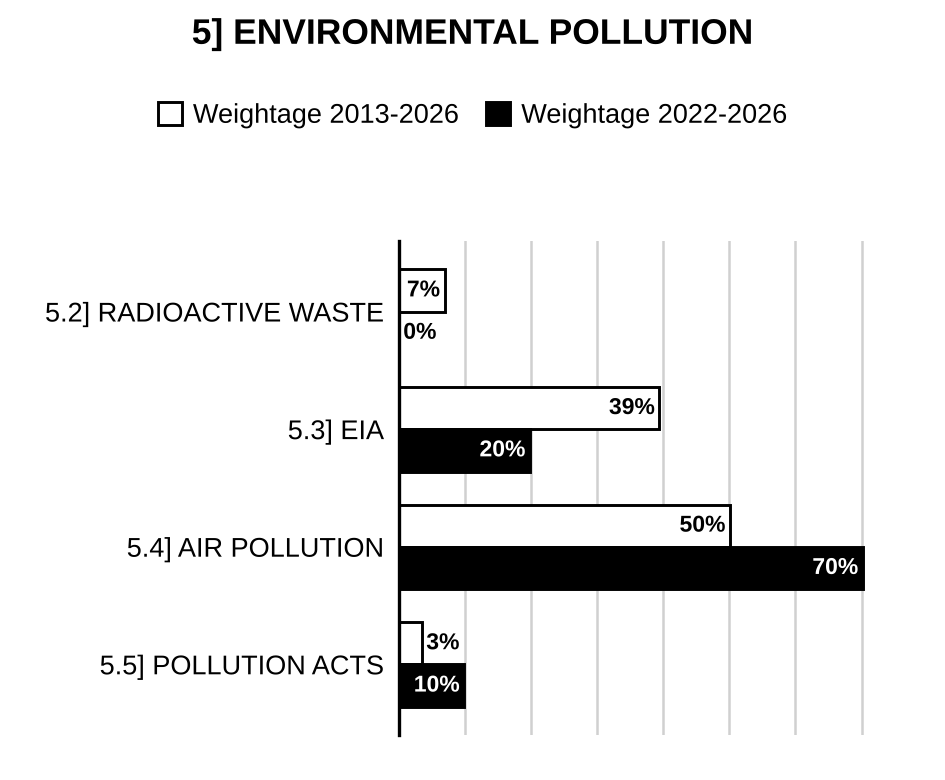
5.1] Sustainable development
1 question
Explain the meaning of “sustainable development” and its role in project planning. Also discuss the appropriateness of the “separate system of sewerage” in India. [2010/10m/8b(ii)]
5.2] Radioactive wastes and disposal
3 questions
Write about the various sources of radioactivity in the environment and its effects on the environment. [2018/15m/8b]
What is radioactive pollution? How is radioactive waste disposed? [2011/10m/8c(i)]
What are the sources of radio-active wastes and the localities where they are incident generally? What methods can be used for handling them to avert hazards to the public? What are the chance factors in the failure of such preventive handling and disposal methods? [2004/10m/8b(ii)]

Preparing for Prelims too?
Our UPSC Prelims Topic-wise PYQ eBook covers every Prelims question with detailed explanations, so you can see exactly where UPSC asks from.
View the BookDownload Free Sample5.3] Environmental impact assessment
7 questions
Explain the purpose and procedure for the following stages in EIA process: (i) Screening (ii) Scoping (iii) Public consultation. [2022/15m/8c]
Briefly describe the process for the award of environmental clearance for a project according to the EIA Act 2006. [2021/15m/8c]
Discuss the positive and negative impacts on environment due to river valley projects. [2020/15m/8c]
Discuss the process of getting environmental clearance, involving screening, scoping, public hearing, appraisal and monitoring; based on environmental impact assessment for river valley projects. [2019/15m/8c]
How do mining activities affect the environment? Discuss the environmental impact of mining in detail. [2017/10m/8c(i)]
Describing the major categories of pollutants generated by thermal power plants, discuss the environmental impacts of thermal power plants. [2015/15m/8b]
Discuss the need of Environmental Impact Assessment study. How do thermal power plants affect the environment? [2011/10m/8c(ii)]
5.4] Air pollution
14 questions
Consider a thermoelectric power plant of 1000 Mega Watt capacity with a load factor of 70 percent and an efficiency of 42 percent. Determine pollutants emitted on an annual basis such as particulates, carbon dioxide, and sulphur dioxide, if coal is used as fuel. The ultimate analysis and calorific value of the coal used are as follows:
| Moisture | Ash | Carbon | Hydrogen | Nitrogen | Sulphur |
| 8% | 7% | 78% | 2% | 2% | 1% |
| Oxygen | Calorific Value | Fly ash |
| 2% | 30 Mega Joules/kg | 77% of ash |
Assume complete combustion as per the stoichiometric equation and no air pollution control device. If an electrostatic precipitator is installed which removes 99% of particulates, compute the amount of particulate emissions. [2026/15m/8b]
Explaining the procedure for developing a wind rose, discuss the applications of wind rose using a typical sketch. [2025/15m/8c]
A dumpsite fire emits 4 g/s of . Write an equation of concentration at 2.0 km downwind from the dumpsite if the wind speed m/s and its stability is ‘D’ type. What would be the maximum concentration at 2.0 km from the dumpsite at the ground and also at 50 m above ground? Assume diffusion coefficients m and m at the downwind distance of 2.0 km from the source for ‘D’ type stability. [2024/8m/6c(ii)]
Mention the sources and health effects on human being of the following elements with reference to Air pollution: Lead, Cadmium, Nickel, Mercury, Carbon Monoxide. [2023/15m/8b]
What are the various pollutants causing pollution of air? Discuss the sources and their effects on human health and environment in general. [2017/10m/8c(ii)]
Define primary and secondary air pollutants with appropriate examples. [2016/3m/7a(i)]
Name at least five greenhouse gases (GHGs). How do greenhouse gases (GHGs) play role in climate change? [2016/3m/7a(ii)]
Illustrate with diagrams the influence of environmental lapse rates on shape and dispersion of plume emitted from stack of a thermal power plant. [2016/9m/7a(iii)]
Define Air Pollution. Discuss the classification of Air Pollutants and effect of them on Human health. [2014/10m/5c]
Find out the effective height of a stack from the following data: Physical stack height = 200 m Inside diameter of the stack = 1 m Wind velocity = 3.5 m/sec Air temperature = 13°C Barometric pressure = 1000 millibars Stack gas velocity = 9 m/sec Stack gas temperature = 140°C Draw a sketch to show the effective height. [2013/20m/7c]
Discuss the status of monitoring and control of air pollution in India. [2012/10m/8c(i)]
What are the sources of particulate matter in the environment? Discuss the control of particulate matters in Industries. [2012/10m/8c(ii)]
Based on type of air pollution and climate, differentiate between ‘Gray air’ and ‘Brown air’ cities, with examples. [2011/10m/5f]
Describe the practices adopted in India for Industrial Zoning to control air pollution at the planning stage? Within the industrial units individually, what are the methods to be enforced for control of industrial pollution? [2004/10m/8c]
5.5] Pollution control acts
1 question
Enumerate the key additions in the Solid Waste Management Rules, 2026 in comparison with the Solid Waste Management Rules, 2016 in India, to emphasize that it is a paradigm shift. [2026/15m/8c]

Strengthen your GS papers
Our UPSC Mains Topic-wise & Year-wise PYQ eBook (2013–2026) maps every GS question to the syllabus, so you know what UPSC asks and how often.
View the BookDownload Free Sample« Previous: Environmental Engineering
Back to: Civil Engineering Optional PYQs – Topic-wise
Last updated: 30 October 2026