
Here are all 149 Environmental Engineering questions asked in UPSC Civil Engineering Optional Paper II from 2004 to 2026, arranged under the 6 topics of the official syllabus. Within each topic the latest questions come first.
Each question ends with a code such as [2024/15m/3b] – the year, the marks, the word limit (where UPSC set one) and the question number in the paper.
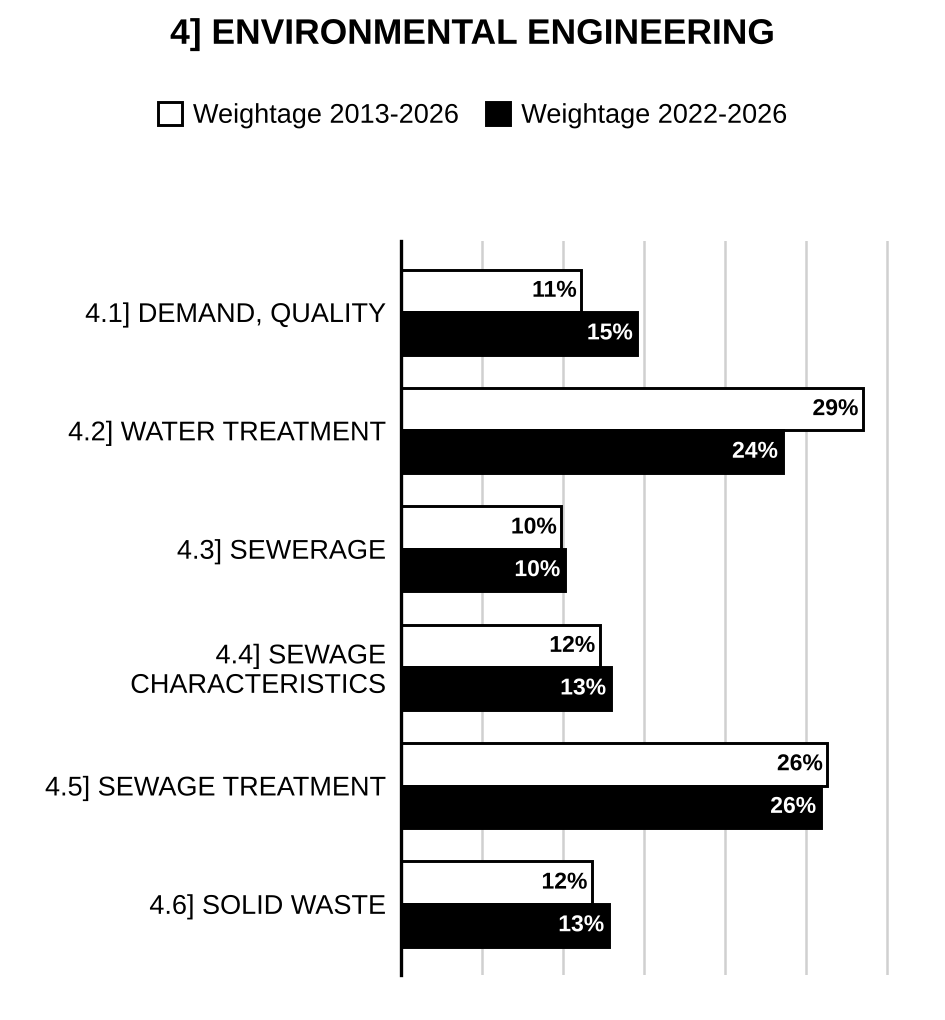
4.1] Water demand, quality and standards
18 questions
A water supply system has several units, and the design of each unit should match with variations in the water demand. How will you take into account the effect of these variations in consumption while designing the following units for water treatment? (i) Filter units (ii) Pumping units (iii) Distribution mains (iv) Sedimentation tank (v) Clear water reservoirs Demonstrate your design values for a town with a design population of 15000 and average per capita demand of 270 litres per capita per day for these units. [2026/10m/5d]
If 20 mL of an odorous water sample is diluted with 180 mL of odour-free water to make a 200 mL mixture where the odour is just detectable, determine the threshold odour number of this water sample. Give your comments on acceptability of this sample from the consumer point of view. The odour sensitivity of an individual varies, so what may be the correct procedure and method to carry out an odour test? [2026/7m/6c(ii)]
What do you understand by ‘per capita demand’ of water? How is it determined? If average daily water demand is 135 litres per capita per day, determine the following: (i) Maximum daily demand of water; (ii) Maximum weekly demand of water; (iii) Maximum monthly demand of water; (iv) Maximum hourly demand of water. [2024/10m/5e]
Explain the significance of the following from the point of view of water quality criteria: (i) Nitrites (ii) Nitrates (iii) E-coli (iv) B.O.D. (v) Dissolved oxygen. [2023/10m/5d]
How does the peak hour demand affect the design of a water supply scheme? Sketch the fluctuation in demand for typical Indian conditions. [2023/15m/6b]
A multiple tube fermentation test of a river water sample gives the following results:
| Serial dilution | 1.0 | 0.1 | 0.01 | 0.001 | 0.0001 |
| Number of positives | 5 | 5 | 3 | 2 | 0 |
The standard values for MPN or coliforms per 100 mL of sample are given below: Number of positive tubes
| 10 mL | 1 mL | 0.1 mL | MPN |
| 5 | 5 | 3 | 920 |
| 5 | 3 | 2 | 140 |
| 3 | 2 | 0 | 14 |
What is the MPN for the river water sample? [2022/10m/5e]
What is an indicator organism? Discuss the required characteristics for an ideal indicator organism. Name any two indicator organisms. [2021/10m/5d]
What is meant by ‘design period’ and ‘population forecast’? Describe the ‘incremental increase’ method of future population forecast of a city, stating its advantages. [2017/10m/5c]
What do you understand by hardness in water? Briefly explain the difference in total hardness, carbonate hardness and non-carbonate hardness. [2016/4m/5a(i)]
Calculate total hardness, carbonate hardness and non-carbonate hardness for a sample of water having following characteristics: Alkalinity = 200 mg/L as ; concentration = 160 mg/L as the ion; concentration = 40 mg/L as the ion; pH = 8.1. [2016/6m/5a(ii)]
What do you mean by the term Per Capita Demand? How is it estimated? The population of a locality as obtained from Census record is as follows:
| YEAR | 1970 | 1980 | 1990 | 2000 | 2010 |
| POPULATION | 15000 | 20000 | 24500 | 29500 | 32500 |
Estimate the population of the locality in 2040 by Arithmetic Increase, Geometrical Increase, Incremental Increase and Rate of Decrease Methods. [2014/20m/6b]
Discuss the significance of Nitrogen Content, BOD, COD, DO, Arsenic and Fluoride in Water Quality. [2014/15m/7a]
Discuss any two methods for predicting population with their relative advantages and disadvantages. [2012/6m/5d(i)]
What are waterborne diseases? Also discuss their control measures. [2012/6m/5d(ii)]
Stating a use-oriented definition of water pollution, list the various sources of water pollution along with the major characteristics of each of the stated source. [2010/12m/5f]
Enumerate and discuss the various factors that play a role in estimating the per capita demand of water supply. Also explain the implications if heavy metals are present in concentrations above their permissible levels. [2010/10m/8b(i)]
What is the significance of the following substances when they exceed the permissible limit in potable water? Also mention the permissible limit for the same: Fluoride, Nitrate, Nitrite, Chloride, Arsenic. [2009/12m/5d]
List the tests to be performed to determine impurities in water. In this context, explain the terms “Hardness” and “pH” of water – in terms of causes, classification as appropriate, and effects due to consumption and the tests relevant therein. [2004/12m/5d]
4.2] Water treatment
42 questions
A bed of uniform sand, having a particle size of 0.55 mm diameter, a specific gravity of 2.67, a porosity of 0.40 and a depth of 75 cm is to be washed hydraulically. Compute: (i) Backwash rate so that expansion will be 50 percent. (ii) Head loss at this backwash rate. [Take the kinematic viscosity as and the coefficient of drag as for water.]. [2026/15m/6b]
Explain the problems encountered during the operation of filters in water treatment and suggest how these are controlled. [2025/10m/6c(i)]
Enumerate the factors to be considered while designing an intake structure. Sketch a river intake and name its components. [2025/5m/6c(ii)]
20 MLD of water with 80 mg/L of suspended solids is treated with alum dose of 60 mg/L. Find the quantity of sludge produced assuming that sufficient natural alkalinity is available. Take specific gravity of sludge as 1.04 and removal efficiency as 60%. [2025/15m/8b]
Determine the size (i.e., diameter and depth) of a circular rapid mixing tank having a mechanical mixer, which is to be designed for treatment of water flow of litres per day and for mean hydraulic detention time of 45 seconds. Also, calculate the power required to achieve a mixing intensity (G) of . Assume viscosity of water = and depth of water to diameter of tank ratio of 2 : 1. [2024/15m/6b]
Uniform sand is used as a filter medium to treat the water. The sand grains are 0.6 mm in diameter with a shape factor () of 0.85 and specific gravity (G) of 2.67. The bed is 0.65 m deep with a porosity () of 0.45. The filter medium is to be expanded to a porosity () of 0.75 by hydraulic backwash. Determine the required backwash velocity, resulting expanded depth and loss through the expanded medium. Assume the following data for use: , Density of water () = 998.2 kg/m³, Viscosity of water () = [2024/15m/8c]
In a continuous flow settling tank 4 m deep and 80 m long, calculate the flow velocity for effective removal of 0.03 mm particles at 25°C. The specific gravity of the particles is 2.65 and kinematic viscosity () for water may be taken as 0.01 cm²/sec. [2023/10m/5e]
What is break point chlorination test? Why is it needed? [2022/5m/6b(ii)]
A rapid sand filter unit is to be provided for a city of 2,00,000 persons with water demand of 150 lpcd. The design loading rate to the filter is . Determine the filter surface area for four filters. If the design loading rate is to be met with one filter out of service, what should be the surface area per filter? [2022/10m/7a(ii)]
Two settling tanks – one rectangular, with length to width ratio of 3 : 1 and side water depth of 3.5 m; and the other circular, with side water depth of 4.0 m – are to be designed to treat of water required for a city’s water supply. The surface overflow rate for satisfactory removal of solids is 20 m/d. Determine the dimensions of the settling zone of the two tanks. Check for retention time, horizontal velocity and weir overflow rate which should respectively be 3–5 hours, less than 10 m/h and 6 to 10 per m. Also determine the overall dimensions of the basins keeping length of inlet zone and outlet zone equal to the side water depth of the basin. [2021/20m/6a]
Find the dimensions of a rectangular sedimentation tank for the following data: Volume of water to be treated = 3 million litres per day Detention period = 4 hours Velocity of flow = 10 cm/min. [2020/10m/5e]
Water has to be supplied to a town with one lakh population at the rate of 150 litres/capita/day from a river 2000 m away. The difference in elevation between the lowest water level in the sump and reservoir is 36 m. If the demand has to be supplied in 8 hours, determine the size of main pipe and horsepower (BHP) of the pumps required. Assume the maximum demand as 1.5 times the average demand. Assume coefficient of friction, , velocity in the pipe 2.4 m/s and efficiency of pump 80%. [2020/20m/8a]
The chlorine residuals measured when various dosages of chlorine were added to a water sample are given below:
| Chlorine dosage (mg/L) | 0 | 0.1 | 0.2 | 0.3 | 0.4 | 0.5 |
| Chlorine residual (mg/L) | 0 | 0.01 | 0.02 | 0.08 | 1.9 | 0.24 |
| Chlorine dosage (mg/L) | 0.6 | 0.7 | 0.8 | 0.9 | 1.0 | |
| Chlorine residual (mg/L) | 0.3 | 0.2 | 0.24 | 0.3 | 0.46 |
Determine: (i) The break-point dosage (ii) The chlorine demand of the water sample (iii) The design dosage to obtain a free residual of 0.2 mg/L at the last consumer’s tap if the water distribution network being old exerts additional chlorine demand of 0.3 mg/L [2019/10m/5e]
A water treatment plant has a horizontal flow sedimentation tank with a surface overflow rate of . What percentage of removal should be expected for particles having settling velocities of 0.1 mm/sec, 0.2 mm/sec and 1.0 mm/sec respectively considering the tank behaving as an ideal sedimentation tank? [2019/15m/6b]
Design a rapid sand filter for 4 MLD of water with a rate of filtration of . [2018/10m/5d]
Discuss the mechanisms of coagulation. [2018/15m/7b]
It is required to supply water to a population of 80000 at a per capita demand of 150 L per day. Chlorine usage in the treatment is 5 kg/day. The residual chlorine after 10 minutes contact is 0.20 mg/L. Calculate the chlorine demand of the water. [2017/10m/5d]
Explain in brief various types of disinfectants and their mechanism, which are used for purification of water at water treatment plants. [2016/4m/5b(i)]
Calculate the chlorine dosage and chlorine demand in mg/L for the chlorine usage of 8 kg/day for treatment of 20000 /day of water when the residual chlorine after 10 min contact is 0.20 mg/L. [2016/6m/5b(ii)]
What do you mean by coagulation and flocculation? How do they play role in water purification? Provide a list of most common coagulants used at water treatment plants along with their relative merits or demerits. [2016/5m/7c(i)]
At a water treatment plant, the coagulation-sedimentation unit clarifies 40 million litres of water each day. The quantity of alum required at the plant is 18 mg/L. If the alkalinity of raw water is 5 mg/L as , find out the quantity of alum and quicklime (having 85% of CaO) required on yearly basis at the plant. [2016/10m/7c(ii)]
A town with population of 1 lakh is supplied with 150 lpcd of water. The chlorine required for disinfection was found to be 0.28 mg/l and residual chlorine required was 0.2 mg/l. Estimate the chlorine dose and quantity of bleaching powder required per year (in kg/year), if available chlorine in bleaching powder is 30%. [2015/10m/5d]
Design the water main to supply water from reservoir to a city with a population of 5 lakhs. Assume per capita demand as 270 lpd and peak factor as 1.8. Also, find the hydraulic gradient at which the main is to be laid. Take, velocity of flow as 1.2 m/s and . [2015/15m/7b]
The difference between the level of catchment and a Service Reservoir is 150 m and the distance between them is 48 km. The Reservoir was originally constructed by a single pipeline designed to carry . It was later found necessary to increase the supply to and it was decided to lay another pipeline of same diameter along the first part of the length and cross connected. Calculate the diameters of the pipes and the length of second pipe. [2014/10m/5a]
Design a Rapid Sand Filter unit for 4.5 MLD, with all its principal components. [2014/15m/7b]
Explain what is meant by filtration for drinking water. Draw a schematic diagram of a slow sand filter showing inlet, outlet and other components. [2013/10m/5b]
Explain with the help of diagrams the Grid iron system and the Radial system of water distribution for a town. [2013/10m/7b]
A water treatment plant is to treat a design discharge of 60 million litres per day. The plant has a paddle flocculator 20 m long, 12 m wide and 3.5 m deep. It is fitted with four horizontal shafts to which revolving paddles are attached which rotate at 150 rpm. Each shaft supports four paddles which are 10 m long, 20 cm wide and centred 1.5 cm from the shaft. Assume mean velocity of flow of water as 20% of the paddle velocity, temperature of water as 10°C and . Determine the difference in velocity between paddle and water, mean velocity gradient and detention time. Dynamic viscosity can be taken as at temperature of 10°C. [2013/20m/8c]
Explain breakpoint chlorination and super chlorination. [2012/2m/5e(i)]
Determine amount of bleaching powder required annually in a water treatment plant treating 10 million litre per day of water if 0.2 ppm of chlorine dose is required. Available bleaching powder contains 30 per cent of available chlorine. [2012/10m/5e(ii)]
Explain the types of sedimentation with examples. [2011/2m/6a(i)]
What path trajectory the settling particles follow in circular and rectangular settling tanks? [2011/2m/6a(ii)]
Given the following data below, design a circular sedimentation tank with launders and find out: (i) The diameter of the settling tank. (ii) Total depth of the settling tank with free board including the depth of the hopper portion.
| Total township area | 20 ha |
| %age areas for roads, public utilities, and open spaces | 10%, 15%, 15% |
| Floor to space ratio | 1.5 |
| Floor area required for each person | |
| Water losses accounts for | 4% |
| Working hours for plant | 23 hrs. |
| Surface loading rate | |
| Detention time | 2.5 hrs |
| Slope for floor slab | 1 in 12 |
| Incoming velocity of flow | 0.6 m/sec. |
Check the design with weir loading calculations. Assume water supply rate as 135 lpcd. Give a neat sketch of final designed circular tank showing all design parameters. [2011/16m/6a(iii)]
A small town with a population of 1000 persons is to be supplied water at 96 lpcd. The demand of water during different periods is given as follows:
| Time hr. | 0-3 | 3-6 | 6-9 | 9-12 | 12-15 | 15-18 | 18-21 | 21-24 |
| Total Demand in litres | 9000 | 10000 | 12000 | 18000 | 14000 | 12000 | 10000 | 11000 |
Determine the balancing capacity of a service reservoir if pumping is done in blocks of 24 hours, the delivery rate being constant. [2010/12m/5c]
Draw a neat sketch of a service pipe connection explaining the functioning and requirements of the various parts in the connection. [2010/12m/5d]
Differentiate between super-chlorination and break-point chlorination. Explain break-point chlorination with a neat sketch explaining the types of chlorine form available in the various stages of the break-point curve. What is the significance of residual chlorine? [2010/10m/6b(i)]
Describe the step-by-step procedure used for backwashing of a rapid sand filter. What is the significance of the backwash time and backwash velocity? [2010/10m/6b(ii)]
Write short notes on each of: (1) Reflux Valve (2) Air-Relief Valve (3) Expansion joint in a water supply distribution system. [2010/10m/8c(ii)]
Design a plain sedimentation tank to treat 4 million litres water per day. The detention period may be assumed as 6 hours and the depth may be assumed as 3.5 m. Assume velocity of flow as 10 cm/minute. [2009/20m/8c]
What considerations rule in the selection of pumps for a water supply scheme with a lake as a source? What are the appurtenances to be installed in the pipeline through the pump up to the overhead reservoir at the area being served? [2004/12m/5e]
Why are coagulants required in the sedimentation phase of water treatment? What factors affect the dosage of coagulants? [2004/10m/6c(i)]
A coagulation-cum-sedimentation tank is to be designed for the water works of a town having a population of 1.5 lakh. The average demand of water is 135 lpd/head and maximum demand is 1.5 times the average. The detention period is 6 hours. Flow rate is to be in the range near of plan area. Design a system of rectangular sedimentation tanks. [2004/10m/6c(ii)]
4.3] Sewerage systems
22 questions
How does the variation of sewage flow affect its velocity in a circular sewer? [2026/8m/6c(i)]
A 30 cm diameter circular sewer is laid in a section where invert slope is 1 in 500. Determine the velocity and sewage flow in the section and check for self-cleansing velocity. Take Manning’s coefficient as 0.015. Assume that the sewer is running full. [2025/5m/6b(ii)]
A sewer having a 60 cm diameter (D) is required to flow at 0.4 depth (i.e., a proportional depth d/D = 0.4) on a grade ensuring a degree of self-cleansing equivalent to that obtained at full depth at a velocity of 80 cm/s. Determine the required grade, associated velocities and discharges at full depth and 0.4 depth. The value of Manning’s rugosity coefficient (N) = 0.015 may be taken same at all depths of flow. [2024/20m/7a]
Considering the Indian conditions, is a separate system of sewerage a better choice than the combined system? Justify your answer. [2022/10m/6b(i)]
Circular sewer of minimum diameter of 150 mm is recommended for the house connections. Calculate the discharge carried by this sewer, when flowing full, laid at a slope of 0.004. Take Manning’s as 0.013. Why this sewer size has been recommended as the minimum size, when the waste water discharge from individual household will be substantially less? [2021/10m/5e]
A main sewer is to be laid for a residential cum commercial area of a town. The area has a residential population of 5000 persons and floating population (offices and shops) of another 5000 persons. The residential population consume 150 lpcd of water, while the floating population consume 45 lpcd of water. Assuming that 90% of water consumed emerges as wastewater, and this also includes infiltration and inflows, design the main sewer. Consider the sewer flowing full at peak discharge. Take peak factor of 3 and minimum discharge factor as one-third. The natural slope of the ground is 1 in 400. Assume Manning’s . Check the sewer for minimum and maximum velocities, and comment on the suitability of design. [2019/20m/6a]
Develop a relationship between the side of a square section of one sewer and the diameter of a circular section of another sewer when both are hydraulically equivalent. [2018/15m/8a]
The classification of the surface on which the rain falls in a city is as follows:
| % of total surface area | Type of surface | Coefficient of runoff |
| 20% | Rooftop | 0.90 |
| 20% | Pavement | 0.85 |
| 10% | Paved yard | 0.80 |
| 15% | Macadam road | 0.40 |
| 35% | Lawns | 0.10 |
Determine the coefficient of runoff of the area. If the total area of the city is 40 ha and the maximum rain intensity is taken as 6 cm/hr, what is the runoff for the city? [2017/15m/7a]
Define the following terms: (i) Sewage (ii) Sewers (iii) Sewerage Explain the Rational method for the design of storm sewers. What are the disadvantages of this method? [2013/10m/5e]
Explain egg shaped sewer section with their relative advantages with circular section. [2012/5m/7a(i)]
Design a sewer for a newly developed town having population of 50,000. The sewer is to be designed for 3 times of dry weather flow when running full. Also find velocity of flow. Available slope for the sewer to be laid is 1 in 700. Assume Manning’s coefficient . [2012/15m/7a(ii)]
What are the factors that influence the flow of sewage in sewers? Define ‘Time of Concentration’ for storm water drains and explain its significance. [2011/5m/7a(i)]
A vitrified clay sewer is to carry a discharge of 1000 l.p.s. When flowing half full, it is laid at a gradient of 0.0032. The manning coefficient of the sewer is same as that of a triangular notch with unit depth and having a slope of 1 in 2. The velocity in the notch is obtained as 0.804 m/s with a gradient of 1 in 400. Determine the velocity of flow and diameter of sewer. [2011/15m/7a(ii)]
What will be the diameter of a circular sewer to carry a sewage discharge of when flowing full at a slope of 10 in 10,000. Use as 0.012 in the Manning’s formula. [2010/10m/7b(i)]
In this sewer, what would be the discharge and velocity if the proportionate depth is held at 0.4? Use the table given herewith.
| 0.4 | 0.32 | 0.88 |
[2010/10m/7b(ii)]
Explain the meaning of “sustainable development” and its role in project planning. Also discuss the appropriateness of the “separate system of sewerage” in India. [2010/10m/8b(ii)]
For setting out a trunk sewer between station A and B, following data was made available. # Gradient of sewer 1 in 250. # Depth of invert at lower end A: 2.650 m (below peg A). # Distance between Section A and B: 75 m. # Staff reading on peg A: 1.80 m. # Staff reading on peg B: 2.30 m. # Height of collimation of the level set up nearby: 250.00 m. # The length of the staff rod: 4 m. Make necessary calculations for fixing the sight rails at A and B. Also write the procedure for fixing the sight rails to the vertical posts. [2009/16m/4c(i)]
What do you mean by hydraulically equivalent section? What are the parameters on which the cross-section of sewer would depend upon? [2009/12m/5f]
Determine using the ‘rational formula’ with runoff coefficient equal to 0.80, the peak storm runoff to be carried out by the underground drainage pipeline AB for the drainage basin area of 0.2 ha shown in the above figure. Take the length of pipeline as 100 m and the level difference between A and B as 0.5 m. Assume initially a pipe diameter of 250 mm. Consider Darcy-Weisbach friction factor . The rainfall duration and rainfall intensity is furnished in tabular form below. Consider time of entry at end A as 2 min. Check whether the pipe size is adequate or not.
[Figure (printed above the text of 8(a)): Pear-shaped drainage basin (outline labelled “Drainage basin”), rounded at the left and tapering to a point B at its right-hand end; point A lies inside the basin towards its rounded end; a straight pipeline (labelled “Pipeline”) runs from A to the outlet B]
| Duration (mins) | Rainfall intensity (mm/hr) |
| 2.0 | 122 |
| 2.5 | 108 |
| 3.0 | 97 |
| 3.5 | 89 |
| 4.0 | 82 |
| 4.5 | 77 |
[2009/20m/8a]
Describe with a sketch the storm water relief weir for a sewerage system. [2004/12m/5f]
Find the requisite size of a combined circular sewer serving an area of 100 ha with a population of 60000 persons and supplied with water at 250 lpd/head. Take time of entry and time of flow of rain water to be 5 and 15 minutes, respectively. Runoff coefficient in rational formula is 0.45. Permissible velocity in the sewer is 3 m/sec. [2004/10m/7c(i)]
What do you understand by “Limiting Velocity” in sewer design? State the methods by which such a velocity is maintained. [2004/10m/7c(ii)]

Preparing for Prelims too?
Our UPSC Prelims Topic-wise PYQ eBook covers every Prelims question with detailed explanations, so you can see exactly where UPSC asks from.
View the BookDownload Free Sample4.4] Sewage characteristics and disposal standards
20 questions
Determine the theoretical oxygen demand (ThOD) for glycine using the following assumptions: (i) In the first step, the organic carbon and nitrogen are converted to carbon dioxide and ammonia respectively. (ii) In the second and third steps, ammonia is oxidized sequentially to nitrite and nitrate. The ThOD is the sum of the oxygen required for all three steps. [2026/10m/5e]
The BOD of wastewater sample incubated @ 30 °C for 1 day was 120 mg/L. Find 5-day BOD @ 20 °C and estimate the percent of unoxidized BOD @ 20 °C after 20 days. Take rate constant as 0.1/day @ 20 °C. [2025/10m/5d]
A high strength wastewater having an ultimate CBOD of 1000 mg/L is discharged to a river at a rate of 2 m³/s. The river has an upstream ultimate CBOD of 10 mg/L and is flowing at a rate of 8 m³/s. Assuming a reaction rate coefficient of 0.1/day, calculate the ultimate CBOD and 5-day CBOD of the river water just after the mixing point of the wastewater (at 0 km) and 20 km downstream from the mixing point. (Assume the velocity of river = 10 km/day) [2024/10m/5d]
(i) The B.O.D. of a sewage incubated for one day at 25°C has been found to be 100 mg/l. What will be the 5 day, 20°C B.O.D.? Assume at 20°C. Take temperature coefficient, . (ii) Despite widespread use of B.O.D., it has some limitations. Mention all those limitations. [2023/15m/6c]
Determine the UBOD and (in mg/L) of a mixture of 100 mg/L glutamic acid () and 100 mg/L glucose (). Assume the value of the first order reaction rate constant as 0.23/d (base ‘e’). [2022/10m/5d]
Although it would be expected that the value of the ultimate carbonaceous BOD would be as high as the COD, this is seldom the case. What are the reasons for the observed differences? [2021/15m/6b]
During BOD test conducted on a 5% dilution of waste, the following observations were taken: DO of aerated water used for dilution = 3.6 mg/L DO of original sample = 0.8 mg/L DO of diluted sample after 5 days’ incubation = 0.7 mg/L Compute: (i) 5 days’ BOD (ii) Ultimate BOD Assume deoxygenation constant at test temperature as 0.12. [2020/10m/5d]
In a BOD analysis, 10.0 mL of industrial wastewater sample was diluted with 290.0 mL of seeded dilution water. The initial DO was 9.2 mg/L and after 5 days of incubation at 20 °C, the final DO of the sample with seeded dilution water is 2.0 mg/L. The final DO of the seeded dilution water is 8.0 mg/L. The volume of the BOD bottle was 300.0 mL. Determine the 5-day, 20 °C BOD of the sample. [2019/10m/5d]
Discuss the significance of ratio in the treatment of wastewater. [2017/5m/7b(i)]
Calculate 2-day 37 °C BOD of a sewage sample, whose 5-day 20 °C BOD is 150 mg/L. Assume at 20 °C as 0.1. [2017/10m/7b(ii)]
Explain the importance of COD/BOD ratio while designing the treatment options for COD/BOD ratio of 1, 3 and 6, and justify the selection of treatment units. [2015/10m/5e]
5% diluted wastewater was subjected to BOD test and the following observations are recorded: DO of water used for dilution = 3.6 mg/l; DO of wastewater sample = 0.8 mg/l; DO in sample after 5 days = 0.7 mg/l; /day. Determine— (i) BOD of wastewater; (ii) ultimate BOD. [2015/15m/8a]
The BOD of a sewage incubated for one day at 30°C has been found to be 110 mg/. What will be the 5 days 20°C BOD? Assume at 20°C. [2014/10m/5b]
Explain significance of ratio. How it helps in deciding type of treatment to be given to waste water. [2012/5m/7b(i)]
A combined sewer system is serving 20,000 persons having BOD, 70 gm per capita and 50,000 litres industrial effluent per day having BOD 450 mg/l. If average standard BOD of domestic sewage is 0.08 kg/day/person, find the population equivalent of sewage. [2012/15m/7b(ii)]
15 mL of the waste sample has been added into a 300 mL BOD incubation bottle. The initial D.O. of the diluted sample was 7.8 mg/L and the final D.O. after 5 days was 1.7 mg/L. The corresponding initial and final D.O. of the seeded dilution water was 8.1 and 6.9, respectively. What is the 5-day BOD of the wastewater sample? [2011/10m/5d]
Estimate the population equivalent for each of (a) combined system for 2000 prsons having 100 gm per capita daily BOD on the assumption that the contribution of BOD is 75 gm per capita per day. (b) 80,000 litres daily contribution of industrial wastes containing 1000 mg/litre of suspended solids on the assumption that the contribution of suspended solids is 50 gm per capita per day. State clearly any other assumptions needed to be invoked. [2010/10m/6c(ii)]
Discuss the phenomenon of self-purification of streams. How can it be evaluated and represented? What are the factors that significantly affect the self-purifying abilities of a stream? [2010/10m/7c(ii)]
How is the dissolved oxygen sag curve interpreted to indicate the critical point or the point of minimum D.O.? [2009/12m/5e]
Explain the term B.O.D. Derive the expression for B.O.D. reaction. [2009/20m/6c]
4.5] Sewage treatment
30 questions
A sedimentation tank is treating 5 million litres of sewage per day containing 250 ppm of suspended solids. The tank removes 60 percent of the suspended solids. Calculate the quantity of sludge produced per day in bulk (volume) and weight, if the: (i) moisture content of the sludge is 97 percent, (ii) moisture content of the sludge is 96 percent, and (iii) specific gravity of the wet sludge is 1.02. Calculate the volume of sludge produced for both moisture contents and the percentage reduction in volume of sludge produced for 1.0 percent reduction in moisture content (wet sludge). [2026/20m/7a]
Using the data pertaining to a wastewater treatment plant, determine the quantity of sludge produced per day: Wastewater flow = 10 MLD Suspended solids (SS) in raw wastewater = 250 mg/L Efficiency of PST = 62% Sludge concentration = 5% Volatile solids (VS) = 60% Specific gravity of VS = 0.980 Fixed solids = 40% Specific gravity of fixed solids = 2.65. [2025/10m/6b(i)]
The data related to the activated sludge process is given below: Population = 500000 Wastewater contribution = 150 lpcd BOD of settled wastewater = 200 mg/L Effluent BOD required = 30 mg/L Using the data, find the design parameters as mentioned below (Take , MLSS = 3000 mg/L, SVI = 100, where MLSS = Mixed liquor suspended solids, SVI = Sludge volume index): (i) Volume of aeration (ii) Efficiency (iii) Volumetric loading (iv) Return sludge ratio (v) Hydraulic retention time (HRT) [2025/20m/7a]
Determine the dimensions of a rectangular septic tank serving 100 persons in a hostel. The dimensions of the septic tank must be able to accommodate sedimentation, sludge digestion and sludge storage functionalities. The peak discharge of sewage can be considered as 240 litres per minute. Use the following data: – Surface area required for every 10 litres per minute of peak flow = 0.92 m² – Water depth required in the sedimentation tank = 0.3 m – Freeboard required = 0.3 m – Capacity required for sludge digestion process = 0.032 m³/capita – Capacity required for digested sludge = 0.0002 m³/capita/day – Sludge withdrawal (cleaning) frequency = once in a year – Length to width of tank ratio [2024/15m/8b]
Discuss the following operational difficulties encountered in the operation of Activated Sludge process: (i) Rising Sludge or Floating Sludge (ii) Sludge Bulking What kind of impact these are having in the operation of Activated Sludge process? [2023/20m/7a]
A city of 1 lakh population is supplied 150 lpcd of water. Assuming 80% of this emerging as wastewater, calculate the volume of a secondary reactor. The influent to the reactor has a of 150 mg/L. It is desired to have an effluent of 5 mg/L, an MLVSS of 3000 mg/L and an underflow concentration of 10,000 mg/L. Use the following constants: kg MLVSS/kg , per day. Take MCRT of 10 days and HRT of 4 hours. What is the volume and mass flow of sludge waste per day? [2022/15m/6c]
Determine the volume of sludge before and after digestion and percent reduction for 500 kg of primary sludge with 5% solids, 55% volatile solids and specific gravity of 1.01. The digested sludge has 10% solids, 90% reduction in original volatile solids and specific gravity of 1.04. [2022/10m/7a(i)]
What is grit? Why is it essential to remove the grit? Why velocity control devices are essential with unaerated horizontal flow grit chambers? Why are the velocity control devices not required with the aerated grit chambers? Name any two velocity control devices used with grit chambers. [2021/15m/7c]
Determine the aeration period, food to microorganism (F/M) ratio (in kg BOD/day/kg MLSS), percentage (%) efficiency of BOD removal and sludge age (in days) for the given operating data for conventional sludge treatment plant: Wastewater flow = Volume of aeration tank = Influent BOD = 250 ppm Effluent BOD = 25 ppm Mixed liquor suspended solids (MLSS) = 2500 mg/L Suspended solids in effluent = 50 mg/L Suspended solids in waste sludge = 11000 mg/L Quantity of waste sludge = [2020/15m/7c]
Septic tanks are one of the most common on-site treatment systems in areas not having sewerage system. Draw a neat diagram of a septic tank showing various arrangements–inlet, outlet, baffles, air vent, etc. Also draw section of an unlined soak pit for the final disposal of the septic tank effluent. [2019/15m/7c]
Design a septic tank for a small colony of 300 persons with an average wastewater flow of 120 litres per head per day. [2018/10m/5e]
Design high-rate and low-rate trickling filters using the following data using empirical formula: Wastewater flow = 5 MLD BOD of wastewater = 300 mg/L BOD removal in PST = 25% Desired BOD of treated wastewater = 50 mg/L Recirculation ratio = 1.4 BOD of recirculated wastewater may be neglected. [2018/20m/7c]
What are the various stages in the sludge digestion process? Also discuss the factors affecting sludge digestion and their control. [2017/10m/7c(i)]
Design an oxidation pond for treating sewage from a hot climatic residential colony with 6000 persons contributing sewage 150 L per capita per day. The 5-day BOD of sewage is 250 mg/L. [2017/10m/7c(ii)]
What do you understand by sludge digestion? [2016/2m/6b(i)]
Briefly explain the distinct stages of sludge digestion and the factors affecting the sludge digestion. [2016/8m/6b(ii)]
Design a circular sludge digestion tank with 6 m depth for the following parameters, when 3.5% of the digester volume is filled on daily basis with the fresh sludge, which is mixed with the digested sludge: Sludge content per capita per day = 0.68 kg; Moisture of the sludge = 94%; Specific gravity of wet sludge = 1.02. Provide 30% additional capacity for fluctuations. [2016/10m/6b(iii)]
What are different unit operations and processes used at a typical wastewater treatment plant? [2016/5m/8b(i)]
Draw typical cross-section of a circular trickling filter. Also, briefly describe the merits and demerits of conventional trickling filters. [2016/5m/8b(ii)]
Design a high-rate single-stage circular trickling filter to treat wastewater generated by a town having population of 40000 persons. Necessary data are given below to be used for the design purpose: 1. Domestic sewage = 150 lpcd having BOD of 200 mg/L 2. Industrial wastewater = 0.25 million litres/day with BOD of 600 mg/L 3. BOD removal in primary clarifier = 35% 4. Permissible organic loading of the filter = 800 kg/hec-m/day (this does not include recirculated sewage) 5. Recirculation ratio = 1.0 6. Permissible surface loading = 160 million litres/hec/day (this includes recirculated sewage) Also, find out the efficiency of the filter and BOD of the effluent. [2016/10m/8b(iii)]
Using the data pertaining to Activated Sludge Process (ASP) given below, determine— (i) efficiency; (ii) volume of aerator; (iii) hydraulic retention time (HRT); (iv) volumetric loading. Wastewater flow = 20 MLD; BOD in settled wastewater = 200 mg/l; Effluent BOD required = 15 mg/l; F/M ratio = 0.2; MLSS = 3000 mg/l. [2015/20m/7c]
An Activated Sludge Tank is 30 m long, 9 m wide and has liquid depth of 4 m. The influent sewage flow rate is 3.5 MLD. The primary effluent has BOD of 130 mg/ and suspended load of 150 mg/. The MLSS concentration in the Aeration Tank is 1800 mg/. Calculate: (i) BOD Loading in kg/Ha-m (ii) F/M Ratio (iii) Aeration Period (iv) Sludge Age. [2014/20m/8b]
Determine the dimensions of a circular Bio-filter to treat waste water with the following characteristics: Daily Flow Rate = Five-days BOD after primary sedimentation = 160 mg/lit The filter is to be designed in accordance with the following criteria: Surface loading = Organic loading = 0.15 kg 5-days BOD value per per day. [2013/15m/6c]
Explain working of skimming tanks for removing oil and grease. [2012/5m/7c(i)]
What are stabilisation ponds? Design an oxidation pond for treating sewage from a town having population of 15,000. Sewage contribution per capita per day is 120 l and BODs 200 mg/l. The town is located in hot climate. [2012/15m/7c(ii)]
Differentiate between Thermophilic and Mesophilic bacteria explaining their roles in anaerobic digestion. [2011/10m/5b]
Determine the BOD loading of an oxidation pond used for treating the domestic sewage of 20,000 persons when the water supply demand is 100 litres per capita per day. Assume a detention period of 6 days and BOD of sewage as 300 mg/l. The pond is to be 1.2 m deep. [2010/12m/5e]
Design a septic tank for a colony of 200 persons with daily sewage flow of 135 litres per person per day. Assume a detention period of 24 hours. Draw a neat sketch of the septic tank so designed. [2009/20m/7c]
What are oxidation ponds? What are their merits and demerits? [2004/10m/7b(i)]
Design an oxidation pond for a colony of 2000 persons wherefrom the sewage flow is 150 lpd/head with a 5-day BOD of 300 ppm, providing a BOD loading of 200 kg/day/ha. [2004/10m/7b(ii)]
4.6] Solid waste management
17 questions
Enumerate the key additions in the Solid Waste Management Rules, 2026 in comparison with the Solid Waste Management Rules, 2016 in India, to emphasize that it is a paradigm shift. [2026/15m/8c]
Explaining the process of composting municipal solid wastes, discuss the important design considerations of aerobic composting. [2025/10m/5e]
What is the “5 R’s” concept in waste management? How do they contribute to managing the ill-effects of waste? Briefly explain. [2024/7m/6c(i)]
(i) Discuss the factors that must be considered in evaluating potential sanitary landfill sites. (ii) How does the occurrence of gases and leachate in sanitary landfill take place? Explain with the help of chemical reactions taking place. [2023/15m/8c]
What is leachate? What problems may it create if left unmanaged in a solid waste landfill? Explain how the leachate is managed in sanitary landfills. [2022/15m/8b]
Describe municipal solid waste sanitary landfill with a schematic diagram showing its various components. [2021/15m/8b]
Explain the methods for sustainable management of municipal solid wastes by emphasizing the role of source reduction and reuse, source segregation, segregated collection and transportation, material recovery, recycling, composting, waste to energy and the final disposal of remaining waste materials in sanitary landfill. [2019/15m/8b]
What are the different types of municipal solid wastes? Explain about each of them. [2018/20m/8c]
Explain the impacts of improper disposal of solid wastes on human health and environment in general. [2017/5m/5e(i)]
Discuss the composition of municipal solid waste (MSW). [2017/5m/5e(ii)]
With the help of flow diagram, explain various elements involved in municipal solid waste management. [2015/20m/8c]
Explain the terms garbage and rubbish. How these are different than ashes? [2012/5m/8b(i)]
Discuss composting for disposal of solid wastes. Also explain methods adopted for composting in rural areas in India. [2012/15m/8b(ii)]
Differentiate between Garbage and Rubbish. [2011/6m/8a(i)]
What are the advantages and disadvantages of sanitary landfills? [2011/7m/8a(ii)]
Define Municipal solid waste. List out the good practices that should be followed for an efficient management of MSW. [2011/7m/8a(iii)]
What are the various functional elements of a solid waste management system? Describe briefly the significance of each functional element. [2009/20m/7b]

Strengthen your GS papers
Our UPSC Mains Topic-wise & Year-wise PYQ eBook (2013–2026) maps every GS question to the syllabus, so you know what UPSC asks and how often.
View the BookDownload Free Sample« Previous: Hydrology, Water Resources and Engineering | Next: Environmental Pollution »
Back to: Civil Engineering Optional PYQs – Topic-wise
Last updated: 30 October 2026