
Here are all 326 Phanerogams questions asked in UPSC Botany Optional Paper I from 1995 to 2026, arranged under the 8 topics of the official syllabus. Within each topic the latest questions come first.
Each question ends with a code such as [2024/15m/3b] – the year, the marks, the word limit (where UPSC set one) and the question number in the paper.
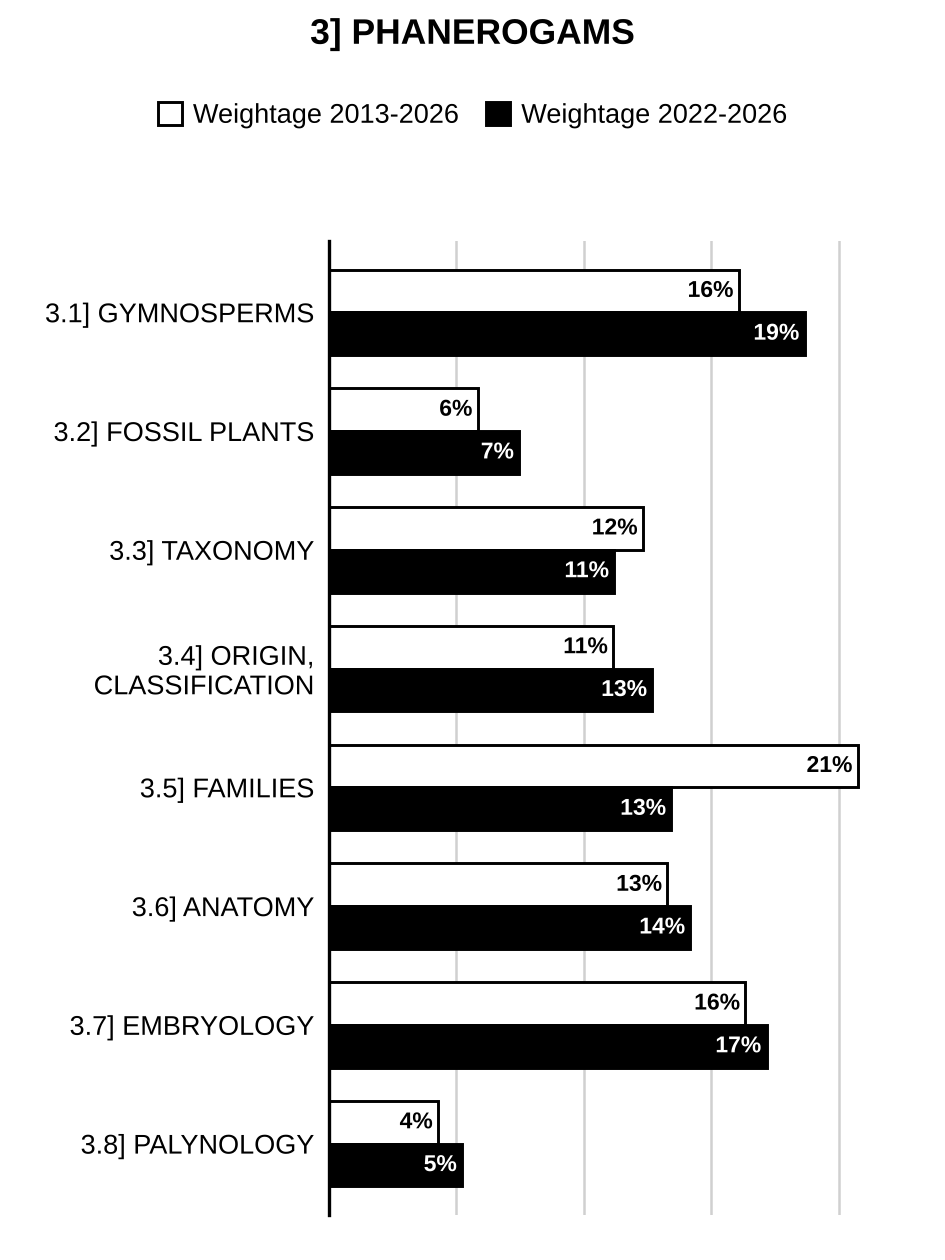
3.1] Gymnosperms
51 questions
Compare the ovule-bearing structures of Cycas and Pinus with the help of labelled diagrams. [2026/15m/2c]
Briefly describe the male and female strobili of Gnetum with suitable labelled diagrams. Why should you consider this plant a gymnosperm? [2025/15m/2c]
Give an account of structural variation in the megasporophylls of different Cycas species with illustrations. Add a brief note on the primitive features in Cycas. [2025/15m/4c]
Where are the gymnosperms distributed naturally in India? Mention the places where fossils of Bennettitales occur abundantly in India. [2024/10m/150w/1d]
Why is Ginkgo biloba called a ‘living fossil’? Discuss in the light of its reproductive structures. [2024/15m/2c]
Describe the male and female gametophytes of Pinus. How are the processes of pollination and fertilization accomplished in Pinus? [2024/20m/4a]
Discuss the distribution of different modern species of Cycas found in India. Enumerate the fern characters observed in Cycas. [2023/10m/150w/1d]
Characterise progymnosperms with examples. Mention their phylogenetic significance. [2023/15m/2c]
Give an account of male gametophyte development in Gnetum. State the angiosperm characters shared by Gnetum. [2023/15m/8b]
Briefly discuss the distribution of gymnosperms in India. [2021/10m/150w/1e]
Describe the concept of progymnosperms with the help of suitable examples. [2021/10m/2c]
Discuss the primitive features of Cycadales. Why is Ginkgo considered as living fossil? [2020/20m/8a]
Discuss the salient features of Gnetales. Why are they regarded as the most evolved Gymnosperms? [2019/15m/8b]
Describe the male and female cones of Pinus. [2018/15m/4b]
Draw a well-labelled diagram of L.S. of Gnetum ovule and briefly describe its female gametophyte also. [2017/20m/2c]
Give an account of distribution of living Gymnosperms in India. [2017/15m/3c]
Describe the different stages in the development of female gametophyte within the ovule in Cycas. [2016/15m/3c]
Concept of Progymnosperms. [2015/10m/150w/1c]
Discuss the distribution of living Gymnosperms in India and their economic importance. [2015/20m/3c]
Draw well-labelled diagrams of the following: T.S. of coralloid root of Cycas. [2014/12.5m/6c]
Draw well-labelled diagrams of the following: V.S. of leaf of Welwitschia. [2014/12.5m/6d]
Distribution of cycads in India. [2013/10m/150w/5d]
Give a brief account of Dwarf shoot in Pinus. [2012/12m/150w/5b]
Compare the female strobili of Pinus and Ephedra. [2012/15m/6a]
Draw a labelled diagram of L.S. of Ovule of Cycas. [2012/15m/6c]
Why is Ginkgo biloba considered as a living fossil? Explain. [2012/15m/6d]
Describe the evolutionary status of Gnetum. [2011/12m/7d]
With the help of labelled diagrams, compare the female gametophyte of Cycas with that of Gnetum. [2010/20m/6a]
Name the genera belonging to phylum Gnetophyta. Mention their angiosperm-like features, types of tracheary elements and leaves. [2009/20m/200w/5c]
With the help of well-labelled diagrams, explain the distinguishing features of the following: Ovule of Gnetum and Pinus. [2009/20m/6c]
Draw neat and labelled diagrams of the following: Male cone and Microsporophyll of Pinus. [2007/20m/7b]
Distribution in India of the genus yielding “Taxol”. [2006/20m/8a]
Commonalities and differences between Cycadofilicales and Cycads. [2006/20m/8c]
Give the salient features of Cycadales. [2005/20m/200w/5a]
Explain pollination in Cycas. [2005/20m/200w/5c]
Differentiate between manoxylic and pycnoxylic wood, giving examples. [2005/20m/8b]
Describe the development of male gametophyte in Gnetum. Discuss the importance of this genus. [2003/60m/7]
What are progymnosperms? Describe with examples their morphology. [2002/20m/200w/5a]
Ovule bearing organ of Pinus is a highly reduced shoot in the axil of bract. Discuss. [2001/30m/7b]
Describe the development of male gametophyte in Pinus. Discuss the economic importance of this genus. [2000/60m/7]
Give an account of the vegetative anatomy of Cycas with the help of diagrams. Enumerate important differences in the anatomical features of Cycas and Gnetum (only vegetative features). [1999/60m/7]
Explain, by referring to anatomy of stem, morphology of reproductive parts and biology of reproduction of Gnetum, why this gymnosperm is considered advanced. [1998/30m/4b]
Compare the following sets Microsporophyll of Cycas and Pinus. [1997/15m/6a]
Describe the ovule structure at the time of pollination in Gnetum. [1997/20m/7a]
Give an account of the staminate strobilus in Gnetum upto the stage of pollen germination. [1996/20m/200w/5d]
Describe the development of the male cone of Pinus till the germination of pollen grain. [1996/20m/6c]
Write short notes on the following: (i) Flower of Hibiscus (ii) Female gametophyte of Gnetum (iii) Pollen embryo sac. [1996/15m/8c]
Give an account of the female cone of Pinus. [1995/20m/200w/5a]
Compare the following Female gametophyte of Cycas and Gnetum. [1995/20m/6b]
Compare the following Inflorescence of Euphorbia and Gnetum. [1995/20m/6c]
Write a brief account on each of the following: (i) male cone of Cycas (ii) Flower of a grass (iii) Leaf anatomy of plants. [1995/15m/8c]
3.2] Fossil plants and palaeobotany
17 questions
Define fossilization. Discuss the major types of fossils that occur in nature. [2026/10m/150w/1d]
Write a note on geological time scale. Briefly discuss the plant life in each era. [2026/15m/3c]
Where are the gymnosperms distributed naturally in India? Mention the places where fossils of Bennettitales occur abundantly in India. [2024/10m/150w/1d]
Diagrammatically present the Geological Time Scale up to ‘Epoch’. Write a note on the different types of fossils found in nature. [2023/20m/4a]
Enumerate the salient features of fossil gymnosperms using suitable examples with special reference to Bennettitales and Cordaitales. [2021/20m/3b]
Floral morphology (Fructification) and L.S. of ovule of Cycadeoidea. [2018/10m/150w/5a]
Comment on salient features of Cordaitales. [2018/10m/7b]
Formation of Petrifaction. [2014/10m/150w/5a]
Draw well-labelled diagrams of the following: Cone of Cycadeoidea. [2014/12.5m/6a]
What are the differences between the following: Palaeozoic and Coenozoic plants. [2011/10m/5e]
Describe the fructification in Williamsonia. [2010/15m/150w/5d]
What are the salient features of Bennettitales? [2009/20m/200w/5d]
Citing suitable examples explain what is meant by ‘form genus’. [2006/20m/200w/5d]
Commonalities and differences between Cycadofilicales and Cycads. [2006/20m/8c]
Give the salient features of Cordaitales. [2004/20m/200w/5a]
Importance of Cycadofilicales. [2003/20m/200w/5a]
“Jurassic was the best age of Gymnosperms.” Discuss. [2001/20m/200w/5a]
3.3] Taxonomy and nomenclature
38 questions
What is chemotaxonomy? Analyze how chemical evidence contributes to solving taxonomic problems in plant classification. [2026/10m/150w/1e]
Briefly explain the method of herbaria preparation. What is its role in modern taxonomic research? [2026/20m/7a]
Explain how the numerical expression of data is utilized in plant systematics. [2025/10m/150w/1c]
Explain holotype, isotype, paratype, lectotype and neotype. Mention the advantages of binomial system of plant nomenclature. [2025/15m/3c]
State the principles of International Code of Botanical Nomenclature. How are Operational Taxonomic Units (OTUs) used in numerical taxonomy? [2023/10m/150w/1e]
Give an account of different types of trichomes found in modern angiosperms. Write a brief note on the systematic value of trichomes. [2023/10m/150w/5c]
Write a note on the role of palynology in plant systematics. [2022/10m/150w/5e]
Enumerate the merits and demerits of numerical taxonomy. [2021/10m/150w/1d]
Enumerate different kinds of trichomes and explain their taxonomic importance. [2021/10m/150w/5a]
Define secondary metabolites. Explain their importance in taxonomy. [2021/10m/6c]
What do you understand by International Code of Botanical Nomenclature? Write its principles. [2020/20m/4a]
Define herbarium and give methods of its preparation and also mention the names of five major herbaria. [2019/20m/6a]
How is Embryology useful in Taxonomy? [2019/15m/7c]
Typification in plant nomenclature. [2018/10m/150w/5b]
Embryology in relation to Taxonomy, with examples. [2017/10m/150w/5a]
International Code of Botanical Nomenclature. [2017/10m/150w/5d]
Write short notes on the following: (i) Cytoplasmic hybrids (ii) Chemotaxonomy. [2017/15m/8c]
Procedure and maintenance of Herbarium. [2016/10m/150w/5b]
Discuss the principle and application of Numerical Taxonomy. [2016/15m/7a]
Relevance of numerical taxonomy. [2014/10m/150w/5b]
Importance of typification in plant nomenclature. [2014/10m/150w/5e]
Beta taxonomy. [2013/10m/150w/5a]
“Embryology has also played an important role in Taxonomy of angiosperms.” Elaborate the statement with the help of some examples. [2012/15m/8a]
What are the differences between the following: Systematics and Classification. [2011/10m/5a]
What are the differences between the following: Apiaceae and Umbelliferae. [2011/10m/5d]
What are the differences between the following: Isotype and Syntype. [2011/10m/5f]
Explain the role of macro and micro biomolecules in taxonomy. [2011/12m/7c]
OTUs. [2011/10m/8f]
Omega taxonomy with reference to chemical substances. [2009/30m/8b]
Give an account of the use of pollen morphological characters in systematics. [2007/20m/200w/5b]
Alpha and Omega taxonomy. [2006/20m/7a]
Discuss the role of chemotaxonomy and numerical taxonomy in systematics of Angiosperms. [2004/30m/6b]
Describe the role of embryology in classification of angiosperms. [2001/20m/200w/5b]
Discuss the role of systematic and biosystematics in biodiversity inventorisation. Describe the parameters which are employed for estimation of biodiversity. [1998/60m/6]
By referring to specific examples discuss the role anatomy can play in taxonomy. [1998/30m/8a]
Write short notes on the following: (i) ICBN (ii) Apomixis (iii) Totipotency (iv) Heterostyly (v) Ultrastructure of egg apparatus. [1997/20m/8c]
Discuss the role of palynology in systematics of flowering plants. [1996/20m/200w/5a]
Enumerate with brief notes the cytogenetic criteria in biosystematics. [1995/20m/7a]
3.4] Origin of angiosperms and systems of classification
25 questions
Explain the APG IV classification. State briefly how it differs from existing classifications. Discuss its merits and demerits. [2026/20m/4a]
What are the principal directions of evolution of floral structure in angiosperms? Name the ANA grade orders of angiosperms. [2024/10m/150w/1e]
Compare the key features of classifications proposed by Hutchinson and Dahlgren. Discuss their merits and demerits. [2024/15m/3c]
Distinguish between the natural and phylogenetic systems of plant classification. Mention their merits and demerits. [2023/15m/3c]
What are the characteristic features of the family Orchidaceae? How did the classification systems of Bentham and Hooker (1862), Engler and Prantl (1931) and Hutchinson (1959) deal with its placement among the families of monocots? [2022/20m/4a]
Give a detailed account of the theories proposed to explain the origin of angiosperms. [2022/15m/4b]
Compare and contrast the systems of classifications of Bentham and Hooker, and Hutchinson. Add a note on their merits and demerits. [2019/20m/4a]
Compare the systems of classifications proposed by Hutchinson and Cronquist with a note on their merits and demerits. [2018/15m/6a]
Describe the classification given by Engler and Prantl and comment on its merits and demerits. [2017/20m/7a]
Compare and contrast the systems of classification of angiosperms proposed by Hutchinson and Takhtajan. [2016/20m/8a]
Position of monocots in APG classification. [2014/10m/150w/5c]
Describe in detail Hutchinson’s system of classification and compare it with the classification system of Engler and Prantl. [2014/20m/8c]
Compare and contrast Bentham and Hooker’s system of classification with Hutchinson’s system of classification. [2013/25m/8b]
“Gymnosperms were perhaps the immediate ancestors of angiosperms.” Substantiate the statement, and also give reasons to disprove the statement. [2012/20m/7c]
Origin of angiosperms from gymnosperms is suggested on the basis of vessels. Give your critical comments. [2010/15m/150w/5a]
Discuss whether the angiosperms are monophyletic or polyphyletic. [2010/20m/6c]
Contributions of the following scientists in plant systematics: (i) A. P. de Condolle (ii) Carl Linnaeus (iii) Theophrastus. [2009/20m/7b]
Compare the outline of system of classification of angiosperms proposed by Hutchinson with the system proposed by Bentham and Hooker. [2007/20m/200w/5d]
Describe the phyletic position of Magnoliaceae. [2006/20m/200w/5c]
Give the classification of angiosperms as proposed by Hutchinson. Discuss its merits and demerits. [2005/20m/8c]
Give the salient features of Bentham and Hooker’s system of classification. [2004/20m/8c]
What are the primitive and advanced characters of flower used in deriving their phylogeny? [2001/20m/200w/5d]
Enumerate the primitive and advanced characters of flowers. [1997/20m/200w/5a]
What is a natural system of classification of plants? Give the outline of Bentham and Hooker’s system of classification justifying that it is a natural system. [1996/20m/6b]
Compare the following System of classification of plants by Bentham Hooker and Engler & Prantl. [1995/20m/6a]

Preparing for Prelims too?
Our UPSC Prelims Topic-wise PYQ eBook covers every Prelims question with detailed explanations, so you can see exactly where UPSC asks from.
View the BookDownload Free Sample3.5] Angiosperm families
64 questions
Describe the androecium of Orchidaceae and Asclepiadaceae. Highlight the differences between them. [2026/10m/150w/5a]
Mention the diagnostic features of family Apiaceae and Solanaceae. Write the botanical names and uses of five members from each family. [2026/20m/6a]
What are the diagnostic characters of the families – Cucurbitaceae and Poaceae? Write the botanical names and economic importance of any five members from each family. [2025/20m/6a]
Explain and illustrate the characteristic features of Brassicaceae. Mention any five species of the family and their economic importance. [2024/15m/6b]
Using diagrams, explain the characteristic features of the family Magnoliaceae. Why is this family considered primitive? [2023/15m/6b]
What are the characteristic features of the family Orchidaceae? How did the classification systems of Bentham and Hooker (1862), Engler and Prantl (1931) and Hutchinson (1959) deal with its placement among the families of monocots? [2022/20m/4a]
Discuss the advanced features of Asteraceae and Orchidaceae. [2021/10m/150w/5b]
Give the botanical name, part used and ethnomedicinal importance of any three species each of Fabaceae, Euphorbiaceae and Liliaceae. [2021/20m/6b]
What are the identifying floral features, floral formula and floral diagram of Malvaceae and Orchidaceae? [2020/20m/6a]
Write botanical names and ethno-medicinal uses of three medicinally important members in each case of Solanaceae and Apiaceae. [2020/15m/6b]
What are the identifying characters, floral diagram and floral formula of Verbenaceae and Liliaceae? [2019/15m/6c]
Explain distinguishing characters of Dipterocarpaceae, Asteraceae and Orchidaceae. [2018/20m/4c]
Write an account of the following families with reference to floral formula and floral diagram. Give Botanical names of four important plant species belonging to each of the families and mention their uses: (i) Euphorbiaceae (ii) Asclepiadaceae (iii) Poaceae. [2018/20m/8a]
Write an account of the following families with reference to floral diagram and floral formula. Give botanical names of four important plant species belonging to each of the families and specify their uses: (i) Cucurbitaceae (ii) Solanaceae (iii) Liliaceae. [2017/20m/8a]
Write an account of the following families in regard to their floral structures. Give the botanical names of three important plant species belonging to each of the families and specify their uses: (i) Asclepiadaceae (ii) Musaceae (iii) Apiaceae. [2016/30m/6b]
Write an account of the following families with respect to floral structures. Give the botanical names of three important plant species belonging to each of the families and specify their uses: Ranunculaceae and Fabaceae. [2015/20m/6a]
Distinguish the Androecium of Malvaceae, Asteraceae and Asclepiadaceae from each other. [2015/12.5m/7b]
Compare the floral characters of the family Solanaceae and Malvaceae. [2015/12.5m/7d]
Draw well-labelled diagrams of the following: T.S. of cyathium of Euphorbia. [2014/12.5m/6b]
Orchidaceae. [2014/12.5m/7a]
Magnoliaceae. [2014/12.5m/7b]
Asteraceae. [2014/12.5m/7c]
Rubiaceae. [2014/12.5m/7d]
Poaceae. [2013/17m/6a]
Liliaceae. [2013/17m/6b]
Asclepiadaceae. [2013/16m/6c]
Make a comparison of Androecium in Malvaceae, Asteraceae and Cucurbitaceae. [2012/12m/150w/5d]
Asteraceae is considered as one of the highly evolved families of angiosperms. Give an account of advanced characters in Asteraceae. [2012/15m/8b]
Compare and contrast the floral characters of the three sub-families of Leguminosae. [2012/15m/8d]
Gynoecium in Asclepiadaceae, Brassicacea and Poaceae. [2011/10m/8b]
Pollinium. [2011/10m/8d]
Compare the androecium in the following groups of families: (i) Malvaceae and Fabaceae (ii) Asclepiadaceae and Asteraceae (iii) Solanaceae and Brassicaceae. [2010/20m/8c]
With the help of well-labelled diagrams, explain the distinguishing features of the following: Flower of Dolichos and Caesalpinia. [2009/20m/6b]
Draw neat and labelled diagrams of the following: Male and female flower of Euphorbia. [2007/20m/7c]
Give an account of diagnostic characters of Liliaceae and Palmae with suitable examples. [2007/30m/8a]
How will you distinguish between the following pairs of families on the basis of important floral characters? Malvaceae and Brassicaceae. [2005/30m/6a]
How will you distinguish between the following pairs of families on the basis of important floral characters? Leguminosae and Solanaceae. [2005/30m/6b]
Floral structure and primitive characters of Magnoliaceae. [2004/20m/7a]
Floral structure and floral formula of Poaceae. [2004/20m/7b]
Differentiate between the pollinia of Asclepiadaceae and Orchidaceae. [2004/20m/7c]
Asteraceae. [2003/20m/6a]
Solanaceae. [2003/20m/6b]
Asclepiadaceae. [2003/20m/6c]
Give salient features of flower of the following families. Give economic importance of three plants from each family Ranunculaceae. [2002/15m/8a]
Give salient features of flower of the following families. Give economic importance of three plants from each family Euphorbiaceae. [2002/15m/8b]
Give salient features of flower of the following families. Give economic importance of three plants from each family Dipterocarpaceae. [2002/15m/8c]
Give salient features of flower of the following families. Give economic importance of three plants from each family Orchidaceae. [2002/15m/8d]
Give important flower characters of the following families. Give economic importance of three plants from each family. Apiaceae. [2001/15m/8a]
Give important flower characters of the following families. Give economic importance of three plants from each family. Rubiaceae. [2001/15m/8b]
Give important flower characters of the following families. Give economic importance of three plants from each family. Arecaceae. [2001/15m/8c]
Give important flower characters of the following families. Give economic importance of three plants from each family. Brassicaceae. [2001/15m/8d]
Write an account of the floral structure of the following families (i) Poaceae (ii) Asclepiadaceae (iii) Brassicaceae Give botanical names of three important plant species belonging to each of the three families and specify their uses. [2000/60m/6]
Write an account of the floral structure of the following families (i) Euphorbiaceae (ii) Rubiaceae (iii) Orchidaceae Give botanical names of three important plant species belonging to each of the three families. Specify why these are important. [1999/60m/6]
Describe the structure of the flower of Liliaceae. [1997/20m/200w/5c]
Describe variations in placentation in Thalamiflorae. [1997/20m/200w/5d]
Compare the following sets Inflorescence in Ficus and Morus. [1997/15m/6b]
Describe the floral structure of Rosaceae giving floral diagram and floral formula. [1997/20m/8b]
Give an account of the characteristic features of the family Asclepiadaceae along with floral diagram and floral formula. Give botanical names of three plants belonging to the family. [1996/20m/7a]
Give an account of the family Arecaceae (Palmae) with floral diagram and floral formula of any representative member. Give botanical names of five plants of the family having economic importance. [1996/15m/8b]
Write short notes on the following: (i) Flower of Hibiscus (ii) Female gametophyte of Gnetum (iii) Pollen embryo sac. [1996/15m/8c]
Describe the floral structure of Musa along with floral diagram and floral formula. [1995/20m/200w/5d]
Compare the following Inflorescence of Euphorbia and Gnetum. [1995/20m/6c]
Describe the characteristic features of the family Cucurbitaceae. Give the floral formula and floral diagram. Write botanical names of five plants of the family having economic importance. [1995/20m/7b]
Compare the floral structure of Magnoliaceae with that of Ranunculaceae. [1995/15m/8b]
3.6] Plant anatomy
51 questions
Describe the components of xylem tissue in plants. What is its role in plant survival and growth? [2026/15m/6c]
What are the various anomalies causing anomalous secondary growth in dicotyledonous plants? [2025/10m/150w/5b]
Give an account of different types of axial parenchyma found in dicotyledonous woody plants stating their phylogenetic significance. Mention two primitive and two advanced features of ray parenchyma. [2025/15m/7c]
Describe how successive cambia cause thickening of the stem in some flowering plants. Name any two families that display this phenomenon. [2024/10m/150w/5b]
Compare the differentiation of xylem and phloem from the cells cut off by cambium. How is a vessel structurally different from a sieve element? [2024/15m/7b]
What are the anatomical differences of the bundle sheath and mesophyll cells between and plants? [2023/10m/150w/5b]
Give an account of different types of trichomes found in modern angiosperms. Write a brief note on the systematic value of trichomes. [2023/10m/150w/5c]
Give a detailed account of types of stomata in angiosperms. [2022/15m/4c]
Enumerate different kinds of trichomes and explain their taxonomic importance. [2021/10m/150w/5a]
Briefly explain anomalous secondary growth in Boerhaavia and Dracaena. [2020/15m/4b]
What causes anomalous secondary growth in some dicot plants? Explain. [2019/15m/4b]
Illustrate Kranz anatomy in a typical C4 plant leaf. [2019/10m/150w/5d]
Describe the different types of stomata in dicots. [2018/10m/6b]
Describe the role of xylem and phloem in secondary growth of plants. [2018/20m/7a]
Discuss the leaf anatomy of and plants. [2018/10m/7c]
Give an account of the following: (i) Developmental details of interxylary phloem (ii) Anomalous secondary growth in Dracaena stem. [2017/20m/7b]
Xylem and phloem differentiation. [2016/10m/150w/5d]
Differentiate between normal and abnormal secondary growth in dicot stem. Discuss with suitable examples. Draw labelled diagrams. [2016/15m/8b]
Write notes on the following: (i) Heart wood and Sap wood (ii) Different types of trichomes. [2016/15m/8c]
Describe the anomalous secondary growth in monocots with suitable diagram. [2015/16m/8c]
Differentiate between interxylary and intraxylary phloems. [2012/12m/150w/5c]
What are the differences between the following: Fascicular and Cork cambium. [2011/10m/5b]
What is interxylary phloem? How is it formed? Support your reply with suitable examples and at least one diagram. [2011/15m/6b]
Stomatal apparatus in Brassica, Dianthus and Poa. [2011/10m/8c]
What are the changes that occur during the conversion of sapwood into heartwood? Which is more durable – sapwood or heartwood, and why? [2010/20m/6b]
Give an account of the main events in the differentiation of a tracheary element. [2010/20m/7a]
Diagrammatically explain the structure-function relationship of plasmodesmata. [2009/20m/200w/5a]
Comment on the formation of amphivasal vascular bundles in Dracaena. [2009/20m/200w/5b]
Discuss secondary growth in lianas. [2007/20m/200w/5a]
Secondary growth in woody monocots. [2007/20m/6b]
Draw neat and labelled diagrams of the following: Stomata of sunflower and maize. [2007/20m/7a]
Explain secondary growth in dicotyledonous stem. [2005/20m/200w/5b]
Explain the secondary growth in Pinus stem. [2004/20m/200w/5b]
Explain the Tunica Corpus theory. [2004/20m/200w/5c]
Differentiate between xylem and phloem. [2004/20m/8b]
Anomalous secondary growth in Dracaena. [2003/20m/200w/5c]
Differentiate between velamen and exodermises. [2002/20m/200w/5b]
What is ‘Krantz anatomy’? Where do you find it? Describe its structure and importance. [2002/20m/200w/5c]
Anomalous secondary growth in monocot stem. [2000/20m/200w/5a]
Describe the anomalous secondary growth in three dicot stems. Draw labelled diagrams in each case. [1999/20m/200w/5a]
Describe the major stomatal types in plants. [1999/20m/200w/5c]
Describe the anatomy of root stem transition region with the help of suitable diagrams only. [1999/20m/200w/5d]
Describe the structure and function of medullary rays. [1998/20m/200w/5c]
With the help of labelled diagram describe the peculiarity in the anatomy of Dracaena stem. [1998/20m/200w/5d]
Give specific differences between: (i) Spring wood and Autumn wood (ii) Cystoliths and Raphides (iii) Tectum and Tapetum (iv) Abscission and Wound healing. [1998/30m/8b]
Compare the following sets Dorsiventral and Isobilateral leaf. [1997/15m/6c]
Give an account of the organization of shoot apical meristem. [1997/20m/7b]
Describe anomalous secondary growth in the stems of (i) Aristolochia (ii) Dracaena. [1996/20m/6a]
Write brief notes on the following (i) Periderm (ii) Helobial endosperm (iii) Protoplast (iv) Pinus needle. [1996/20m/7c]
Give brief account of the following: (i) Senescence (ii) Nucellus (iii) Interxylary phloem (iv) Coenospecies (v) Embryo culture. [1996/15m/8d]
Write a brief account on each of the following: (i) male cone of Cycas (ii) Flower of a grass (iii) Leaf anatomy of plants. [1995/15m/8c]
3.7] Embryology
56 questions
Discuss the different types of polyembryony in plants and add a note on its importance. [2026/10m/150w/5b]
Give an account of post-fertilization changes leading to formation of seeds in angiosperms. [2025/10m/150w/5a]
Distinguish between polyembryony and parthenocarpy. Classify parthenocarpy and add a note on its significance. [2025/15m/8b]
Distinguish various types of agamospermy. Why is apomixis now regarded a tool of practical importance? [2024/10m/150w/5c]
Describe different types of endosperm development in angiosperms. What is the significance of aleurone tissue? Mention the function of endosperm in seed. [2024/20m/6a]
What are the different means of pollination in plants? Which natural devices ensure cross-pollination? [2023/20m/6a]
Endosperm is essentially a triploid tissue in angiosperms with some exceptions. Give a detailed account of Helobial endosperm emphasizing on the developmental variations. What type of differences can be seen in the sequence of occurrences of karyokinesis and cytokinesis in nuclear, cellular and Helobial type of endosperm? [2022/15m/6b]
Using appropriate diagram of normal embryo sac, elaborate the structural complexity of angiosperm embryo. [2022/15m/6c]
Describe the development of female gametophyte in angiosperms with the help of suitable illustrations. [2021/20m/6a]
Classification and importance of Polyembryony. [2020/10m/150w/5c]
Endosperm haustoria. [2020/10m/150w/5d]
Describe the development of male gametophyte in angiosperms with suitable diagrams. [2020/15m/7b]
Compare and contrast the pattern of embryo developments in Dicots and Monocots with suitable illustrations. [2020/15m/7c]
How many types of embryo-sacs are known among angiosperms? Describe their formation. Give one example for each. [2019/20m/8a]
Development of endosperm and its functions. [2018/10m/150w/5c]
Describe the major types of embryos with suitable examples. [2018/10m/7d]
Comment on polyembryony and apomixis in flowering plants. [2017/20m/6a]
Embryo development in Arabidopsis. [2014/10m/150w/5d]
Double fertilization. [2013/10m/150w/5e]
Types of endosperms. [2013/17m/7a]
Types of ovules. [2013/17m/7b]
Apomixis. [2013/16m/7c]
Give a brief account of polyembryony in Angiosperms. [2012/12m/150w/5e]
Compare the development of typical monosporic, bisporic and tetrasporic embryo sacs. [2012/15m/6b]
Draw a cross section of a typical anther and label the parts carefully. [2012/20m/7b]
What are the differences between the following: Megasporogenesis and Megagametogenesis. [2011/10m/5c]
What are Ubisch bodies? How and where are these formed and what is their role? [2011/15m/6a]
What is Nemec phenomenon? Comment on its significance. [2011/12m/7e]
Define agamospermy. What is its significance in crop improvement? [2010/20m/7c]
Describe the structure and function of synergids in angiosperms. [2010/20m/8a]
With suitable examples, enumerate the floral characteristics of bird pollinated trees. [2010/20m/8b]
Cleavage polyembryony. [2009/20m/200w/4b]
With the help of well-labelled diagrams, explain the distinguishing features of the following: Porogamy and Chalazogamy. [2009/20m/6a]
Tetrasporic embryo sac. [2009/30m/8a]
With the help of suitable diagrams explain: Development of a bisporic embryo sac. [2006/30m/6a]
Nemec phenomenon. [2006/20m/7c]
Phenomenon of apomixis and its importance. [2006/20m/8b]
Give an account of the pollen grain formation in dicots and monocots. [2005/60m/7]
Development of female gametophyte in Angiosperms. [2003/20m/200w/5b]
Gametophytic apomixis. [2003/20m/200w/1b]
What is polyembryony? Describe the practical value of polyembryony. [2002/60m/6]
What is double fertilization? In the light of recent studies discuss the mode of fertilization in angiosperms. [2001/60m/6]
Polyembryony. [2000/20m/200w/5c]
Different kinds of female gametophyte found in angiosperms. [2000/20m/200w/5d]
Enumerate various types of angiospermic embryo sacs in a tabular form. [1999/30m/8b]
What are subterranean flowers? Name some plants which carry such flowers. What can be the possible advantages and disadvantages of such flowers? [1998/20m/200w/5b]
Describe the phenomenon of pollen-stigma interaction. [1998/20m/7a]
Compare the following sets Glandular and Amoeboid tapetum. [1997/15m/6d]
Write short notes on the following: (i) ICBN (ii) Apomixis (iii) Totipotency (iv) Heterostyly (v) Ultrastructure of egg apparatus. [1997/20m/8c]
Describe the process of fertilization (from pollination to gametic fusion) in angiospermic plants. [1996/20m/200w/1b]
Describe the development of typical dicot embryo. [1996/20m/200w/5b]
Write brief notes on the following (i) Periderm (ii) Helobial endosperm (iii) Protoplast (iv) Pinus needle. [1996/20m/7c]
Give brief account of the following: (i) Senescence (ii) Nucellus (iii) Interxylary phloem (iv) Coenospecies (v) Embryo culture. [1996/15m/8d]
What is apomixis? What is its significance in plants? [1995/20m/200w/5b]
Describe the structure and morphological nature of endosperm in angiosperm. [1995/15m/8a]
Briefly describe each of the following: (i) Tetrasporic embryo sac (ii) Somaclonal variation (iii) Wood of Gnetum (iv) Polarity (v) Flower of Umbelliferae. [1995/15m/8d]
3.8] Palynology and experimental embryology
24 questions
Describe the techniques used in experimental embryology. [2026/15m/8b]
What is the importance of pollen storage? Explain the methods adopted for storage of pollen grains. Add a note on test tube fertilization. [2025/15m/6c]
Write a note on the role of palynology in plant systematics. [2022/10m/150w/5e]
Palynology and its significance. [2019/10m/150w/5e]
Write notes on the following: (i) NPC system of classification of pollen grains (ii) Cytodifferentiation and its regulation. [2018/15m/8c]
Forensic application of palynology. [2016/10m/150w/5a]
NPC system. [2013/10m/150w/5b]
Application of palynology. [2013/10m/150w/5c]
Describe the characteristic features of the component on the basis of which the basic source/s of a sample of honey is/are determined. [2011/15m/6c]
Describe various mechanisms employed to raise hybrids between incompatible species. [2011/12m/7b]
Describe the development of pollen exine and point out the role of sporopollenin. [2010/15m/150w/5b]
Give an account of the use of pollen morphological characters in systematics. [2007/20m/200w/5b]
Practical application of ovule culture. [2006/20m/3b]
What are the symptoms and causes of hay fever? [2006/20m/200w/5a]
Give an account of pollen grain morphology and application of palynology. [2004/30m/6a]
What is palynology? Describe the applications of palynology. [2002/30m/7a]
Describe the detailed structure of pollen wall. How has palynology helped in forensic science? [2001/20m/200w/5c]
Applications of palynology. [2000/20m/200w/5b]
What is palynology? Describe the basic and applied importance of this science. [1999/30m/8a]
Write brief account on in vitro fertilization. [1998/20m/7b]
Describe the procedure of intra-ovarian pollination. [1998/20m/7c]
Give specific differences between: (i) Spring wood and Autumn wood (ii) Cystoliths and Raphides (iii) Tectum and Tapetum (iv) Abscission and Wound healing. [1998/30m/8b]
Give an account of the pollen morphological characters. [1997/20m/200w/5b]
Discuss the role of palynology in systematics of flowering plants. [1996/20m/200w/5a]

Strengthen your GS papers
Our UPSC Mains Topic-wise & Year-wise PYQ eBook (2013–2026) maps every GS question to the syllabus, so you know what UPSC asks and how often.
View the BookDownload Free Sample« Previous: Cryptogams | Next: Plant Resource Development »
Back to: Botany Optional PYQs – Topic-wise | Also see: Botany Optional year-wise question papers
Last updated: 31 October 2026