
Here are all 85 Agricultural Extension questions asked in UPSC Agriculture Optional Paper I from 1995 to 2026, arranged under the 6 topics of the official syllabus. Within each topic the latest questions come first.
Each question ends with a code such as [2024/15m/3b] – the year, the marks, the word limit (where UPSC set one) and the question number in the paper.
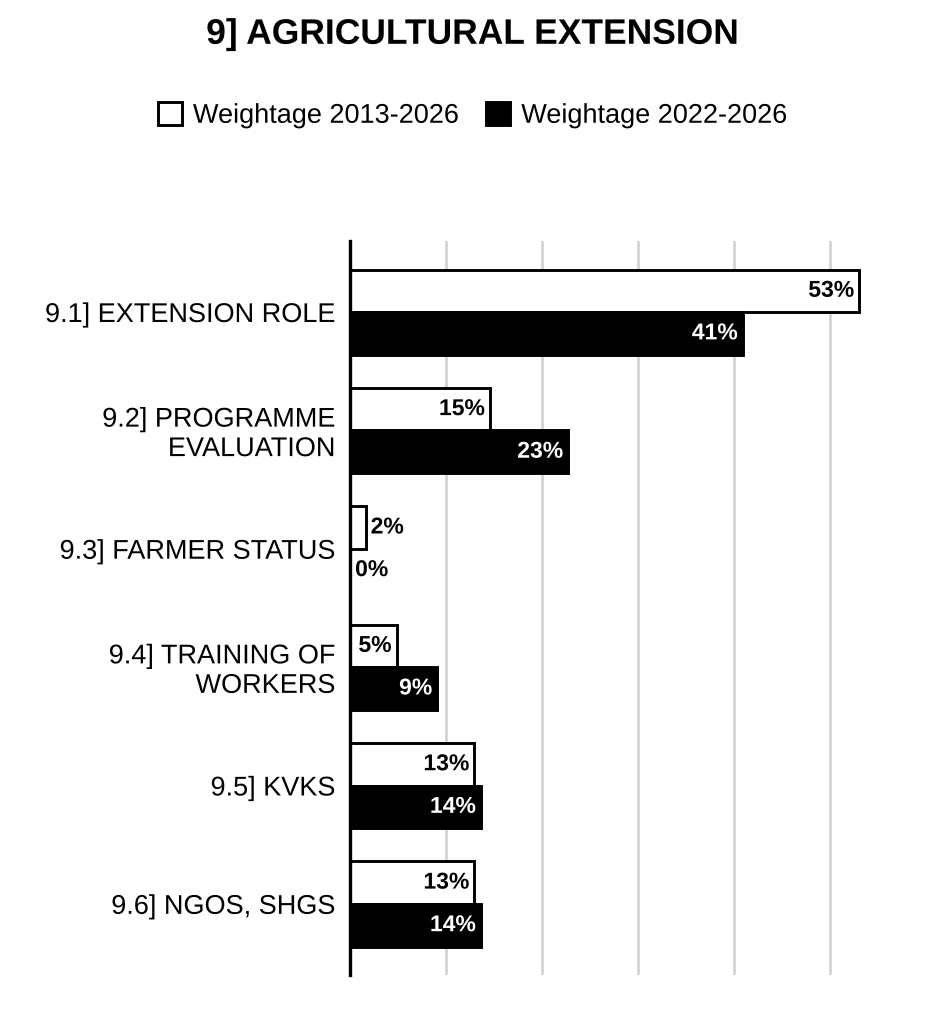
9.1] Agricultural extension: importance and role
44 questions
Differentiate between extension education and extension services. Discuss extension education as an applied science. [2026/20m/7b]
Explain ‘Farmer FIRST’. Briefly discuss the objectives of ‘Farmer FIRST’. [2025/10m/150w/5e]
Give the account of new tools and methods used in agricultural extension. [2024/10m/150w/5d]
Describe the five steps of effective extension education process as per Leagans (1967). [2024/10m/6c]
Discuss the chronological developments of National Extension System of India after independence. [2024/20m/7a]
What are the target groups in Agricultural Extension? What role KVKs can play to reach such target groups? [2022/20m/6a]
Explain about Participatory Rural Appraisal technique for farmers’ need identification. [2022/10m/7c]
Describe Q. Nos. 5(a), 5(c), 5(d), 5(e) and answer Q. No. 5(b) (in about 150 words each): Define Information and Communication Technologies (ICTs). Discuss various initiatives to promote ICTs in agriculture. [2021/10m/150w/5b]
Discuss various approaches of extension. Describe the recent emerging concepts in transfer of technology. [2021/10m/7c]
Critically examine the major extension programmes of agricultural sector in India. Suggest different measures to improve technology dissemination and adoption at farmer’s field. [2021/20m/8a]
Describe training methods suitable for small and marginal farmers and agriculture labours. Explain the contribution of self-help groups in Agriculture development in India. [2020/20m/4a]
Give an account of modern communication technologies for agricultural transformation. [2019/20m/8b]
Use of Information and Communication Technology (ICTs) in agricultural extension. [2018/10m/150w/5d]
What is Front Line Demonstration (FLD)? How does it help in boosting the production and productivity of crops? [2018/10m/8c]
What are the target groups in agricultural extension? What role can KVKs (Krishi Vigyan Kendras) play to reach such groups? [2017/20m/7b]
What are the principles of agricultural extension education? How does it differ from formal education? [2017/10m/8c]
Define agricultural extension. Differentiate between extension education and formal education. Discuss its importance in agricultural development. [2016/20m/7a]
Frontline demonstration and Method demonstration. [2015/10m/3d]
Why is Broad Based Extension (BBE) multidirectional? What difficulties arise in its implementation? [2015/15m/7c]
What is the role of Agricultural Technology Management Agency (ATMA) as a converging agency? [2014/10m/150w/5d]
How is a new technology assessed and refined? [2014/20m/7a]
Who are the target groups in agricultural extension? State the mechanism to reach such groups. [2014/20m/8a]
Group discussion and Buzz session. [2013/10m/150w/3e]
Participatory rural appraisal. [2013/10m/150w/5c]
Broad-based extension. [2013/12.5m/200w/8c]
Describe technology assessment and refinement through institution-village linkage programmes. [2012/15m/200w/4a]
Emerging concepts of transfer of technology. [2012/12m/150w/5e]
Discuss about indigenous technical knowledge (ITK) and its importance. [2012/15m/200w/6d]
Result demonstration and Method demonstration. [2012/15m/7d]
What is private extension? Give agencies involved in this type of technology dissemination. [2012/15m/200w/8b]
Kisan call centre. [2011/15m/150w/5c]
What is extension programme planning? Explain principles and steps of extension programme planning. How will you evaluate an extension programme? [2011/30m/6b]
What is expert system? How can it help in disseminating information to the farmers across the country in the scarce situation of human and financial resources to extension? [2011/30m/7b]
Method of demonstration. [2007/15m/8a]
Farmers and research linkages. [2007/15m/8d]
Extension-teaching methods. [2006/20m/200w/5d]
Lab to land programme. [2005/20m/200w/5a]
What are the difference between formal education and extension education? Which are the extension methods employed to introduce new agricultural technologies for the farming community? Write the beneficial effects of extension for increasing agricultural production. [2005/60m/8]
Describe the importance and role of agricultural extension in the context of small and marginal farmers. Discuss the limitations in effective transfer of technology to the farmers in India. [2004/60m/8]
Role of Agricultural Extension. [2002/20m/200w/1d]
Discuss the need for changing the concept of ‘Lab to Land’ to ‘Farmer First’. Explain the roles of an agricultural scientist and farmer in these two concepts. [1999/60m/8]
How much agricultural technology has been transferred to the farmers? Discuss. [1998/60m/7]
Training and visit system. [1997/20m/200w/5d]
Research-Extension-Farmer Linkage. [1996/20m/200w/1d]
9.2] Evaluation of extension programmes
9 questions
Differentiate between monitoring and evaluation of extension programmes. Discuss the various types of evaluation of extension programmes. [2026/20m/8a]
Explain in detail about Bennett’s hierarchy extension programme evaluation model. [2025/10m/8c]
Why are the evaluation of extension programmes needed? Explain the various types of evaluation and also discuss the steps involved in the evaluation process. [2023/20m/8b]
Enlist and explain the methods of evaluation of extension programmes. Explain what kind of qualitative changes can be achieved by adopting educational approach in extension programmes. [2020/20m/6b]
Discuss the various methods of evaluation of extension programmes. Discuss the significance of Self-Help Groups for rural development, with successful examples. [2016/20m/6b]
Why is evaluation an essential part of any extension programme? State its advantages in brief. [2013/10m/150w/1d]
What is extension programme planning? Explain principles and steps of extension programme planning. How will you evaluate an extension programme? [2011/30m/6b]
Comment on the process of evaluation of extension programmes. [2010/15m/8d]
Methods of evaluation of extension programmes. [2001/20m/200w/5d]
9.3] Socio-economic survey and status of farmers
5 questions
Small and marginal farmers. [2017/10m/150w/5c]
Discuss the status of unemployment and disguised unemployment in Indian agriculture. [2010/30m/6a]
Comment on the methodology of socio-economic survey in India. [2010/10m/7c]
Define marginal & small farmers. Give a list of (a) Non-monetary inputs & (b) Low cost inputs technology useful for these farmers, Discuss in detail two each from a & b list. [2007/60m/4]
Describe the importance and role of agricultural extension in the context of small and marginal farmers. Discuss the limitations in effective transfer of technology to the farmers in India. [2004/60m/8]

Preparing for Prelims too?
Our UPSC Prelims Topic-wise PYQ eBook covers every Prelims question with detailed explanations, so you can see exactly where UPSC asks from.
View the BookDownload Free Sample9.4] Training programmes for extension workers
4 questions
Discuss various training methods suitable for agricultural extension personnel in India. [2025/20m/8b]
What are the institutional arrangements and mechanism for imparting training for extension workers in India? [2020/10m/150w/1e]
Training for Human Resource Development. [2009/20m/200w/5b]
Agricultural extension training. [1995/20m/200w/5d]
9.5] Krishi Vigyan Kendras (KVKs)
10 questions
Justify the statement that Krishi Vigyan Kendra (KVK) is playing vital role in solving location specific problems and transfer of technologies in agriculture. [2024/10m/7c]
How do Farmers Producers Organizations (FPOs) help in empowering the farmers through addressing their needs? Describe the role of Krishi Vigyan Kendras in climate resilient agriculture, citing suitable examples. [2023/20m/7b]
What are the target groups in Agricultural Extension? What role KVKs can play to reach such target groups? [2022/20m/6a]
What are the mandates of Krishi Vigyan Kendras? How KVKs are helping in dissemination of agricultural technologies and upliftment of socio-economic conditions of farmers? [2018/20m/3b]
What are the target groups in agricultural extension? What role can KVKs (Krishi Vigyan Kendras) play to reach such groups? [2017/20m/7b]
Role of Krishi Vigyan Kendras. [2016/10m/150w/5c]
What is the importance of Krishi Vigyan Kendra (KVK) in the context of rural livelihood? [2015/10m/150w/5e]
Krishi Vigyan Kendra and Agricultural Technology Information Centre. [2012/15m/3d]
Despite existence of Krishi Vigyan Kendras in most of the districts, it is argued that only selective technologies have gone to ultimate clients. Evaluate this argument and enumerate the constraints in dissemination of technologies. [2010/30m/7a]
Krishi Vigyan Kendras (KVKs) [2009/20m/200w/5c]
9.6] NGOs and self-help groups in rural development
13 questions
Discuss on the various issues related to farm women empowerment. How do self-help groups play major role in empowering farm women? [2023/10m/150w/5c]
Explain the roles of various Non-Governmental Organizations in agriculture extension and socio-economic upliftment of landless agricultural labourers. [2023/10m/6c]
Self Help Groups (SHGs) and Farmers Producers Organizations (FPOs) [2022/10m/150w/5a]
Cooperative Societies and Non Government Organizations (NGOs) [2022/10m/150w/5e]
Describe training methods suitable for small and marginal farmers and agriculture labours. Explain the contribution of self-help groups in Agriculture development in India. [2020/20m/4a]
Give the contributions of Self-help Groups for rural livelihood security. [2019/10m/7c]
What is role of Non-Government Organizations (NGOs) and Self Help Groups in technology dissemination for agricultural development? [2018/10m/2c]
Self-Help Group (SHG) approach for agriculture and rural development. [2017/10m/150w/5d]
Discuss the various methods of evaluation of extension programmes. Discuss the significance of Self-Help Groups for rural development, with successful examples. [2016/20m/6b]
Self-help groups and Farmer interest groups. [2012/15m/7c]
Role of self help group in empowering rural women. [2011/15m/8c]
Role of Self-Help Groups in rural development. [2010/12m/100w/5e]
Community development programme. [1998/20m/200w/5d]

Strengthen your GS papers
Our UPSC Mains Topic-wise & Year-wise PYQ eBook (2013–2026) maps every GS question to the syllabus, so you know what UPSC asks and how often.
View the BookDownload Free Sample« Previous: Farm Management and Agricultural Economics | Next: Cell Biology and Genetics »
Back to: Agriculture Optional PYQs – Topic-wise
Last updated: 30 October 2026