
Here are all 60 Solid State questions asked in UPSC Chemistry Optional Paper I from 2000 to 2026, arranged under the 3 topics of the official syllabus. Within each topic the latest questions come first.
Each question ends with a code such as [2024/15m/3b] – the year, the marks, the word limit (where UPSC set one) and the question number in the paper.
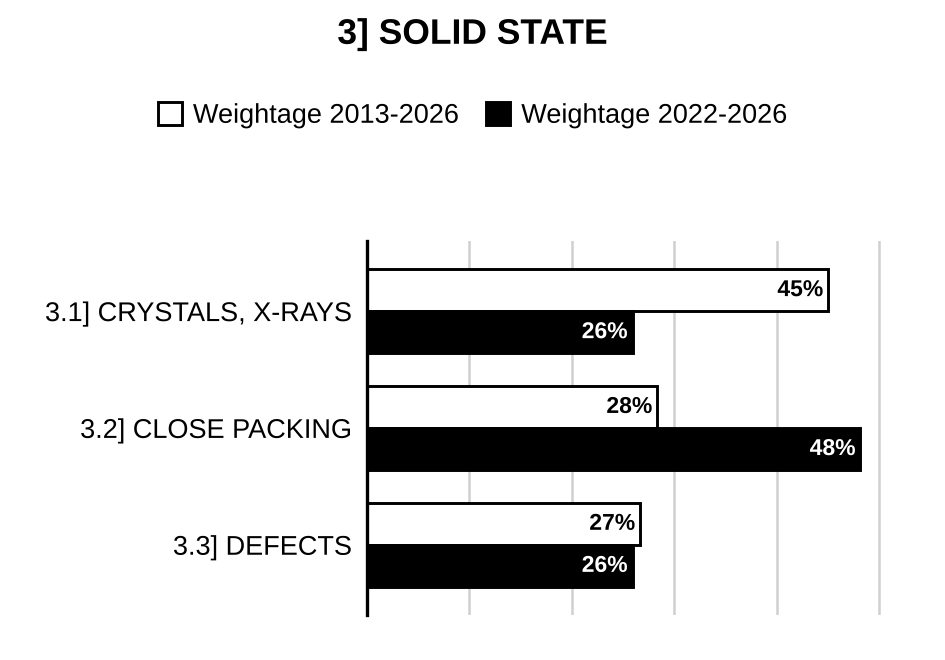
3.1] Crystal systems and X-ray diffraction
25 questions
What is the shortest distance between two successive 111 planes of simple cubic lattice of edge length 200 pm? Explain. [2026/5m/5d]
For Bragg X-ray diffraction studies of crystalline solid, what is the Bragg condition for constructive interference? Explain. [2026/5m/7c(ii)]
Define ‘unit cell’. Draw all the Bravais lattices for a cubic system. [2024/5m/1b(ii)]
(i) Derive an expression that relates the wavelength of the X-rays with the distance between the layers of atoms in a crystal. (ii) The X-rays of wavelength 220 pm are diffracted from an ionic crystal at an angle of 23°. What is the distance between the layers that are responsible for this diffraction? [2023/10m/1c]
In a certain material of simple cubic structure, (100) diffraction is obtained at with radiation of Å. Can this material accommodate an atom of 1.08 Å radius interstitially in void space without lattice distortion? [Sin 14.88 = 0.257]. [2022/20m/2c]
Iron crystallizes in a b.c.c. unit cell at room temperature (). Calculate the radius of an iron atom in this crystal. At temperatures more than 910 °C, iron prefers to be in f.c.c. If we neglect the temperature dependence of radius of iron on the grounds that it is negligible, use this information to determine whether iron expands or contracts when it undergoes transformation from b.c.c. to f.c.c. structure. The atomic mass of iron is 55.845 u. [2021/20m/2c]
An orthorhombic unit cell has the following parameters: Å, Å, Å. What will be the smallest spacing between two successive 123-planes? [2020/10m/1b]
Derive Bragg’s equation. [2018/5m/2d(i)]
The potassium chloride crystal structure is like that of sodium chloride. The unit cell contains four potassium ions and four chloride ions. Given that the size of unit cell as 6.29 Å and the density of potassium chloride as 1.99 g/c.c. Calculate the number of potassium ions and chloride ions in 1.00 g of the salt. [2018/5m/2d(ii)]
Polonium crystallizes in the cubic system. Using X-ray of wavelength 0.154 nm, first order Bragg reflections occur at values 0.225, 0.316 and 0.388 from (100), (110) and (111) planes respectively. Determine the class (SC or BCC or FCC) of the cubic crystal and edge length (a) of unit cell. [2017/15m/3c]
Derive the relation in crystallography. [2016/5m/1c(i)]
What is the perpendicular distance between (110) planes of a cubic unit cell? [2016/5m/1c(ii)]
Buckminsterfullerene () molecules crystallize to form a face-centred cubic unit cell of molecules. (i) How many buckminsterfullerene molecules are there in the unit cell of buckminsterfullerene? (ii) How many carbon atoms are there in the unit cell? (iii) What is the mass of carbon atoms in the unit cell? (iv) Given that the radius of a buckminsterfullerene molecule is 502 pm. Calculate the density of buckminsterfullerene in . [2015/10m/1d]
Copper metal has an f.c.c. unit cell. The accepted value for the metallic radius of copper is 0.128 nm. Calculate the density of copper (at. wt. of Cu = 63.5). [2015/10m/2d]
Potassium crystallizes as a body centred cubic lattice having unit cell length a = 520 pm. (i) What is the distance between nearest neighbours? (ii) What is the expected density of crystalline K metal? (Given: At. wt. of K = 39.1) (iii) What is the ionic radius of ? [2013/15m/3b]
Metallic sodium crystallises in a body centred cubic lattice and has a density of . Calculate the length of the side of the unit cell (a) and the distance between 200 plane (d200). Atomic weight of sodium is . [2012/20m/2b]
(i) Derive Bragg’s equation and show that for the reflection of X-rays from the faces of a crystal. (ii) Calculate the interplanar spacing (d-spacing) in a cubic crystal if the second-order reflections from such planes are obtained. , when X-rays of 154 pm are used. [2010/20m/6b]
Derive Bragg’s equation. Using X-ray powder pattern of a compound describe how do you calculate the spacing between the planes. [2009/20m/1c]
(i) Explain Frenkel and Schottky defects in a crystal, with a suitable example (ii) What do the indices of a set of planes passing through the lattice stand for? Draw the sets of planes, viz. 100 and 110, passing through the lattice points of the crystal. [2007/20m/2a]
What are seven crystal systems and 14 Bravais lattices? Discuss the structures of CsCl and ZnS. [2005/20m/3b]
Describe the X-ray diffraction technique for the determination of crystal structure. [2004/20m/1c]
(i) What do the indicies of a set of planes passing through the lattice stand for? What is the importance of these planes? Draw two sets of planes viz., 110 and 010, passing through the lattice points of the crystal (ii) What is the perpendicular distance d between 222 planes of a cubic unit cell? [2003/30m/3a]
What are Miller indices? Discuss their usefulness in expressing the separation of planes. [2002/7m/4c(i)]
Calculate the separation of (a) the {123} planes and (b) the {246} planes of an orthorhombic unit cell with a = 0.71 nm, b = 0.93 nm and c = 0.75 nm. [2002/8m/4c(ii)]
Calculate the wavelength of X-rays if the reflected angle for NaCl with density 2.163 gm per cc. is 5.9°. [2001/20m/1d]

Preparing for Prelims too?
Our UPSC Prelims Topic-wise PYQ eBook covers every Prelims question with detailed explanations, so you can see exactly where UPSC asks from.
View the BookDownload Free Sample3.2] Close packing and ionic structures
18 questions
Out of three lattice structures SC, BCC and FCC, which one is most economically packed and which one least? Give your answer, calculating packing fraction of each lattice structure. [2026/20m/7c(i)]
The radii of and ions are 0.74 Å and 1.84 Å respectively. Determine the most stable form of arrangement of ions in ZnS crystal lattice. Draw the CCP (Cubic Close Packing) structure of ZnS. [2025/15m/2c]
Calculate the limiting radius ratio for the crystals with coordination number 3 and 6. [2024/10m/2c(i)]
Consider a primitive cubic lattice structure of an element. (i) How many lattice points are present in this unit cell? (ii) What is the coordination number of the atom present in this structure? (iii) What is the percentage void volume of this structure? (iv) If the radius of the atom present in this lattice is 178.1 pm, then find the radius of the sphere that can fit in the centre of this cubic unit cell. (v) What is the coordination number of this sphere? [2023/10m/2c]
In a certain material of simple cubic structure, (100) diffraction is obtained at with radiation of Å. Can this material accommodate an atom of 1.08 Å radius interstitially in void space without lattice distortion? [Sin 14.88 = 0.257]. [2022/20m/2c]
The ionic radii of , and are 137, 148 and 195 pm, respectively. Determine the coordination number and geometry of cations in NaBr and KBr. [2020/10m/6b]
Calculate the radius ratio in an octahedral lattice. Explain why lithium salts crystallize in octahedral lattice, although radius-ratio values are much below the expected ratio. [2014/10m/1a]
(i) CsCl crystallizes in a cubic structure and has a at each corner and a at the centre of the unit cell. Use the ionic radii of (169 pm) and (181 pm) to predict the lattice constant and compare this value with the value of calculated from the observed density of CsCl, (Cs = 132.9, Cl = 35.4). (ii) Calculate the packing efficiency in the primitive unit cell. [2011/30m/3b]
With proper diagram, calculate and explain briefly the limiting radius ratio values for tetrahedral and octahedral sites. [2010/20m/3c]
What is atomic radius of a cubic lattice? Find the atomic packing factor in simple cubic system, body- centered cubic system and face-centered cubic system. [2008/20m/1c]
Given evidence to establish that sodium chloride (NaCl) has fcc structure but caesium chloride (CsCl) has bcc structure. [2006/20m/1b]
What are seven crystal systems and 14 Bravais lattices? Discuss the structures of CsCl and ZnS. [2005/20m/3b]
Explain and bring out the significance of radius ratio rule, lattice energy. Madelung constant and Born-Haber cycle. [2004/20m/1d]
Discuss the structures of NaCl and (rutile). [2002/20m/1d]
Describe the crystal structures of CsCl and . [2001/20m/5d]
Radius ratio of two types of ions is the determining factor for the ultimate crystal structure. Elaborate the statement taking examples of NaCl, BeO and CsCl. [Ionic radii values in Å = , 0.98; , 0.30; , 1.67; , 1.45; , 1.81]. [2000/20m/4a]
Explain the crystal structure of . [2000/20m/4b]
A unit cube in the sodium chloride crystal contains 14 chlorine and 13 sodium ions and yet it contains four molecules of NaCl. Explain. [2000/20m/4c]
3.3] Defects and semiconductors
17 questions
Germanium and Silicon elements have very low electrical conductivity. How can the electrical conductivity be enhanced by adding other elements in trace amount? Explain by examples. [2025/5m/1c]
In a sample of NaCl, one of every 10,000 sites, normally occupied by , is occupied instead by . Assuming that all of the sites are fully occupied, what is the stoichiometry of the sample? [2025/5m/2d]
Explain why crystalline solids are generally more defective as a result of increasing temperature. [2025/5m/3e]
Explain stoichiometric defects with an example. [2024/10m/2c(ii)]
(i) -centre defect can be introduced in several ways. Regardless of the method used, the colour produced in any particular crystal is always same. Explain the reasons. (ii) How would the formation of -centre affect the density of the crystal? [2022/10m/1c]
Zinc oxide is a semiconductor that loses oxygen atoms in a vacuum but gains additional oxygen atoms when heated in oxygen. Its conductivity increases when it is heated in a vacuum but decreases when it is heated in oxygen. Account for these observations. [2019/10m/3a]
What are crystal defects? Give a brief account on stoichiometric defects. [2018/10m/4a(i)]
Explain the conduction mechanism in semiconductors. [2018/5m/4a(ii)]
What are semiconductors? Explain n-type and p-type semiconductors. Discuss the effect of temperature on semiconductors. [2016/10m/3a(ii)]
What is the basic difference between Schottky and Frenkel defects in ionic crystals? How do solids with such defects differ from non-stoichiometric compounds? [2014/10m/3b]
If germanium shows photoconductivity at a wavelength of 1824 nm, calculate the energy gap between the valence band and conduction band in germanium. [2012/20m/3b]
What are stoichiometric and non-stoichiometric defects? Explain Schottky defects and Frenkel defects and mention their consequences. [2009/20m/3a]
What are semiconductors? Explain n – type and p-type semiconductors. Discuss the effect of temperature on semiconductors. [2008/20m/3a]
(i) Explain Frenkel and Schottky defects in a crystal, with a suitable example (ii) What do the indices of a set of planes passing through the lattice stand for? Draw the sets of planes, viz. 100 and 110, passing through the lattice points of the crystal. [2007/20m/2a]
What do you understand by imperfection in crystals? Explain various types of defects and resulting change in properties. [2006/15m/8c]
Define Frenkel and Schottky defects in a crystal with a suitable example for each. [2005/20m/5a]
On doping non-conducting pale-green nickel (II) oxide with a small amount of lithium oxide, not only its colour changes to grey-black but it also becomes a semiconductor. Explain. [2003/20m/5b]

Strengthen your GS papers
Our UPSC Mains Topic-wise & Year-wise PYQ eBook (2013–2026) maps every GS question to the syllabus, so you know what UPSC asks and how often.
View the BookDownload Free Sample« Previous: Chemical Bonding | Next: The Gaseous State and Transport Phenomenon »
Back to: Chemistry Optional PYQs – Topic-wise
Last updated: 30 October 2026