
Mechanical Engineering Optional PYQs Topic-wise for UPSC Mains (1995–2026) are listed below unit by unit, in the order of the official syllabus – 1740 questions in all. Click any unit to open all its previous year questions, arranged topic-wise with the latest first.
Paper I
| Unit | Topic (click to open PYQs) | Sub-topics | Questions | Link |
|---|---|---|---|---|
| 1 | Mechanics | 10 | 198 | Click here → |
| 2 | Engineering Materials | 4 | 102 | Click here → |
| 3 | Theory of Machines | 8 | 149 | Click here → |
| 4 | Manufacturing Science | 17 | 439 | Click here → |
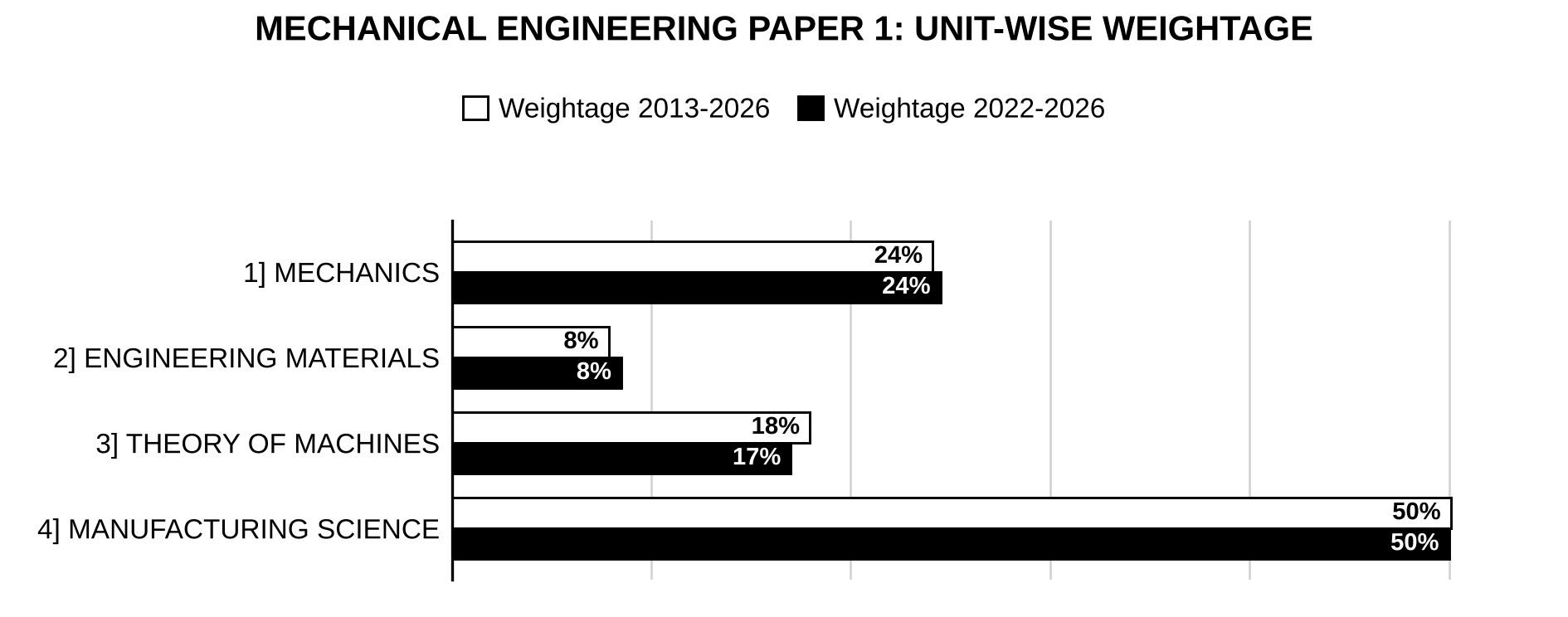
Trend: Manufacturing Science alone takes half of the paper – about 50% both since 2013 and in the last five years. Mechanics carries about a quarter (24%), Theory of Machines about 17–18% and Engineering Materials about 8%. Within manufacturing, metal cutting and machine tools (topic 4.1) is the most-asked topic, followed by inventory management and JIT (4.12), non-conventional machining (4.3), statistical quality control (4.15) and engineering economics and capacity planning (4.8), all of which have held or gained share in 2022–2026. In Mechanics, principal stresses and combined stresses (1.6) lead, with bending stresses (1.5) and particle dynamics (1.3); in Theory of Machines, gears and gear trains (3.3) and flywheels (3.4) lead since 2013, while governors (3.5) and balancing (3.6) have come up more often in 2022–2026.

Preparing for Prelims too?
Our UPSC Prelims Topic-wise PYQ eBook covers every Prelims question with detailed explanations, so you can see exactly where UPSC asks from.
View the BookDownload Free SamplePaper II
| Unit | Topic (click to open PYQs) | Sub-topics | Questions | Link |
|---|---|---|---|---|
| 1 | Thermodynamics, Gas Dynamics and Turbine | 8 | 262 | Click here → |
| 2 | Heat Transfer | 6 | 151 | Click here → |
| 3 | Engines | 5 | 158 | Click here → |
| 4 | Steam Engineering | 6 | 154 | Click here → |
| 5 | Refrigeration and Air-Conditioning | 5 | 127 | Click here → |
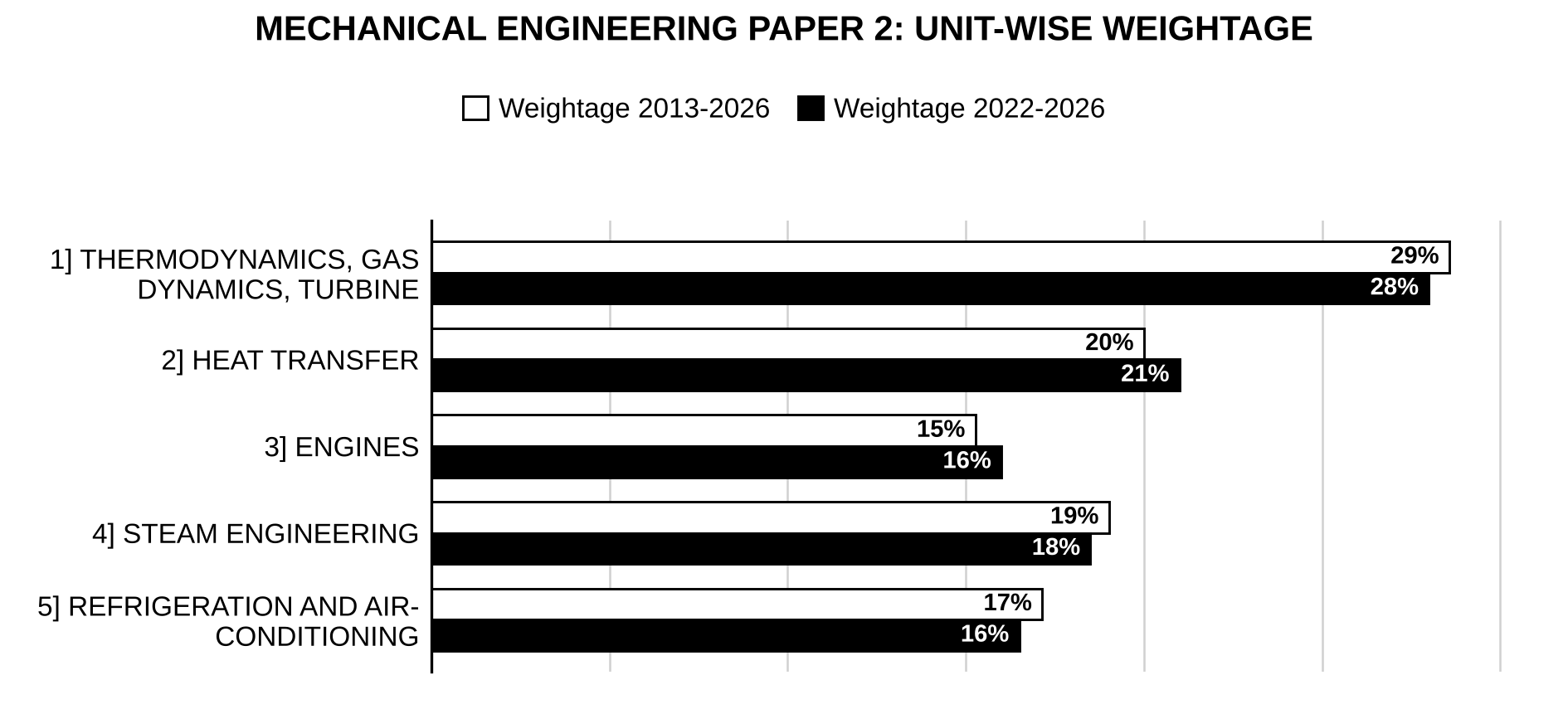
Trend: Thermodynamics, Gas Dynamics and Turbine is the largest unit (about 28%), followed by Heat Transfer (20–21%), Steam Engineering (about 19%), Refrigeration and Air-conditioning (16–17%) and Engines (15–16%); the balance has hardly changed in 2022–2026. The laws of thermodynamics (topic 1.1) and fans, blowers and compressors (1.7) dominate unit 1; conduction (2.1) and heat exchangers (2.6) lead in Heat Transfer; engine performance and the heat balance sheet (3.2) is the main Engines topic; the Rankine cycle with reheat and regeneration (4.5) and steam turbines (4.4) lead in Steam Engineering; and the vapour compression cycle (5.1) and air-conditioning load (5.5) in Refrigeration and Air-conditioning. In 2022–2026 convection in tubes and free convection (2.4), fuels and emissions (3.4) and combined-cycle and co-generation plants (4.6) have been asked more often.
More questions
Other questions (outside the present syllabus) – 18 questions
How this collection is organised
Considering the changing exam pattern over the years, we felt it necessary to declare some practices we’ve adopted in this collection.
Units follow the official syllabus – Paper 1: 1 Mechanics, 2 Engineering Materials, 3 Theory of Machines, 4 Manufacturing Science; Paper 2: 1 Thermodynamics, Gas Dynamics and Turbine, 2 Heat Transfer, 3 Engines, 4 Steam Engineering, 5 Refrigeration and Air-conditioning. Because the notification’s sub-heads are very broad, each unit is divided here into finer topics (for example Paper 1 – 4.12 Inventory management and JIT); these topic numbers differ from the notification’s sub-head numbers. Where a unit has many questions, they are further divided by these topics.
Questions on areas the syllabus does not name separately are placed under the nearest topic: for example, springs under simple stress (Paper 1 – 1.4); column buckling and fatigue under dynamic loading and theories of failure (1.10); brakes, clutches, belts and gyroscopes under plane mechanisms (3.1); casting under forming processes (4.4); queuing under factory location models (4.7); in Paper 2, fluid mechanics of the older papers under fluid flow equations (1.3), pumps and reciprocating compressors under fans and compressors (1.7), hydraulic turbines under gas turbines (1.8), fins under conduction (2.1), boiler fuels and combustion calculations under steam generation (4.1), other power plants and power-plant economics under steam power plants (4.6), and cooling towers under psychrometry (5.4).
Questions on subjects no longer in the syllabus (for example computer programming in the older Paper 1 papers, and hydrodynamic lubrication) are placed at the end of the paper under “Other Questions (Outside the Present Syllabus)”. Every question is kept in its own paper.
Some questions cover more than one topic. We’ve kept such questions in each topic of relevance.
Every figure printed with a question is given as a complete description in square brackets – [Figure: …] – with every link, member, dimension, load and value shown, so that the question can be solved from the description. Steam tables, gas tables, psychrometric charts and statistical tables attached to a paper are not reproduced.
Graphs at the start of each paper show the weightage of every unit in that paper, and graphs for each unit show the weightage of its topics. Weightage is the share of marks asked from a unit or topic, compared for 2013–2026 (white bars) and the last five years, 2022–2026 (black bars). A question placed under two topics has its marks split equally between them.
Each of the topicwise question is suffixed by a question code like this [2024/20m/2a]. This code indicates a) year in which the question was asked, b) maximum marks the question carried, c) prescribed word limit (where UPSC set one, e.g. 200w) and, d) the question number in actual paper, in given order.
Until 2012, each paper carried 300 marks (60 per question); since 2013 each paper carries 250 marks (50 per question). Where a compulsory question offered more parts than were to be answered (“any three” of four), every part is included with its own marks. Where a retyped copy of an older paper prints no marks for a part, the code carries the marks implied by the question.
2016–2026 papers are transcribed from the official UPSC question papers, 2009–2015 from scans of the printed papers, and 1995–2008 from retyped copies, reconciled with a second copy wherever one could be found. Doubtful readings in the older copies are marked [?].
The wording, figures and data of the questions are as printed, including the papers’ own grammar and apparent misprints such as wrong units.
Spotted an error? Use the “Report an Error” box at the end of any page – we review every report and update the page.

Strengthen your GS papers
Our UPSC Mains Topic-wise & Year-wise PYQ eBook (2013–2026) maps every GS question to the syllabus, so you know what UPSC asks and how often.
View the BookDownload Free SampleLast updated: 30 October 2026