
Here are all 126 Cell Biology and Genetics questions asked in UPSC Agriculture Optional Paper II from 1995 to 2026, arranged under the 8 topics of the official syllabus. Within each topic the latest questions come first.
Each question ends with a code such as [2024/15m/3b] – the year, the marks, the word limit (where UPSC set one) and the question number in the paper.
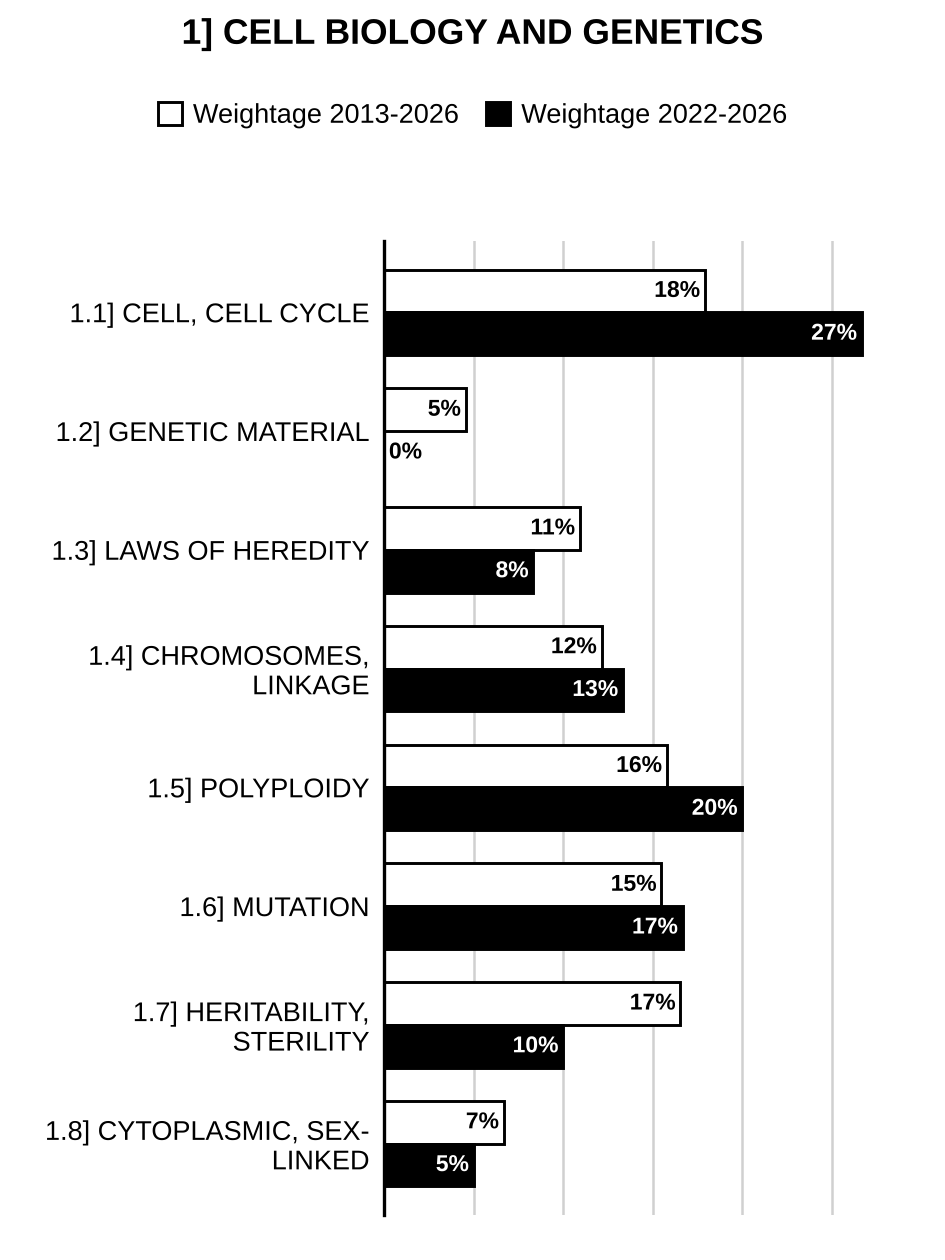
1.1] Cell structure, function and cell cycle
23 questions
Explain the functions and structure of mitochondria with suitable diagram. [2026/20m/2b]
Define cell cycle. Describe different types and phases of cell cycle. [2025/10m/150w/1a]
Explain the functions of plant cell wall in growth, development, maintenance and reproduction of plants. [2025/10m/3c]
Explain the ultrastructure of chloroplast with the help of diagram. Briefly discuss the chemical composition and functions of chloroplast in higher plants. [2024/10m/150w/1a]
Enumerate the functions of Endoplasmic reticulum and Golgi apparatus. [2023/10m/150w/1a]
Enlist the molecular models of cell membrane and explain the models given by S.J. Singer and G. Nicholson (1972), Green and Capaldi (1974) and Racker (1976). [2023/20m/2a]
Define cell. How is a plant cell different from an animal cell? Describe a typical cell structurally and functionally, with a suitable diagram. [2021/15m/2a]
What are the major components that constitute cell structure? Describe their functions. [2019/20m/2a]
What is protoplasm? Briefly discuss its chemical composition and physical properties. [2018/10m/150w/1a]
What is cell? Enlist different organelles of plant cell with brief description of functions of mitochondria. [2017/10m/150w/1a]
What is cell? Explain the structure and function of the cell. [2015/12.5m/7d]
What is cell cycle? Describe different stages of interphase of mitosis. [2012/15m/200w/2a]
Describe briefly the ultrastructure of a plant cell. Explain cell as a structural and functional unit of life. [2011/15m/150w/2a]
What are cell organelles? Give their list. Discuss the function and the significance of any two of them. [2005/20m/200w/1a]
Mitosis and meiosis. [2005/20m/4a]
Briefly describe leucoplastids and chromoplastids. [2004/20m/200w/1a]
Describe with suitable diagrams the events and their significance during interphase, prophase and metaphase stages of Meiosis-I. [2000/20m/200w/5d]
Write about the functions of various parts of the cell. [1999/20m/3b]
How do prokaryote cell and eukaryote cell differ? [1999/20m/3c]
Explain the differences between Mitosis and Meiosis. [1998/20m/200w/1a]
Plant Cell. [1997/12m/8e]
What are the components of cytoplasm? Give their functions. [1996/30m/3a]
Enumerate 10 most important differences between prokaryotes and eukaryotes. List five diseases of national importance caused by organisms in each of above two groups and mention their ‘hot spots’ in India. [1996/20m/200w/5c]
1.2] Genetic material
8 questions
Give an account of mechanism of protein synthesis. Compare it with prokaryotes and eukaryotes. [2016/12.5m/4b]
What are the components of DNA and RNA? Give the characteristic difference of the DNA and RNA. [2015/12.5m/4d]
DNA is the genetic material. How does DNA contribute to the development of various traits? [2014/12.5m/3b]
Define DNA and RNA, and compare them with each other. [2004/20m/200w/1b]
Define the nucleic acids and discuss their structure and functions. [2003/20m/5a]
Describe salient features of ‘transcription’ and ‘translation’ in protein synthesis. [2000/20m/2b]
Distinguish between RNA and DNA of a cell. [1998/20m/200w/1b]
Genetic code. [1998/7.5m/4a]
1.3] Laws of heredity
17 questions
Give an account of seven different pairs of contrasting characters whose inheritance was studied by Mendel in Garden Pea (Pisum sativum). Give the reasons for Mendel’s success in the study. [2023/20m/2b]
Explain various theories of inheritance. Write down the evidences suggesting the presence of cytoplasmic inheritance in the crosses’ results. [2023/10m/2c]
Describe various Laws of Heredity. Explain the Law of Independent Assortment with suitable examples. [2019/15m/6b]
Enlist Mendel’s different laws. Describe in detail about the law of segregation with suitable examples. [2018/15m/2c]
Elaborate Mendel’s law of ‘independent assortment’ by giving suitable example. [2016/10m/150w/1a]
Laws of heredity. [2015/12.5m/8b]
Why do quantitative traits show continuous variation? [2014/12.5m/2d]
Discuss about Back Cross and Test Cross. [2007/20m/3c]
Describe the laws of heredity and their significance in plant breeding. [2006/20m/200w/3b]
Back cross and test cross. [2005/20m/4b]
Phenotype and genotype. [2005/20m/4c]
Homozygous and heterozygous. [2005/20m/4d]
What were the reasons for Mendel’s success in his genetic experiments? Explain how Mendelian inheritance differs from cytoplasmic inheritance. [2000/20m/200w/1a]
What are Mendel’s laws of inheritance? Explain briefly the principles of dominance. [1998/20m/200w/1c]
Write Mendelian principles in your own words. [1997/20m/200w/1a]
Allelic Genes. [1997/12m/8d]
White fruit colour in summer squash is dependent on a dominant allele (W), and coloured fruit on the recessive allele (w). In the presence of ww and a dominant gene (G), the colour is yellow, but when G is absent (i.e. gg), the colour is green. Give the F2 phenotypes and proportions that are expected from crossing a white-fruited (WWGG) with green-fruited (wwgg) plant. [1996/20m/200w/1b]
1.4] Chromosome structure, aberrations, linkage and crossing-over
13 questions
What is chromosomal aberration? Briefly discuss the changes in chromosomal structure due to aberrations. [2024/20m/2a]
Discuss the structure of a plant chromosome and its role in genetic diversity. [2022/20m/2a]
Describe chromosome under the following headings: (i) Chromosome number (ii) Chemical constituents of chromosomes (iii) Chromomere (iv) Y chromosomes. [2020/10m/150w/1e]
Enumerate various types of structural chromosomal aberrations with their types. Give detailed account of inversion-type structural aberration. [2020/15m/2c]
Write short notes on the following: (i) Sex-linkage (ii) Double cross-over (iii) Autosome (iv) Cytoplasmic male sterility (v) Aneuploids. [2020/15m/4c]
What do you understand by chromosomal aberration? Discuss in brief, the major types of chromosomal aberrations. [2018/15m/2b]
What is meant by linkage and crossover? Write their significance in recombination breeding. [2015/12.5m/2c]
Describe different types of structural variations in chromosomes. Mention its genetic implications. [2012/12m/150w/1a]
Various types of gene linkage and their detection. [2010/15m/150w/1a]
Define Chromosome. Describe briefly the size, shape and number of Chromosomes found in crop plants. [2005/60m/3]
Define the chromosome theory of hereditary and discuss about inter chromosomal linkage. [2003/20m/200w/1a]
Paracentric inversion. [2000/15m/4a]
Euchromatin and heterochromatin. [1999/10m/4a]

Preparing for Prelims too?
Our UPSC Prelims Topic-wise PYQ eBook covers every Prelims question with detailed explanations, so you can see exactly where UPSC asks from.
View the BookDownload Free Sample1.5] Polyploidy, euploids and aneuploids
16 questions
Give an account on double haploid and its applications in plant breeding. Also discuss the production methods of haploid. [2025/20m/2b]
What is allopolyploidy? Describe its applications and limitations in crops. [2024/20m/3a]
What is polyploidy? Give a brief account of classification of polyploids. [2022/10m/150w/1a]
Define aneuploidy. Give an account of morphological and cytological functions of aneuploidy, and discuss its application in crop improvement. [2022/20m/4b]
What is polyploidy? Describe its application in crop improvement with its limitations. [2019/10m/150w/5b]
Differentiate between aneuploid, euploid and polyploid. Explain in detail the applications of allopolyploidy in crop improvement. [2018/20m/4a]
What is polyploidy? Briefly discuss its application and limitations in crop improvement. [2017/20m/3b]
“Aneuploids are generally weak, but they are useful in plant breeding”. Evaluate this statement in the light of available information. [2014/10m/150w/1a]
Discuss the usefulness of autopolyploidy in crop improvement. [2013/10m/150w/1c]
What are haploids? How are they produced? Discuss their applications in crop improvement. [2011/15m/150w/2b]
Describe the origin and production of aneuploids. [2010/15m/150w/5c]
Discuss the importance of allopolyploids in evolution and crop improvements. Give suitable examples. [2009/20m/200w/2b]
Describe briefly the types of changes in chromosomes number. [2006/20m/200w/1a]
Describe the role of polyploidy in plant breeding. [2003/20m/3a]
Autotetraploid. [1999/10m/4f]
Polyploidy. [1996/10m/4d]
1.6] Mutation and crop improvement
14 questions
Define mutagens. Explain the different mutagen groups. [2026/10m/150w/1e]
Explain mutagenesis with its classification. Discuss briefly the mechanisms of action of alkylating agents and azide mutagens in crop improvement. [2025/20m/2a]
What do you mean by mutation? What is the significance of induced mutation in plant breeding? [2022/20m/3a]
Describe the applications of mutation breeding. Also discuss the limitations of this approach of plant breeding. [2020/15m/3b]
Define mutation. Write its classification and role in crop improvement. [2019/10m/150w/1a]
What are mutations? Indicate the use of induced mutation in varietal development. [2017/20m/4a]
Discuss the practical applications of mutations in wheat, rice and barley. Name two varieties of wheat released by the use of induced mutations in India. [2016/12.5m/4a]
Classify the mutation. Explain the application of mutation breeding. [2015/10m/150w/1a]
Briefly describe the procedure for utilization of induced mutation in plant breeding. [2014/10m/150w/1d]
Define micromutations. Briefly discuss the methods for their detection and applications in crop improvement. [2009/20m/200w/1a]
What is mutation? Give its classification. Describe in brief spontaneous and induced mutation. [2005/20m/200w/1d]
Mutant varieties. [2003/20m/8c]
Mutation creates variability needed for evolution. [2001/15m/4a]
Differentiate between macro- and micro-mutations. Explain the role of mutations in crop improvement with appropriate examples. [2000/20m/200w/5b]
1.7] Heritability, sterility and incompatibility
23 questions
Define heritability. What do you mean by broad sense and narrow sense heritability? Explain its applications in crop improvement. [2026/20m/3a]
Give an account of cytoplasmic genetic male sterility and its utilization in plant breeding. Also discuss its limitations. [2024/20m/4a]
Classify types of male sterility and self-incompatibility system in plants. Describe the limitations of cytoplasmic genetic male sterility system in hybrid seed production. [2021/20m/2c]
Explain self-incompatibility and its mechanism. Discuss relevance of self-incompatibility in plant breeding. [2020/20m/2a]
Explain sterility systems in crop plants. Describe the role of male sterility in hybrid seed production in vegetable crops with suitable examples. [2019/15m/3c]
What do you mean by hybrid seed production? Describe the different types of sterility systems to facilitate hybrid seed production. [2018/20m/2a]
What do you mean by self-incompatibility? Discuss ways and means to overcome self-incompatibility. [2018/15m/3b]
What do you mean by male sterility? List various types of male sterility systems found in plants and discuss the chemically induced male sterility. [2017/10m/150w/1d]
Discuss sterility systems used in hybrid seed production. Briefly mention chemically induced male sterility. [2016/10m/150w/1e]
Given the seed from a male sterile line of corn, how would you determine if the sterility is genetic or cytoplasmic? [2016/12.5m/3c]
Explain the use of cytoplasmic-genetic male sterility in hybrid seed production. [2014/12.5m/2c]
Which measure of heritability (broad sense or narrow sense) will be appropriate for selection in a mixture of homozygous lines and for segregating generations. Explain the basis for your answer. [2013/10m/150w/1d]
What are male sterile lines? Describe its role in seed production. [2012/12m/150w/1c]
What is heritability? Explain the types of heritability and their significance in crop improvement. [2011/15m/150w/3a]
Discuss the types of self-incompatibility and their relevance in plant breeding. [2010/15m/3a]
Describe briefly the mechanism of self-incompatibility. [2006/20m/200w/1c]
What is self-incompatibility? Describe in brief the mechanism of self incompatibility. [2002/20m/200w/1b]
What is biometry? Discuss the usefulness of biometrical techniques to the plant breeders. [2002/20m/200w/1c]
Discuss the role of self-incompatibility in plant breeding. [2001/20m/200w/1a]
What are different components of variation in a plant population? How do you calculate how heritability using variance components? Explain how heritable variation can be created artificially. [2000/20m/200w/1b]
Distinguish incompatibility from sterility. Give classification of incompatibility. Explain the significance of incompatibility in plant breeding with relevant examples. [2000/20m/7b]
What is male sterility? How can it be used for crop improvement? [1997/20m/200w/1d]
Briefly discuss the importance of male sterility in the improvement of crop plants. [1995/20m/200w/1b]
1.8] Cytoplasmic inheritance; sex-linked, sex-influenced and sex-limited characters
12 questions
Define cytoplasmic inheritance. Explain briefly about sex-influenced and sex-limited traits. [2026/10m/3c]
Explain various theories of inheritance. Write down the evidences suggesting the presence of cytoplasmic inheritance in the crosses’ results. [2023/10m/2c]
Write short notes on the following: (i) Sex-linkage (ii) Double cross-over (iii) Autosome (iv) Cytoplasmic male sterility (v) Aneuploids. [2020/15m/4c]
Explain cytoplasmic inheritance and its characteristics. [2017/10m/2c]
Briefly describe the salient features of cytoplasmic inheritance, and give the reasons therefor. [2013/10m/150w/1e]
Sex-influenced and sex-limited characters. [2013/12.5m/200w/3d]
What are cytoplasmic mutations? Discuss their role in crop improvement. [2011/15m/150w/1b]
Briefly explain the salient features of cytoplasmic inheritance. [2001/20m/200w/1b]
What were the reasons for Mendel’s success in his genetic experiments? Explain how Mendelian inheritance differs from cytoplasmic inheritance. [2000/20m/200w/1a]
What is sex-linked inheritance? How does it differ from Mendelian inheritance? Explain sex determination in Drosophila. [2000/20m/3b]
Sex-limited characters. [2000/15m/8a]
Critically discuss sex-linked, sex-limited and sex-influenced characters. [1995/20m/200w/1d]

Strengthen your GS papers
Our UPSC Mains Topic-wise & Year-wise PYQ eBook (2013–2026) maps every GS question to the syllabus, so you know what UPSC asks and how often.
View the BookDownload Free Sample« Previous: Agricultural Extension | Next: Plant Breeding »
Back to: Agriculture Optional PYQs – Topic-wise
Last updated: 30 October 2026