
Here are all 243 Law of Crimes questions asked in UPSC Law Optional Paper II from 1995 to 2026, arranged under the 16 topics of the official syllabus. Within each topic the latest questions come first.
Each question ends with a code such as [2024/15m/3b] – the year, the marks, the word limit (where UPSC set one) and the question number in the paper.
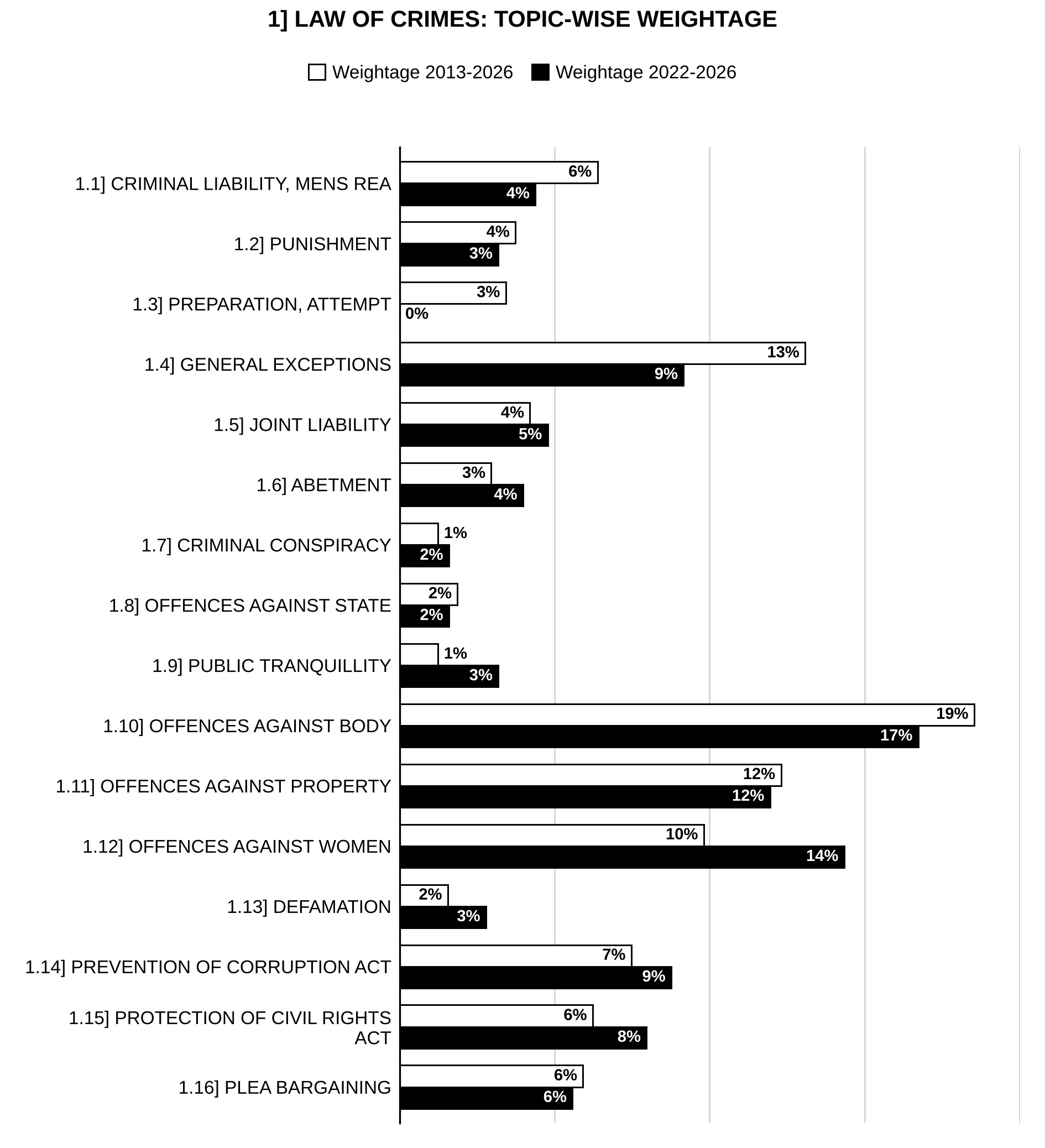
1.1] General principles of criminal liability
19 questions
How far does a ‘mistake of fact’ negate mens rea? Does it operate as a justification or an excuse, and should it be allowed as a defence in strict liability offences? Explain. [2026/15m/3b]
The underlying principle of mens-rea is expressed in the familiar Latin maxim – ‘actus non-facit reum nisi mens sit rea,’ – ‘the act does not make a man guilty unless the mind is also guilty.’ Explain with decided cases. [2024/10m/150w/1a]
“The existence of mens rea along with commission of actus reus makes the act an offence.” Explain. [2022/10m/150w/1a]
Mere proof of presence of both ‘actus reus’ and ‘mens rea’ is not sufficient, the concurrence between the two also needs to be established to impose criminal liability. Elucidate in the light of case law. [2020/15m/4b]
Even without mens rea there are certain acts, which are offences under the Indian Penal Code, 1860. Enumerate such offences. [2019/10m/150w/1a]
“Whether the maxim ‘actus non facit reum nisi mens sit rea’ in general and the Common Law doctrine of ‘mens rea’ as an independent doctrine in particular are relevant in the interpretation of provisions of the Indian Penal Code?” Explain the above in the light of juristic opinions and judicial pronouncements. [2018/10m/150w/1a]
“In determining the quantum of criminal liability, the law takes into account the motive, magnitude and character of the offender.” Examine this statement in the light of absence of mens rea in statutory offences. [2016/10m/150w/1a]
What are the constituent elements of crime? Elaborately discuss mens rea with relevant case law. [2014/20m/2a]
“The word ‘Voluntary’ as used in the Indian Penal Code is very significant and it does not mean willingly but knowingly or intentionally.” Explain. [2013/10m/125w/1a]
‘Although the requirements of mens rea is general throughout the criminal law, there are numerous exceptions to it’. Explain with illustrations. [2009/20m/200w/1a]
Discuss the importance of mens rea in criminal law. Also explain the role of mens rea in statutory offences with the help of relevant case law. [2005/30m/2a]
“An act which is done by one against his will is not his act.” Discuss. [2003/20m/200w/1b]
A corporation aggregate cannot be fastened with criminal liability. [2002/20m/200w/1a]
It is not at all in doubt that the proof of existence of guilty intent is an essential element in a crime under common law. [2002/20m/200w/1c]
“Intention and the act both must concur to constitute a crime.” Explain. [2000/30m/2a]
In the light of the relevant provisions in the Prevention of Food Adulteration Act, 1954 and the judicial pronouncements discuss as to whether a company enjoys immunity from prosecution in respect of those offences where the minimum punishment prescribed is imprisonment. [1997/30m/4b]
Discuss in detail the very wide powers given to the food inspectors by the Prevention of Food Adulteration Act, 1954. [1996/30m/4b]
“Under the Indian Penal Code an act which is done by one against his will is not his act.” Examine. [1995/20m/200w/1a]
Explain adulterated and misbranded food under the Prevention of Food Adulteration Act, 1954 and differentiate between the two. [1995/30m/4b]
1.2] Kinds of punishment
11 questions
How can ‘community service’, as a type of punishment, be used to address local issues? Discuss. [2026/10m/150w/1b]
Under what circumstances can the appropriate government commute the sentence of death and life imprisonment for any other punishment? Discuss. [2025/10m/150w/1e]
Though the ‘capital punishment’ is not abolished in India, the recent trends show that the Supreme Court, in appeals, is inclined to modify the same and sentence the convict to life imprisonment with further direction that the convict must not be released from prison before he/she actually serves certain specified number of years usually 20, 25 or 30 years. Do you think the Court is justified in issuing such directions? Comment. [2020/20m/3a]
“The criminal justice is administered in India by punishing the wrongdoer and the object of punishment is viewed differently by different criminologists.” Elucidate. [2015/10m/150w/1b]
“Fake police encounters are nothing but murders and police officers committing it without any protection of law to them deserve death penalty as the cases fall into rarer of the rarest category.” Comment. [2013/10m/125w/1b]
What test has the Supreme Court prescribed to understand ‘the rarest of the rare cases theory’ while inflicting Capital Punishment? Can one argue that Capital Punishment in any case is against society? [2010/20m/3a]
Describe the kinds of punishments to which offenders may be punished under the provision of Indian Penal Code, 1960. [2007/20m/200w/1a]
“Compensation to the victims of crime in India is the vanishing point of criminal jurisprudence.” Comment. [2006/20m/200w/1b]
“In murder cases sentence of imprisonment for life is the rule and death sentence an exception”. Discuss. [2003/30m/4a]
What test has the Supreme Court prescribed to understand ‘the rarest of the rare cases’ while inflicting capital punishment? Can one argue that capital punishment in any case is against human right jurisprudence? [1998/20m/200w/1d]
“It is now a settled law in India that death sentence can be imposed only in the rarest to the rare cases.” Examine the above statement with the help of important decided cases clearly identifying as to what are rarest of rare cases. [1997/30m/2a]
1.3] Preparation and criminal attempt
8 questions
Has ‘Attempt’ been defined anywhere in the IPC, 1860? What are the various tests for determining, whether an act amounts to preparation or attempt to commit an offence? Explain with the help of relevant case laws. [2021/20m/2a]
A attempts to steal some jewels by breaking open a box belonging to B and finds, thereafter so opening the box, that there is no jewel in it, but A simultaneously puts ₹ 100 currency note in the box, which was already stolen by A from C. Decide as to what offence(s) is/are committed by A. [2019/20m/3a]
“In order to constitute criminal attempt, the act caused must be proximate to the intended result.” Explain the observation with the help of decided case law. [2017/15m/4b]
Discuss various stages of crime. How is the stage of attempt punishable under the Indian Penal Code? [2014/10m/150w/1b]
‘A’, with the intention of bringing “Hashish”, a prohibited drug in India, stealthily brought in his bag a cover believing that it contains “hashish” while coming from Bangladesh to India. While trying to sell the same to ‘B’ a dispute regarding its price arose. B grudgingly informed the police who opened the bag. It was found that it was a harmless snuff powder and not hashish. Discuss the liability of A. [2011/30m/2b]
Distinguish between culpable homicide and causing death by rash or negligent act. A, a woman with a view to poisoning her husband, administered to him a substance which she believed to be poison, but which in fact was harmless. What offence if any she has committed in this case? [2009/30m/2b]
“Offence does not happen all of a sudden, it passes through some stages.” Discuss and distinguish between preparation to commit offence and an attempt to commit an offence. [2008/20m/200w/1a]
The accused picked up a revolver and believing it to be loaded pulled the trigger with the criminal intention of shooting B dead. Fortunately for B, the revolver was not loaded and he escaped unhurt. What offence, if any, has the accused committed? Is it open to the accused to contend in his defence that when the intended offence was physically impossible of being accomplished on the facts as they turned out to be ultimately, he is entitled to a verdict of acquittal? [1999/20m/200w/1a]
1.4] General exceptions
35 questions
How far does a ‘mistake of fact’ negate mens rea? Does it operate as a justification or an excuse, and should it be allowed as a defence in strict liability offences? Explain. [2026/15m/3b]
“Right to private defence is a valuable right but it must be exercised reasonably.” Explain with examples. [2025/15m/2b]
‘Intoxication impairs perception and judgement both so one fails to foresee the result of his conduct.’ In this backdrop, examine the law relating to the defence of intoxication and refer to the leading cases. [2024/15m/2b]
Discuss the nature and scope of right of Private defence of property along with limitations if any, on the exercise of such right. [2023/10m/150w/1b]
The Right of Private Defence is based on the cardinal principle that it is the primary duty of man to help himself, but this right is not absolute. Explain. [2022/10m/150w/1e]
What amounts to ‘Legal Insanity’ that would entitle an accused for exemption from Criminal Liability? [2021/10m/150w/1a]
If a person, who voluntarily consumed intoxicating liquor, commits an offence, while under the influence of such intoxication, can he plead ‘voluntary intoxication’ as a defence? Discuss in the light of relevant provisions of the IPC. [2020/10m/150w/1a]
Right to private defence under the Indian Penal Code, 1860 is available only to an innocent person. It is not a right to retribution. Analyze. [2019/10m/150w/1b]
“Act done by me against my will, is not my act.” Examine in the light of legal provisions of the Indian Penal Code, 1860. [2019/10m/150w/1c]
“Right of private defence to the extent of causing death of an assailant cannot be based on the surmises and speculation. The accused must be under a bonafide fear of death or grievous hurt would otherwise be the consequence of the assault, if he does not defend. To determine the existence of apprehension is always a question of fact.” Explain the above proposition in the light of existing legal provisions and judicial decisions. [2018/10m/150w/1e]
“Law recognizes that ‘mistake’ must be in good faith.” In this backdrop, explain the defence of ‘mistake’ contained under General Exceptions of the Penal Code. [2017/10m/150w/1a]
“A man is not criminally responsible for unintended and unknown consequences of his lawful acts performed in a lawful manner, by lawful means with proper care and caution.” Elucidate. [2016/15m/2c]
“No communication made in good faith is an offence by reason of any harm to the person to whom it is made, if it is made for the benefit of that person.” Critically examine. [2015/20m/2a]
What is meant by right of private defence? What are the general principles which form the basis of right of private defence? [2014/10m/150w/1a]
“Involuntary drunkenness is a defence.” Critically examine the law relating to intoxication as defence. [2013/10m/125w/1d]
X, the producer of a film showing life of ‘homosexuals’, is prosecuted under Section 292 of the Indian Penal Code, alleging that the film was obscene and indecent. The film was certified by the Censor Board of Film of India for public shows. X intends to claim protection against his charge under Section 79 of the Indian Penal Code. Can he do so? Justify your answer. [2013/25m/2a]
Q refused to marry her boyfriend P, resulting into P’s depression. Mr. R, a friend of P, suggested him to take revenge with an intention that P will come out of shock. R provided P with a bottle of liquid believing it as acid. P mistook X to be Q in darkness and threw it on her (X) causing rashes on the face of X, which later resulted into serious injuries. The investigations revealed that it was not acid but was a concentrate of fungicide. Decide the liability of P and R in this case, keeping in mind that defences which may be available to P and R. [2013/25m/4b]
“The expression ‘good faith’ has a definite identity in the Indian Penal Code.” Discuss. [2012/12m/150w/1c]
“The Indian Penal Code gives protection to one who does an act in good faith for the benefit of another.” Discuss. [2011/15m/150w/1a]
“The Indian Penal Code extends protection to acts done by misfortune under certain circumstances.” Discuss. [2011/15m/150w/1b]
“Right of private defence is available only against offences.” Discuss. [2010/20m/200w/1b]
‘A’ and ‘B’ were both security guards posted outside the home of a senior army officer, Mr. X. They often used to exchange hot words with each other in context to the other. On the day of Holi festival both of them had a verbal exchange due to the fact that both wanted to go to home early for festival, that led to altercation between the two, both of them instantaneously aimed their revolvers at each other respectively. ‘C’ who was also on duty with them intervened and pacified both of them. Both lowered their weapons respectively. The moment ‘B’ noted that ‘A’ had lowered his revolver, he immediately fired at ‘A’ and killed him. On being tried ‘B’ was awarded death sentence. However, on appeal the High Court acquitted ‘B’ on the plea of self-defence. The State intends to go in for appeal in the Supreme Court against the decision of the High Court. Advise in the light of the case law on the subject. [2010/20m/2b]
‘Necessity knows no law’. Comment giving illustrations. [2009/20m/200w/1b]
“Right of private defence can be exercised only against the offender.” Explain and discuss also the circumstances when even death can be caused of the accused in exercise of right of private defence of property. [2008/30m/2a]
A with the intention in good faith of saving human life and property, in a great fire, pulls down houses in order to prevent the conflagration from spreading it. A pleads that the harm to be prevented was of such a nature and so imminent as to justify or excuse his act. Decide, whether A has committed any offence? [2007/30m/2b]
Under what conditions may the defence of insanity be pleased on behalf of an accused? [2005/20m/200w/1a]
Referring to relevant legal provisions and decided cases, point out what offence, if any, has been committed: A soldier A fires on a mob by the order of his superior officer in conformity with the commandments of law. [2004/10m/2a]
Referring to relevant legal provisions and decided cases, point out what offence, if any, has been committed: A sees B commit what appears to A to be a murder. A in good faith seizes B in order to bring B before the proper authorities. Later on, it turns out that B was acting in self-defence. [2004/10m/2b]
Discuss the law relating to commencement and continuance of the right of private defence of property. When does the right of private defence of property extend to the causing of death? [2004/30m/3a]
The defence of irresistible impulse has frequently been rejected in charges of murder. [2002/20m/200w/1b]
“Nothing is an offence which is done by a person who is bound by law to do it.” Discuss. [2001/20m/200w/1a]
“Mere medical insanity is not a valid defence under the Indian Penal Code but legal insanity is.” Discuss. [2001/20m/200w/1b]
On what grounds can a person committing any harm on a consenting individual be not punished? Is there any limit to the harm or can it be a harm to any extent? [1998/20m/200w/1c]
“Under the Indian Penal Code there is no right of private defence in which there is time to have recourse to the protection of public authorities.” Examine. [1997/20m/200w/1a]
Examine the criminal liability of A in the following: A, with a known background of sleep-walking, got up from sleep one night, walked to the garage while asleep and drove away in his car in that condition for quite some distance. He halted the car at his brother-in-law’s place, entered the room where his brother-in-law was asleep and gave a hard blow to him, thereby severely injuring him. In a prosecution for attempt to commit murder A’s lawyer pleads non insane automatism, on the basis of which he seeks an acquittal. Decide. Do you think that this case should be dealt with under section 84 of the Indian Penal Code? [1996/15m/2b(i)]
1.5] Joint and constructive liability
9 questions
“In case of joint offenders, their liability is joint and separate.” Explain the conditions when such principle is applicable. [2025/15m/4b]
“The provisions of Section 149 of the IPC, 1860 relate to the question of offence while Section 34 is a question of evidence.” Give reasons for the statement. [2022/15m/2b]
Though both Sections 34 and 149 of the Indian Penal Code provide for imposition of constructive criminal liability, there are substantial points of difference between the two. What are they? [2020/15m/2c]
A group of persons decided to act in concert with common intention to commit rape on victim (V). More than one person from the group, in furtherance of common intention, acted in concert in the commission of rape as per pre-arranged plan. One lady member of the group facilitated the commission of such rape by many persons of the group. The essence of liability in such situation being the existence of common intention. Decide the criminal liability of the following members of the group: (i) Who were members of the plan but did not participate in the act (ii) Who committed rape (iii) The sole lady member who lend full facilities for the commission of rape. [2018/15m/2c]
“Section 34 is incorporated in the Indian Penal Code to deal with the cases where it is very difficult to distinguish precisely the part taken by each individual in criminal act.” While examining the rationality of this Section, support the answer with the help of decided cases. [2017/15m/2a]
Distinguish common intention from abetment and criminal conspiracy. [2010/20m/200w/1a]
Discuss the rules regarding joint and constructive liability in Criminal Law. Do you find any distinction between similar intention and common intention? [2008/20m/200w/1b]
X group, consisting of seven persons, waylaid Y group of persons. In the fighting that ensued between the two groups A, a person belonging to the X group, was injured. Because of the injury A had to withdraw to one side and he took no further part in the fight that continued between the two groups. Sometime later a person belonging to the Y group was killed in the fighting. A along with other persons of the X group are prosecuted for the murder. Decide. [1997/30m/2b]
A, in association with B, relieved C of his watch in a running train, and when A and B tried to get down from the train C raised an alarm whereupon B slapped him. Discuss the liability of A and B. [1995/30m/2b]
1.6] Abetment
13 questions
‘The offence of abetment depends upon the intention of the abettor not upon the act committed by the abetted person.’ Explain. [2024/15m/4c]
Illustrate the doctrine of ‘constructive-criminality’ with reference to law on Abetment. [2023/10m/150w/1c]
“The abetment of the illegal omission of an act may amount to an offence although the abettor may not himself be bound to do that act.” Explain and illustrate. [2014/10m/2c]
Q refused to marry her boyfriend P, resulting into P’s depression. Mr. R, a friend of P, suggested him to take revenge with an intention that P will come out of shock. R provided P with a bottle of liquid believing it as acid. P mistook X to be Q in darkness and threw it on her (X) causing rashes on the face of X, which later resulted into serious injuries. The investigations revealed that it was not acid but was a concentrate of fungicide. Decide the liability of P and R in this case, keeping in mind that defences which may be available to P and R. [2013/25m/4b]
“There may be an element of abetment in a conspiracy but conspiracy is something more than an abetment.” Discuss with illustrations. [2012/20m/4a]
“An abetment of an offence being a complete offence by itself, an attempt of abetment of an offence is also an offence.” Examine. [2006/20m/200w/1a]
X strikes Y with a stick. Y is by this provocation excited to violent rage. Z, a bystander intending to take advantage of Y’s rage and to cause him kill X, puts a knife into Y’s hand for that purpose. Y kills X with that knife. What offence is committed by Y and Z? Explain and discuss with reasons. [2005/30m/2b]
“Whenever an illegal omission of an act is abetted, the same may amount to an offence although the abettor may not be bound to do that act.” Discuss. [2003/20m/200w/1a]
“The law of criminal conspiracy insists on an agreement between two or more persons whereas in abetment by conspiracy a mere engagement between them may be sufficient.” Discuss. [2001/30m/2a]
“The abetment of the illegal omission of an act may amount to an offence although the abettor may not himself be bound to do that act.” Examine. [1997/20m/200w/1b]
“Whereas in criminal conspiracy an agreement between two or more persons is needed, in abetment by conspiracy an engagement between them is enough.” Examine. [1996/20m/200w/1b]
A buys milk from B knowing that it contains water, in order to have B prosecuted for selling adulterated milk. What offence has A committed? [1996/15m/2b(ii)]
“An abetment of an offence being a complete offence by itself, an attempt of abetment of an offence is also an offence.” Examine. [1995/20m/200w/1b]
1.7] Criminal conspiracy
8 questions
‘The principle that every conspirator is liable for all the acts of co-conspirators if they are towards attaining the goals of the conspiracy even if some of them have not actively participated in the commission of that offence/s.’ In the light of above statement, explain the principle of criminal conspiracy as per Indian Penal Code 1860. [2024/10m/150w/1b]
“To constitute the offence of criminal conspiracy there must be an agreement to do, or cause to be done, an illegal act, or an act which is not illegal by illegal means.” Critically examine. [2015/10m/150w/1d]
“There may be an element of abetment in a conspiracy but conspiracy is something more than an abetment.” Discuss with illustrations. [2012/20m/4a]
Distinguish common intention from abetment and criminal conspiracy. [2010/20m/200w/1a]
“To constitute the offence of conspiracy there must be an agreement of two more persons to do an act which is illegal or which is to be done by illegal means for one cannot conspire with oneself.” Discuss. [2006/30m/2a]
“The law of criminal conspiracy insists on an agreement between two or more persons whereas in abetment by conspiracy a mere engagement between them may be sufficient.” Discuss. [2001/30m/2a]
The appellant along with the other three named accused were charged under Sec 120-B (criminal conspiracy) read with Sec 471 and Sec 420 IPC for conspiring to use forged documents and thereby induced the Controller of Imports to grant import licences. The magistrate acquitted all accused persons on all charges. The High Court on appeal reversed the acquittal of the appellant and convicted him for the substantive offence as well as conspiracy to commit such offence under Sec 120-B of the Indian Penal Code. Do you advise the appellant to appeal to the Supreme Court? Give reasons. [1998/20m/200w/1a]
“Whereas in criminal conspiracy an agreement between two or more persons is needed, in abetment by conspiracy an engagement between them is enough.” Examine. [1996/20m/200w/1b]
1.8] Offences against the State
4 questions
From ‘sedition’ under the Indian Penal Code, 1860 to ‘acts endangering sovereignty, unity and integrity of India’ under the Bharatiya Nyaya Sanhita, 2023, how has the law changed? Explain. [2026/10m/150w/1e]
“Section 124A of the IPC dealing with sedition is ultra-vires of the Constitution insofar as it seeks to punish merely bad feelings against the Government. It is an unreasonable restriction on freedom of speech and expression guaranteed under Article 19(1)(a) and is not saved under Article 19(2) of the Constitution by the expression “in the interest of public order”.” Comment. [2016/20m/2a]
“Merely doing certain acts that would bring the Government established by law into hatred or contempt is not the decisive ingredient of Sedition.” Discuss. Also state the view of Law Commission of India about reforms on this provision. [2011/30m/2a]
“The constitutional validity of Section 124A of Indian Penal Code was questioned in Kedar Nath Singh on the ground of the provision of the section being in violation of freedom of speech and expression.” Briefly discuss the contentions and give reasons for or against the decision in the said case. [2004/20m/200w/1a]

Preparing for Prelims too?
Our UPSC Prelims Topic-wise PYQ eBook covers every Prelims question with detailed explanations, so you can see exactly where UPSC asks from.
View the BookDownload Free Sample1.9] Offences against public tranquillity
4 questions
What do you understand by an ‘unlawful assembly’? Discuss the circumstances when a lawful assembly becomes unlawful. Support your answer with suitable illustrations. [2022/20m/3a]
“It would be wrong to perceive nudity and sex as essentially obscene, indecent or immoral. Sex and obscenity are not always synonymous.” In the light of the above statement elaborate the position of obscenity as an offence in India. [2011/30m/3a]
“In order to constitute a public nuisance there must be an act or an illegal omission, and it is not necessary that the act should be illegal.” Explain the offence of public nuisance with the help of decided cases. [2010/20m/2a]
The offence of riot is not committed unless all the five elements are present. [2002/20m/200w/1d]
1.10] Offences against the human body
41 questions
How effectively does the law distinguish between ‘pre-meditated killing’ and ‘murder as a consequence of a sudden fight’? Explain in the light of relevant statutory provisions. [2026/20m/3a]
“Homicide means killing of a human being by a human being.” Explain the statement and distinguish between culpable homicide amounting to murder and not amounting to murder. [2025/20m/2a]
‘It is the degree of negligence which really determines whether a particular action will amount to rash and negligent act as required to hold a person guilty of homicide under Section 304-A of Indian Penal Code, 1860.’ Discuss. [2024/10m/150w/1c]
‘Kidnapping is a substantive offence while abduction is not an offence exclusively. It becomes offence, when committed with a criminal intent.’ Explain. [2024/15m/4b]
Discuss the doctrine of ‘Transferred Malice’ as applied to law relating to culpable homicide under the Indian Penal Code, 1860. [2023/10m/150w/1a]
A twenty year old girl ‘G’ was coming back to home after attending college. A man ‘M’ held her, shut her mouth and dragged her to a nearby bush, where he slit the girl’s throat thereby killing her. Thereafter he raped her. Decide what offence(s), if any, ‘M’ has committed in the above case. Explain the relevant statutory provisions in detail. [2023/20m/2a]
Summarize the law relating to ‘attempt to suicide’ in India. How far the Mental Healthcare Act, 2017 added new dimensions to the law of attempt to suicide in India? [2022/20m/4a]
Discuss ‘Grave and Sudden Provocation’ as a defence to charge of murder under IPC, 1860? [2021/10m/150w/1b]
Differentiate between the following: (i) ‘Kidnapping’ and ‘Abduction’ (ii) ‘Riot’ and ‘Affray’ (iii) ‘Criminal Breach of Trust’ and ‘Dishonest Misappropriation of property’. [2021/15m/2b]
The definition of ‘murder’ under Section 300 of the Indian Penal Code is very wide. It includes not only both ‘intentional’ and ‘unintentional’ causing of death but also cases where the death is not even ‘foreseen’. Explain. [2020/20m/2a]
“Every culpable homicide and murder is necessarily a hurt, but every hurt is not necessarily a culpable homicide and murder.” Elucidate. [2019/20m/2c]
In view of the consistent opinion rendered in Aruna Shanbaug case and also considering the socio-legal, medical and constitutional significance of Euthanasia, do you consider that the view expressed by the Constitutional Bench of Supreme Court in Common Cause (A Regd. Society) vs. Union of India (2018) is conclusive? Comment critically. [2018/10m/150w/1c]
“Section 300 (4) of the Indian Penal Code will be applicable in cases where the knowledge of the offender as to the probability of death of a person approximates to practical certainty.” Illustrate the above statement. [2018/20m/2a]
“For fixing criminal liability of a doctor under Section 304-A of the Indian Penal Code, it is necessary to prove that the act complained against the doctor must show such rashness or negligence of such higher degree as to indicate mental state which can be described as totally apathetic towards patient. Such gross negligence alone is punishable.” In the light of the latest judicial pronouncement, explain the above statement. [2018/20m/4c]
“There is a very thin but fine and subtle distinction between culpable homicide and murder. The difference lies merely in the different degrees of probability of death ensuing.” Discuss the statement and refer to decided cases. [2017/20m/3a]
“Culpable homicide is not murder, if it is committed without premeditation, in a sudden fight in the heat of passion.” Critically examine the statement with leading case law. [2016/15m/2b]
Explain with the help of decided cases as to when Culpable Homicide under Section 299(3) will become Murder under Section 300(4) of Indian Penal Code. [2015/10m/150w/1e]
‘A’ assaulted his wife by kicking her repeatedly on non-vital parts of her body. She fell down and became unconscious. In order to create an appearance that she had committed suicide he took up the unconscious body and thinking it to be a dead body hung it up by a rope. The post mortem examination showed that death was due to hanging. With the help of decided cases determine the culpability of A. [2014/20m/2b]
“Distinction between death caused by rash or negligent act under section 304-A and culpable homicide not amounting to murder under section 304 of the Indian Penal Code is fine, but if overlooked, can result in grave injustice.” Discuss. [2014/20m/3b]
“Culpable homicide is the genus and murder is species, and that all murders are culpable homicide but not vice versa.” Discuss in the light of legal provisions and some decided cases. [2012/12m/150w/1a]
The accused (appellant) was separated from his wife. She was living with her father. The accused was keeping their youngest child with someone else. During the noon of a day, his wife took away the child from that someone. The accused, on hearing this, reached his father-in-law’s place and quarrelled. Later in the evening of the same day, the accused and his father-in-law happened to meet at a marketplace. They again quarrelled, grappled with each other. Both fell down. In the heat of passion thus generated, the accused stabbed his father-in-law and he died. Discuss in the light of legal provisions whether the accused would have any lawful defence in this case. [2012/20m/3b]
The accused, one of the two joint owners of a shop, put her lock on the shop which was let out by another joint owner without her consent. The tenant charged the accused with the offence of wrongful restraint in that he was prevented by the lock from entering into the shop. Discuss in the light of legal provisions whether the accused has committed the offence of wrongful restraint. [2012/20m/4b]
An army Jawan X who was away from his home for the last two years, requested his senior Y for leave, which Y refused. Annoyed at this, X fired two shots at Y, one shot hitting Y beneath the knee of the right leg as a result of which he fell down. X fired another shot which hit Y at the upper left arm. Y died after ten days. Discuss the liability of X. [2011/30m/3b]
Mr. A, a chronic heart-patient was drawn into a political debate and in the course of arguments his adversary looked at him fiercely and said that “people like him should be hit till they are dead”. Hearing this ‘A’ suffers a heart attack and dies on the spot. Discuss the liability of his adversary. Argue for the State also. [2010/10m/3c]
‘A’, a minor girl leaves her parents House because of ill treatment and lives with ‘B’, her friend. Can he (B) be prosecuted for kidnapping? [2010/10m/3d]
Distinguish between culpable homicide and causing death by rash or negligent act. A, a woman with a view to poisoning her husband, administered to him a substance which she believed to be poison, but which in fact was harmless. What offence if any she has committed in this case? [2009/30m/2b]
The Supreme Court of India in a recent judgement pronounced, “Doctors cannot be held criminally liable under Section 304 A of the Indian Penal Code unless they are ‘grossly’ rash or negligent in performing their duties”. Is the judgement in favour of doctors or is it against the poor and illiterate patients in our country? Give your views with reasons. [2006/30m/4a]
Discuss, “attempt to commit suicide,” referring to the decisions of the Supreme Court on the Constitutional validity of Section 309 of the Indian Penal Code. [2005/20m/200w/1b]
X strikes Y with a stick. Y is by this provocation excited to violent rage. Z, a bystander intending to take advantage of Y’s rage and to cause him kill X, puts a knife into Y’s hand for that purpose. Y kills X with that knife. What offence is committed by Y and Z? Explain and discuss with reasons. [2005/30m/2b]
Referring to relevant legal provisions and decided cases, point out what offence, if any, has been committed: A intentionally gives a sword cut to B sufficient in the ordinary course of nature to cause death. B dies in consequence. [2004/10m/2e]
Referring to relevant legal provisions and decided cases, point out what offence, if any, has been committed: A without any excuse, fires a loaded pistol into a crowd of persons and kills one of them. [2004/10m/2f]
“The question as how is a court to determine as to whether a bodily injury intentionally inflicted by an accused is likely to cause death or not depends on many factors.” Discuss. [2003/30m/2a]
Explain whether any offence is committed, and under what circumstances (give reasons): X shakes his fist at Z so as to cause reasonable apprehension in the mind of Z that she would be hit. [2002/10m/100w/2d]
Explain whether any offence is committed, and under what circumstances (give reasons): X takes Y a girl of 13 years of age without her knowledge to Mumbai to send her to Dubai to handover for marriage to a Sekh over there and dispatches her to Dubai for the above purpose. [2002/10m/100w/2h]
‘A’ intentionally attacks ‘B’. While doing so ‘A’ does not know that ‘B’ is suffering from an enlarged appendix. The blow falls on the appendix as a result of which the appendix bursts and ‘B’ dies. Discuss A’s liability. [2001/30m/2b]
A, a pickpocket, puts his hand in the pocket of B, a person, who was reclining in the park. Incidentally, the person had a piston in his pocket and as the pickpocket put his hand in the pocket, it touched the trigger and the pistol went off killing the person. Is A guilty of culpable homicide? Explain when culpable homicide does not amount to murder with the help of illustrations and decided cases. [2000/20m/200w/1a]
X, a girl of 14, is ill-treated by her father and step mother. ‘A’, the neighbour under the belief that X was 18; takes her away from her parent’s house on her request but without the consent of the parents. Is he guilty of any offence? If yes, analyse the nature of the offence and cite relevant cases. [2000/20m/200w/1b]
In the scheme of the Penal Code, “culpable homicide” is the genus and “murder” its species. All murder is “culpable homicide” but not vice-versa – Supreme Court in State of A.P. Vs Punnayya – 1977 Cr.L.J. 1 (S.C.). Discuss and illustrate. [1999/30m/2a]
How do you distinguish between wrongful imprisonment and wrongful restraint? Explain with illustrations. [1998/30m/4a]
Examine as to whether a person who causes death of a pregnant woman is guilty of committing one homicide or two. [1996/20m/200w/1a]
“To hold an accused guilty of murder under Clause (3) of Section 300 of the Indian Penal Code the prosecution must prove that there was an intention to inflict that particular injury; that is to say that the injury was not accidental or unintentional or that some other kind of injury was intended, and that particular injury was sufficient in the ordinary course of nature to cause death.” Examine. [1995/30m/2a]
1.11] Offences against property
27 questions
“Theft is an offence against possession, not ownership.” Comment. Also explain the changes introduced in the law relating to theft under the provisions of the Bharatiya Nyaya Sanhita, 2023. [2026/15m/4b]
“Dacoity is an aggravated form of theft and robbery.” Explain with relevant provisions and case-laws. [2025/20m/4a]
“It is the mode of acquiring possession of property of other party with/without his consent, which determines the type of offence against property and thus distinguishes theft, misappropriation and Criminal breach of trust.” Discuss. [2024/20m/3a]
“Dishonest Intention is the gist of the offence of Theft.” Examine the above statement with the help of relevant illustrations. Also discuss how ‘theft’ is different from ‘dishonest misappropriation of property.’ [2023/20m/4a]
Differentiate between the following: (i) ‘Kidnapping’ and ‘Abduction’ (ii) ‘Riot’ and ‘Affray’ (iii) ‘Criminal Breach of Trust’ and ‘Dishonest Misappropriation of property’. [2021/15m/2b]
Unless the ingredients of either ‘theft’ or ‘extortion’ are present, neither the offence of ‘robbery’ nor the offence of ‘dacoity’ can be made out. Explain. [2020/20m/4a]
A attempts to steal some jewels by breaking open a box belonging to B and finds, thereafter so opening the box, that there is no jewel in it, but A simultaneously puts ₹ 100 currency note in the box, which was already stolen by A from C. Decide as to what offence(s) is/are committed by A. [2019/20m/3a]
Six people decided to carry out dacoity of a bank in a village. They went to the bank to commit it, but were intercepted by police. All of them ran away. While the police was chasing them, one of the dacoits (X) killed Mr. Y, who tried to obstruct his way. Decide liability for the murder committed by one of them in view of Sections 391 and 396 of the Indian Penal Code. [2018/15m/3a]
In all robbery, there is either theft or extortion. Explain. [2017/10m/150w/1b]
Whether the conduct of depriving someone from possession of property without causing wrongful gain or wrongful loss amount to theft? Comment. [2015/15m/2c]
“Criminal breach of trust and cheating are two distinct offences generally involving dishonest intention but mutually exclusive and different in basic concept.” Explain with the help of decided cases. [2014/20m/3a]
The natural calamity in Uttarakhand left hundreds dead. Some people were seen removing gold ornaments, watches and other valuables from these dead bodies. Few days later, police apprehended them and wanted to prosecute them. Under which provisions of the Indian Penal Code can they be prosecuted? Discuss. [2013/25m/2b]
A contractor was given cement for construction work by the Minor Irrigation Department of a State Government under a specific agreement that he would return unused cement but instead of doing so, he sold the cement to outsiders. Mentioning relevant legal provision, discuss what offence, if any, is committed by the contractor. [2012/20m/4c]
Discuss the law relating to criminal intimidation. Refer to case law. In what way is extortion different from criminal intimidation? [2010/20m/2c]
Explain the ingredients of the offence of criminal misappropriation of property and distinguish this from criminal breach of trust. A sees Z drop his purse with money in it. A picks up the purse with the intention of returning it to Z, but afterwards appropriates it for his own use. Has A committed any offence? Discuss. [2009/30m/2a]
“In all robbery there is either theft or extortion.” Explain. A holds Z down, and fraudulently takes Z’s money and jewels from Z’s person without Z’s consent and for this purpose he causes a wrongful restraint to Z. Discuss A’s liability. [2008/30m/2b]
What is meant by ‘extortion’? Explain its ingredients and distinguish between ‘theft’ and ‘extortion’. [2007/20m/200w/1b]
An assistant sub-inspector A and a head constable B barged into the house of C, a businessman where he (C) was playing cards along with his six friends. A and B directed the card players to take out their wallets, threatening to take them to the police station. Apprehending registration of a case under the Gambling Act, all of them parted with Rs. 10,500/- in all. What offence have A and B committed? [2006/30m/2b]
Distinguish between criminal breach of trust and criminal misappropriation of property. [2004/20m/200w/1b]
Referring to relevant legal provisions and decided cases, point out what offence, if any, has been committed: A finds a ring on the highway not in the possession of any one person. A picks it up. [2004/10m/2c]
Referring to relevant legal provisions and decided cases, point out what offence, if any, has been committed: A cuts down a tree on B’s ground with the intention of dishonestly taking the tree out of B’s possession without B’s consent. [2004/10m/2d]
A boatman gets hold of gold ornaments from the body of a person who had drowned. A police constable takes away the same after slapping the boatman. The constable does not enter the same in the records and dishonestly keeps them with himself. Discuss the criminal liability of the constable. [2003/30m/2b]
Explain whether any offence is committed, and under what circumstances (give reasons): X burns a share certificate of Z due to which she suffered mental agony in addition to financial loss. [2002/10m/100w/2c]
Explain whether any offence is committed, and under what circumstances (give reasons): X finds a valuable ring on the street and immediately sells the same for using the money to buy a computer. [2002/10m/100w/2f]
Explain whether any offence is committed, and under what circumstances (give reasons): X sells the estate of which he is not the owner and executes a conveyance deed in favour of the purchaser. [2002/10m/100w/2g]
“In all robbery there is either theft or extortion.” Comment. [1998/20m/200w/1b]
A, in association with B, relieved C of his watch in a running train, and when A and B tried to get down from the train C raised an alarm whereupon B slapped him. Discuss the liability of A and B. [1995/30m/2b]
1.12] Offences against women
26 questions
‘X’, a 25-year-old boy, makes a promise to ‘Y’, an 18-year-old girl, that he will marry her if she has ‘carnal-relations’ with him. The girl is reluctant, but agrees after repeated assurances from the boy that he will marry her. Fifteen days after the act, the boy sends her a text message stating that he cannot keep his promise because marriage with her does not align with his career plans and that he needs to marry an NRI girl to facilitate his settlement abroad. What offence, if any, has been committed by the boy? Discuss. In this context, explain the provisions of the Bharatiya Nyaya Sanhita in the light of amendments relating to sexual offences, which recently took place. [2026/20m/4a]
Critically examine the provisions relating to few major offences which fall under the ‘offences against marriage’ in the criminal law of India. Support your answer with case-law. [2025/15m/3c]
A twenty year old girl ‘G’ was coming back to home after attending college. A man ‘M’ held her, shut her mouth and dragged her to a nearby bush, where he slit the girl’s throat thereby killing her. Thereafter he raped her. Decide what offence(s), if any, ‘M’ has committed in the above case. Explain the relevant statutory provisions in detail. [2023/20m/2a]
Discuss the law relating to ‘Assault or Criminal force’ to woman with intent to ‘Outrage her Modesty’ and ‘Sexual Harassment’ as defined under Indian Penal Code, 1860. Is there any difference between the two? Explain. [2023/20m/3a]
Analyze the effectiveness of Sections 326-A and 326-B of the Indian Penal Code, 1860. What additional suggestions have been made by the Supreme Court of India in Laxmi vs. Union of India Case in 2015? [2022/10m/150w/1c]
“The consent of victim negates the offence of rape.” How far will it be true in case it is obtained by the offender on the false promise of marriage? [2022/15m/3c]
From ‘Mathura’ to ‘Nirbhaya’ and beyond, discuss the development of Rape laws in India. [2021/20m/3a]
If a woman watches or captures the image of another woman engaging in a private act in circumstances where she would usually have the expectation of not being observed by any other person, does that amount to offence of ‘voyeurism’ under the Indian Penal Code? Discuss. [2020/10m/150w/1b]
“Recent judicial decisions of the courts have changed the spirit of Section 498 A of the Indian Penal Code, 1860.” Explain the statement with the help of judicial pronouncements. [2019/15m/2b]
A group of persons decided to act in concert with common intention to commit rape on victim (V). More than one person from the group, in furtherance of common intention, acted in concert in the commission of rape as per pre-arranged plan. One lady member of the group facilitated the commission of such rape by many persons of the group. The essence of liability in such situation being the existence of common intention. Decide the criminal liability of the following members of the group: (i) Who were members of the plan but did not participate in the act (ii) Who committed rape (iii) The sole lady member who lend full facilities for the commission of rape. [2018/15m/2c]
Discuss the different forms to outrage the modesty of a woman which have been made punishable in the Indian Penal Code through the Criminal Law (Amendment) Act, 2013. [2017/15m/2b]
“The recent Criminal Law (Amendment) Bill, 2011 seeks to replace ‘rape’ by the term ‘sexual assault’ in the IPC and intends to make rape a gender-neutral offence in the country.” Examine whether this is appropriate. [2012/12m/150w/1b]
Do you find it is necessary to convict the accused both under Section 304-B and Section 498-A of Penal Code? Refer to recent cases. [2010/20m/3b]
When an offence of ‘adultery’ is said to be committed? Whether a wife may be punished for the offence of adultery as an abettor? Distinguish between the offences of ‘rape’ and ‘adultery’. [2007/30m/2a]
“The evil of dowry system has been a matter of serious concern to everyone in view of its ever increasing and disturbing proportion.” Discuss and critically analyse whether the Dowry Prohibition Act, 1961 can cope with this social menace. [2005/30m/4b]
Explain whether any offence is committed, and under what circumstances (give reasons): X husband of W, cohabits with Z. [2002/10m/100w/2a]
Explain whether any offence is committed, and under what circumstances (give reasons): X has sexual intercourse with his wife without her consent. [2002/10m/100w/2e]
A promises to B, his student, and induced her to cohabit with him. He has given her a false assurance of marriage and also fraudulently gone through certain ceremonies of marriage making B to believe that she was a lawfully wedded wife of A. Later A refused to recognise her as his wife. What is the offence committed by A? Explain its ingredients. [2000/20m/200w/1c]
Critically examine viability of the Dowry Prohibition Act. [2000/30m/4b]
A and B are Hindus and are married under the Hindu Marriage Act, 1955. During the subsistence of their marriage A, the husband, embraces Islam and goes through a second marriage ceremony with C, his girl-friend. On the complaint of B, wife of the first marriage, A is prosecuted for the offence of bigamy under Section 494 of the Penal Code. Decide, citing relevant case law. [1999/20m/200w/1b]
The accused succeeded in getting a decree of restitution of conjugal rights in his favour, but his wife, who was living separately with her parents, refused to rejoin him. He, thereupon, went to his in-law’s place and there he had sex with his wife without her consent. The wife desires to have her husband criminally prosecuted for the offence of rape and seeks your legal advice. What advice will you give her? [1999/20m/200w/1c]
H files a petition for divorce against W. The court allows the divorce petition ex-parte. H marries Z after waiting for the period of appeal and the appeal being not preferred within the time. W, makes an appeal after the stipulated appeal period. The appeal court allows the appeal. Can H be tried for bigamy? Give reasons. [1998/20m/2a]
When will sexual intercourse by a man with wife be ‘rape’? [1998/20m/2b]
What changes are incorporated in the law dealing with the offence of rape in the recent past? [1998/20m/2c]
When is a man said to commit the offence of rape? [1996/30m/2a]
Discuss the concept of ‘dowry’ as stated under the Dowry Prohibition Act, 1961. Also suggest necessary changes which are needed in your opinion to be made in the definition of ‘dowry’. [1995/30m/4a]
1.13] Defamation (criminal)
3 questions
Discuss the law of defamation. Is this correct to say that law of defamation gives too much protection to ‘reputation’ and imposes too a great restriction on the freedom of speech? Comment. [2025/20m/3a]
“The ‘Right of Reputation’ is acknowledged as an inherent personal right of every person.” Discuss the statement in the light of Law of Defamation in India. [2022/15m/3b]
Mention the defences of tort of defamation and also discuss whether exceptions given under the Indian Penal Code, 1860 for the offence of defamation may be claimed as additional grounds by the defendant. [2017/15m/3c]
1.14] Prevention of Corruption Act, 1988
13 questions
‘X’, a public servant, asks ‘Y’, a person to give him an amount of Rupees ten thousand in order to process ‘Y’s routine application for a cooking gas connection on time. What offence, if any, has ‘X’ committed? Explain in the light of the relevant statutory provisions. Refer to leading cases. [2026/15m/4c]
“The definition of ‘public servant’ as per the Prevention of Corruption Act, 1988 is only illustrative and not exhaustive.” Comment. [2025/10m/150w/1b]
How far do you agree that prevention of corruption Act 1988 is an important legal instrument in curbing corruption in the society. Discuss. What are the types of offences recognised under this law and what are punishments? [2024/15m/2c]
Examine the term ‘Undue-Advantage’ as difined under the Prevention of Corruption Act, 1988. Also discuss the persons authorised and the procedure required to be followed while investigating cases that are registered under the Prevention of Corruption Act, 1988. [2023/15m/4b]
Is it mandatory to obtain previous sanction for prosecuting a public servant for offences under the Prevention of Corruption Act, 1988? Discuss in the light of relevant provisions and the decisions of the Supreme Court. [2020/10m/150w/1c]
Corruption by public servants has become gigantic problem. Large-scale corruption retards the nation-building activities and everyone has to suffer on their count. The efficiency of public servant would improve only when the public servant does his duty truthfully and honestly. Therefore, in such cases, it is difficult to accept any plea of leniency in sentence (State of MP vs. Shambhu Dayal Nagar (2006) 8 SCC 693). Comment. [2018/20m/3c]
“The Prevention of Corruption Act, 1988 prevents the public servants from misuse and abuse of their official capacity.” Comment. [2016/10m/150w/1b]
Explain the various circumstances under which a ‘public servant’ is said to commit the offence of “Criminal misconduct” under ‘The Prevention of Corruption Act, 1988’. [2015/15m/2b]
“Prevention of Corruption Act, 1988 is an important legislation to safeguard democracy in India.” Discuss. [2014/10m/150w/1e]
Define and discuss the ingredients of “corruption” as given under the provisions of the Prevention of Corruption Act, 1988. [2007/30m/4b]
When is a public servant said to have committed an offence of criminal misconduct as defined in the Prevention of Corruption Act, 1988? Discuss referring to some decided cases. [2005/30m/4a]
‘Prevention of Corruption Act, 1988 has many lacunae leading to undesirable consequences, which call for immediate requisite amendment to the Act.’ – Critically examine the above statement and suggest reasons for such amendment, if any. [2002/30m/4a]
“Whether a public servant is guilty of criminal misconduct under the Prevention of Corruption Act, 1988 or not is not an easy question for the courts to determine.” Discuss. [2001/30m/4a]
1.15] Protection of Civil Rights Act, 1955 and subsequent legislative developments
15 questions
How has the law against untouchability evolved to give effect to Article 17 of the Constitution of India? Discuss in the light of relevant legislative enactments and judicial pronouncements. [2026/15m/2b]
Describe the salient features of the Protection of Civil Rights Act, 1955. [2025/10m/150w/1c]
Define ‘Atrocity’. Also discuss the acts that amount to ‘atrocity’ under the provisions of The Scheduled Castes and Scheduled Tribes (Prevention of Atrocities) Act, 1989. [2023/15m/2c]
How far has Section 7-A of the Protection of Civil Rights Act, 1955 been effective to control untouchability in India? [2022/10m/150w/1d]
Recently there have been changes in Scheduled Castes & Scheduled Tribes (Prevention of Atrocities) Act, 1989. Enumerate. [2021/15m/4c]
The basic spirit of the Scheduled Castes and Scheduled Tribes (Prevention of Atrocities) Act, 1989, which was diluted by the judiciary in Kashinath Mahajan’s case, has been restored by the legislature recently. Examine critically. [2019/15m/3b]
“The object of the Protection of Civil Rights Act, 1955 is to abolish untouchability.” Discuss. [2017/10m/150w/1c]
“The enforcement of any disability arising out of ‘Untouchability’ shall be an offence punishable in accordance with law.” Comment in the light of protection of Civil Rights. [2015/10m/150w/1a]
“The enforcement of any disability arising out of untouchability is to be an offence punishable in accordance with law”. Comment upon this statement and discuss in this context the scope of protection of Civil Rights Act, 1955. [2009/20m/4a]
What are the ‘Civil Rights’ as defined by the Protection of Civil Rights Act, 1955? Enumerate the offences prescribed under the Act. [2006/30m/4b]
Critically examine the provisions of ‘The Protection of Civil Rights Act, 1955’ and highlight the deficiencies, if any, in the said law. [2004/30m/4b]
What are the changes that were brought to the Untouchability Act of 1955? [2000/30m/4a]
What do you mean by untouchability in the context of Protection of Civil Rights Act, 1955? Discuss, highlighting the salient features of the Act. [1999/30m/4a]
“The thrust of the Protection of Civil Rights Act, 1955 is to liberate the society from blind ritualistic adherence and traditional beliefs which have lost all legal and moral base.” Examine. [1997/30m/4a]
Discuss in detail the various provisions under section 7 of the Protection of Civil Rights Act, 1955 with respect to punishment for other offences arising out of untouchability. [1996/30m/4a]
1.16] Plea bargaining
7 questions
Discuss the procedural safeguards provided under the law along with the role of judiciary in ensuring the voluntary participation of the parties in ‘plea-bargaining’. [2026/15m/3c]
“Justification for introduction of ‘plea-bargaining’ in India was that it will reduce delay in case of undertrial prisoners in a cheaper and quicker method.” Do you appreciate its existence in the same form or not? Justify your answer. [2024/20m/2a]
Explain the concept of Plea-bargaining under the Cr.P.C. 1973. In what cases Plea-bargaining is not available? [2021/10m/150w/1c]
“Plea bargaining in India is the truncated one, as it is applicable to sentence only and not to the charge. Equally it is a court-monitored procedure, except that it provides a clause related to compensation to the victim.” Critically analyse the retention of such provision in the Indian Criminal Justice dispensation. Also suggest reforms, if any, you understand are necessary. [2018/15m/4a]
Critically examine the Code of Criminal Procedure (Amendment) Act, 2005 especially with reference to plea bargaining. [2016/10m/150w/1e]
“Plea bargaining, which was considered unconstitutional, illegal and tending to encourage complaint, collusion and pollution of the pure punt of justice, is now a part of sentencing under the Indian Criminal Law.” Comment. [2013/25m/4a]
Critically examine the concept of ‘plea bargaining’ and evaluate its scope in India. [2008/30m/4b]

Strengthen your GS papers
Our UPSC Mains Topic-wise & Year-wise PYQ eBook (2013–2026) maps every GS question to the syllabus, so you know what UPSC asks and how often.
View the BookDownload Free Sample« Previous: International Law | Next: Law of Torts »
Back to: Law Optional PYQs – Topic-wise
Last updated: 30 October 2026