
Here are all 89 Social Change in Modern Society questions asked in UPSC Sociology Optional Paper I from 1995 to 2026, arranged under the 5 topics of the official syllabus. Within each topic the latest questions come first.
Each question ends with a code such as [2024/15m/3b] – the year, the marks, the word limit (where UPSC set one) and the question number in the paper.
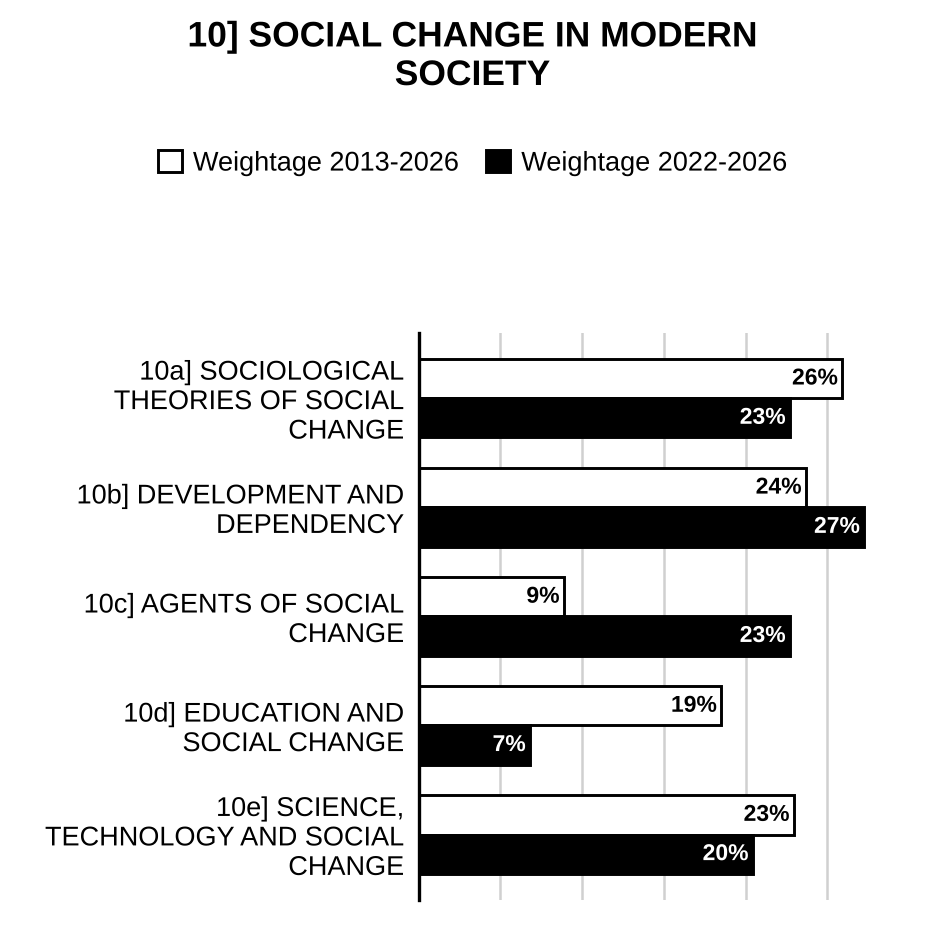
10.1] Sociological Theories of Social Change
19 questions
Critically evaluate the relevance of the cyclical theory of social change in understanding contemporary societies. [2026/20m/8b]
Discuss various theories of social change. Explain the limitations of unilinear theory of social change. [2024/20m/8b]
How do little tradition and great tradition coexist in contemporary Indian society? [2022/10m/6c]
Do you think Talcott Parsons gave an adequate theory of social change? Justify your answer. [2021/10m/150w/5e]
How does Marx view social conflict as an essential element in social change? [2020/20m/8a]
Is the theory of cultural lag valid in present times? Discuss. [2018/10m/150w/5a]
Examine any two theories of social change in detail. [2017/20m/8a]
“Social conflict is both a cause and a consequence of social change.” Explain. [2016/10m/150w/5e]
Explain the relevance of the idea of ‘cultural lag’ in understanding social change. [2015/10m/150w/5e]
Examine the dialectical relation between tradition and modernity in the study of social change. [2015/20m/8b]
Illustrate the conflict and tensions experienced by societies undergoing social change. [2013/20m/8a]
Critically examine the cultural theories of social change with suitable examples. [2013/20m/8b]
Write a short note on: Theory of Cultural Lag – Ogburn and Nimkoff. [2012/12m/150w/5e]
Bring out a comparative analysis of Marxian and Parsonian views of social change and examine the relevance of each view for social development in the contemporary India. [2004/60m/8]
Pitirim A. Sorokin sees the course of history as a continuous but irregular fluctuation between two basically different kinds of culture. While explaining this stand of Sorokin, analyse whether it is appropriate to characterise such a notion of change as a cyclical theory of social change. [2000/60m/6]
Elaborate on the concept of structural change. Discuss the endogenic factors of structural change in a society, with suitable examples. [1999/60m/8]
Explain the concept of social change. Critically examine the contribution of Karl Marx’s theory of social change. [1997/60m/8]
Discuss Talcott Parsons’ contribution to the analysis of social change. [1996/60m/2]
Explain the classical concept of social change and critically examine the contribution of the linear theories of social change. [1995/60m/8]
Contribute to Optional Province
Is every Sociology question under the right topic?
We sorted 1,326 Sociology PYQs topic by topic with AI help, so a few may be in the wrong place. Help us check them: read one question, tell us if its topic is right. It takes about 10 seconds a question.
Start checking Sociology PYQs →10.2] Development and Dependency
24 questions
What do you understand by sustainable development? Discuss the elements of sustainable development as proposed in the UNDP’s Sustainable Development Goals Report–2015. [2025/20m/8a]
Critically examine the World-Systems theory of Immanuel Wallerstein in terms of development and dependency of various nations. [2024/10m/8c]
Examine the relevance of corporate social responsibility in a world marked by increasing environmental crises. [2023/10m/150w/5a]
Assess critically A. G. Frank’s ‘theory of development of underdevelopment’. [2023/10m/7c]
Trace the trajectory of development perspectives on social change. [2022/10m/150w/5e]
Critically examine the contribution of dependency theories in understanding the present global scenario. [2021/20m/7b]
Technology has accelerated the process of development and dependency. Discuss. [2020/20m/7a]
Critique A. G. Frank’s ‘development of underdevelopment’. [2019/10m/150w/5d]
“Social change can be brought about through development.” Illustrate from the contemporary situation of India. [2016/20m/6b]
Write a short essay on the Latin American perspective on ‘dependency’. [2014/20m/8b]
Examine the social dimensions of displacement induced by development. [2013/10m/150w/5d]
Write a short note on: Development and dependency. [2011/12m/150w/5e]
“Social support mechanism needs to be strengthened for effective implementation of development programmes.” Comment. [2011/20m/8a]
Discuss World System Theory in the context of modern society. [2011/20m/8b]
Analyse the social impact of market economy on traditional societies. [2010/15m/7b]
Examine the social dimensions of displacement induced by development. [2010/15m/7c]
Comment on the critics’ charge that Immanuel Wallerstein’s dependency theory is simplistic and wrong. [2009/30m/6a]
Indicate social determinants of economic development. Discuss any one sociological perspective analysing backwardness and poverty in the developing societies. [2007/60m/6]
State significance of social policy in social development. Under what conditions a social policy fails to be effective in its performance? [2006/60m/8]
Write a short note on: Social determinants of economic development. [2005/20m/200w/5a]
Write a short note on: Social determinants of economic development. [2003/20m/200w/5c]
Define ‘social policy’. Evaluate the performance of social policy in modernization of developing societies. [2001/60m/8]
Write a short note on: Social determinants of economic development. [2000/20m/200w/5b]
Write a short note on: Social consequences of economic development. [1995/20m/200w/5d]

Preparing for Prelims too?
Our UPSC Prelims Topic-wise PYQ Book covers every Prelims question with detailed explanations, so you can see exactly where UPSC asks from. Now available as a hard copy and an eBook.
Buy Hard Copy on AmazonBuy eBook (PDF)10.3] Agents of Social Change
7 questions
Discuss the role of geographical factors in social change and development. [2026/10m/150w/1c]
Evaluate the socio-economic impacts of migration on rural households. [2026/20m/4b]
Are traditional social institutions getting weakened as agents of social change in the contemporary society? Substantiate. [2022/20m/8b]
Assess the role of mass media as an agent of social change. [2017/10m/5e]
Write a short note on: Human factors involved in directed social change. [2006/20m/200w/5d]
Write a short note on: Industrialisation and social change. [2002/20m/200w/5a]
Write a short note on: Industrialization and social change. [1997/20m/200w/5d]
10.4] Education and Social Change
22 questions
To what extent can education and skill development be an agent of social change? Critically analyze. [2025/10m/150w/5e]
Does women’s education help to eradicate patriarchal discriminations? Reflect with illustrations. [2023/10m/150w/5e]
Explain the concept of social mobility. Describe with suitable illustrations how education and social mobility are related to each other. [2021/20m/4a]
According to Durkheim, “The major function of education is the transmission of society’s norms and values.” Discuss. [2020/20m/4b]
Discuss the issues of access and exclusion in higher education in India. [2019/10m/150w/5b]
Schooling does not ensure upward mobility of all members of the society. Discuss with reference to class societies. [2018/20m/4b]
“Education is a major source of social mobility in contemporary society.” Explain. [2016/20m/8a]
“Education helps in perpetuating social and economic inequalities.” Critically examine the statement. [2015/20m/6a]
Education is often viewed as an agency of social change. However, in reality it could also reinforce inequalities and conservatism. Discuss. [2014/20m/7b]
Write a short note on: Education as an agent of social change. [2008/20m/200w/1d]
Write a short note on: Education as an instrument of social change. [2007/20m/200w/5c]
“Education is one of the basic activities for the continued existence and development of a society.” Elaborate this statement. [2006/60m/6]
Discuss mass education as an instrument of social change and modernization. [2005/60m/8]
Write a short note on: Privatisation of education and equality of opportunity. [2004/20m/200w/5b]
Write a short note on: Education and social development. [2003/20m/200w/1d]
Distinguish between the processes of formal education and socialization. Examine the effectivity of formal education as an instrument of social change. [2001/60m/6]
Write a short note on: Education and culture. [1998/20m/200w/5b]
Write a short note on: Role of education in social development. [1997/20m/200w/5c]
“Education is an instrument of social control and social change.” Critically examine the statement. [1997/60m/6]
What are the problems of universalisation of primary education? Discuss fully. [1997/60m/7]
Write a short note on: Education and social inequalities. [1996/20m/200w/5c]
Elaborate the meaning of the term ‘equality of educational opportunity’. Discuss education as a medium of cultural reproduction and social transformation. [1995/60m/7]
10.5] Science, Technology and Social Change
17 questions
Critically assess the impact of technological advancement and automation on the nature of work and employment. [2024/10m/4c]
Critically examine the roles of science and technology in social change. What is your opinion on their increasing trend in ‘online’ education and teaching? [2024/10m/150w/5e]
Examine the role of science and technology in addressing age-old taboos and superstitions. [2023/10m/8c]
Sociologists argue for democratization of science and technology for inclusive development. Comment. [2022/20m/8a]
Describe the role of Science and Technology in enabling us to face the challenges triggered by the COVID-19 pandemic. [2021/20m/8b]
Is humanity at the mercy of Nature, Science and Technology? Comment in the light of pandemic situation. [2020/20m/4a]
Feminist scholars argue that ‘New media’ is masculine and hence reinforces structural hierarchies rather than reconfiguring them. Comment. [2019/20m/7b]
Critically analyse the role of science and technology in bringing about social change. [2017/20m/8b]
How is the increasing use of technology changing the status of women in Indian society? [2014/20m/8a]
Examine science and technology as agents of social change. [2013/10m/150w/1d]
“Science and technology are major forces accelerating the process of social change.” Comment. [2011/20m/8c]
Explain the idea of social responsibility of science. Analyse the social consequences of development of science and technology in the context of removal of backwardness in developing societies. [2006/60m/7]
Write a short note on: Social consequences of science and technology in India. [2005/20m/200w/5d]
Write a short note on: Science and social responsibility. [2004/20m/200w/5c]
Write a short note on: Social impact of new technologies in India. [2003/20m/200w/5a]
Write a short note on: Ethos of science. [2002/20m/200w/5d]
Examine social consequences of changes in technology. Illustrate your answer with examples from new productive processes and equipment. [1998/60m/6]

Strengthen your GS papers
Our UPSC Mains Topic-wise & Year-wise PYQ Book (2013–2026) maps every GS question to the syllabus, so you know what UPSC asks and how often. Now available as a hard copy and an eBook.
Buy Hard Copy on AmazonBuy eBook (PDF)« Previous: Systems of Kinship | Next: Other Questions (Earlier Syllabus) »
Back to: Sociology Optional PYQs – Topic-wise | Also see: Sociology Optional year-wise question papers
Last updated: 30 October 2026