
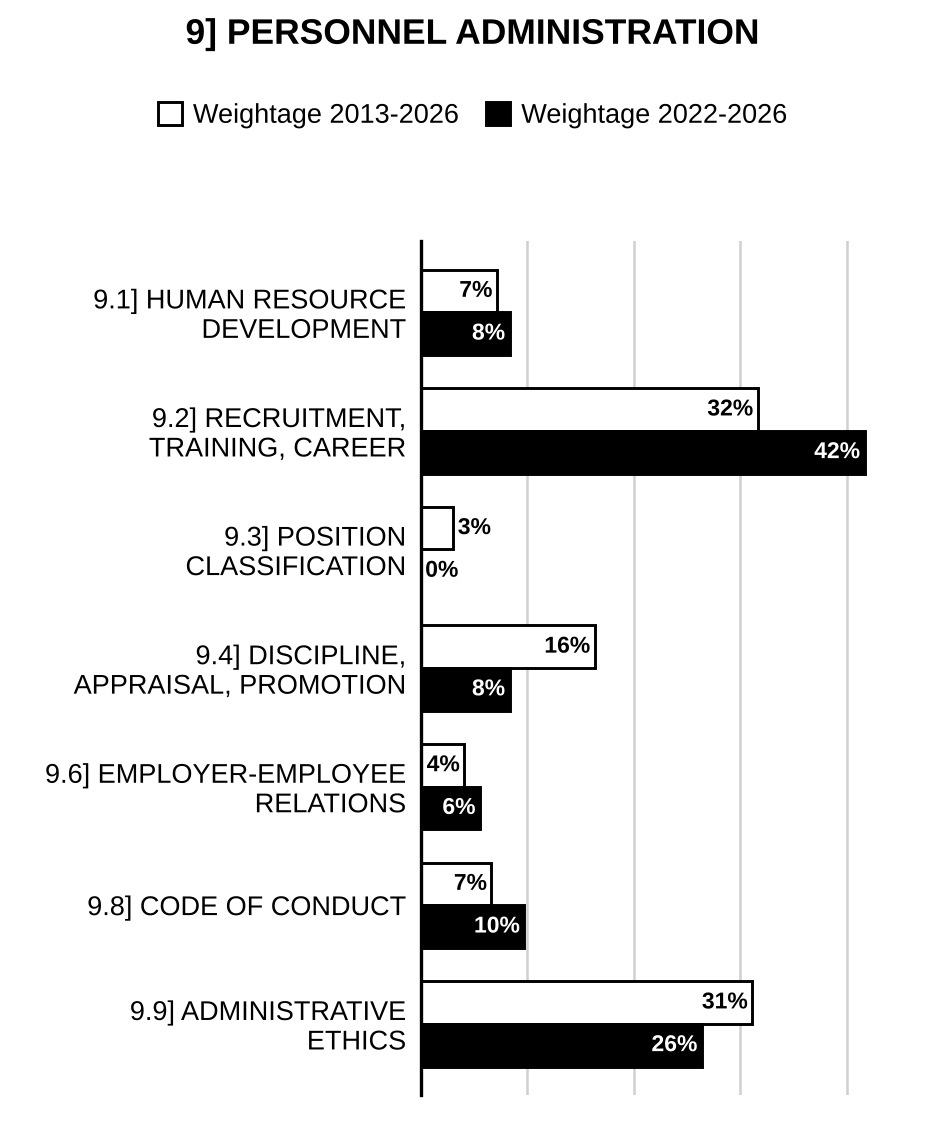
Here are all 66 Personnel Administration questions asked in UPSC Public Administration Optional Paper I from 1995 to 2026, arranged under the 8 topics of the official syllabus. Within each topic the latest questions come first.
Each question ends with a code such as [2024/15m/3b] – the year, the marks, the word limit (where UPSC set one) and the question number in the paper.
9.1] Importance of human resource development
5 questions
The environment and situational conditions under which the government operates have an important bearing on its human resource development practices. Examine. [2022/15m/6b]
“Various components of Human Resources Management are inter-related.” Discuss. [2017/20m/8a]
“To talk of administrative modernization and still continue with the conventional practice of public personnel administration is a gross incongruity.” Offer suggestions to initiate radical reforms in Human Resource Management of public administrative systems. [2008/60m/6]
To what extent has the human relations movement contributed to the knowledge and practice within the field of personnel administration? [2006/60m/7]
“Be it an occupation or a profession, Public Personnel has certainly developed a series of sub specialists and techniques that, over the years, have combined to produce an organizational subsystem that must be staffed by experts if it is to meet the standards set by Public Personnel Administration.” Explain. [1995/60m/2]
9.2] Recruitment, training and career advancement
21 questions
Affirmative action for equal opportunity is a corner-stone in recruitment to public services. Discuss it in global context. [2025/15m/6c]
Can competency mapping linked to career development incentivise civil servants commitment to effective service delivery? Elaborate. [2025/15m/7c]
“In career advancement, civil servants are necessitated to political superiors and hence the phenomenon poses the challenges to civil service neutrality.” Comment. [2023/15m/7b]
“Training is not a short affair; rather it is a step-by-step process of developing skills, habits, knowledge and aptitude.” Elucidate. [2023/15m/8c]
Performance problems are rarely caused simply by lack of training and rarely can performance be improved by training alone. Critically analyse the statement. [2022/15m/7c]
In the absence of a merit-based, fair and objective civil service a more partisan and corrupt government will emerge. Is the statement justified? Give reasons. [2019/15m/8c]
“Lateral entry is an antidote to the complacency in civil service.” Discuss. [2018/15m/6c]
Currently, administrative training focusses more on improving efficiency than on transforming the attitudes and behaviour of civil servants. What type of training will you suggest to fill this gap? Elaborate. [2018/15m/8b]
“Lateral entry of competent experts into the government will promote freshness and innovation, but it can create problems of accountability.” Discuss. [2017/15m/6b]
“Training is considered as paid holidays.” Comment. [2016/10m/150w/5a]
“The technical and multidisciplinary nature of e-government has created an interdependent relationship within government between policymakers, programme administrators and technical specialists.” Analyze in the context of generalist-specialist relationship. [2014/20m/7a]
The ‘selection model of recruitment rests on the assumption that the primary needs to be met are those of the organization.’ Examine. [2012/12m/150w/5c]
Distinguish fully between the syndicate method, role playing method, and T-Group training method in personnel management. [2010/40m/7a]
“Training has proved its incapacity to change the attitudes, behaviour and values of civil servants.” Do you agree with this statement? [2008/20m/200w/5d]
“Training is essential not only for efficiency and effectiveness but also for broadening the vision of the employees.” Substantiate. [2007/20m/200w/5b]
Recruitment is the backbone of Public Administration. Explain. [2004/20m/200w/5c]
“Training is practical education in any profession, not only to improve skills but also to develop attitudes and scheme of values necessary for effective performance.” Elaborate. [2003/20m/200w/5c]
What opportunities are available to All India Services and state services in career development? Do you agree that days of generalists in modern administrative state are numbered? [2000/60m/4]
“The Generalist will always have an edge over the specialist.” Substantiate the view. [1999/30m/3a]
“Public Personnel Administration is concerned with a number of functions.” Elaborate. Why are PROCUREMENT and DEVELOPMENT functions important? [1998/60m/4]
“It is said that the generalist rationale was part of a revealed truth. All of us should have known better, for in a world of increasing scientific and technical complexity, it has compelling inadequacies.” Discuss. [1996/60m/2]
9.3] Position classification
4 questions
“The position-classification attempts to establish a triangular relationship between duties and responsibilities, working conditions and qualification requirements.” Elucidate. [2015/15m/8b]
‘Position Classification can be problematic. A serious complaint in its practice is that it dehumanises the employee.’ Discuss. [2011/20m/200w/5c]
It is said that ‘position classification’, as originally conceived is sound in terms of its operational characteristics, but complicated and unresponsive in practice. Why is it still considered better than other models of civil service classification? [2009/60m/7]
“If positions are the raw material of classification, class is the operating unit.” Discuss. [2005/20m/200w/5b]
9.4] Discipline, performance appraisal and promotion
12 questions
Performance Management and Performance Appraisal are two distinct activities in Public Personnel Administration. Discuss. [2024/15m/7b]
Performance appraisal needs to be seen beyond the mere suitability of the official for vertical promotion. Explain. [2021/10m/150w/5c]
A more effective system of performance appraisal should acknowledge the subjective elements in it and be less obsessed with the objective criteria. Elucidate. [2019/15m/6b]
“360° performance appraisal system is a rational idea, but it involves complex and inauthentic procedures.” How can it be made foolproof? [2017/10m/150w/5d]
“A central reason for utilization of Performance Appraisal is performance improvement of the employees.” In the light of the statement, analyze the needs of Performance Appraisal in an organization. [2016/15m/7b]
“Disciplinary action may be informal and formal.” Explain and point out the provisions made in the Constitution or Statute to check the misuse of power to take disciplinary action. [2016/15m/8b]
Explain the ‘Peter Principle’ in respect of promotion policy in a hierarchical organisation. [2010/20m/6a]
Discuss in this connection the case for and against promotion based on seniority. [2010/40m/6b]
Why do public organisations evaluate employees’ performance? How can performance evaluation systems affect employees’ behaviour? How can administration effectively evaluate employees? [2005/60m/6]
What techniques the Government of India have employed to evaluate (appraise) the performance of senior level employees, i.e., Class I and Class II? Are you satisfied with these techniques? [2001/60m/7]
Comment on: In a hierarchy every employee tends to rise to his level of incompetence. [1996/20m/200w/1c]
Comment on: Public Agencies have used a number of sources and procedures for measuring Performance. [1996/20m/200w/5c]

Preparing for Prelims too?
Our UPSC Prelims Topic-wise PYQ eBook covers every Prelims question with detailed explanations, so you can see exactly where UPSC asks from.
View the BookDownload Free Sample9.5] Pay and service conditions
1 question
“The widening gap in emoluments of government employees versus the public sector corporations and private sector employees has a strong bearing on the motivation and ability to work.” Comment. [2007/60m/7]
9.6] Employer-employee relations
3 questions
“Instead of conflicting, the employer-employee relationship should be one of mutual reliance.” Explain. [2023/10m/150w/5e]
Analyse the relevance of Whitleyism in contemporary employer-employee relationship. [2015/10m/150w/5b]
Analyse the constitutional, political and operational dimensions of employer-employee relations. What are your suggestions to bring about a satisfactory relationship between them? [2002/60m/6]
9.8] Code of conduct
4 questions
Civil Servants should be allowed only to cast vote or to participate in the electoral process of the country. Examine. [2024/10m/150w/5b]
Most civil service regimes still equate ‘Public Sector Ethics’ with anti-corruption efforts. Discuss the insufficiency of Ethics-code in this background. [2022/15m/8b]
“Administrative ethics includes the code of conduct of civil servants, but goes beyond it as well.” Discuss. [2017/15m/8b]
Distinguish between ‘Codes of Conduct’ and ‘Codes of Ethics’. Justify your answer. [2015/15m/7b]
9.9] Administrative ethics
16 questions
Administrative ethics is an abstract concept, and in practice, is an unresolved dilemma between ‘what is’ and ‘what ought to be’. Comment. [2026/10m/150w/5b]
Values and ethics in civil services are shaped by global practices and trends. Explain. [2025/10m/150w/5d]
A trend to adopt innovative practices in administrative ethics is gaining ground for improving public trust in government. Discuss. [2024/20m/6a]
Most civil service regimes still equate ‘Public Sector Ethics’ with anti-corruption efforts. Discuss the insufficiency of Ethics-code in this background. [2022/15m/8b]
Civil servants generally tend to exhibit the values and ethical framework of the political executives under whom they function. Explain. [2021/15m/8c]
“Prevention of misconduct requires institutionalization of ethical values at the political and administrative levels.” Justify. [2020/10m/150w/5e]
The imperatives of administrative ethics are necessarily an antidote to “I was only obeying the orders” argument by public officials. Explain. [2019/15m/7b]
Edward Gibbon, the author of Decline and Fall of the Roman Empire remarked: “Corruption, the most infallible symptom of Constitutional liberty.” Critically examine this statement. [2018/10m/150w/5b]
“Administrative values have no value unless they are valued by all stakeholders of the governance system.” Comment. [2018/15m/6b]
“Administrative ethics includes the code of conduct of civil servants, but goes beyond it as well.” Discuss. [2017/15m/8b]
“Administrative ethics is a process of independently critiquing decision standards, based on core social values that can be discovered, within reasonable organisational boundaries that can be defined, subject to the personal and professional accountability.” (Denhardt). Explain. [2015/20m/6a]
Distinguish between ‘Codes of Conduct’ and ‘Codes of Ethics’. Justify your answer. [2015/15m/7b]
“In the globalized public administration, hierarchy creates more ethical problems than it solves ….” Comment. [2013/10m/150w/1c]
Civil Servants must be social moralists in action, living up to Paul Appleby’s dictum that ‘responsible government is ethical government’. Examine this statement in the light of good governance. [2011/30m/7a]
Briefly discuss the principles of ensuring ethics in public service as recommended in the Nolan Committee Report (1994). [2010/20m/8b]
Account for the increasing corruption in Administration. Suggest remedies to curb administrative corruption. [2003/60m/3]

Strengthen your GS papers
Our UPSC Mains Topic-wise & Year-wise PYQ eBook (2013–2026) maps every GS question to the syllabus, so you know what UPSC asks and how often.
View the BookDownload Free Sample« Previous: Development Dynamics | Next: Public Policy »
Back to: Public Administration Optional PYQs – Topic-wise | Also see: Public Administration Optional year-wise question papers
Last updated: 30 October 2026