
Here are all 64 Attitudes, Values and Interests questions asked in UPSC Psychology Optional Paper I from 1995 to 2026, arranged under the 7 topics of the official syllabus. Within each topic the latest questions come first.
Each question ends with a code such as [2024/15m/3b] – the year, the marks, the word limit (where UPSC set one) and the question number in the paper.
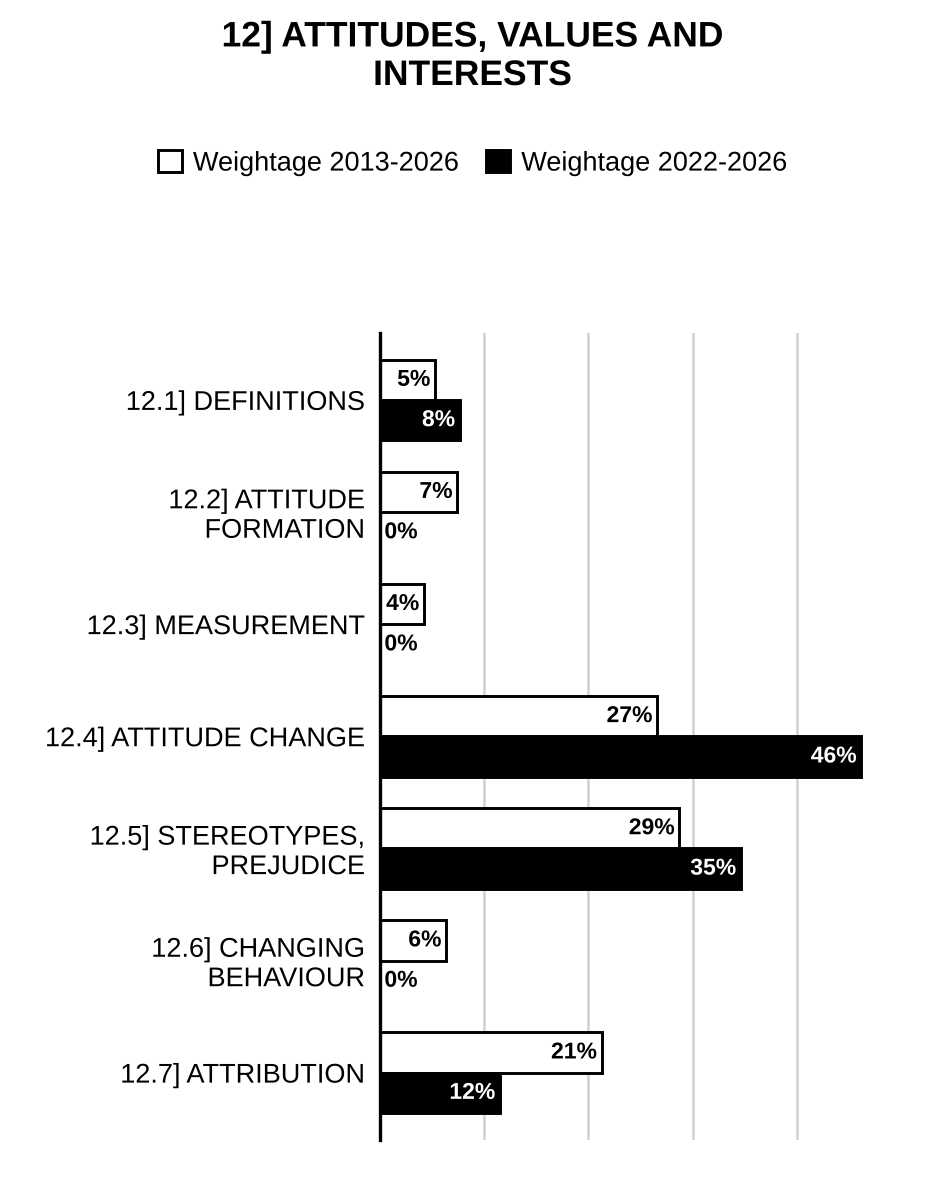
12.1] Definitions of attitudes, values and interests
7 questions
Discuss the nature and functions of attitudes and values with reference to development of human behaviour. Suggest relevant strategies for attitude change and development. [2026/20m/7a]
Discuss the significance and correlates of values. Comment on the impact of social media on values. [2018/15m/7c]
Trace the common linkages between interests and values. Describe the factor analytical studies of the structure of interests and values. Also delineate upon those strategies that ought to be adopted for fostering values in the Indian socio-cultural milieu. [2006/60m/8]
Discuss the significance of attitudes, interests and values in human life. Explain the usefulness of different procedures of attitude measurement. [2004/60m/6]
How do one’s values motivate his behaviour? Illustrate your answer. [1998/20m/200w/5b]
In terms of motivational properties how would you rank attitudes and values? [1997/60m/6]
How do values motivate human beings? Answer giving suitable examples from research. [1996/20m/200w/5a]
12.2] Components, formation and maintenance of attitudes
7 questions
A young person helped a visually impaired woman to cross the road. He explained his action saying that he has positive attitude towards such persons. Did his attitude determine his behaviour or the behaviour determine his attitude. Explain. [2017/20m/6b]
Explain the components of attitude and examine the methods of attitude formation. [2016/15m/6a]
Discuss A-B-C components of attitude. Describe the procedure of development of a tool for measurement of attitude. [2012/30m/400w/7b]
Discuss nature, formation and measurement of attitude. Can attitude be changed? Substantiate your answer citing research finding. [2009/60m/8]
Do attitudes influence behaviour? If yes, when and how? Give your answer in the light of relevant research studies. [2007/60m/6]
How attitudes are formed? Discuss its various components. [2003/60m/7]
Citing experimental evidences discuss how social learning, social comparison and genetic factors influence formation of attitudes. Also explain how trivialisation reduces cognitive dissonance. [2001/60m/8]
12.3] Measurement of attitudes, values and interests
7 questions
Discuss in detail about different attitude rating scales. How can we measure intergroup prejudice among students in the class using Likert scale and how can their behaviour be rectified through moral education? [2020/20m/8a]
Discuss A-B-C components of attitude. Describe the procedure of development of a tool for measurement of attitude. [2012/30m/400w/7b]
Describe different psychological measures of values and outline a programme for fostering values among school-going children. [2011/30m/8b]
Distinguish between aptitude and interest and describe methods of their measurement. [2007/20m/200w/5b]
Discuss the significance of attitudes, interests and values in human life. Explain the usefulness of different procedures of attitude measurement. [2004/60m/6]
Describe in detail the Thurstone’s method of scale-construction. [2002/20m/200w/5d]
Discuss the problems encountered in the use of verbal statements as the items of attitude scales. [2000/60m/8]

Preparing for Prelims too?
Our UPSC Prelims Topic-wise PYQ eBook covers every Prelims question with detailed explanations, so you can see exactly where UPSC asks from.
View the BookDownload Free Sample12.4] Theories of attitude change; strategies for fostering values
19 questions
Discuss the nature and functions of attitudes and values with reference to development of human behaviour. Suggest relevant strategies for attitude change and development. [2026/20m/7a]
Why do human beings form attitudes and prejudices? Discuss the role of psychosocial factors in bringing the change in them, in the present Indian socio-cultural context. [2025/20m/8a]
Is cognitive dissonance effective in changing attitude? Discuss in the light of research evidence. [2024/10m/150w/5e]
What are values? What strategies can be used in fostering value of equality in early childhood? Discuss. [2022/10m/150w/1b]
Explain the nature of human attitudes. How is the knowledge of attitude change process helpful in bringing religious harmony in the Indian context? Discuss. [2022/20m/6a]
Suggest some strategies for fostering values in Indian settings. [2020/10m/150w/1e]
Illustrate that values can best be fostered during childhood. Discuss different methods for fostering moral and ethical values among school-going children. [2019/15m/4c]
In what way can dissonance be an effective means for changing attitudes and behaviour? [2018/10m/150w/5d]
Discuss cognitive dissonance theory of attitude change. [2016/10m/150w/5c]
What makes a persuasive attempt effective? Discuss. [2013/20m/250w/8b]
Describe different psychological measures of values and outline a programme for fostering values among school-going children. [2011/30m/8b]
What is likely to happen if a person is asked to behave in a manner contrary to the attitude the person holds? Explain on the basis of a theory. [2010/10m/100w/5f]
Discuss nature, formation and measurement of attitude. Can attitude be changed? Substantiate your answer citing research finding. [2009/60m/8]
What is effective communication? Discuss the role of message and communicator variables in ensuring effective persuasive communication. [2007/60m/7]
Trace the common linkages between interests and values. Describe the factor analytical studies of the structure of interests and values. Also delineate upon those strategies that ought to be adopted for fostering values in the Indian socio-cultural milieu. [2006/60m/8]
Citing experimental studies, discuss cognitive-dissonance theory of attitude change. [2005/60m/7]
Citing experimental evidences discuss how social learning, social comparison and genetic factors influence formation of attitudes. Also explain how trivialisation reduces cognitive dissonance. [2001/60m/8]
Can attitudes be changed? Discuss the factors to be considered in changing attitudes. [1999/20m/200w/5d]
What are attitudes? Can they be changed? Explain the characteristics of the source of message which strongly affect one’s response to any attempt at changing attitudes. [1995/60m/8]
12.5] Formation of stereotypes and prejudices
10 questions
Examine the role of causal attribution in the formation of prejudice and discrimination. [2026/10m/150w/5c]
Why do human beings form attitudes and prejudices? Discuss the role of psychosocial factors in bringing the change in them, in the present Indian socio-cultural context. [2025/20m/8a]
What advice would you give to a civil servant to reduce prejudice and discrimination in Indian society? Discuss. [2024/15m/8c]
Discuss formation of stereotypes and prejudices with the help of suitable examples. [2023/15m/6b]
While playing cricket, Team-A got into fight with Team-B. Discuss it in the context of ‘realistic group conflict theory’. How can conflict resolution strategies be used to manage and control such fights? [2020/20m/4a]
“Stereotypes can lead to the development of prejudice and discrimination.” Explain citing examples from Indian context. [2019/10m/150w/5c]
“Children are not born with stereotypes; they learn them from their family, peers, media and society.” — Discuss. [2015/20m/8a]
Discuss the roots of gender-related prejudice in the Indian society. Why is it so resistant? [2014/15m/8b]
What is the role of social categorization in the formation of prejudice? Suggest some strategies to reduce prejudice. [2013/25m/400w/7a]
Khap Panchayats have been in the news recently because of their opposition to same-‘gotra’ marriages. What psychological constructs would explain their behaviour? [2010/30m/6b]
12.6] Changing other’s behaviour
4 questions
Why do some people behave aggressively towards those who defy social norms? How can such aggressive behaviours be changed? [2017/15m/7c]
What psychological techniques can be used to enhance cleanliness in public places? [2014/15m/2b]
You are the head of an office in which employees habitually come late and leave early. Suggest a behaviour modification plan for such employees. [2010/20m/2b]
Which model of man is most suited and relevant to behaviour modification? [1999/20m/200w/5a]
12.7] Theories of attribution
10 questions
Examine the role of causal attribution in the formation of prejudice and discrimination. [2026/10m/150w/5c]
Do attribution processes explain success and failure behaviour in social context? Answer this in the light of Weiner’s model of attribution. [2025/10m/150w/1c]
Humans strive to assign causes to actions of self and others and fall into traps of biases and errors. Critically discuss. [2021/20m/8a]
Explain the concepts of self-serving bias and fundamental attribution error. How do they affect problem solving? [2018/15m/8b]
People emphasize the personal traits more than the situational factors. Evaluate the statement. [2017/15m/8c]
What is meant by attribution? Describe, citing examples, the phenomenon of attributional augmentation. [2016/10m/150w/5e]
Is self-serving bias universal in attribution process? Comment. [2014/10m/150w/5e]
Explain correspondence bias. Is it universal or culturally variable? [2013/15m/250w/6c]
Describe pattern of attribution that are used by persons in supporting their interaction. [2008/20m/200w/5c]
Is person perception a critical variable in human interaction? Illustrate your answer. [1998/20m/200w/1b]

Strengthen your GS papers
Our UPSC Mains Topic-wise & Year-wise PYQ eBook (2013–2026) maps every GS question to the syllabus, so you know what UPSC asks and how often.
View the BookDownload Free Sample« Previous: Personality | Next: Language and Communication »
Back to: Psychology Optional PYQs – Topic-wise | Also see: Psychology Optional year-wise question papers
Last updated: 30 October 2026