
Here are all 53 Personality questions asked in UPSC Psychology Optional Paper I from 1995 to 2026, arranged under the 5 topics of the official syllabus. Within each topic the latest questions come first.
Each question ends with a code such as [2024/15m/3b] – the year, the marks, the word limit (where UPSC set one) and the question number in the paper.
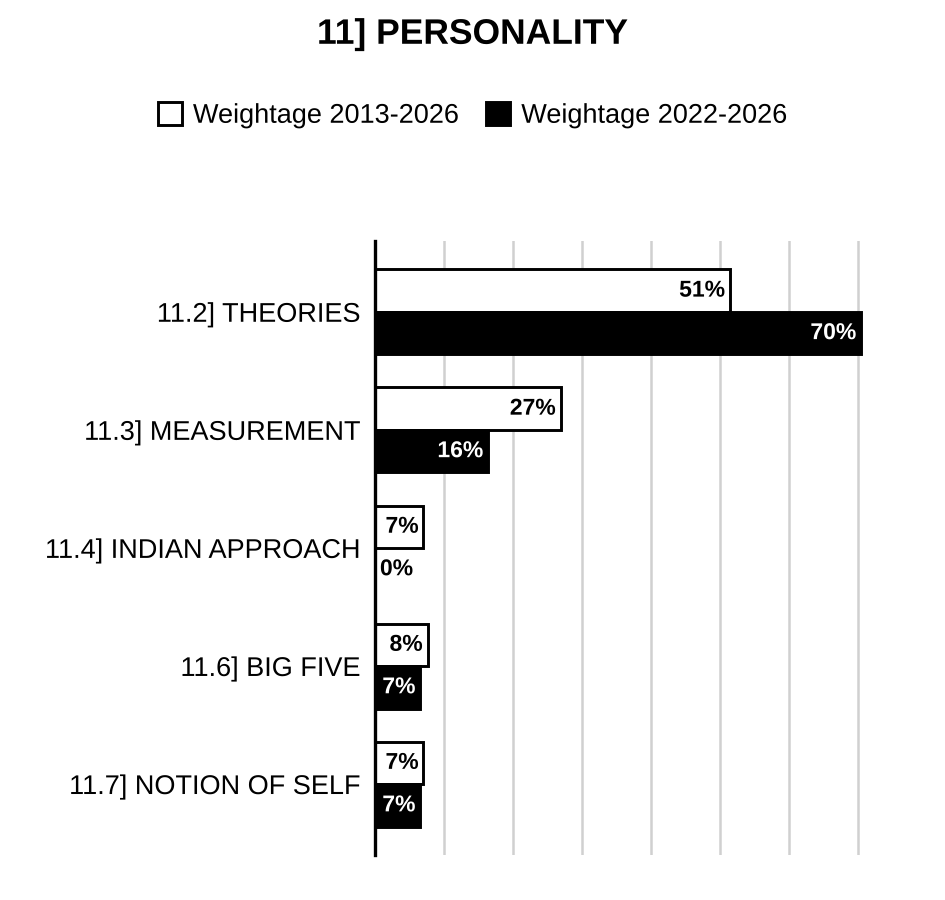
11.2] Theories of personality: psychoanalytical, socio-cultural, interpersonal, developmental, humanistic, behaviouristic, trait and type
25 questions
What do you mean by defense mechanism? Distinguish between healthy and unhealthy defense mechanisms. Explain how it influences personality of an individual. [2026/20m/6a]
“Personality is all in our genes.” Evaluate the statement in the context of different personality theories. [2025/20m/2a]
When psychologists label their perspective ‘humanistic’, what does this term mean to you? What is its relevance in the modern era? [2025/15m/2b]
Describe the biological and socio-cultural determinants of personality. Illustrate your answer with the help of Indian studies. [2024/10m/150w/5d]
Distinguish between psychoanalytic and humanistic approaches to personality. Discuss in detail the recent developments in the applications of these approaches. [2024/20m/7a]
Do childhood experiences affect us in our entire lives? — Elaborate your answer in the light of personality theories. [2023/20m/8a]
Can human beings be fully functioning and self-actualized? Evaluate it from humanistic and psychoanalytic perspectives of personality. [2022/20m/4a]
Are we born with personality? Critically evaluate with theoretical interpretation. [2021/20m/6a]
Differentiate between Erikson’s psychosocial and Freudian psychosexual theories. Also explain different virtues attached to each stage of psychosocial theory. [2020/20m/6a]
How is NEO Five-Factor Theory different from 16 Personality Factors Theory? Explain. [2019/15m/4b]
Compare the trait perspective and humanistic perspective on personality. [2018/20m/6a]
How do we explain self-defeating behaviour of a person from the Humanistic perspective? [2017/15m/8b]
Describe the trait and type approaches to personality. Highlight Jung’s typology with its weaknesses. [2015/20m/7a]
Briefly discuss the evolution of psychoanalytic theory as reflected in the works of Fromm, Erikson and Sudhir Kakar. [2014/20m/7a]
What is the situationalist critique of trait psychology? [2013/10m/150w/5a]
Give a comparative account of ‘Self’ as conceived by Adler and Rogers. [2008/60m/6]
The scientific theories of traits have an intuitive appeal because their basic unit of analysis, personality traits, are very similar to simple nonscientific folk understandings of personality. Critically evaluate this statement in the light of theoretical developments in the trait approach of personality. [2007/60m/8]
What is personality? Discuss Freudian approach to personality. [2005/20m/200w/5a]
State the trait and type approaches to personality. Is there a reconciliation in the two in Eysenckian approach? [2004/20m/200w/5c]
Is personality consistent? Give your answer with the support of relevant studies. [2003/20m/200w/5a]
Elucidate Rogers’ concept of a ‘fully functioning person’. Indicate the importance of self-concept and anxiety in his account of human personality. [2002/60m/8]
Critically examine the optimistic conclusions of humanistic theories regarding human nature and existence. [2000/60m/7]
Elucidate Freud’s conceptualization of human personality. Discuss its implications for counselling therapy. [1999/60m/7]
Is there any relation between process of socialization and the social learning theories of personality? [1997/60m/3]
Factorial approach to the study of personality. [1995/20m/200w/5a]
11.3] Measurement of personality: projective tests, pencil-paper tests
14 questions
Distinguish between projective tests and psychometric tests of personality along with their advantages and disadvantages. [2026/15m/8b]
What hypothetical ideas lead to the development of projective personality tests? [2023/10m/150w/5d]
What are the major features do clinicians use to interpret Rorschach responses? [2020/10m/150w/1a]
Describe different personality assessment techniques and also highlight their strengths and weaknesses. [2020/20m/7a]
Critically evaluate the uses of paper-pencil tests in personality assessment. [2019/15m/8c]
Can we do justice to measuring personality by projective and objective tests? Discuss. [2017/20m/7b]
Are projective tests really projective in nature? Describe Rorschach and TAT tests and comment on their reliabilities. [2016/15m/6c]
Highlight the problems in assessment of personality using the pencil-paper tests. [2015/10m/150w/5c]
What is the essence of a projective technique? Critically evaluate perceptive, apperceptive and productive projective tests in the measurement of personality. [2012/30m/400w/7a]
Critically evaluate the relative merits and demerits of psychometric measures of personality and intelligence. [2009/60m/7]
What are the key assumptions of projective tests? Indicate the problems encountered in determining their reliability and validity. [2007/20m/200w/5c]
Do the projective techniques of personality assessment have an edge over psychometric tests? Cite experimental evidences in this context. [1998/60m/7]
Explain the rationale in using perception as a medium for studying personality. Cite major findings of research in this area. [1996/60m/3]
Briefly describe various projective measures of personality. Evaluate each of them. [1996/60m/7]

Preparing for Prelims too?
Our UPSC Prelims Topic-wise PYQ eBook covers every Prelims question with detailed explanations, so you can see exactly where UPSC asks from.
View the BookDownload Free Sample11.4] The Indian approach to personality
3 questions
Discuss the Indian approach to personality as evident in tri-gunas. [2016/15m/8b]
Describe the Indian approach to personality as reflected in the principle of three Gunas. [2013/15m/250w/8c]
Can you relate the ‘Guna’ theory of personality with any Western model of personality? [1997/20m/200w/5b]
11.6] Latest approaches like big 5 factor theory
4 questions
Do we need 16 factors to describe human personality? Illustrate your answer in the light of big five-factor theory of personality. [2022/10m/150w/5c]
How is NEO Five-Factor Theory different from 16 Personality Factors Theory? Explain. [2019/15m/4b]
State the components of Big-5 factor theory of personality. Why is it considered superior to other factor theories of personality? [2015/15m/8c]
What are the ‘big five’ personality factors? Critically examine their conceptual basis. [2010/30m/6a]
11.7] The notion of self in different traditions
7 questions
Discuss how the narrative approach to personality hinges on answering the question, ‘Who am I?’ [2025/10m/150w/5d]
How is self related to culture? Discuss in the light of studies on self-construal and individualism-collectivism. [2014/20m/6a]
How is the information we hold about ourselves organized and interpreted? [2011/10m/100w/5d]
Compare the Indian and western constructions of ‘Self’ with reference to cross-cultural studies and bring out their implication for well-being. [2011/30m/7b]
Give a comparative account of ‘Self’ as conceived by Adler and Rogers. [2008/60m/6]
Describe the process of emergence of self-concept during late childhood. Citing suitable illustrations from Indian social milieu explain the impact of child rearing practices on the emergence of self-concept. [2001/60m/2]
Is it necessary to conceptualize self as a determinant of behaviour besides heredity and environment? Give real life examples to support your contention. [1999/20m/200w/1b]

Strengthen your GS papers
Our UPSC Mains Topic-wise & Year-wise PYQ eBook (2013–2026) maps every GS question to the syllabus, so you know what UPSC asks and how often.
View the BookDownload Free Sample« Previous: Intelligence and Aptitude | Next: Attitudes, Values and Interests »
Back to: Psychology Optional PYQs – Topic-wise | Also see: Psychology Optional year-wise question papers
Last updated: 30 October 2026