
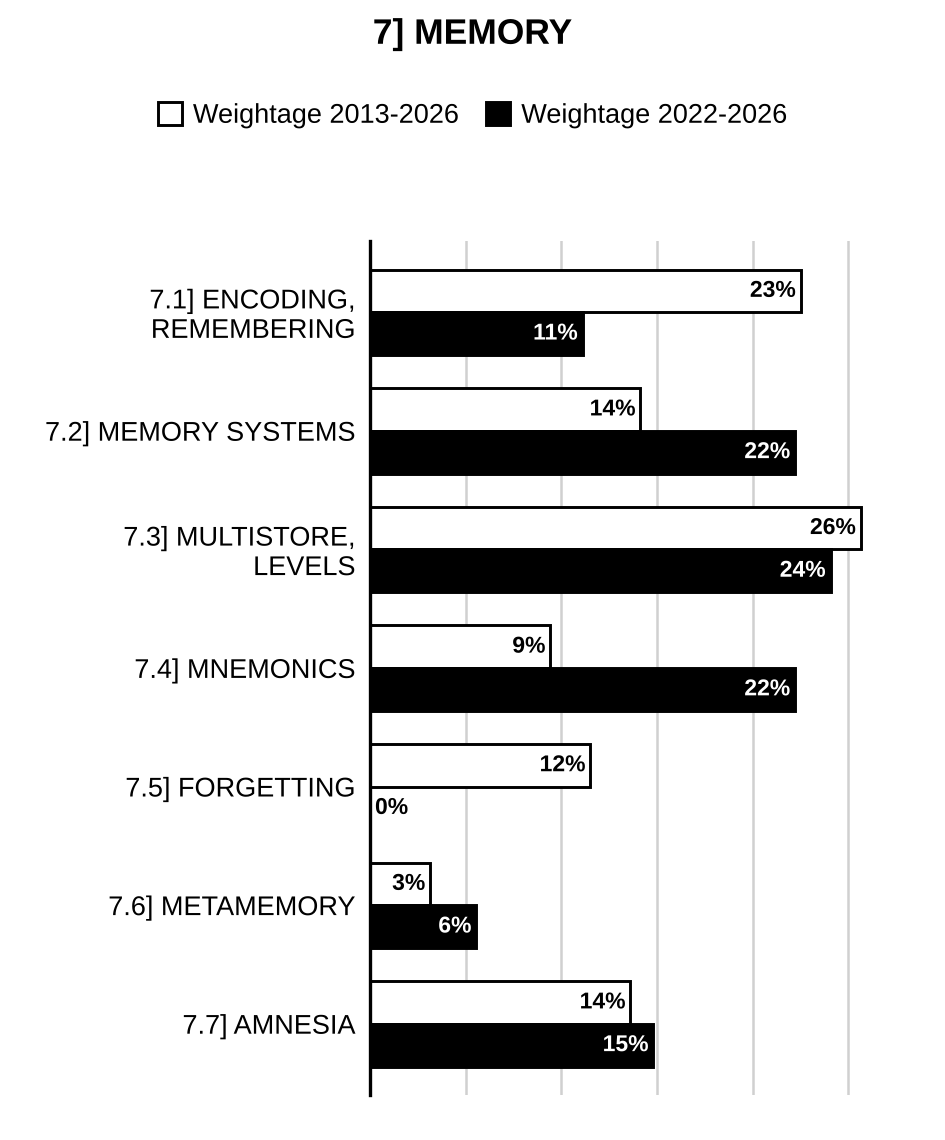
Here are all 65 Memory questions asked in UPSC Psychology Optional Paper I from 1995 to 2026, arranged under the 7 topics of the official syllabus. Within each topic the latest questions come first.
Each question ends with a code such as [2024/15m/3b] – the year, the marks, the word limit (where UPSC set one) and the question number in the paper.
7.1] Encoding and remembering
12 questions
Is reconstructed memory accurate? Describe the process of reconstruction, citing research evidence. [2024/15m/3c]
Comment on: With reference to the concept of memory construction evaluate the accuracy of eyewitness testimony in judicial trial. [2021/10m/150w/1e]
How does prior knowledge shape encoding in memory? [2020/10m/150w/1b]
“Human memory is not like information stored in a tape recorder or compact disc.” Critically evaluate the statement. [2018/10m/150w/1b]
Demonstrate the importance of the shallow and deep levels of processing in remembering. With the help of daily life examples, explain how retrieval cues enable us to remember. [2018/15m/2c]
Explain the role of meaningfulness and emotional arousal in encoding. Discuss the implications of encoding specificity principle. [2017/15m/4b]
How far do you agree with the contention that research findings on infant memory can present novel approaches toward analyzing adult memories? Corroborate your answer with examples. [2015/15m/3b]
What is the role of constructive and reconstructive processes in human memory? Explain. [2014/15m/4c]
What factors contribute to the encoding of information into LTM? [2013/10m/150w/1c]
How the principles of encoding help enhancing the use of mnemonic devices? [2011/10m/100w/1d]
How would you process information for maintaining it for long-term usage? [2010/10m/100w/1d]
Explain the basic processes involved in remembering and also highlight the phenomenon which may occur when any one of the basic processes fails to operate properly. [2003/20m/200w/1b]
7.2] Short-term, long-term, sensory, iconic and echoic memory
12 questions
How do the ‘leaky bucket’ and ‘working memory’ approaches differ in their explanation of the short-term memory? [2026/10m/150w/1e]
Discuss various types of long-term memory. Explain how primacy and recency effect illustrate the serial position effect in transferring information from short-term memory to long-term memory. [2026/20m/3a]
Citing research evidence, explain the components of working memory. [2024/10m/150w/5a]
Describe 3-stage model of memory with special emphasis on working memory. [2020/15m/3c]
Explain the phenomena of implicit and explicit memories. Also critically evaluate Tulving’s model of long-term memory. [2016/20m/4c]
Citing studies on amnesia show how the explicit and implicit memory systems are separate. [2015/20m/2b]
Compare Sperling’s experiments with that of Neisser’s experiments in the study of sensory memory. What did these two experiments prove? [2012/20m/250w/2b]
On what grounds are STM and LTM distinguished? [2011/10m/100w/1c]
Prepare an experimental design following Sperling’s technique to study iconic memory. What does the experiment prove? [2009/30m/2b]
What is meant by ‘echoic memory’? How long does this memory last? Discuss with experimental evidence. [2008/20m/200w/5a]
Critically evaluate the efficacy of multi store and multi componential models of memory in the light of relevant experimental evidence. [2007/60m/3]
How far is it correct to state that working memory presents the most complete description of a multicomponent nature of the Short-term memory? Describe the components of working memory with suitable examples. [2006/60m/4]
7.3] The multistore model and levels of processing
16 questions
Discuss various types of long-term memory. Explain how primacy and recency effect illustrate the serial position effect in transferring information from short-term memory to long-term memory. [2026/20m/3a]
Differentiate between the processes of memory and forgetting. Also, discuss multistore model and meta-memory as innovations in the study of memory. [2024/15m/4c]
Discuss the levels of processing model and highlight its relevance for explaining individual differences in memory. [2022/15m/4c]
Describe 3-stage model of memory with special emphasis on working memory. [2020/15m/3c]
“Multistore model of memory best explains the nature of memory.” Evaluate the statement in theoretical perspective and empirical evidences. [2019/20m/2a]
Demonstrate the importance of the shallow and deep levels of processing in remembering. With the help of daily life examples, explain how retrieval cues enable us to remember. [2018/15m/2c]
Explain the differences in information processing at various levels of memory. In what way is recall affected by initial processing of information? [2017/15m/4c]
Distinguish between single-process theory and dual-process theory of short-term memory. [2014/20m/2a]
Describe and evaluate the modal model of short-term memory. [2013/20m/250w/4b]
What is McCrary-Hunter ‘invariance hypothesis’? Discuss the shape and characteristics of serial position error curve in terms of ‘invariance hypothesis’. [2012/20m/250w/4a]
How does level of processing model differ from multistore and working memory models? Explain. [2011/30m/3b]
Discuss the levels of processing framework of memory and the relevant supporting research evidence. [2010/30m/4b]
The level at which an information is processed has a bearing on recall of that particular information. Discuss in the light of experimental studies. [2008/20m/200w/1c]
Critically evaluate the efficacy of multi store and multi componential models of memory in the light of relevant experimental evidence. [2007/60m/3]
Present a critical appraisal of stage versus process models of memory and citing suitable studies show how elaborative processing and self-generation improve memory. [2001/60m/4]
Discuss the information-processing approach to the study of memory. How does it differ from other approaches? Describe the three interacting systems of memory implied in the approach. [1996/60m/4]

Preparing for Prelims too?
Our UPSC Prelims Topic-wise PYQ eBook covers every Prelims question with detailed explanations, so you can see exactly where UPSC asks from.
View the BookDownload Free Sample7.4] Organization and mnemonic techniques to improve memory
5 questions
Describe some major strategies for memory retention and explain each one with relevant examples. [2025/15m/8c]
How can the memory be improved with the help of organization and mnemonic techniques? [2023/15m/8b]
Describe the role of schemas and mnemonic devices in expertise and exceptional memory. [2021/15m/4c]
How the principles of encoding help enhancing the use of mnemonic devices? [2011/10m/100w/1d]
Can human memory be improved? If yes, what techniques would you recommend? Explain how each technique proposed by you can bring about improvement in memory. [2002/60m/3]
7.5] Theories of forgetting: decay, interference and retrieval failure
9 questions
Repression is a motivated forgetting process that protects us by inhibiting anxiety-arousing memories. Explain its role in dissociative amnesia. [2020/15m/6c]
Is amnesia merely a phenomenon of retrieval failure? Discuss in the light of empirical evidences. [2019/15m/8b]
Why do we forget? Differentiate between anterograde and retrograde amnesia. [2017/20m/2a]
Give a critical appraisal of interference theory of forgetting and show how the process of retrieval inhibition influences forgetting. [2016/20m/3a]
Bring out the disruption in retrieval processes due to anxiety, context and repression. [2015/10m/150w/1e]
Discuss the role of repression and interference in forgetting. [2007/20m/200w/1c]
What is Reminiscence? Discuss this phenomenon in terms of interference processes. [1999/20m/200w/1a]
What role does extinction play in long-term-memory? [1997/20m/200w/1d]
Is reminiscence a fact or a misnomer? Answer with relevant findings in support. [1995/20m/200w/1c]
7.6] Metamemory
2 questions
Differentiate between the processes of memory and forgetting. Also, discuss multistore model and meta-memory as innovations in the study of memory. [2024/15m/4c]
Differentiate between metamemory and self-instructional learning. Elaborate your answer with suitable examples. [2020/15m/2b]
7.7] Amnesia: anterograde and retrograde
9 questions
Can amnesia patients recall emotional events? Explain your answer citing research evidence. [2025/10m/150w/5c]
Discuss the techniques to assess patients with memory disorders. [2022/10m/150w/5d]
Repression is a motivated forgetting process that protects us by inhibiting anxiety-arousing memories. Explain its role in dissociative amnesia. [2020/15m/6c]
Is amnesia merely a phenomenon of retrieval failure? Discuss in the light of empirical evidences. [2019/15m/8b]
Why do we forget? Differentiate between anterograde and retrograde amnesia. [2017/20m/2a]
What do you understand by amnesia? Illustrate the types of amnesia with reference to the case of “H.M.’s brain operation”. [2016/10m/150w/1e]
Citing studies on amnesia show how the explicit and implicit memory systems are separate. [2015/20m/2b]
Explain anterograde amnesia with special reference to the classical case of HM. [2010/10m/100w/5d]
Representational knowledge can be investigated neurocognitively through the studies of amnesia. Elaborate this statement. [2008/60m/8]

Strengthen your GS papers
Our UPSC Mains Topic-wise & Year-wise PYQ eBook (2013–2026) maps every GS question to the syllabus, so you know what UPSC asks and how often.
View the BookDownload Free Sample« Previous: Learning | Next: Thinking and Problem Solving »
Back to: Psychology Optional PYQs – Topic-wise | Also see: Psychology Optional year-wise question papers
Last updated: 30 October 2026