
Here are all 60 Learning questions asked in UPSC Psychology Optional Paper I from 1995 to 2026, arranged under the 6 topics of the official syllabus. Within each topic the latest questions come first.
Each question ends with a code such as [2024/15m/3b] – the year, the marks, the word limit (where UPSC set one) and the question number in the paper.
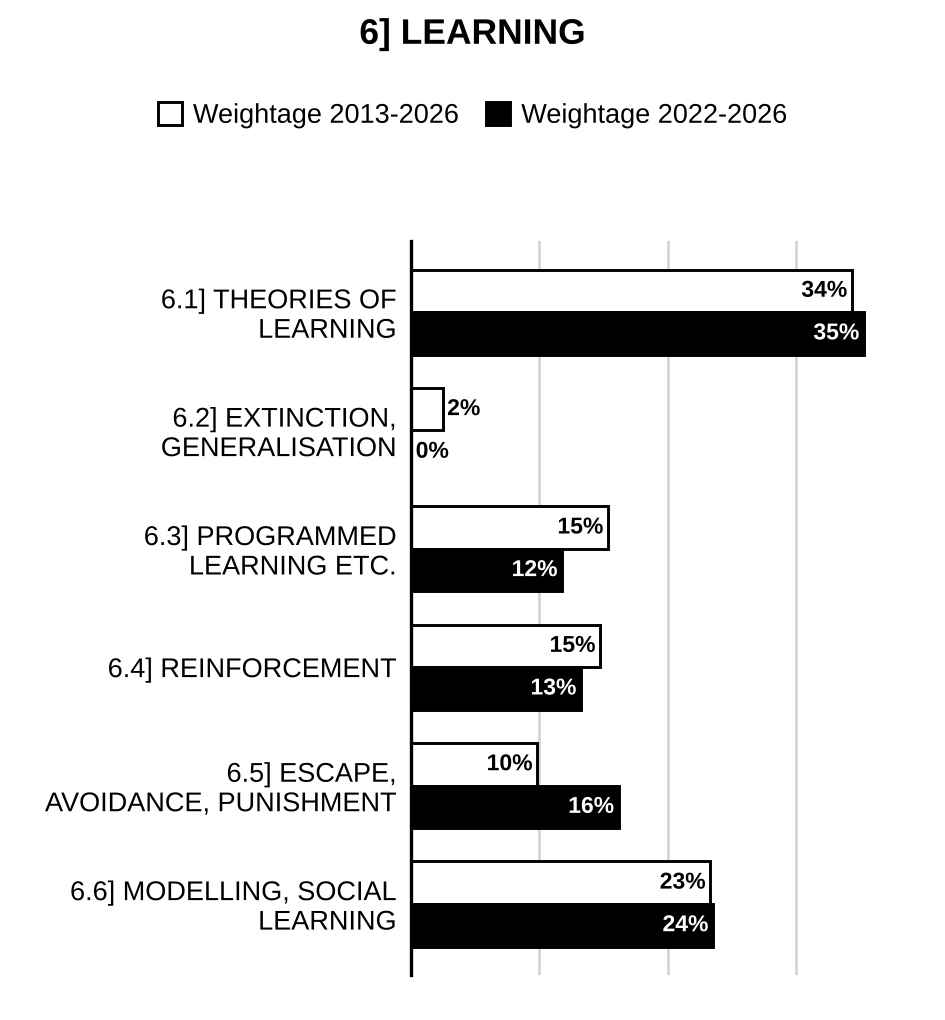
6.1] Concepts and theories of learning: behaviourist, Gestaltist and information processing models
17 questions
Explain how learning takes place through classical conditioning. Discuss the role of reflexive behaviour and contingency in the acquisition of conditioned behaviour. [2026/20m/4a]
How do the principles of classical conditioning help in the formation of likes and preferences? Discuss. [2024/10m/150w/1e]
Differentiate between classical and operant conditioning. Discuss their applications with suitable examples. [2024/20m/4a]
Your relative is going through chemotherapy. How your knowledge about learning theories will be helpful? [2023/10m/150w/1d]
Describe the principles of classical conditioning. Illustrate the application of classical conditioning principles in real life. [2021/15m/3b]
“Any sort of learning takes place with the help of suitable associations and reinforcement.” Critically examine that how much cognitivists, Gestaltists and evolutionary psychologists agree with the statement. [2020/15m/4c]
How would you apply Operant Conditioning technique for toilet training to a 3-year-old boy? [2017/15m/2c]
Drug-addiction is just a maladaptive behaviour. Like other behaviour, it can be easily changed. Discuss. [2017/10m/150w/5c]
Show your acquaintance with the cognitive approach to classical conditioning and describe how classical conditioning principles can be used to solve everyday problems. [2016/20m/2c]
Distinguish between ‘social learning’ and ‘conditioning’. [2014/10m/150w/1a]
What do you mean by S-R and S-S conditioning? Discuss the question with the help of relevant experimental evidences. [2007/60m/4]
Explain the nature of ‘operant conditioning’. Evaluate its various uses in shaping human behaviour. [2004/60m/4]
Differentiate between learning and training. Discuss Pavlovian learning theory with the help of experimental evidence. [2003/60m/2]
Explain how operant conditioning be used to establish behaviour which is not spontaneously emitted by an organism. [2000/60m/2]
Describe, in brief, the typical classical and operant conditioning experiments. Comment on the nature of reinforcement in the two. Are they basically different? [1999/60m/4]
Can we sustain the statement that much of our behaviour is the result of classical and operant conditioning? [1998/60m/4]
Give an adequate description of the classical and the operant conditioning situations and compare them with respect to the nature of reinforcement and the kind of responses that are learned. [1995/60m/4]
6.2] Extinction, discrimination and generalisation
3 questions
“Discrimination and generalization are two complementary processes in skill learning.” Discuss with reference to operant conditioning. [2019/10m/150w/5b]
What is the importance of discrimination and generalization in learning? [2000/20m/200w/5b]
What is the relation between Discrimination learning and Generalization? [1997/20m/200w/1c]
6.3] Programmed learning, probability learning, self instructional learning
9 questions
Compare and contrast between programmed and probability learning and also highlight their advantages and disadvantages. [2023/20m/4a]
Differentiate between metamemory and self-instructional learning. Elaborate your answer with suitable examples. [2020/15m/2b]
Examine how probability learning is different from other types of learning. Give examples. [2018/10m/150w/1e]
Evaluate the notion of programmed learning and describe its relevance for modern day education with suitable examples. [2015/10m/150w/1d]
What are the distinctive features of probability learning? How useful is it in real life? [2014/15m/3b]
Discuss various characteristics of probability learning. Prepare an experimental design of probability learning following ‘Bernoulli Sequence’. When is the behaviour of the subject labeled as ‘gambler’s fallacy’? [2009/60m/4]
Using the procedure of programmed learning, how would you conduct ‘anger-reduction’ training for a group of individuals who have been assessed high on anger? The training procedure needs to be as per the instructional design model. [2008/60m/4]
Delineate the principles involved in programmed learning. Is it feasible to programme higher form of learning? [1998/20m/200w/1c]
Nature of and theory underlying programmed learning and its implications for teaching. [1996/20m/200w/1b]

Preparing for Prelims too?
Our UPSC Prelims Topic-wise PYQ eBook covers every Prelims question with detailed explanations, so you can see exactly where UPSC asks from.
View the BookDownload Free Sample6.4] Reinforcement: concepts, types and schedules
11 questions
“Negative reinforcement and punishment are different.” Justify your point of view with relevant examples. [2026/10m/150w/1d]
Reward and punishment sometimes fail to effectively change behaviour. Explain with relevant examples. [2025/15m/7c]
How can parents use reinforcement contingencies to manage their children’s aggressive behaviour? [2022/10m/150w/1d]
Differentiate between positive and negative types of reinforcement and punishment. Describe how these could be applied to enforce putting on the seat belts while driving. [2018/15m/3b]
Distinguish between negative reinforcement and punishment. Do you think punishment is an effective way to modify behaviour? [2017/10m/150w/1b]
How far do you agree with the contention that a more preferred activity can be used to reinforce a less preferred activity? Also describe the types of reinforcement. [2016/15m/4b]
Describe different reinforcement schedules and indicate their effects on the strength of learning. [2013/10m/150w/1e]
Comment on: With suitable examples, critically evaluate both primary and secondary reinforcements and bring out their role in establishing conditioning. [2012/20m/250w/2c]
Distinguish between negative reinforcement and punishment. Indicate the limitations of punishment in the context of learning. [2011/10m/100w/1e]
You are the head of an office in which employees habitually come late and leave early. Suggest a behaviour modification plan for such employees. [2010/20m/2b]
Comment on the impact of immediate and delayed reinforcement on learning. [2010/10m/2d]
6.5] Escape, avoidance and punishment
7 questions
“Negative reinforcement and punishment are different.” Justify your point of view with relevant examples. [2026/10m/150w/1d]
Reward and punishment sometimes fail to effectively change behaviour. Explain with relevant examples. [2025/15m/7c]
Does punishment work in all situations? Discuss the pros and cons of punishment. [2024/15m/3b]
Differentiate between positive and negative types of reinforcement and punishment. Describe how these could be applied to enforce putting on the seat belts while driving. [2018/15m/3b]
Distinguish between negative reinforcement and punishment. Do you think punishment is an effective way to modify behaviour? [2017/10m/150w/1b]
Distinguish between negative reinforcement and punishment. Indicate the limitations of punishment in the context of learning. [2011/10m/100w/1e]
Discuss the consequences of learned helplessness as demonstrated in classic experiment on dogs. Find out its parallels in real life. [2011/20m/2b]
6.6] Modelling and social learning
13 questions
Describe social cognitive theory and its applications to solve large scale societal problems. [2025/20m/4a]
“Learning occurs not only through conditioning but also from our observations of others.” Discuss this statement from children’s point of view. What are the pros and cons of observational learning for children? [2022/20m/8a]
What is self-efficacy? Discuss the potential benefits of enhancing self-efficacy. [2021/10m/150w/5c]
What is vicarious learning? Discuss its applications in acquisition of emotional responses. [2019/15m/6c]
According to Bandura, human beings often demonstrate impressive capacity for the self-regulation of their own behaviour. Evaluate. [2018/10m/150w/5c]
Review Bandura’s social learning theory and evaluate its impact on understanding aggression as a result of media generated violence. [2015/15m/3c]
Distinguish between ‘social learning’ and ‘conditioning’. [2014/10m/150w/1a]
Explain Bandura’s theory using a suitable social learning task. Extend research support to your answer. [2008/60m/2]
Show how self-efficacy and outcome judgments influence the process of social learning. Answer with relevant experimental studies. [2006/20m/200w/1c]
Citing relevant research study, discuss the significance of modeling in social learning. [2005/20m/200w/1d]
What is observational learning? How does it differ from other forms of learning? Give three examples to explain its nature. [2002/60m/2]
Discuss the role of vicarious reinforcement in social learning and modelling. [2001/20m/200w/1d]
How do models help in the process of socialization? [2000/20m/200w/1b]

Strengthen your GS papers
Our UPSC Mains Topic-wise & Year-wise PYQ eBook (2013–2026) maps every GS question to the syllabus, so you know what UPSC asks and how often.
View the BookDownload Free Sample« Previous: Sensation, Attention and Perception | Next: Memory »
Back to: Psychology Optional PYQs – Topic-wise | Also see: Psychology Optional year-wise question papers
Last updated: 30 October 2026