
Here are all 65 Sensation, Attention and Perception questions asked in UPSC Psychology Optional Paper I from 1995 to 2026, arranged under the 9 topics of the official syllabus. Within each topic the latest questions come first.
Each question ends with a code such as [2024/15m/3b] – the year, the marks, the word limit (where UPSC set one) and the question number in the paper.
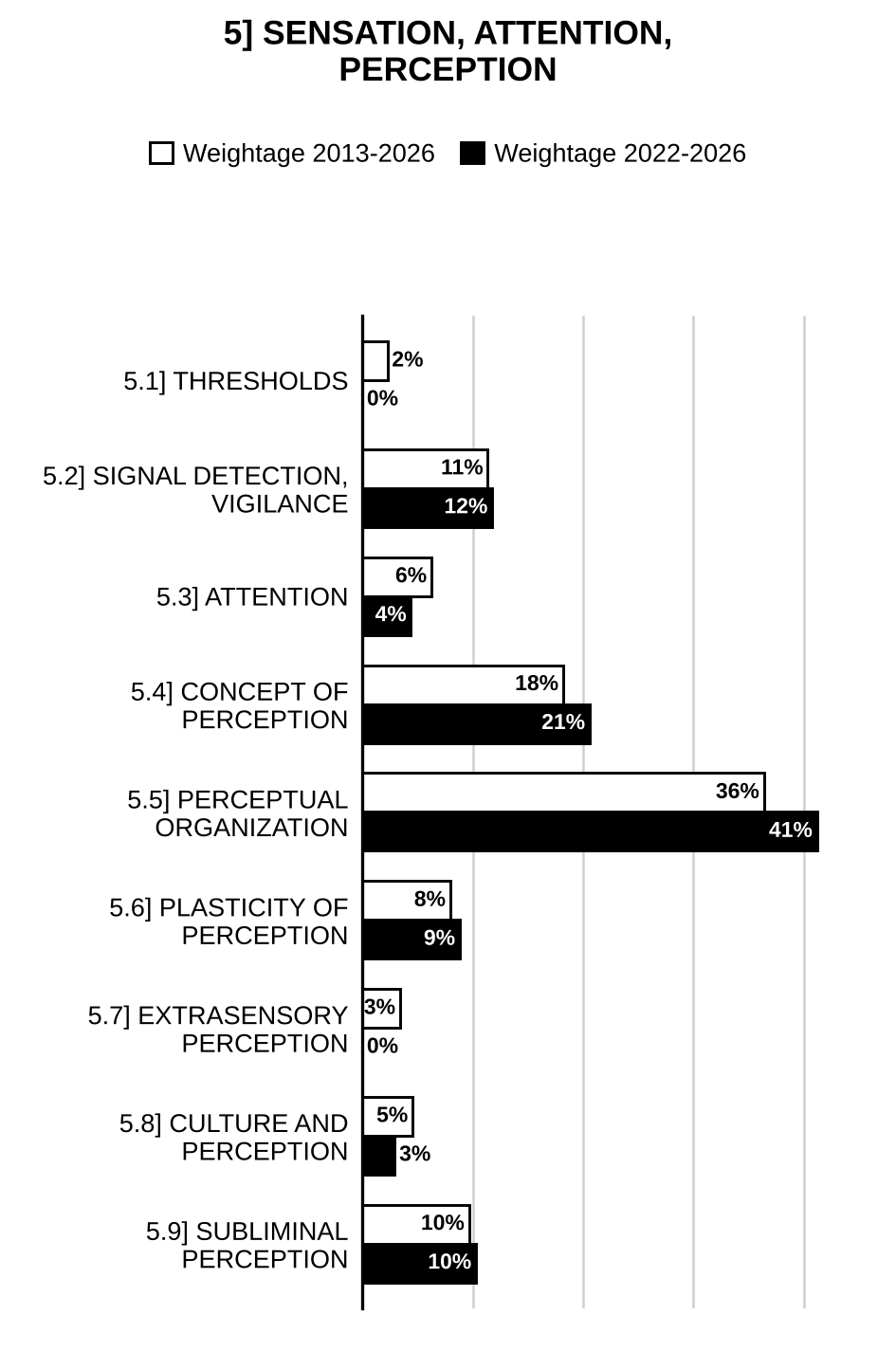
5.1] Sensation: threshold, absolute and difference thresholds
3 questions
Explain the concept of ‘sensory adaptation’ and discuss its uses in day-to-day life. [2014/10m/150w/1b]
What is sensory adaptation? Explain with examples. [2010/10m/100w/1f]
How is psychological measurement different from measurement in physical sciences? Giving appropriate illustrations, distinguish clearly between psycho-physical and psychometric measures. [1996/60m/2]
5.2] Signal-detection and vigilance
8 questions
Discuss the signal detection theory (SDT) with reference to perceptual vigilance task performance. [2024/20m/3a]
Discuss signal detection theory and explain its applications. [2018/15m/4b]
Demonstrate with suitable examples how the signal detection theory has helped in modifying the process of vigilance. [2015/15m/2c]
Discuss the ‘pay-off matrix’ in relation to the signal detection theory. [2012/12m/150w/1e]
How does signal-detection theory envisage the decision process? In what other areas of psychology can it be applied? [2011/30m/3a]
Distinguish the application of signal detection theory in the selection process of defence personnel. How do you get and interpret ROC curve? [2009/20m/200w/1d]
What are the theoretical and practical implications of research on signal detection and vigilance? Discuss in the light of experimental studies. [2007/20m/200w/1d]
Describe the decision rules employed by an individual for maximizing his gains. Also explain the uses of ROC curves. [2001/20m/200w/1b]
5.3] Factors influencing attention including set and characteristics of stimulus
7 questions
What do you understand by ‘inattentional blindness’? How can subliminal stimulus affect our behaviour? [2026/15m/4b]
Why is selective attention important? Discuss the theories of selective attention. [2021/20m/4a]
Describe Broadbent’s filter theory of attention. Why this elegant theory turned out to be inadequate? Comment upon the alternate approaches. [2012/30m/400w/3b]
How do task similarity and modality influence dual-task performance? [2010/30m/4a]
What is attention? Discuss factors influencing attention. [2005/20m/200w/1c]
How is attention different from perception? Describe the role of various factors that influence attention. [2004/60m/3]
Attention develops from unfocussed scanning to focussed planfulness. Discuss giving illustrative examples. [2002/20m/200w/1a]
5.4] Definition and concept of perception; biological factors in perception
12 questions
Critically examine the top-down and bottom-up processing in perception. How can we make the combined use of both the processing in everyday life? Support your answer with appropriate examples. [2026/20m/2a]
Is there perception without sensation? Evaluate critically in the light of empirical evidences. [2022/15m/6c]
Describe the bottom-up and top-down processing of sensory information. [2021/15m/2c]
Describe the processing of sensory input and explain how it is selected, organized and interpreted. [2016/15m/2b]
Compare template matching and feature detection accounts of pattern recognition. [2013/15m/250w/2c]
Evaluate ‘duplicity theory’ of vision. Cite experimental evidences in support of this theory. [2012/20m/250w/4b]
Comment on: Contrast bottom-up and top-down theories of perception. [2011/10m/2d]
Is there a conceptual continuity between sensation and perception? Explain the role of contextual constraints in the inferential nature of the psychological construct of perception. [2006/60m/2]
Explain in detail the role of Bottom-up and Top-down process in recognition with the help of suitable examples. [2005/60m/2]
What is perception? Discuss biological factors in perception. [2005/60m/3]
Discuss the characteristic features of perception and bring out the significance of redundancy and feature detectors in it. [2001/60m/3]
How is perception of inanimate objects different from the person perception? [2000/20m/200w/5a]

Preparing for Prelims too?
Our UPSC Prelims Topic-wise PYQ eBook covers every Prelims question with detailed explanations, so you can see exactly where UPSC asks from.
View the BookDownload Free Sample5.5] Perceptual organization: past experience, perceptual defence, space and depth perception, size estimation, perceptual readiness
23 questions
Explain how psychological and cultural factors affect perception. [2025/10m/150w/5b]
What enables us to see the world in 3D despite our retinas capturing only 2D images? Explain. [2025/15m/6c]
How do various monocular and binocular cues help us with depth perception? Discuss with the help of examples. [2024/15m/4b]
Describe the factors influencing perceptual organization with reference to past experiences and perceptual readiness. [2023/20m/3a]
What principles of perceptual organization are useful for air traffic controllers? Also, indicate how they use each of them. [2022/15m/7b]
How do we see the objects in three dimensions? Discuss the factors influencing the same. [2019/10m/150w/1d]
Why do most people experience geometrical illusions? Explain from the psychological perspective. [2019/10m/150w/5e]
Citing examples from life situations, explain the phenomenon of perceptual organization. [2019/15m/6b]
Explain and critically evaluate the phenomenon of perceptual defence. [2018/10m/150w/1d]
How are we able to perceive the world in three dimensions when our eyes are capable of sensing only two-dimensional images? [2017/15m/3c]
Is perception a constructive process? Explain in the light of studies on illusions and constancies. [2014/15m/3c]
Why our representations of the external world are not entirely accurate? [2013/15m/250w/4a]
What do illusions tell about the nature of perception? [2011/10m/100w/1f]
Discuss the role of monocular and binocular cues in depth perception. [2010/20m/2a]
Perception of size is explained from visual angle perspective. Evaluate its adequacy. [2009/20m/200w/1a]
Explain the concept of perceptual organization. What are the processes which influence it? Support your answer with theoretical constructs. [2006/20m/200w/1b]
What is perceptual organization? Describe its various factors with the help of examples. [2003/60m/3]
How can the phenomenon of perceptual defence be demonstrated experimentally? [2000/20m/200w/1d]
What are perceptual styles? Evaluate attempts to conceptualise them as personality variables. [1999/60m/3]
Do the principles of perceptual organisation point to their inborn nature? Cite experimental evidences in this context. [1998/60m/3]
Relationship between emotions and perception with special reference to perceptual defence. [1996/20m/200w/1c]
Explain the rationale in using perception as a medium for studying personality. Cite major findings of research in this area. [1996/60m/3]
Evaluate critically the contribution of the Gestalt school to the development of psychology as a science with special reference to the study of perception. [1995/60m/3]
5.6] The plasticity of perception
3 questions
What is the meaning and significance of plasticity of perception? Discuss. [2023/15m/7b]
Perception is plastic. However, it may also be affected by innate tendencies. Critically evaluate. [2018/20m/2a]
Why do Figural-After-Effects take place? [1997/20m/200w/1b]
5.7] Extrasensory perception
2 questions
Discuss the cognitive and motivational determinants of the belief in extra sensory perception. [2021/15m/8b]
Citing relevant example, describe extra-sensory perception. [2005/20m/200w/5c]
5.8] Culture and perception
2 questions
Explain how psychological and cultural factors affect perception. [2025/10m/150w/5b]
Do the cultural settings influence the understanding and evaluation of meanings of external stimuli? Provide suitable justification for your answer. [2015/15m/4c]
5.9] Subliminal perception
5 questions
What do you understand by ‘inattentional blindness’? How can subliminal stimulus affect our behaviour? [2026/15m/4b]
What do you mean by subliminal perception? Discuss its role in advertising with the help of suitable example. [2023/10m/150w/1c]
Do you think subliminal messages can actually lead to significant changes in attitudes or behaviour? Cite research evidence. [2017/10m/150w/1d]
Describe the phenomenon of subliminal perception and explain it with reference to the concepts of backward marking and visual priming. Do you think that the effect of the phenomenon of subliminal perception can be generalized? [2016/15m/3b]
Is subliminal perception a myth or a reality? Answer citing relevant experimental evidence. [2002/20m/200w/1b]

Strengthen your GS papers
Our UPSC Mains Topic-wise & Year-wise PYQ eBook (2013–2026) maps every GS question to the syllabus, so you know what UPSC asks and how often.
View the BookDownload Free Sample« Previous: Development of Human Behaviour | Next: Learning »
Back to: Psychology Optional PYQs – Topic-wise | Also see: Psychology Optional year-wise question papers
Last updated: 30 October 2026