
Here are all 82 Contemporary Issues questions asked in UPSC Geography Optional Paper II from 1995 to 2026, arranged under the 9 topics of the official syllabus. Within each topic the latest questions come first.
Each question ends with a code such as [2024/15m/3b] – the year, the marks, the word limit (where UPSC set one) and the question number in the paper.
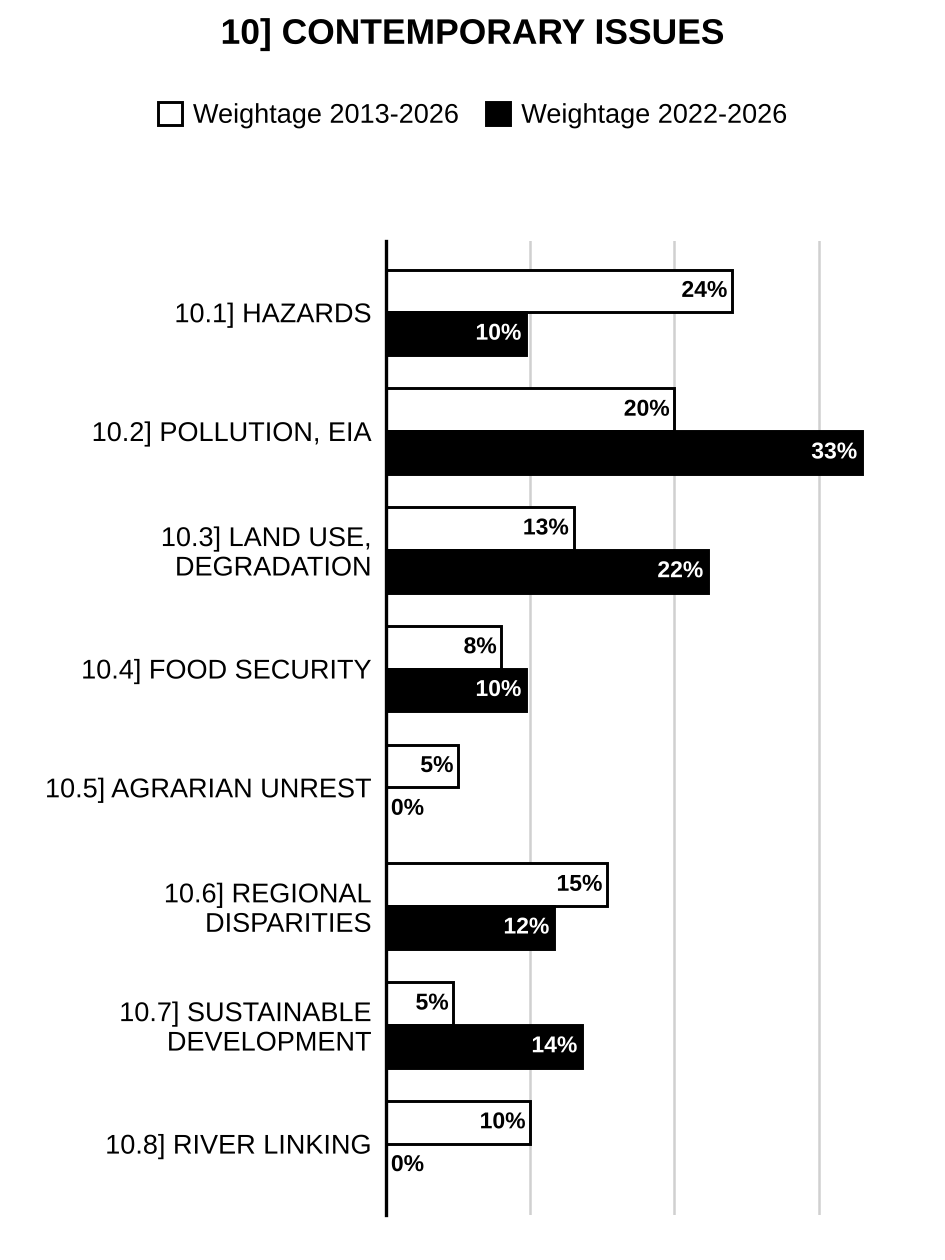
10.1] Environmental hazards: landslides, earthquakes, tsunamis, floods and droughts, epidemics
21 questions
Disaster risk reduction and community resilience are the two pillars that need to be prioritized in the flood prone areas of India. Critically analyse. [2026/10m/5e]
Incidence of extreme rainfall events and flash floods in recent times have led to devastating consequences for people living in low-lying areas and flood plains of the country. Discuss. [2022/15m/4c]
Landslide is a major problem in Himalayan region. Discuss its causes and mitigation measures. [2021/20m/2a]
Describe the problems of cloud burst in India giving suitable examples. [2021/10m/150w/5b]
Avalanche is a major hazard in the Himalayas. What are its causes and mitigation measures? [2020/15m/6b]
Demarcating the seismic zones of India, suggest suitable interventions required in most sensitive seismic zones for sustainable human settlements. [2020/20m/7a]
Examine the problems of Glacial Lake Outburst Flood (GLOF) in India. [2019/10m/150w/5e]
Describe the altitudinal and spatial geo-environmental hazards in the Himalayas. [2019/15m/8b]
Describe the socio-spatial consequences of the recent Nipah viral encephalitis in India. [2018/10m/150w/5e]
Account for the growing frequency and intensity of floods in India, and suggest short- and long-term remedial measures indicating the chronically flood-prone areas. [2015/20m/4a]
Differentiate between the ‘intensity’ and ‘magnitude’ of an earthquake and explain its varying impact in different parts of India. [2014/15m/7b]
Identify the earthquake-prone zones and suggest strategy for their management. (250 words) [2013/20m/250w/8a]
Identify Tsunami affected areas and give their management problems in India. [2012/12m/150w/5d]
Explain the causes, impact and remedial measures of flood-hazards in the middle Ganga plain. Represent the flood-affected areas of middle Ganga plain on a sketch map in your answer-book. [2012/30m/7b]
Define an ‘Epidemic’ and discuss the occurrence of ‘Chikungunya’ in India. [2010/30m/6a]
Identify the regions affected by Chikungunya with the help of a sketched map and bring out the regional pattern of the disease. [2010/30m/6b]
Give an account of the distribution of flood-prone areas of India and the programmes and policy of controlling the impact of floods in the country. [2005/60m/6]
Explain the causes, impacts and remedial measures of flood-hazards in middle and lower Ganga plain. [2004/60m/7]
Explain the causes, impacts and remedial measures of earthquake disaster. [2002/60m/6]
Explain the geographical characteristics of the regional distribution of earthquakes in India. [2001/60m/8]
Give a reasoned account of either flood hazards or drought hazards occurring in India, and also suggest measures for controlling them. [2000/60m/8]
10.2] Issues related to environmental pollution; environmental impact assessment and management
12 questions
Why is it difficult to improve the quality of air during the winter season in the Gangetic plain? Critically evaluate with suitable examples. [2026/20m/7a]
Industrial waste is diversified. Discuss the potentials and challenges associated with it. [2024/20m/6a]
Examine the environmental challenges caused by the solid waste in metropolitan regions of India and discuss the efforts to overcome it. [2023/20m/2a]
Why has extreme particulate pollution remained a festering issue in Delhi NCR region? [2022/10m/1b]
Groundwater contamination in the fast expanding urban landscape of India appears to have become a major public health issue. Discuss. [2022/15m/2c]
Discuss the methods of crop residue management in rural India to reduce pollution. [2020/10m/1c]
Give a reasoned account of high level of pollution in North Indian cities as compared to South Indian cities. [2019/15m/7b]
Make a critical appraisal of the factors affecting river water quality in India. [2018/10m/150w/5c]
What do you understand by soil pollution? Delineate the areas vulnerable to it in India and suggest remedial measures. [2017/15m/6c]
Describe how urbanization creates air and water pollution in India. (150 words) [2013/15m/150w/8c]
Discuss the problems of environmental degradation generated by urban wastes in India. [2011/30m/8a]
What are the cause and consequences of environmental degradation in India’s industrial areas? Give specific examples. [2009/60m/6]
10.3] Changes in land use; deforestation, desertification and soil erosion; environmental degradation
13 questions
Deforestation in the upper reaches of a river augments the magnitude of soil erosion. Elaborate your answer citing the example of any North Indian river. [2026/15m/7b]
Highlight the characteristics of land utilisation in Eastern Ghats region of India. What are the recent threats to land utilisation method in the region? [2025/15m/3b]
What are the causes and consequences of land degradation due to desertification in India? Examine with reference to various regional issues. [2025/15m/7b]
Urban built environment in big cities of India creates key changes in biophysical character of the landscape. Discuss. [2023/10m/150w/5b]
The process of desertification leads to soil desiccation and soil loss. Explain. [2022/10m/1d]
Explain the impact of economic development on environmental degradation in India. (In about 200 words) [2016/15m/200w/4b]
How does climate change affect the process of desertification of India? [2015/15m/4b]
Explain how change in land use can promote eco-development at different levels in the country. (In about 150 words) [2015/10m/150w/5d]
Identify the ravine-affected areas in India and discuss the environmental and economic impacts of their reclamation. [2011/30m/7b]
Analyse the causes of desertification in India. Represent the desertified areas of the country on a sketch map and suggest remedial measures to control it. [2011/30m/8b]
Spatial pattern of soil erosion in India. [2010/15m/250w/5c]
Discuss environmental problems of India in the context of rapid economic development and population growth. [2007/60m/7]
Evaluate the nature of ecological problem in India and suggest measures for their management. [1997/60m/3]
10.4] Population explosion and food security
7 questions
Explain the factors that contribute to droughts in India with specific reference to food production, distribution and availability. Can Indian agricultural policies resolve the issue? [2025/20m/7a]
Evaluate the role of the National Food Security Act, 2013 in providing access of food to the poor in India. [2022/15m/8c]
Stunting and wasting among children are major consequences of food insecurity. Discuss various schemes of Government of India to address these problems and their achievements. [2020/15m/4b]
Examine the ongoing process of agricultural diversification and its implications for food security in India. [2018/20m/3a]
Snags in the Food Security Policy of India. [2013/10m/150w/5b]
Assess as to how surface water utilisation affects food production and food security in the country. [2010/30m/4b]
Write an essay on the population exploitation and food security in India. [2006/20m/200w/5c]

Preparing for Prelims too?
Our UPSC Prelims Topic-wise PYQ eBook covers every Prelims question with detailed explanations, so you can see exactly where UPSC asks from.
View the BookDownload Free Sample10.5] Problems of agrarian and industrial unrest
3 questions
Identify the Naxal-affected areas in India and discuss their socio-economic problems. [2017/15m/2b]
Farmers’ suicide is one of the major agrarian problems in India. Bring out its causes and suggest the remedial measures with special reference to Maharashtra, Andhra Pradesh and Punjab. [2017/15m/4b]
With the help of a map, indicate the principal areas of dry land farming in the country and account for farmers’ suicides mainly in those areas. [2015/15m/3b]
10.6] Regional disparities in economic development
14 questions
India has wide-ranging regional disparities in economic development. Explain the patterns, implications and challenges. [2024/20m/3a]
Why do disparities in development and incomes between regions persist in large countries like India? How does the recent ADP plan address the issue? [2022/20m/6a]
Digital Divide in India needs quick redressal to reduce regional disparity in development. Elaborate with suitable examples. [2020/20m/6a]
Analyse the role of interstate migration in regional disparity in India. [2019/20m/7a]
Analyse the incentive oriented programmes for removing regional imbalances in socio-economic development of India. [2019/15m/7c]
Goods and Services Tax (GST) has differential impact on developed and backward States of the country. How and why? [2017/10m/150w/5e]
Examine the causes of regional disparities in economic development in India. (In about 200 words) [2016/15m/200w/7c]
Reduction in regional disparities has been one of the priority goals of national planning in India. How the proposed new Smart urban centres may contribute to the process? [2015/20m/7a]
Enumerate the basic indicators of development and explain their application in identification of the spatial diversity in development in India. (150 words) [2013/15m/150w/6c]
Explain the process and pattern of regional disparities in India and suggest suitable measure for it. [2006/60m/8]
Explain the causes of regional disparities in economic development of India. [2003/60m/8]
Give a reasoned account of regional disparities in economic development in India and bring out the contribution of decentralized planning in solving this problem. [2002/60m/8]
Analyse the causes of regional disparities in the economic development of India and suggest measures for their removal. [1999/60m/R9]
Write a short note on: Magnitude of regional imbalances in economic development in India. [1996/20m/200w/5c]
10.7] Sustainable growth and development; environmental awareness
5 questions
While defining the green architecture, discuss its principles and challenges in response to climate change in India. [2025/20m/8a]
Discuss the significance of organic farming for sustainable agricultural development in India. [2023/15m/6b]
Explain the concept of sustainable development and examine its relevance. [2008/20m/200w/5d]
Elucidate the concept of sustainable growth and development. [2005/20m/200w/5c]
Evaluate the concept of sustainable growth and development. [2004/20m/200w/5d]
10.8] Linkage of rivers
6 questions
Discuss the ecological and economic challenges of river linking in India. [2021/15m/2c]
“Intrabasins linkages of rivers are more feasible economically, socially and ecologically.” Discuss with suitable examples from India. [2019/20m/6a]
Interlinking of rivers may serve as a major source of assured irrigation and all-weather inland navigation in India. Comment on its feasibility taking into account physical, economic and ecological implication. [2017/20m/6a]
Comment on the feasibility of interlinking of rivers of India and its possible contribution to resolution of water crisis. (250 words) [2013/20m/250w/4a]
Examine the relevance of linkage of rivers in India with special reference to Ganga-Cauveri linkage canal. [2012/20m/200w/8a]
Evaluate the feasibility of the proposed Ganga-Cauveri drainage link. [1998/20m/200w/1a]
10.9] Globalisation and Indian economy
1 question
Discuss the impact of globalisation of India’s industry and agriculture sectors. [2009/30m/8b]

Strengthen your GS papers
Our UPSC Mains Topic-wise & Year-wise PYQ eBook (2013–2026) maps every GS question to the syllabus, so you know what UPSC asks and how often.
View the BookDownload Free Sample« Previous: Political Aspects | Next: Map Questions »
Back to: Geography Optional PYQs – Topic-wise | Also see: Geography Optional year-wise question papers
Last updated: 30 October 2026