
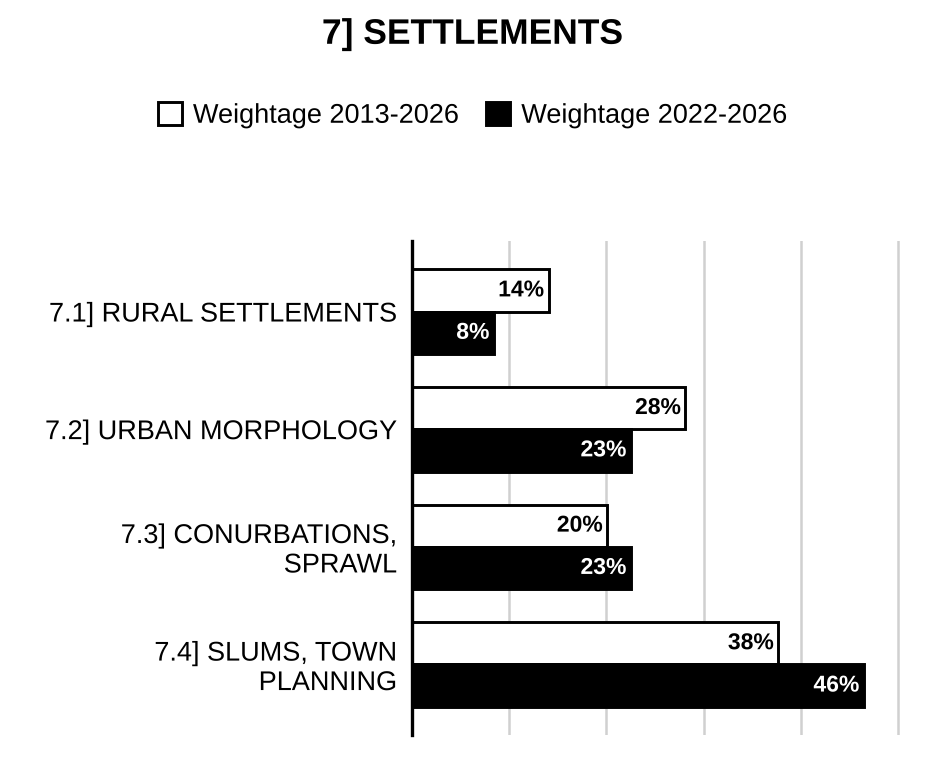
Here are all 58 Settlements questions asked in UPSC Geography Optional Paper II from 1995 to 2026, arranged under the 4 topics of the official syllabus. Within each topic the latest questions come first.
Each question ends with a code such as [2024/15m/3b] – the year, the marks, the word limit (where UPSC set one) and the question number in the paper.
7.1] Types, patterns and morphology of rural settlements
11 questions
“The rural settlements in India are highly diversified due to both physical and cultural factors.” Justify the statement with examples. [2025/15m/4c]
Give a reasoned geographical account of changing rural folk houses in India. [2020/15m/3c]
Describe the changing regional morphology of rural settlements in India. [2018/20m/8a]
Present a comparative analysis of geographical factors responsible for distribution of human settlements in Rajasthan desert and North-Eastern regions of India. (In about 250 words) [2016/20m/250w/6a]
Morphological characteristics of villages situated in hilly regions. [2012/12m/150w/5e]
Give an account of geographical conditions responsible for the development of different types of rural settlements in India. [2012/30m/6b]
State the geographical factors which influence rural house types in India. [2009/20m/200w/5c]
Discuss briefly the principal types of rural settlements in India. [2005/20m/200w/5b]
Discuss the geographical control of rural settlement pattern in India. [1998/20m/200w/5b]
Write a short note on: Role of rural market centres in promoting intra and inter-regional trade. [1995/20m/200w/5b]
Explain, with the help of suitable examples and illustrations, the distribution of various patterns of rural settlements in India. [1995/60m/7]
7.2] Urban developments; morphology of Indian cities; functional classification of Indian cities
15 questions
How can morphology of Indian towns be described historically? Discuss the major features of the first planned city in India after independence. [2024/20m/8a]
A large number of Indian cities have a complex morphological characteristics due to their historical evolution. Elucidate. [2023/20m/6a]
Discuss Ashok Mitra’s classification method of Indian cities. [2021/10m/150w/5e]
Identify challenges faced by generative and parasitic towns in India and their possible remedies. [2020/10m/150w/5e]
Examine the driving forces of changing urban morphology of million-plus cities of India with suitable examples. [2018/20m/4a]
Small towns in India have problems and prospects of their own. Elaborate. [2017/10m/1d]
Mention various methods of functional classification of towns in India and explain the method applied by Asok Mitra. [2017/20m/4a]
“Mono-functional towns are economically vulnerable.” Discuss. (In about 150 words) [2015/10m/150w/5c]
Write a note on the emergence of National Settlement System in colonial India and discuss the factors contributing to urbanization in post-independence period. (250 words) [2013/20m/250w/7a]
Outline the role of Class II and Class III towns in the urban process of India and indicate their contribution towards balanced urban development. [2010/30m/7a]
Explain the morphology of Indian cities in the Background of existing morphological Model. [2006/60m/6]
Discuss the census definition of urban areas in India. [2003/20m/200w/5a]
Describe the salient characteristics of the morphology of Indian cities. [2000/60m/6]
Examine the census concept of urban areas in India. [1997/20m/200w/5b]
Name the million cities of India according to the 1991 census and critically examine the factors for unprecedented growth in their population in the last 50 years. [1996/60m/7]

Preparing for Prelims too?
Our UPSC Prelims Topic-wise PYQ eBook covers every Prelims question with detailed explanations, so you can see exactly where UPSC asks from.
View the BookDownload Free Sample7.3] Conurbations and metropolitan regions; urban sprawl
11 questions
How can rural-urban fringe be delineated? Explain with suitable examples from India. [2025/10m/5a]
Discuss the process of formation of conurbations in India and describe their problems. [2024/15m/2c]
What are the drivers of urban sprawl around the major cities of the country? How have new investments in transport projects supported sprawl development? [2022/15m/7c]
Urban sprawl around planned cities evolve leading to emergence of squatter settlements. Discuss the advantages and disadvantages of such outgrowth. [2020/15m/7c]
Provide a reasoned account on emerging conurbations in India and explain with suitable examples the problems associated with it. [2019/15m/6b]
Peri-urbanization has created enormous environmental problems. Discuss their causes and consequences with reference to the National Capital Region (N.C.R.) of India. [2018/15m/7c]
How has an inappropriate urban land use policy accounted for undesirable development in and around metropolitan cities? [2014/15m/8c]
Differentiate between conurbations and metropolitan regions. Give a reasoned account of emerging conurbations in India. [2011/30m/7a]
There is no sharp divide where an urban settlement stops and rural areas begin. Analyze the statement with reference to the sprawl of Indian cities. [2009/60m/7]
Discuss the concept of city region and referring to Indian cities, examine critically functional indicators used for delimiting the city region. [1998/60m/7]
Write a short note on: Land-use characteristics of the rural urban fringe in India. [1995/20m/200w/5c]
7.4] Slums and associated problems; town planning; problems of urbanisation and remedies
21 questions
Explain the government initiatives for the redevelopment of slum areas in the mega cities of India. [2026/10m/5b]
Poor road infrastructure and inadequate public transport system remain the key issues in Indian metropolitan areas. Discuss with suitable examples. [2026/15m/8b]
Describe the causes of the phenomenon of ‘urban heat island’. What are the effective measures to deal with this phenomenon in India? [2025/20m/6a]
What are the major regional rapid transit systems developed in India? How are urban problems being addressed by them? [2024/15m/8c]
Poor quality of urban planning in India is a huge constraint in realizing the true economic potentials of urbanization. Critically examine. [2023/15m/4b]
Examine the role of high population concentration in Indian slums in making them more vulnerable during pandemic conditions like the COVID-19. [2022/15m/6c]
Critically examine the importance of Smart Cities Programme for solving urban problems in India. [2021/15m/3b]
Comment on: Correlate the price of land, vertical growth of cities and the growth of slums in large cities of India. [2019/10m/150w/5c]
How do slums develop? Give concrete suggestions for their improvement. [2016/10m/150w/5c]
Describe the causes and effects of urbanization in India and explain its impact on rural landscape and urban ecology. (In about 250 words) [2016/20m/250w/8a]
Reduction in regional disparities has been one of the priority goals of national planning in India. How the proposed new Smart urban centres may contribute to the process? [2015/20m/7a]
Analyse the feasibility of ‘Smart Towns’ Development in India. (150 words) [2014/10m/150w/5c]
Account for the multiple problems of urban agglomerations. [2014/15m/6b]
Define slums and explain their problems. (150 words) [2013/15m/150w/7b]
How do the ‘push’ and ‘pull’ factors operate for the emergence of slums in the metropolises of India? [2009/30m/8a]
‘Unplanned urban development has created numerous problems.’ Comment. [2008/60m/6]
“Slums are urban menace.” Elucidate with Indian cities as examples. [2007/60m/8]
Discuss the elements and approaches of town planning in India. [2006/20m/200w/5d]
How do slums develop? Give concrete suggestions for their improvement. [2004/20m/200w/5b]
Discuss the environmental impact of the growth of slums in Indian cities. [2000/20m/200w/5d]
Write a short note on: Factors for the growth of slums in the metropolitan cities of India. [1996/20m/200w/5b]

Strengthen your GS papers
Our UPSC Mains Topic-wise & Year-wise PYQ eBook (2013–2026) maps every GS question to the syllabus, so you know what UPSC asks and how often.
View the BookDownload Free Sample« Previous: Cultural Setting | Next: Regional Development and Planning »
Back to: Geography Optional PYQs – Topic-wise | Also see: Geography Optional year-wise question papers
Last updated: 30 October 2026