
Here are all 59 Agriculture questions asked in UPSC Geography Optional Paper II from 1995 to 2026, arranged under the 8 topics of the official syllabus. Within each topic the latest questions come first.
Each question ends with a code such as [2024/15m/3b] – the year, the marks, the word limit (where UPSC set one) and the question number in the paper.
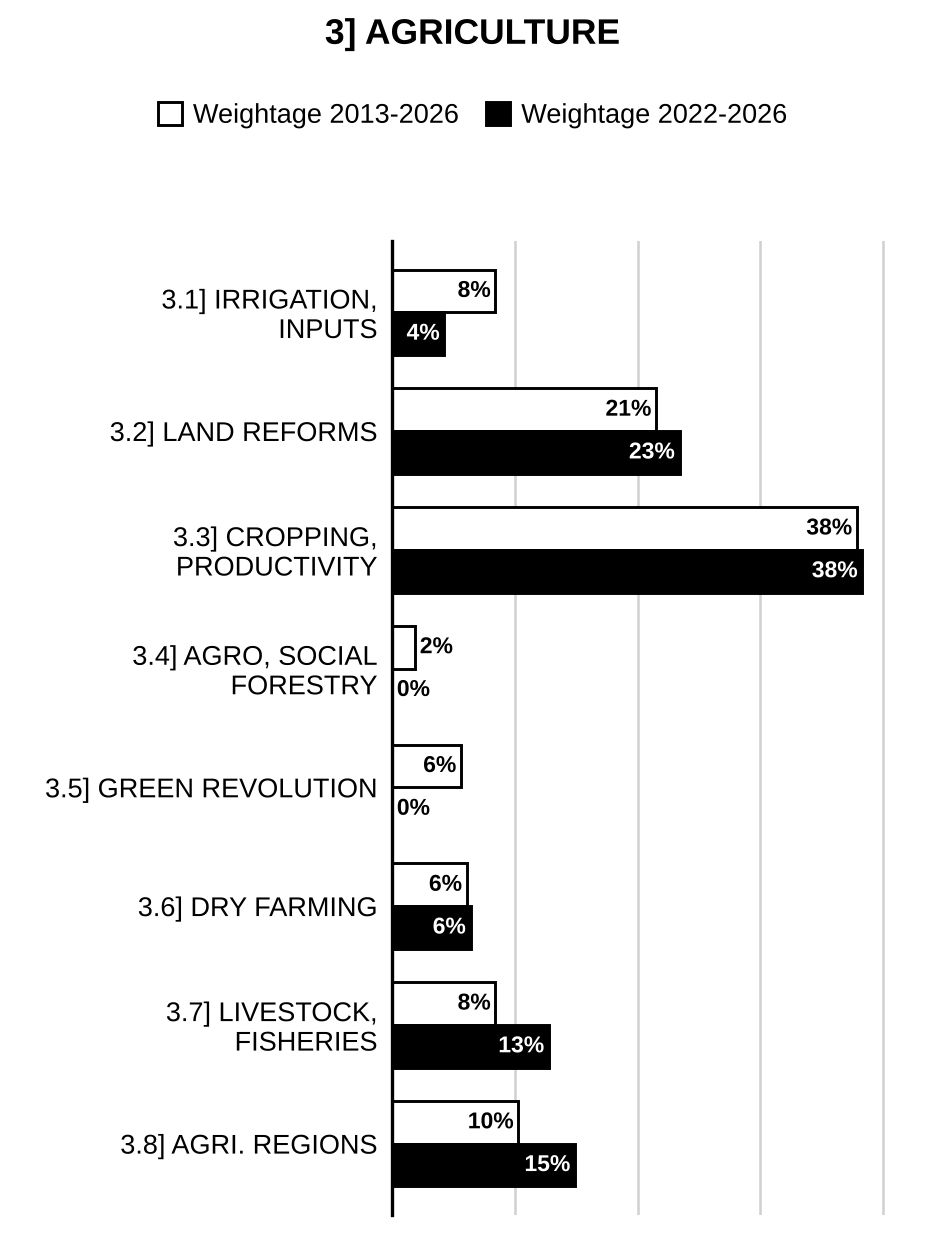
3.1] Infrastructure: irrigation, seeds, fertilizers, power
7 questions
Examine the transitional role of technology on Indian agriculture sector. [2024/10m/150w/5c]
Elucidate the benefits of neem coated urea scheme for Indian agriculture. [2020/10m/150w/5b]
Canal irrigation has led to monocropping in India. Explain with suitable examples. [2020/10m/150w/5c]
Discuss the use of chemical fertilizers, pesticides and insecticides in agriculture and its impact on human health. [2019/20m/3a]
Present a comparative analysis of the regimes of Himalayan and Peninsular rivers of India and examine their implications in the irrigation system of the country. [2011/60m/2]
Discuss the importance of irrigation in Indian Agriculture and describe the methods of irrigation practised in either the Ganga Valley or the Karnataka-Maharashtra region. [1996/60m/4]
Discuss the role of infrastructural, scientific and technological development in the recent transformation of Indian agriculture. [1995/60m/4]
3.2] Institutional factors: land holdings, land tenure and land reforms
10 questions
Institutional factors are playing a dominant role in controlling the agricultural prosperity in India. Justify with evidences. [2024/20m/2a]
How do small and fragmented landholdings affect the agro-ecological system in rural India? What are the resilient steps needed to overcome this issue? [2024/15m/7c]
Discuss the recent changes brought about in institutional frameworks of agriculture in India. Evaluate its impact on the agrarian economy of the country. [2022/20m/3a]
The Essential Commodities (Amendment) Bill 2020 aims to deregulate the production, supply and distribution of farm produce. Critically examine its spatial consequences. [2020/15m/4c]
Land reform is a key to modern agriculture in India. Describe various measures taken in this direction after Independence. [2017/15m/4c]
Explain how modernization of Indian agriculture is affected by unfavourable institutional factors with suitable examples. [2015/15m/2c]
Discuss the role of institutional factors in shaping the pattern of Indian agriculture. (150 words) [2013/15m/150w/3b]
Impact of land tenure on agriculture productivity in India. [2011/15m/200w/5c]
“The institutional factors have grip over the crop pattern and crop productivity on Indian agriculture.” Justify. [2007/60m/4]
Discuss the role of institutional factors in the efficiency and productivity of agriculture in India. [1998/20m/200w/1b]
3.3] Cropping pattern, agricultural productivity, agricultural intensity, crop combination, land capability
16 questions
Examine the causes and consequences of crop diversification in India. How can crop diversification contribute to sustainable agriculture? [2026/20m/3a]
How does Himalayan ecosystem regulate the cropping pattern and agricultural activities in Himalayan region of India? Discuss. [2025/10m/1c]
How does the agricultural sector of India confront with the contemporary physical and politico-economic changes in the different regions of the country? Elucidate. [2025/15m/2c]
Discuss the necessary conditions for the cultivation of fox nuts and describe the areas of its production in India. [2025/10m/5e]
Why are millets considered as ‘nutri-cereals’ and climate-resilient? Discuss the constraints and opportunities of millet cultivation in India. [2023/15m/2b]
Why India lags behind many other countries in agricultural productivity? Suggest suitable measures to raise productivity across the regions in a sustainable manner. [2023/20m/8a]
Identify oilseeds producing areas in India and discuss the measures to promote edible oil industry. [2020/15m/3b]
Canal irrigation has led to monocropping in India. Explain with suitable examples. [2020/10m/150w/5c]
Explain the contemporary agricultural scenario in the context of rapid urbanization in India. [2018/15m/2b]
Examine the ongoing process of agricultural diversification and its implications for food security in India. [2018/20m/3a]
Define agricultural intensity and bring out its regional distribution in India. (In about 150 words) [2016/10m/150w/1d]
Distinguish between ‘agricultural productivity’ and ‘agricultural efficiency’, and bring out the disparity in regional distribution of agricultural efficiency. [2015/20m/3a]
Explain the method of delineating crop-association regions with reference to India. (150 words) [2013/10m/150w/1e]
Discuss the potentiality and present status of horticulture in the Western and Central Himalaya. (250 words) [2013/20m/250w/2a]
Define agricultural productivity. Mention the methods of its measurement and bring out the disparities in its regional distribution. (150 words) [2013/15m/150w/4b]
Discuss the cropping patterns in different agricultural regions of India. [1998/60m/3]
3.4] Agro and social-forestry
3 questions
Why has agro and social forestry has failed to achieve its objectives? (150 words) [2014/10m/150w/1e]
Agro-forestry in India. [2011/15m/200w/5d]
Examine the significance of social forestry in the rural economy of India. [1997/20m/200w/1b]

Preparing for Prelims too?
Our UPSC Prelims Topic-wise PYQ eBook covers every Prelims question with detailed explanations, so you can see exactly where UPSC asks from.
View the BookDownload Free Sample3.5] Green revolution and its socio-economic and ecological implications
4 questions
“India has paid heavily for achievement of Green Revolution in the form of economic, social and ecological cost.” Discuss. (In about 200 words) [2016/15m/200w/8b]
‘In spite of various negative impacts of Green Revolution, there is a demand for New Green Revolution’. Elaborate. [2014/15m/4b]
Critically evaluate the dual impacts of green revolution in India. [2002/60m/3]
Discuss the impact of green revolution on the agricultural production in India. [1997/20m/200w/1d]
3.6] Significance of dry farming
4 questions
Discuss the importance of ‘Dry-land’ farming in the drought-prone regions of India. [2022/15m/4b]
Explain the significance of dry farming in drought prone areas of India. [2019/10m/1d]
With the help of a map, indicate the principal areas of dry land farming in the country and account for farmers’ suicides mainly in those areas. [2015/15m/3b]
Discuss the Problems and Prospects of dry zone agriculture in India and highlight strategies and scheme for its development. [2006/60m/3]
3.7] Livestock resources and white revolution; aqua-culture; sericulture, apiculture and poultry
8 questions
What are the challenges of dairy sector in India? Describe the contribution of bovine population. [2025/15m/3c]
India’s poultry sector has become one of the fastest growing areas of the country’s agricultural sector. Examine its opportunities and challenges. [2023/15m/7b]
Discuss the scope of replication of ‘White Revolution’ in India. [2015/15m/4c]
Discuss the potentiality and status of aqua-culture in the Ganga Plain. [2011/30m/4a]
Prospects of Rainbow Revolution in India. [2011/15m/200w/5a]
Present an account of the success and constraints of White Revolution in India. [2005/60m/3]
Give an account of the success and prospects of Blue Revolution with comments on its impacts on rural economy of India. [2003/60m/3]
Write an essay on the role of animal husbandry and household industries in the development of rural economy in India. [1999/60m/R6]
3.8] Agricultural regionalisation; agro-climatic zones; agro-ecological regions
7 questions
Divide India into agro-ecological regions and highlight the salient features of any one of them. [2026/15m/4c]
How do agro-climatic and land capability indicators assist in macro-agricultural regionalisation of India? Illustrate with an appropriate map. [2022/20m/8a]
Correlate the agro-climatic zones with agro-ecological regions of India. [2019/20m/2a]
Divide India into agricultural regions and critically examine the role of ecological and human factors responsible for transformation of agricultural economy in any one region. [2012/30m/3b]
Discuss the bases of identifying agro climate zones and explain the core strategies for agricultural development. [2008/60m/3]
Examine the geographical basis of agro-climatic planning regions of India. [2001/60m/3]
Divide Peninsular India into agricultural regions. Explain the basis of such a regionalisation. [1997/60m/4]

Strengthen your GS papers
Our UPSC Mains Topic-wise & Year-wise PYQ eBook (2013–2026) maps every GS question to the syllabus, so you know what UPSC asks and how often.
View the BookDownload Free Sample« Previous: Resources | Next: Industry »
Back to: Geography Optional PYQs – Topic-wise | Also see: Geography Optional year-wise question papers
Last updated: 30 October 2026