
Here are all 60 Environmental Geography questions asked in UPSC Geography Optional Paper I from 1995 to 2026, arranged under the 6 topics of the official syllabus. Within each topic the latest questions come first.
Each question ends with a code such as [2024/15m/3b] – the year, the marks, the word limit (where UPSC set one) and the question number in the paper.
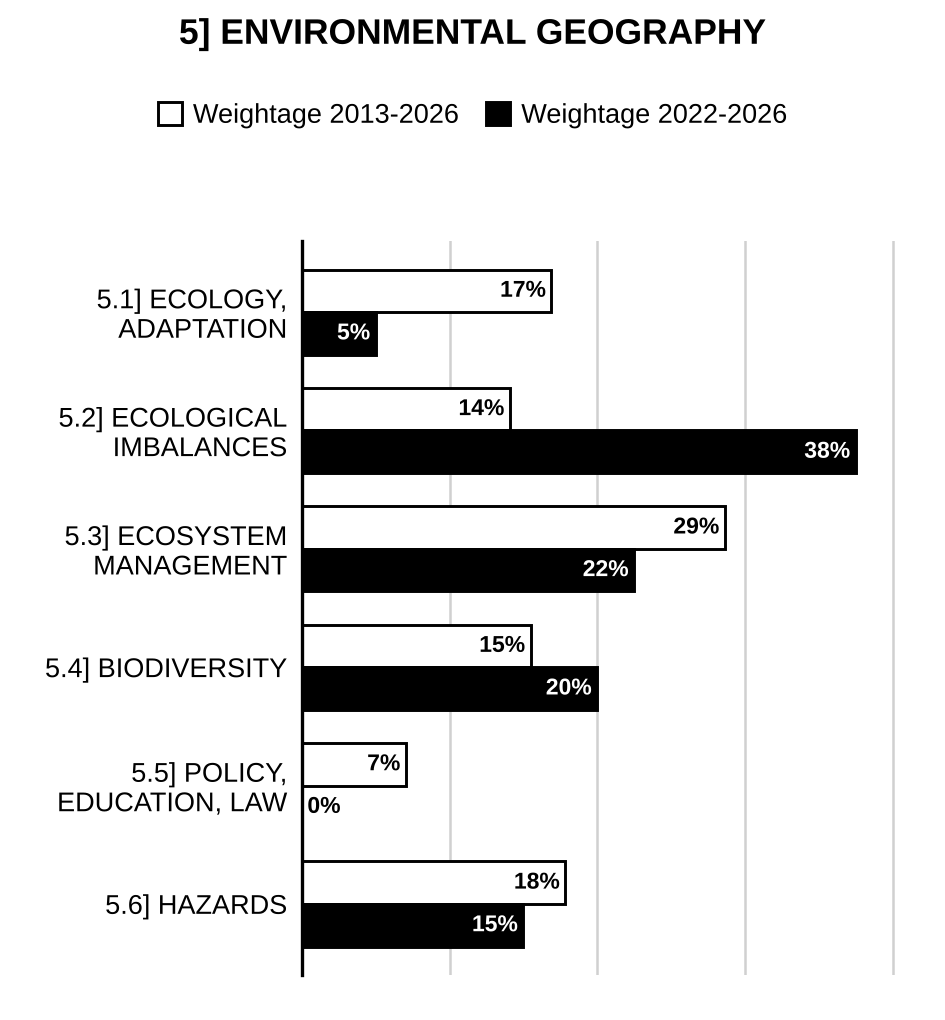
5.1] Principles of ecology; human ecological adaptations; influence of man on ecology and environment
10 questions
How is ‘Deep Ecology’ as a concept different from ‘Shallow Ecology’? Explain. [2023/10m/150w/1d]
With suitable examples, elaborate human ecological adaptations. Explain its impacts on ecology and environment in various parts of the world. [2021/20m/4a]
“Human ecology is the study of mutual relationship of people and their environment both natural and social.” Discuss in detail using ecological concepts. [2020/15m/8c]
“The web of life is seamless and the consequences of disruption to one part of the ecosystem ripple throughout the whole.” Elaborate. [2019/15m/3c]
Explain the different stages of ecological adaptation of man and bring out the changing balance between man and environment. [2015/20m/4a]
Give an account of the nature of biosphere as an ecosystem. [2014/10m/150w/1c]
Write a short note on: Marine Ecosystem. [2011/12m/150w/1e]
Give an account of the structure of ecosystem and describe its functional aspects. [2010/30m/4b]
Write in detail on the concept of biosphere as an ecosystem. [2002/60m/4]
Discuss the concept, components and functioning of an ecosystem. [2001/60m/4]
5.2] Global and regional ecological changes and imbalances
6 questions
“Overgrazing has become an alarming situation of bioloss in many bio-geographical regions of the world.” Illustrate with examples. [2026/15m/2c]
Anthropogenic impacts have caused major global and regional changes and imbalances in ecosystem. Elucidate with examples. [2026/15m/3b]
Mountain regions are more fragile to ecological changes. Elucidate. [2024/10m/150w/1e]
What are the factors affecting regional ecological changes? How do these affect human health? [2023/15m/3c]
Sequential changes in land use and land cover have brought global and regional ecological changes and imbalances. Elucidate. [2022/20m/2a]
Discuss the global ecological imbalances and their management. [2006/60m/4]
5.3] Ecosystem, their management and conservation; environmental degradation, management and conservation
18 questions
What is scarification? List out various impacts and examples of scarification on land. [2026/15m/3c]
Construction of large dams poses serious challenges. Describe the threats and solutions associated with it. [2026/15m/4c]
What is the ‘UN Decade on Ecosystem Restoration’? How does it balance ecological goals with emerging socio-economic needs like food security and development? [2025/15m/3b]
Describe how ecosystem services of Himalaya are essential for Highland-Lowland sustainability in Asia. [2021/10m/150w/1e]
How do mountaineers constitute a threat to Mount Everest? [2019/10m/150w/1e]
Explain the ecosystem approach to environmental management and highlight its advantages and disadvantages. [2018/15m/4b]
Discuss the Perception, Attitude, Value and Emotion (PAVE) Theory of environmental management. [2017/15m/4c]
Write a critical note on the tendency of “use and throw” in the context of economic status and environment. [2016/15m/3c]
Enumerate the major causes of increasing degradation of environment in hills and hillslopes, and state its down-valley impact. [2014/15m/2c]
What are the characteristics that make CHC a serious threat to the ecosystem? Give examples. [2013/15m/250w/2b]
Explain the levels of Noise pollution and the legislative measures to control it. [2013/25m/400w/4b]
Bring out the major problems of environmental pollution at global scale and suggest measures to check it. [2005/60m/4]
Write a short note on: Environmental Pollution. [2003/20m/200w/5b]
Discuss the causes and consequences of environmental degradation and highlight the related conservation measures. [2000/60m/4]
Discuss the relevance of ‘watershed’, as an ecosystem for the purpose of sustainable development. [1999/60m/5]
Examine the impact of advanced agricultural technology on environment. Support your answer with examples. [1998/60m/8]
Write a short note on: Buffer zone. [1997/20m/200w/2a]
Write a short note on: Desertification and its preventive measures. [1996/20m/200w/2b]

Preparing for Prelims too?
Our UPSC Prelims Topic-wise PYQ eBook covers every Prelims question with detailed explanations, so you can see exactly where UPSC asks from.
View the BookDownload Free Sample5.4] Biodiversity and sustainable development
13 questions
“Sustainable development requires Intergenerational and Intragenerational equity.” Comment with examples. [2026/10m/150w/5d]
Perception, Attitude, Value and Emotion (PAVE) are important components for biodiversity and sustainable environmental conservation. Elaborate. [2024/15m/3c]
How can Sustainable Land Management (SLM) harmonise the complimentary goals of environmental, economic and social opportunities? Discuss. [2023/15m/7b]
Give an account on sustainable development and its components. [2017/10m/150w/5e]
Discuss the methods of conserving biodiversity for sustainable development. [2015/15m/2c]
“Food productivity with purity of ecosystem is the need of the hour.” Elaborate. [2014/15m/8c]
Write a short note on: Types of endemic plants and their degree of vulnerability to extinction. [2013/10m/150w/1e]
Write a short note on: Ingredients of Sustainable Development. [2011/12m/5e]
Explain the concept of sustainable development and propose a model for agricultural development. [2007/60m/6]
Write a short note on: Sustainable development. [2006/20m/200w/5c]
Write an essay on ‘sustainable development’ from the perspective of geography. [2002/60m/7]
Discuss the relevance of ‘watershed’, as an ecosystem for the purpose of sustainable development. [1999/60m/5]
‘Man must realize the importance of maximizing agricultural production without destroying the ecological basis on which our entire food production systems rests.’ Explain with examples. [1995/60m/5]
5.5] Environmental policy; environmental education and legislation
3 questions
Discuss the objectives and principles of environmental education. Describe the basic concerns of formal and non-formal environmental education in India. [2018/15m/2c]
Comment on the impact of environmental education on quality of life. [2015/10m/150w/1e]
Explain the levels of Noise pollution and the legislative measures to control it. [2013/25m/400w/4b]
5.6] Environmental hazards and remedial measures
10 questions
Comment on: With suitable examples describe the hazards of flood plain settlement. [2026/10m/150w/1e]
Explain the causes of glacial lake outburst flood. [2025/10m/150w/1a]
What are the high altitude environmental hazards? Explain with suitable examples. [2022/10m/150w/1b]
Discuss the human response to and management of hazards and disasters in India. [2020/15m/4c]
The impact of floods on life and property can be most effectively reduced by hazard mapping. Comment. [2019/15m/4b]
Explain the natural and anthropogenic causes and mitigation measures of frequent flooding in Mumbai. [2018/10m/150w/1e]
“Geomorphological changes are largely responsible for environmental hazards in the Himalayan region.” Comment with relevant examples. [2018/15m/3b]
Explain the hydro-meteorological hazards in the Himalayas. [2016/10m/150w/1e]
Write a short note on: Desertification as an environmental hazard. [2008/20m/200w/5a]
Write a short note on: Natural Hazards. [1995/20m/200w/2a]

Strengthen your GS papers
Our UPSC Mains Topic-wise & Year-wise PYQ eBook (2013–2026) maps every GS question to the syllabus, so you know what UPSC asks and how often.
View the BookDownload Free Sample« Previous: Biogeography | Next: Perspectives in Human Geography »
Back to: Geography Optional PYQs – Topic-wise | Also see: Geography Optional year-wise question papers
Last updated: 30 October 2026