
Here are all 157 Indian Economy after Independence: A. The Pre-Liberalization Era questions asked in UPSC Economics Optional Paper II from 2004 to 2026, arranged under the 5 topics of the official syllabus. Within each topic the latest questions come first.
Each question ends with a code such as [2024/15m/3b] – the year, the marks, the word limit (where UPSC set one) and the question number in the paper.
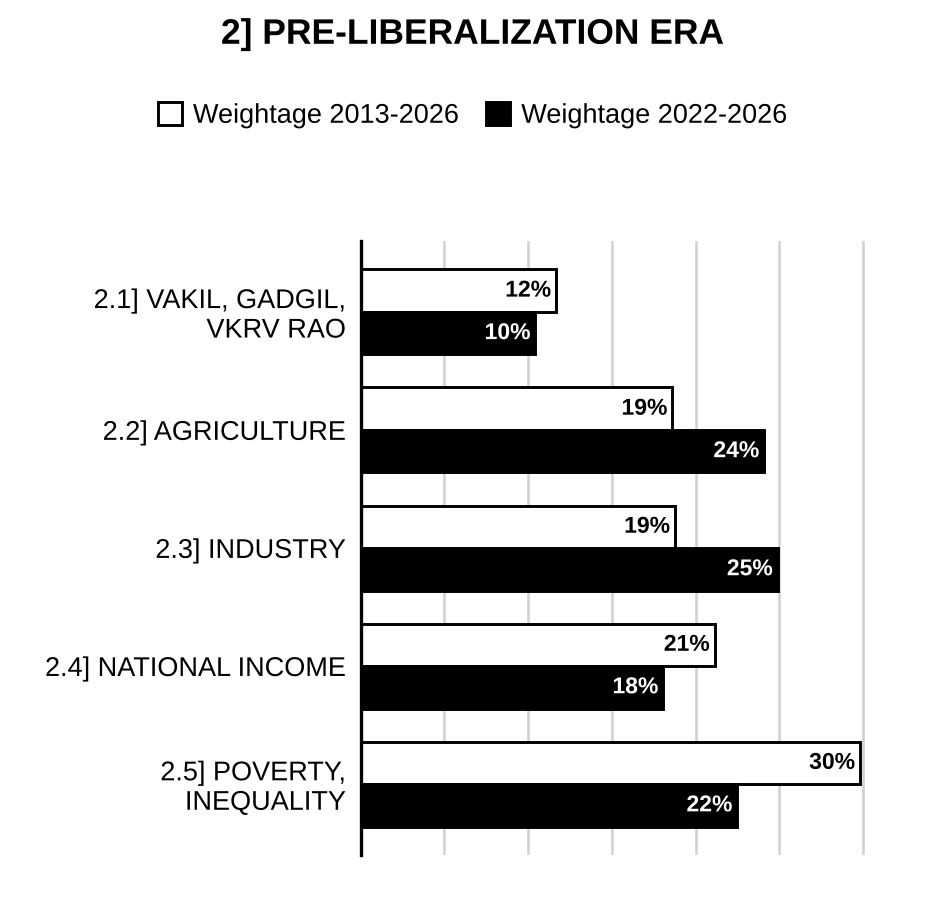
2.1] Contribution of Vakil, Gadgil and V.K.R.V. Rao
20 questions
Compare and contrast the economic thoughts of D. R. Gadgil and V. K. R. V. Rao regarding Indian economic planning and development strategies. [2026/15m/2c]
Examine the alternative model of planning given by C. N. Vakil. [2024/10m/150w/5a]
How did V. K. R. V. Rao improve upon the earlier national income estimates of India? [2023/10m/150w/1b]
Discuss the role of D. R. Gadgil in economic planning and development in India. [2023/20m/3a]
Point out the contribution of C. N. Vakil to Indian Economic Planning. [2022/10m/150w/1c]
Analyse the relevance of Gadgil formula in reducing horizontal imbalance of fiscal health. [2021/10m/150w/1c]
Evaluate the contributions of V.K.R.V. Rao in the National Income Accounting of India. [2020/10m/1b]
Highlight the main contributions of C. N. Vakil to Indian planning as opposed to that of the Mahalanobis Model at the time of the formulation of the Second Five Year Plan for India. [2019/10m/150w/1c]
How did V. K. R. V. Rao improve upon the earlier national income estimates of India? [2018/10m/150w/1b]
Discuss the Wage-Goods model of development as given by C.N. Vakil and P.R. Bramhanand. [2016/15m/2c]
Explain the contribution of V.K.R.V. Rao in the estimation of National Income. [2016/15m/7b]
Do you think that pursuit of wage-goods model could have been more appropriate for post-independence strategy of development? Give reasons. [2015/15m/2a]
Do you think Gandhian vision of development is still relevant in India? Explain with reasons. [2014/15m/2b]
“A close connection between the finance on the one hand, and politics and administration on the other hand, and the influence of the latter on the former cannot be avoided. This is all the more true in India.” Do you agree with this statement of C. N. Vakil? Is it relevant even today? [2013/25m/2b]
Discuss in detail the views of VKRV Rao on deficit financing. [2012/12m/150w/1a]
Throw light on wage-goods model of C.N. Vakil and P.R. Brahmanand. [2011/15m/150w/1b]
Elaborate upon Gandhian versus Nehruvian visions of India’s development. Do you think Gandhian approach is again attracting scholars and the people? Give reasons. [2011/30m/2b]
Discuss the contributions of D.R. Gadgil to Indian Economic Planning and Policy. Evaluate the key elements of the ‘Gadgil Formula’ used by the Planning Commission. [2010/20m/200w/1a]
In a supply constrained economy, how was it argued in India in the 1950s that deficit financing would help raise the growth rate? In hindsight, analyse the validity of this view. [2010/30m/3b]
What is the role played by basics (wage goods) and non-basics (luxury goods) in a model of development for a mixed economy? [2005/20m/200w/1d]
2.2] Agriculture
22 questions
Assess the efficacy of land tenurial system reforms in post-Independent India in addressing intermediary abolition. [2026/10m/150w/1c]
“The Green Revolution ensured food security but exacerbated regional disparities.” Give your views. [2026/10m/150w/1d]
Evaluate the success of land reforms in post-Independent India. Why was the success limited in certain States while non-existent in others? Link land reforms to the broader agricultural transformation and explain. [2026/20m/2a]
Analyze the relationship between the Green Revolution and capital formation in Indian agriculture. Did this strategy-led growth trickle down to small and marginal farmers? [2026/15m/2b]
Is land reform necessary to improve agricultural productivity in India? Discuss. [2025/20m/2a]
Critically analyse the constraints of public and private capital formation in Indian agriculture. [2025/15m/2b]
Examine the objectives and components of the Green Revolution in India. [2025/20m/3a]
Examine the impacts of Green Revolution on production and productivity in the agriculture sector. [2023/10m/150w/1c]
Explain the concept of ceiling on agricultural landholding in India. Examine its rationality with respect to equity and efficiency. [2023/15m/3c]
Discuss, how the green revolution has affected the indigenous crops in India? What measures have been initiated by the Government in the later years to improve the productivity? [2022/15m/2c]
Do you think that effective land reforms are necessary but not sufficient conditions for raising agricultural productivity in India? Explain your answer. [2021/20m/3a]
Analyse the impact of Green Revolution on agricultural output, employment and income distribution in India. [2021/15m/3c]
“The progress in the implementation of tenancy and revenue reforms during the first three decades after independence in India was not satisfactory.” Do you agree with this view? Do you think that the advent of the Green Revolution made such land reforms policy redundant? [2019/20m/3a]
Discuss the technological factors relating to the Green Revolution in India. [2019/15m/3b]
How would you justify the policy of land reforms in the light of the farm size-productivity debate in India? [2018/15m/3b]
Do you think that the green revolution had limited impact on Indian agriculture? Justify your answer. [2018/15m/6c]
Do you agree with the view that an increase in the productivity of agriculture as a result of Green Revolution was only short-term? Give reasons. [2016/10m/150w/1b]
Why are land reforms still not complete in India? What are the obstacles in its way? Elaborate. [2014/15m/2c]
Why Green Revolution lost its steam and India needs yet another Green Revolution or Evergreen Revolution? Discuss. [2014/20m/3a]
What are the components of Land Reforms in India? Has it been completed? If not, then what are the obstacles? [2013/10m/150w/1e]
Evaluate the track record of land reform in India in its various aspects, bringing out inter-state differences. How would you interpret this record? [2009/60m/2]
“The success of the Green Revolution shows the importance of the State in agrarian transformation.” Comment. [2009/20m/200w/5a]

Preparing for Prelims too?
Our UPSC Prelims Topic-wise PYQ eBook covers every Prelims question with detailed explanations, so you can see exactly where UPSC asks from.
View the BookDownload Free Sample2.3] Industry
33 questions
Trace the trajectory of India’s industrial policy from the Nehruvian model of ‘Mahalanobis Strategy’ to the liberalization era. How has the focus shifted regarding the role of the State and heavy industries? [2026/20m/3a]
Trace the evolution of the debate between the public and private sectors in India’s industrial development from the Industrial Policy Resolutions to the 1991 reforms. [2026/20m/4a]
Discuss the significance of small-scale and cottage industries during 1947–1991. What role did Indian States play during the above period in facilitating these industries? [2026/15m/4b]
Point out the main challenges faced by the small-scale and cottage industries in Indian economy. [2025/15m/3c]
What are the causes of industrial backwardness in India? Critically evaluate the role of the New Industrial Policy, announced in July 1991, towards correcting such backwardness. [2025/20m/6a]
Why was the public sector given a leading role in industrial development during the pre-liberalisation era? Explain. [2025/15m/8b]
Why the Mahalanobis strategy of development was abandoned? What were its inadequacies? [2024/15m/2b]
Discuss the inadequacies in the process of industrialisation in the pre-liberalised India. [2024/15m/3c]
Deceleration and structural retrogression have been the key features of industrial sector in India during 1965–80. Give reasons. [2023/10m/150w/1d]
Explain the role of public sector in the Indian economy. Also point out its main problems faced during the period between 1970 to 1980. [2023/15m/3b]
‘The small and cottage industries promote indigenous entrepreneurship’. Comment on the statement with respect to India. [2022/15m/3c]
Explain the principal causes of deceleration in industrial growth during the mid-1960s to mid-1970s. [2021/10m/150w/1d]
Analyse the trends in the production of primary goods and capital goods in Indian industries during the pre-liberalisation period. [2021/15m/2b]
Critically analyse the performance of public sector enterprises during the pre-reform period. [2021/15m/2c]
Comment on the role of the public sector during the early phase of industrial development in India. [2020/10m/1d]
Explain the principal causes of deceleration in industrial growth during the mid 1960’s to mid 1970’s in India. Do you think that the reasons for the slowdown in industrial growth since the late 1990s are basically different from those of the earlier deceleration? Answer with proper arguments. [2019/20m/4a]
Critically examine the relative contributions of public and private sectors in the pre-liberalisation period in India. [2018/10m/150w/5c]
What were the economic and non-economic rationale for adopting mixed-economy model in India? [2016/10m/150w/1c]
During post-independence era India assigned the role of ‘Commanding Heights’ to the public undertakings. Should this policy be continued? Give reasons for your answer. [2016/20m/7a]
What was the impact of policy reservation in favour of small scale industries in India during the post-independence but pre-liberalisation era? [2015/10m/150w/1b]
Mixed economy is an outcome of the compromise between laissez-faire capitalism and socialist state control of resources. Elaborate. Mention its salient features. [2013/10m/150w/1b]
State the basic features of Mahalanobis model. [2013/10m/150w/1c]
The industrial development agenda framed by the Industrial Policy, 1956 transformed the Indian economy substantially from an agricultural to an industrial economy. Elucidate. State in brief sectoral composition of growth during the period before 1990. [2013/25m/3a]
Delineate the trends in the growth and industrial composition of public sector in India during the pre-liberalisation period. [2012/20m/250w/2c]
How was the Jute industry affected after partition? What remedial measures were taken to arrest its decline? [2012/20m/250w/3b]
A number of production lines were reserved for the small scale sector in the pre-liberalisation period. Did such reservation achieve its objectives? Explain in detail. [2012/30m/300w/4a]
What were the shortages faced by the manufacturing sector in India at the dawn of Independence? [2010/10m/2c]
“It was needless export pessimism that led India to adopt import substitution strategy of industrialisation in the pre-liberalisation period.” Critically examine. [2010/30m/3a]
What are your perceptions on: the slowing down of industrial growth in India from the mid 1960s till the mid/late 1970s. [2009/20m/200w/8a]
What are your perceptions on: Whether public and private investments in India are complementary or competing? [2009/20m/200w/8b]
What are your perceptions on: the role of small scale and cottage industries in the present context of the Indian economy. [2009/20m/200w/8c]
Write a detailed note on the import-Substitution and export promotion strategy of India. [2007/60m/6]
What is the role of the small-scale industries in the Indian economy? Discuss briefly the main recommendations of the Study Group on Development of Small Enterprises. [2004/60m/3]
2.4] National and per capita income
31 questions
Provide a detailed analysis of the trends in National Income in India since Independence. Discuss the structural changes in the sectoral composition of GDP. [2026/15m/3b]
What is the sectoral composition of India’s national income? Mention the most important source of national income in India. [2025/20m/7a]
Describe the trend in the growth rate of national income in India from 1950 to 1980 and its impact on poverty. [2024/15m/3b]
Is service-led growth in India sustainable? Comment. [2024/10m/150w/5b]
Examine the factors responsible for acceleration in the growth of national income in the decade of 1980s as against 1960s and 1970s. [2023/10m/150w/1e]
What are the factors contributing towards shift in sectoral composition in Gross National Product (GNP) in India during the pre-economic reform period? Discuss. [2023/15m/2b]
Describe the pattern and trends in national income in India during the pre-economic reform period. [2023/15m/4b]
Highlight the major features of National Income trend and its sectoral composition during the last five decades. [2022/20m/2a]
Do you think that India experienced a major break in GDP growth and its sectoral composition during the 1980s? Give reasons. [2021/20m/4a]
Analyse the trends in GDP growth and inequality during the first three decades of planning in India. Has the distribution of income in India become more equal during the post reform period? Suggest some policy measures that could help reduce income inequalities. [2020/20m/4a]
Discuss the changes in sectoral composition of GDP with the changes in the sectoral components of employment in India since Independence. [2020/15m/4b]
Examine the trends in GDP at factor cost during the pre-reform period in India. [2019/10m/150w/5c]
Reflect on issues and implications of structural transformation in India’s national income. [2018/20m/3a]
Relative contribution of agriculture to the GDP of India has been going down steadily since Independence. Do you think this highlights a weakness of the economy? Explain. [2017/10m/150w/5a]
“Though economic liberalisation in India in the mid 90s aimed at industrial growth, actually the services sector led the economy.” Elucidate. [2017/10m/150w/5d]
How did per capita income in India behave since Independence? Has it improved the well-being of the people uniformly? Give specific reasons. [2017/15m/8c]
What were the major hurdles to development as experienced in India during first decade after independence? Discuss them and what steps were taken to remove them? [2016/15m/4c]
Discuss the changes in the sectoral composition of GDP in recent years. [2016/15m/8c]
Explain the major factors that affected the growth rate of the economy in post-independence India till 1991. [2015/20m/2b]
It is often said that the prime generator of economic growth in India in the post-liberalisation period has been the service sector. Do you agree with this view? What has been its implication on the balance of payments in India? [2015/20m/4a]
Why socialist model of development could not bring about equitable distribution of income in India and the country remained on a slow growth trajectory of 3 to 3.5 percent for a long time? Discuss. [2014/10m/150w/1c]
Highlight the structural changes in Indian economy before 1991. [2014/15m/3b]
While Indian economic growth in recent years is services-led growth and Chinese model is manufacturing-led growth, show the implications of the two models for long-term sustainable development. [2014/10m/150w/5b]
The industrial development agenda framed by the Industrial Policy, 1956 transformed the Indian economy substantially from an agricultural to an industrial economy. Elucidate. State in brief sectoral composition of growth during the period before 1990. [2013/25m/3a]
Accelerated growth of tertiary sector during the past two decades in Indian economy has posed multiple challenges. Discuss. [2013/25m/7b]
What do you mean by the ‘Hindu rate of growth’? Why has it been argued that poverty can not be eradicated under the Hindu rate of growth? [2012/12m/150w/1c]
Trace the growth of real per capita income in India in the pre-liberalisation period, keeping in view the interplay of increasing population and increasing real national income. [2012/12m/150w/1d]
What are the factors which determine the size and composition of national income? In this respect contrast the scenarios between pre and post liberalisation periods. [2012/30m/300w/4b]
“The declining share of commodity producing sectors – agriculture and industry – and rising share of Services sector is creating imbalances of far-reaching consequences in the economy.” Critically analyse. [2011/30m/4a]
“India has of late been over-tertiarized.” Do you agree? Substantiate your answer. [2010/20m/6b]
Provide an analytical description of growth and change in the Indian economy during the period from 1950-51 to 1966-67. [2009/60m/3]
2.5] National income, distribution, poverty and inequality
51 questions
What are the different methods of measurement of poverty in India? Which one do you think is most appropriate and why? [2026/10m/150w/1e]
Why does inter-State disparity in income persist in India despite plethora of development initiatives undertaken by the Government of India? Analyse. [2025/15m/3b]
What are the methods used in measuring poverty and inequality in India? Analyse. [2025/20m/4a]
How have rural and urban economic development contributed to poverty reduction in India? Discuss. [2025/15m/4b]
Describe the trend in the growth rate of national income in India from 1950 to 1980 and its impact on poverty. [2024/15m/3b]
Is poverty ‘capability deprivation’? Discuss. [2024/10m/150w/5e]
Explain the various estimates of rural poverty in India. What measures have been adopted by the Government to reduce it? [2024/15m/7c]
Explain the main causes of inequality in income distribution in India and examine how it affects welfare of the society. [2023/20m/4a]
Do you think that Multi Dimensional Poverty Index (MPI) is a better measure of poverty? Give reasons in support of your answer. What is the position of India in respect of MPI? [2022/20m/3a]
The economic growth has caused deterioration in income distribution in India during liberalisation period. Comment. [2022/15m/4b]
Distinguish between absolute measure and relative measure of poverty. What kind of measure is used in estimating poverty in India? [2021/10m/150w/1e]
Examine the relative role of demand side factors in determining national income in India. [2021/15m/4b]
Do you think that non-income dimensions should be treated as complementary to income dimension in measuring poverty in India? Give reasons. [2021/15m/4c]
Analyse the validity of the inverted ‘U’-shaped hypothesis of Kuznets in the context of changes in inequality in India. [2020/15m/2c]
Analyse the trends in GDP growth and inequality during the first three decades of planning in India. Has the distribution of income in India become more equal during the post reform period? Suggest some policy measures that could help reduce income inequalities. [2020/20m/4a]
“While absolute poverty declines over the decades, the poverty gap between different social groups shows rising trend in India”. Discuss. [2020/15m/4c]
How is the methodology followed by the Rangarajan Committee different from that of the Tendulkar Committee in measuring poverty in India? [2019/10m/150w/5d]
Explain how multi-dimensional poverty index is computed. [2018/10m/150w/1d]
Reflect on the relationship among economic growth, inequality and poverty in the post-reform period in India. [2018/15m/4c]
Throw light on the poverty debate in the pre-liberalisation era in India. [2018/15m/7b]
India’s economic growth is associated with rising inequality. How does it so happen and what actions need to be taken to mitigate the problem? [2017/20m/4a]
How did per capita income in India behave since Independence? Has it improved the well-being of the people uniformly? Give specific reasons. [2017/15m/8c]
Critically examine the difference between absolute poverty and relative poverty. Between the two which is more appropriate? Give reasons. [2016/20m/3a]
Explain the major tools for measuring inequality. Highlight the more appropriate method of measuring inequality. [2016/15m/3b]
The ‘dichotomy of development’ in India emerged owing to ‘governance deficit’ and ‘crony capitalism’. Examine. [2015/15m/3c]
Why socialist model of development could not bring about equitable distribution of income in India and the country remained on a slow growth trajectory of 3 to 3.5 percent for a long time? Discuss. [2014/10m/150w/1c]
Specify the main factors which hindered trickle-down in Indian economy and agenda of ‘inclusive growth’ is being pressed into for economic justice. [2014/10m/150w/1d]
What are the consequences of deviation from socialistic pattern of society and mixed economy particularly for the persons below the poverty line? Explain. [2014/10m/150w/1e]
In Indian economy, dichotomy of development emerged during the pre-reform period despite efforts of holistic development. Delineate the factors responsible for it. [2014/15m/4c]
Highlight the issues of Bhagwati-Sen controversy over tackling poverty and slow growth rate. [2014/10m/150w/5a]
‘Elitist bias’ and ‘crony capitalism’ have eclipsed the issues of efficiency and distributive justice in India. Elaborate. [2014/20m/7a]
How is development looked upon by A. K. Sen in terms of freedom and poverty as unfreedoms? Point out his narration of five dimensions of poverty. [2013/10m/150w/1d]
How are ‘absolute’ and ‘relative’ poverty measured? What modification in it has been suggested by Amartya Sen? What are the recent advances in the area of poverty measurement? Discuss. [2013/25m/3b]
Write on ‘dichotomy of development’ and ‘urban-bias’ in Indian economy. [2013/10m/150w/5d]
What is ‘Crony Capitalism’? How it compromises economic and social justice issues? Explain. [2013/10m/150w/5e]
What do you mean by the ‘Hindu rate of growth’? Why has it been argued that poverty can not be eradicated under the Hindu rate of growth? [2012/12m/150w/1c]
Explain why in spite of economic planning income-distribution has turned more unequal through time. [2012/12m/150w/1e]
Compare the strategies of trickle down growth with inclusive growth. Why should the strategy of inclusive growth be preferred? [2012/20m/250w/3a]
Discuss the various measures of poverty with policy implications for removal of poverty. [2012/20m/250w/3c]
What are the factors which determine the size and composition of national income? In this respect contrast the scenarios between pre and post liberalisation periods. [2012/30m/300w/4b]
Discuss Amartya Sen’s poverty measure and recent advances in poverty measurement. [2011/15m/150w/1a]
“By restricting social benefits to BPL households, the poverty line (in India) will be fully converted from a statistical benchmark to a real-life social division” (Dreze). Discuss. [2011/15m/150w/1d]
Discuss the poverty trends – both rural and urban, between 1973–74 and 2004–05 across States in terms of pace of reduction and concentration and relate them with changes in growth rates between the pre- and the post-liberalisation periods. [2010/60m/4]
Critically assess the Tendulkar Committee’s approach to measuring poverty in India. [2010/15m/150w/5a]
Recent trends show that poverty incidence in urban areas is higher than its rural counterpart in more prosperous states. What factors, do you think, explain this? [2010/20m/6c]
Carefully examine and analyse the argument that over the last two decades there is an increasing divergence between the incidence of poverty based on the Planning Commission’s Expert Committee methodology and that based on calorie intakes as obtained from the National Sample Surveys. [2009/60m/4]
Examine critically the Economic Reforms underway since 1991 with reference to their effect on inequality, poverty reduction and vulnerability to external shocks. [2009/60m/6]
Discuss the nature and incidence of the problem of rural poverty in India. What suggestions do you offer to solve it? [2007/20m/200w/1b]
Write a detailed note on the structure & determinants of rural poverty in India. [2005/20m/200w/1b]
What are the determinants of the distribution of income in India? [2005/60m/3]
Critically evaluate the process of ‘trickle down’ as a policy stance for Indian economy. [2005/60m/8]

Strengthen your GS papers
Our UPSC Mains Topic-wise & Year-wise PYQ eBook (2013–2026) maps every GS question to the syllabus, so you know what UPSC asks and how often.
View the BookDownload Free Sample« Previous: Indian Economy in Pre-Independence Era | Next: Indian Economy after Independence: B. The Post Liberalization Era »
Back to: Economics Optional PYQs – Topic-wise | Also see: Economics Optional year-wise question papers
Last updated: 30 October 2026