
Here are all 120 International Economics questions asked in UPSC Economics Optional Paper I from 2004 to 2026, arranged under the 8 topics of the official syllabus. Within each topic the latest questions come first.
Each question ends with a code such as [2024/15m/3b] – the year, the marks, the word limit (where UPSC set one) and the question number in the paper.
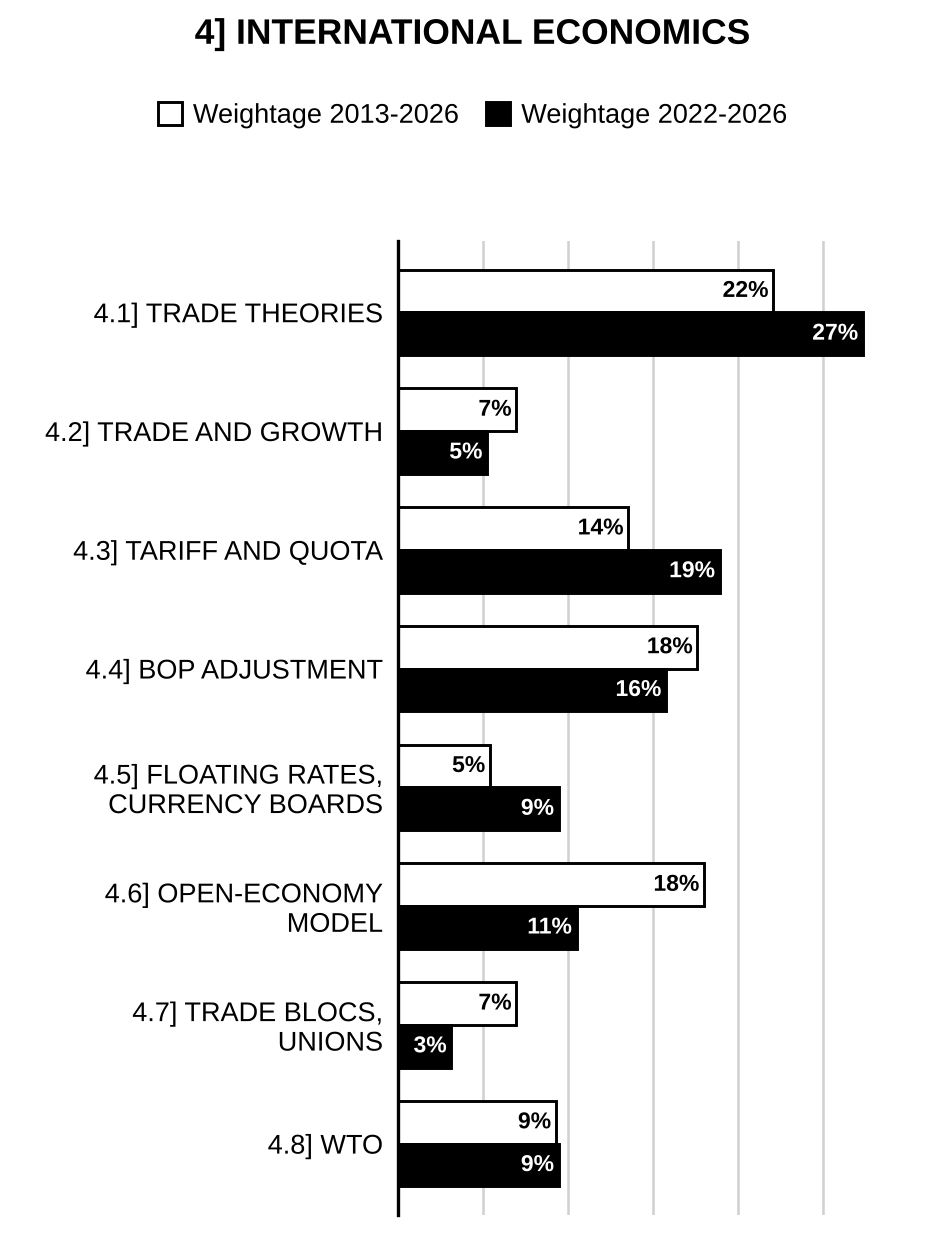
4.1] Old and new theories of international trade
30 questions
Discuss the major differences between Old and New international trade theories. [2026/20m/6a]
Define offer curve and explain its slope. [2025/10m/150w/5a]
State Heckscher-Ohlin theory. Explain the Leontief Paradox in this context. [2025/10m/150w/5c]
Explain how the equilibrium terms of trade are determined by using offer curves of the trading partners. [2024/10m/150w/5e]
By using Stolper-Samuelson theorem, discuss the possible effects of free trade on income inequalities in developing countries. [2024/15m/6b]
“Factor intensity reversal is incompatible with Heckscher-Ohlin model.” Examine this statement. [2023/10m/150w/5a]
“A continuous process of innovation and invention would give rise to trade even between countries with similar factor endowments and tastes.” Examine the statement. [2023/15m/6b]
Examine the significance of external economies and product variety in the context of international trade theory. [2023/15m/6c]
Discuss the Factor Endowment theory of trade in terms of ‘abundance in factor prices’ and ‘factor abundance’. [2022/10m/150w/1d]
Examine whether in Ricardian model, the theory of comparative advantage actually becomes a doctrine of comparative costs. [2022/15m/7a]
Discuss the theory of acquired advantage in international trade using suitable examples. [2021/15m/7a]
In the context of international trade theory, discuss in detail the various stages of the international product life cycle. [2020/10m/150w/5b]
What are the features based on which the new trade theories are built that are distinctly different from the old theories? [2019/20m/4c]
Explain, with the help of diagram, how Haberler’s theory of opportunity cost is an improvement over the comparative cost theory of Ricardo. [2018/15m/6a]
Write a short note on gravity model of trade. [2017/10m/150w/5b]
Differentiate between inter-industry and intra-industry trade. Can standard H-O model explain intra-industry trade? Discuss. [2016/10m/150w/5a]
Explain Brander-Krugman model of intra-industry trade in an oligopolistic market. [2016/10m/150w/5c]
“Technical progress in capital-intensive sector almost invariably reduces the real wage rate and increases the real return to capital. Technical progress in labour-intensive sector will lead to increase in real wage rate and decrease in the real return to capital.” Explain. [2016/15m/6b]
What is meant by ‘factor abundance’? How does it affect the shape of the production frontier of a nation? [2014/10m/150w/5a]
Explain the conditions under which complete specialisation will be possible for two nations in case of comparative advantage. Suppose productivity per unit of labour for two nations, India and UK, is given as under: Will mutually beneficial trade be possible for the two nations? If yes, explain whether specialisation shall be complete or not. [2014/10m/6c]
Distinguish between single and double factor terms of trade. Explain how far terms of trade of a developing economy would change with technological advancement and economic growth. [2014/20m/7b]
What is an offer curve in international trade? For two countries engaged in trade in two goods, draw the offer curves such that the offer curve of the home country has a section reflecting inelastic import demand and the foreign country’s offer curve is elastic throughout. Indicate in your diagram which part of the home country’s offer curve is inelastic. What is the reason for this shape of the offer curve? Suppose the home country imposes a tariff on imports. Demonstrate the implications for trade. [2013/10m/150w/5b]
What are the two key conclusions of the Heckscher-Ohlin model of international trade? Under what assumptions are these conclusions arrived at? [2013/15m/8c]
Show different stages of product life cycle. How do the shortcomings of diffusion lag of new technologies in recent years cause a time compression of the cycle? [2012/12m/150w/5d]
How do the small trading nations share the gains from trade which occur, as a consequence of gains from exchange and gains from specialisation? [2011/20m/4a]
If all assumptions hold true, how does trade between nations tend to bring about equalisation of factor prices? [2011/20m/4b]
Does the Heckscher–Ohlin theorem withstand the factor intensity reversal test? In this context, state the relevance of Leontief Paradox. [2010/30m/3b]
“If each country is endowed with a certain fixed commodity combination, the differences in demand patterns in these countries can lead to emergence of international trade.” Explain this statement with the help of offer curves of the two countries. [2009/20m/200w/5a]
“Heckscher-Ohlin theory does not invalidate the classical theory of comparative cost but rather powerfully supplements it”. Substantiate the statement. [2007/60m/6]
Explain Leontief paradox. [2004/20m/200w/5b]
4.2] Trade as an engine of growth and theories of underdevelopment in an open economy
7 questions
In what sense trade can act as an engine of growth? Elaborate. [2026/10m/150w/5b]
Illustrate Jagdish Bhagwati’s doctrine of ‘Immiserising Growth’. [2022/15m/7c]
Trade can be growth-promoting or growth-inhibiting. Argue in terms of the established theories. [2019/20m/8b]
“The argument that export-biased growth may turn the terms of trade unfavourable to the country and hence may not be beneficial, is applicable in the case of a large country and not a small country.” Explain. [2016/20m/7a]
What is ‘immiserizing growth’? How can it be prevented through trade policy interventions? [2015/10m/150w/5b]
Distinguish between single and double factor terms of trade. Explain how far terms of trade of a developing economy would change with technological advancement and economic growth. [2014/20m/7b]
Summarize the main arguments of the trade optimists and trade pessimists with regard to trade policy for developing countries. Which argument does the data tend to support? [2013/10m/150w/5c]
4.3] Forms of protection
16 questions
“Import tariffs typically result in a net welfare loss for a country”. Do you agree? Justify your answer by applying an import tariff for a small economy and a large economy. [2026/10m/150w/5a]
Explain the price effect, protective effect, consumption effect, revenue effect and distributive effect of tariff in partial equilibrium framework. [2025/20m/6a]
“Higher tariffs do not increase employment, they just redistribute the unemployed.” Do you agree with the statement? Explain. [2024/10m/150w/5d]
Consider the market for good X for Country 1 and Country 2. The supply and demand functions for Country 1 are given as and , while that of Country 2 are given as and . Assume that there are two countries in the world and trade is balanced. Free trade price is stabilized in between autarky prices of both the countries. Based on the above information, answer the following questions: (i) From the free trade price and zero transportation cost, if the importing country imposes an import quota of 50 units, determine the quantity of good X produced and consumed. Calculate the consumer and producer surplus and protection cost due to import quota. (ii) From the free trade price, assume that the importing country is small and consider an import tariff of Rs. 10 per unit on good X. Calculate the impact on consumer surplus, producer surplus and government revenue. Does this policy increase national welfare? [2023/20m/6a]
Under Partial equilibrium analysis, discuss the consumption and revenue effects of tariffs. [2022/10m/150w/5c]
Distinguish between nominal and effective rates of protection in Standard Trade Model. Suppose • nominal tariff on imported good is 40%, • tariff rate on input is 40%, • cost share of imported input in the total cost of production of commodity is 0.5%. Determine the effective rate of protection and show that in this case nominal tariff rate is equal to the effective rate of protection. [2022/20m/7b]
Many countries subsidize some of their export industries. Use a partial equilibrium model under perfect competition to illustrate the following effects of an export subsidy for a large country: (i) Welfare effects of an export subsidy (ii) Which group is winning and which is losing from the subsidy? [2020/15m/4a]
In what way does the concept of a positive optimal tariff apply to only large countries and not to small countries? Explain. [2019/15m/7a]
A quota on import and an equal-import tariff are equivalent in a competitive market but not under monopoly. Explain. [2018/15m/6b]
Determine optimum tariff of a country with the help of offer curve. [2017/10m/150w/5c]
“The consumption and production effects of a tariff for a commodity depend on the elasticities of demand and supply respectively.” Discuss. [2017/15m/6a]
Analyse the partial equilibrium effects of a tariff imposed by a large country on its imports in terms of consumers’ surplus. [2014/10m/150w/5e]
What is an offer curve in international trade? For two countries engaged in trade in two goods, draw the offer curves such that the offer curve of the home country has a section reflecting inelastic import demand and the foreign country’s offer curve is elastic throughout. Indicate in your diagram which part of the home country’s offer curve is inelastic. What is the reason for this shape of the offer curve? Suppose the home country imposes a tariff on imports. Demonstrate the implications for trade. [2013/10m/150w/5b]
How is subsidy better than tariff to achieve domestic objectives? [2011/20m/6c]
“In the presence of domestic distortions, subsidies are the first best policies and tariffs are the second best.” Do you agree? Explain. [2009/20m/200w/5c]
Examine the effects of quota and tariffs on terms of trade. Discuss the advantages of quota over tariffs in the present day context. [2005/60m/6]
4.4] Balance of payments adjustments: alternative approaches
21 questions
What is J-curve effect? Explain it graphically. [2025/10m/150w/5b]
Discuss the elasticity approach and absorption approach for adjustments in balance of payments. [2024/20m/6a]
Explain how the elasticity of demand for foreign exchange is influenced by the elasticity of home demand for imports and by the elasticity of home supply of import-competing goods. [2024/15m/6c]
Explain the concept of “sterilization” in the context of monetary approach to balance of payments. [2023/20m/4a]
Why depreciation of a currency is inflationary? Explain. [2023/10m/150w/5b]
Show that the economic integration is the pre-requisite to establish covered interest rate parity. [2021/10m/150w/5c]
Under what condition Real Exchange Rate is synonymous to ‘terms of trade’? Discuss. [2021/10m/150w/5d]
Do you think that movement of the nominal exchange rate of Rupee represents a corresponding movement of Indian goods vis-á-vis foreign goods? Explain your position. [2021/15m/7b]
In an economy, the government is trying to boost the local economy by a massive advertisement ‘buy local – local is best’. (i) Assuming that the public tend to be persuaded by the campaign, what effect might this have on the economy’s multiplier? (ii) Critics argue that this is unfair and leads to distortions in free trade. Examine how the economy performs here under flexible exchange rate system. [2020/15m/6a]
Under what conditions will devaluation create trade surplus and increase output in the simple Keynesian framework? [2018/10m/150w/5a]
“Monetary Contraction is a better option than devaluation to improve balance of payments position of a developing economy under fixed exchange rate system.” Discuss. [2017/15m/6b]
Petroleum is sold in the world market and priced in US dollars. RISCO in India must import petroleum to use it in its manufacturing. How are its profit affected when Indian rupee depreciates against the US dollar? [2017/15m/7a]
With the help of Salter-Swan diagram, define the zones of disequilibrium and assign policy prescriptions for the situations pertaining to unemployment and inflation vis-à-vis BOP deficit. [2016/20m/7b]
What are the elasticity and absorption approaches to BOP adjustment? Discuss. [2016/20m/8a]
How do depreciation and appreciation in the external value of a currency impact a country’s balance of payments? [2015/10m/150w/5d]
In the context of a two-country model, derive foreign trade multiplier and explain its working. What will be its repercussion? [2015/20m/6a]
How does portfolio balance approach differ from monetary approach in determining the exchange rate? [2011/20m/4c]
How does the policy mix of fiscal and monetary policies maintain equilibrium in balance of payments and full employment? [2011/20m/7a]
What are the different kinds of disequilibrium in balance of payment? Suggest some measures to solve the problem of structural disequilibrium in balance of payments. [2007/20m/200w/1c]
“Under the flexible foreign exchange rate scenario devaluation has become redundant”. Comment upon the statement. [2007/20m/200w/5c]
Critically examine Mundell’s approach for the effective use of monetary and fiscal policy to attain macro balances. [2004/60m/2]

Preparing for Prelims too?
Our UPSC Prelims Topic-wise PYQ eBook covers every Prelims question with detailed explanations, so you can see exactly where UPSC asks from.
View the BookDownload Free Sample4.5] Floating rates, currency boards and trade policy for developing countries
6 questions
Explain managed floating and sterilized interventions for exchange rate. [2024/10m/150w/5b]
Discuss the issues (pros and cons) in the debate over import substitution and export promotion strategy for developing countries. Which strategy would you favour and why? Explain. [2024/15m/7c]
State the functions of United Nations Conference on Trade and Development (UNCTAD). Do you think that UNCTAD has been successful in extending economic cooperation among the developing countries? Justify your answer. [2022/20m/8a]
How can controls on foreign trade contribute to the development of developing countries? [2019/20m/2c]
Summarize the main arguments of the trade optimists and trade pessimists with regard to trade policy for developing countries. Which argument does the data tend to support? [2013/10m/150w/5c]
Distinguish between Currency Board Arrangement and dollarisation. Why would a nation adopt one or the other? [2012/12m/150w/5e]
4.6] Open-economy macro-model, policy coordination and speculative attacks
21 questions
Explain the effect of a monetary expansion on exchange rate in the short and the long run under perfect capital mobility. [2026/15m/6b]
Do you think that perfect capital mobility under fixed exchange rate improves the effectiveness of fiscal and monetary policies? Explain. [2025/15m/6c]
Discuss the effectiveness of the monetary policy in an open economy with flexible exchange rate and perfect capital mobility. Will this policy remain effective with fixed exchange rate also, while other things remain the same? Explain. [2022/20m/3c]
Do you think that increase in Government spending through borrowing from public accompanied by fall in required reserve ratio generates recession in the economy? Illustrate your answer: (i) in a closed economy with fixed exchange rate. (ii) in an open economy with fixed exchange rate and without any capital mobility. [2021/20m/4c]
In an economy, the government is trying to boost the local economy by a massive advertisement ‘buy local – local is best’. (i) Assuming that the public tend to be persuaded by the campaign, what effect might this have on the economy’s multiplier? (ii) Critics argue that this is unfair and leads to distortions in free trade. Examine how the economy performs here under flexible exchange rate system. [2020/15m/6a]
In case of perfect capital mobility, explain the difference of the impact of an increase in money supply on GDP under two alternative exchange rate regimes – one fixed and the other flexible. [2019/15m/3b]
What are the obstacles to international macro-economic policy coordination? Discuss. [2019/10m/150w/5e]
In an open economy with high capital mobility, monetary management can be a successful tool to increase output. Explain. [2018/15m/4b]
Give an outline of a model of speculative attack under fixed exchange rate. [2018/10m/150w/5e]
What are the advantages and disadvantages of capital mobility for developing countries? [2015/10m/6c]
What do you understand by a small open economy in the context of both goods and money markets? [2014/10m/150w/5c]
Why is it that in a pure flexible exchange rate system, foreign exchange market has no direct effects on the monetary base and money supply? Does this mean that the foreign exchange market has no effect on the monetary policy? [2014/20m/7a]
After 2003 till 2008 many emerging economies including India received huge capital inflows. To contain the effect of these flows the central bank sterilized the inflows. What is sterilization and how does it affect the supply of money in the economy? [2013/25m/4b]
Suppose the goods, financial, current account and foreign exchange markets are initially in equilibrium. The economy has low or imperfect capital mobility and operates at a fixed exchange rate. The economy is subject to a favourable demand shock that raises expenditure. What is the outcome of the shock on the aggregate income and interest rate in the short-run? How is the balance of payments equilibrium achieved? Draw a diagram in support of your answer. [2013/25m/7a]
What is a speculative attack on a currency? Suppose the economy has a fixed exchange rate and the government is following an expansionary macroeconomic policy. The government increases the budget deficit which it finances through a monetary expansion. How does this lead to a crisis? What is the timing of the speculative attack? [2013/25m/7b]
In the contemporary world of perfect capital mobility and fixed exchange rates, why is the monetary policy ineffective to maintain equilibrium? [2011/20m/7c]
Show that in an open economy, given full capital mobility, fiscal action has maximum effect under fixed exchange rate and monetary action has similar effect under flexible exchange rate. [2010/40m/6a]
What do you understand by ‘sterilisation’ effects of foreign exchange market intervention? How does ‘sterilisation’ work in the case of imperfect capital mobility? [2010/30m/7b]
Do you subscribe to the view that in a small open economy with perfect capital mobility, expansionary fiscal policy is ineffective under freely flexible exchange rate, whereas expansionary monetary policy will increase the national income? Elaborate your answer using suitable diagrams. [2009/60m/6]
Define a balance of payments function and explain the factors that cause a shift in this function. Explain the general equilibrium situation in a four-sector IS-LM model. [2009/20m/200w/8a]
Discuss critically the role of International Monetary Fund in imparting stability in international monetary system. [2005/20m/200w/5b]
4.7] Trade blocs and monetary unions
7 questions
Define the concepts of trade creation and trade diversion. Explain their role in the context of gains from trade bloc. [2025/15m/6b]
What are the different categories of trade blocks? Are trade blocks beneficial to less developed economies? Justify your answer. [2021/20m/7c]
Explain how trade blocks are important in the process of economic globalization. Illustrate your answer with suitable examples. [2020/15m/7b]
Distinguish between Monetary union and Economic union. Do the proliferating trading blocks adversely affect the free trade in the world? Give reasons for your answer. [2015/20m/6b]
“With the Doha Round of multilateral trade talks stalled, regional trade agreements (RTAs) have emerged as an alternative approach to increase trade, spur stronger economic growth and lower unemployment rates in the participating countries.” Explain. [2014/20m/6a]
Why are trading blocks formed? Explain the welfare impact of such trading blocks for non-member countries. [2012/20m/7c]
What is a Customs’ Union? Discuss the effects of a Customs’ Union formation under partial equilibrium conditions. [2004/60m/6]
4.8] WTO
12 questions
Explain the “Single Undertaking” principle used in the Doha Round and its implications for WTO negotiations. [2026/10m/150w/5e]
Explain whether the parallel imports violate provisions of TRIPS and affect the pricing policy of a patent holder MNC. Give reasons why all rich nations do not follow this? [2026/15m/6c]
Explain the role of World Trade Organization (WTO) in the present context. Discuss the merits and demerits of TRIMs and TRIPs. [2025/20m/8a]
What is Doha Development Agenda? Explain how it negotiated TRIPS and TRIMS among nations. [2018/20m/6c]
What are the implications of trade in higher education under GATS for India? [2017/10m/150w/5e]
Do you agree with the view that the honeymoon with free trade under W.T.O. is at an end? Give reasons for your answer. [2017/20m/6c]
What is the stalemate in the WTO about subsidies in less-developed economies? Discuss. [2016/15m/6c]
Explain the Trade Related Investment Measures (TRIMs) of World Trade Organisation (WTO). What are the major debates relating to it? [2014/10m/8c]
What are India’s gains under WTO regime with respect to (i) Service sector, (ii) Globe-Hex model? [2011/20m/8c]
Describe the structure of WTO with reference to five main agreements. [2010/30m/7a]
“The Ministerial Declaration adopted at Hon Kong addresses some of the concerns of developing countries related to agriculture”. Comment upon the statement. What were the time frames and targets in specific areas decided in the declaration? [2007/20m/200w/5a]
Give salient features of WTO Agreement in relation to agriculture. In this context explain the concept of TRIPS. [2005/20m/200w/5d]

Strengthen your GS papers
Our UPSC Mains Topic-wise & Year-wise PYQ eBook (2013–2026) maps every GS question to the syllabus, so you know what UPSC asks and how often.
View the BookDownload Free Sample« Previous: Money-Banking and Finance | Next: Growth and Development »
Back to: Economics Optional PYQs – Topic-wise | Also see: Economics Optional year-wise question papers
Last updated: 30 October 2026