
Here are all 91 Advanced Macro Economics questions asked in UPSC Economics Optional Paper I from 2004 to 2026, arranged under the 4 topics of the official syllabus. Within each topic the latest questions come first.
Each question ends with a code such as [2024/15m/3b] – the year, the marks, the word limit (where UPSC set one) and the question number in the paper.
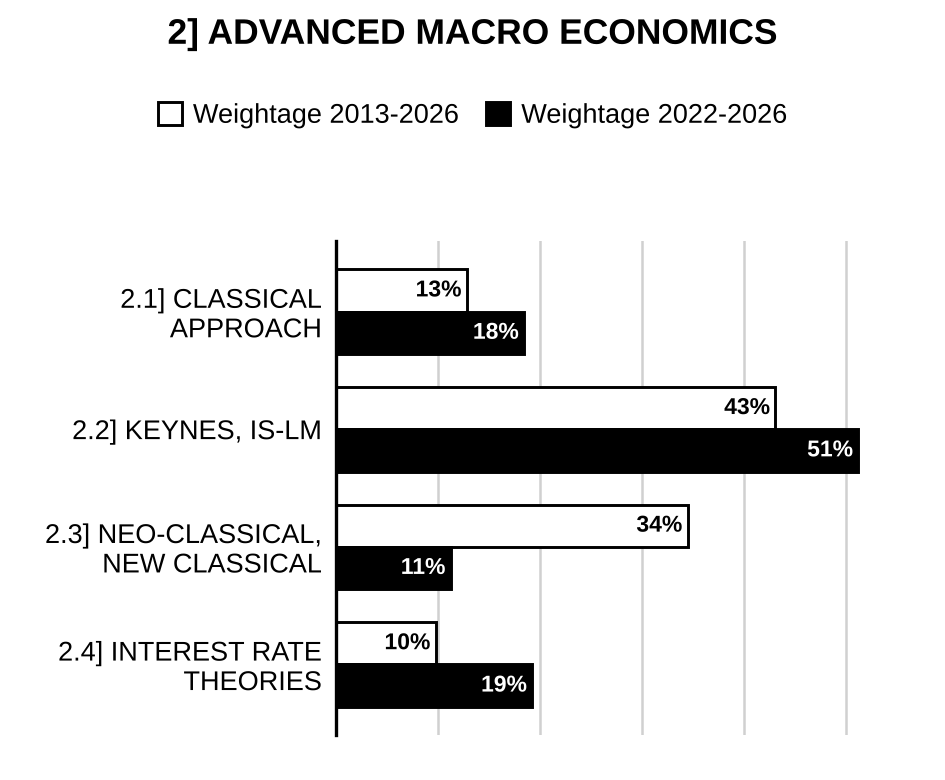
2.1] Classical approach to employment, income and interest rate determination
14 questions
Show how the aggregate demand curve is derived in the classical system. Mention its special property. [2026/10m/150w/1b]
(i) Show how automatic full-employment is guaranteed in the classical model. (ii) How does Keynes show the possibility of underemployment equilibrium in the labour market? [2026/15m/3b]
What is classical dichotomy? Is it the same as neutrality of money? Explain. [2025/10m/150w/1c]
“The failure of classical full employment equilibrium paved the way for Keynes’ theory of underemployment equilibrium.” Discuss critically. [2025/15m/3c]
Discuss critically the phenomenon of classical dichotomy. [2024/10m/150w/1b]
Explain the major differences between classical and Keynesian macroeconomics. [2023/10m/150w/1c]
What will be the shape of the aggregate supply curve in the Classical and Keynesian models? Give detailed explanation. [2022/15m/4c]
Show that full employment is the logical conclusion of the Classical macro model. [2017/10m/150w/1e]
Explain how the equilibrium employment and real wage would change in a typically classical model if, in the event of increase in supply of labour, money wage becomes rigid. [2017/20m/2c]
Discuss the classical dichotomy that money is neutral. [2014/10m/4c]
Explain the determination of output and employment in a macroeconomy under the conditions when individuals are subject to (i) no money illusion, (ii) money illusion. [2013/10m/150w/1c]
Macroeconomics is usually approached via the outcomes of economic interaction in the following four markets – commodities, money, bonds, and labour markets. The Classical economists focused on which three of these four markets? In which market does the loanable fund theory of interest rate determination of the Classical economists focus and how is the interest rate determined? The Neo Classical synthesis focuses on which three markets? In which market is the interest rate primarily determined in the liquidity preference theory? [2013/25m/4a]
Why is under-employment equilibrium possible in Keynesian economics, but not possible in Classical economics? Give reasons. [2012/20m/2b]
“In the Keynesian system, aggregate demand determines the conditions of labour market, whereas in the classical system, the labour market takes care of itself.” Explain this statement. [2005/60m/3]
2.2] Keynes: the IS-LM curve
44 questions
The following values for an economy are given: , , , , , , . The variables have their usual meaning. Find the following: (i) The equilibrium values of and (ii) Slopes of IS and LM curves (iii) Expression of government expenditure multiplier for income in terms of slopes of savings function, investment function and money demand function (iv) If the government expenditure goes up by 240, how much will be the rise in in terms of the multiplier derived in the part (iii) above? [2026/20m/3a]
(i) Show how automatic full-employment is guaranteed in the classical model. (ii) How does Keynes show the possibility of underemployment equilibrium in the labour market? [2026/15m/3b]
Interpret the slope of the IS curve. Why is IS curve normally negatively sloped? [2025/10m/150w/1b]
Define liquidity trap. Show that fiscal policy is fully effective in the horizontal part while the monetary policy is fully effective in the vertical part of the LM curve. Illustrate your answer graphically with economic reasons. [2025/20m/3a]
“The failure of classical full employment equilibrium paved the way for Keynes’ theory of underemployment equilibrium.” Discuss critically. [2025/15m/3c]
Explain the concept of underemployment equilibrium with graphical illustration. Why full employment cannot be reached automatically in Keynes’ approach? Analyse. [2024/20m/3a]
Calculate the equilibrium national income () and interest rate () by using an appropriate macroeconomic model from the information given below: Aggregate saving function: Tax function: Investment function: Money demand function: Aggregate money supply: (rupees in crore) How will the equilibrium values change when money supply is increased by ₹ 20 crore? [2024/15m/3b]
Explain the major differences between classical and Keynesian macroeconomics. [2023/10m/150w/1c]
What is meant by internal rate of return in the theory of investment? What is its importance in deciding whether to accept investment project? [2023/10m/150w/1d]
In the IS-LM framework, the effectiveness of monetary and fiscal policies depend on the interest elasticity of investment. Explain. [2023/15m/3b]
How important is speculative demand for money in achieving unemployment equilibrium in the Keynesian model? Discuss. [2023/15m/3c]
IS curve is the locus of equilibrium points in the commodity market. What do the points above and below the IS curve signify? [2022/15m/3a]
What will be the shape of the aggregate supply curve in the Classical and Keynesian models? Give detailed explanation. [2022/15m/4c]
Examine the relationship between business cycle and changes in autonomous expenditure. [2021/10m/150w/1c]
The slope of the IS schedule will become steeper if the government reduces the rate of proportional tax but will not change at all if the government reduces the level of a lump sum tax. True or false? Explain. [2021/10m/150w/1e]
Do you think that increase in Government spending through borrowing from public accompanied by fall in required reserve ratio generates recession in the economy? Illustrate your answer: (i) in a closed economy with fixed exchange rate. (ii) in an open economy with fixed exchange rate and without any capital mobility. [2021/20m/4c]
Explain how equilibrium rate of interest and income are determined with the interaction of both product and money market. [2020/10m/150w/1a]
You are given the data on the following variables in an economy: (i) Consumption () is 600, when income () is equal to 1500. Solve for autonomous consumption. (ii) Solve for the equilibrium levels of output denoted (respectively by and ) in the two scenarios – presence and absence of income tax in the economy. (iii) Solve for the change in net exports that would bring the equilibrium output level in the economy with the income tax to the level of that you found in (ii). Specify both the magnitude and sign of the change. [Figures are in ₹ ’000 crore, obviously except tax rate and MPC]. [2020/20m/3c]
In the context of a developing economy, do you think that fiscal policy is more effective than monetary policy? Give reasons in support of your answer. [2020/10m/150w/5d]
What do you mean by Tobin’s ‘q’ theory of investment? How would you modify the standard IS-LM functions in the presence of Tobin’s ‘q’? [2020/15m/6b]
The following data are given for an economy: Consumption function, Investment function, Real money demand function, Nominal money supply, Price level, Tax Government expenditure Here Real income, Real rate of interest, Nominal money demand, Price level. (i) Find the equations for and curves, and solve for and . (ii) Find out the multiplier formula for money supply change and then calculate the change in output if money supply changes by 510. [2019/15m/2b]
Keynesian demand for money is one of the key concepts of Keynesian theory of unemployment. Illustrate. [2019/15m/7b]
Using the IS-LM model, show how expected deflation may cause equilibrium output to remain at less than full-employment level. [2018/10m/150w/1c]
In the simple Keynesian model, if consumption and investment are both functions of income, how would the multiplier be affected? [2018/15m/3a]
Show that in the complete Keynesian model only fiscal policy is effective during a period of depression. [2017/10m/150w/1c]
Explain the Keynesian and classical extreme monetary assumptions for showing their effects on the slope of the LM curve. [2017/20m/4c]
What are the fiscal and monetary implications of vertical IS and vertical LM curves? [2016/10m/150w/1d]
Show that liquidity preference is neither necessary nor sufficient for the existence of involuntary unemployment in Keynesian system. [2015/20m/3b]
Explain the meaning and significance of money illusion on the part of workers in the Keynesian theory of employment. [2015/10m/4c]
Explain the paradox of thrift. [2014/10m/150w/1e]
Explain with appropriate assumptions, the determination of equilibrium income and interest rate in a Keynesian model of goods and money markets, through diagrams. [2014/20m/3a]
Explain the determination of output and employment in a macroeconomy under the conditions when individuals are subject to (i) no money illusion, (ii) money illusion. [2013/10m/150w/1c]
Why is under-employment equilibrium possible in Keynesian economics, but not possible in Classical economics? Give reasons. [2012/20m/2b]
Why does the point of intersection of IS and LM curves coincide with two markets? [2012/20m/6b]
What are the fiscal and monetary implications of vertical IS and vertical LM curves? [2012/20m/6c]
The marginal efficiency of capital together with the current rate of interest determine the profitability of an investment project. How does it help in the selection of an investment project? [2011/20m/200w/1b]
What is ‘liquidity trap’? How does it occur? Illustrate. [2011/20m/3b]
Why does the point of intersection of IS and LM curves coincide with the equilibrium of two markets? [2010/20m/200w/2a]
What are the fiscal and monetary implications of vertical IS and vertical LM curves? [2010/20m/200w/2b]
In Keynesian theory “rate of interest is what it is because it is expected to become other than it is. If it is not expected to become other than it is, there is nothing to tell us why it is what it is.” Critically evaluate this comment and explain the role of rate of interest in determination of equilibrium income. [2010/40m/4a]
Is the speculative demand for money responsible for the existence of involuntary unemployment in Keynesian system? Give reasons. [2010/20m/200w/5b]
“Cambridge equation determines income () assuming rate of interest () as given, whereas Keynes theory of interest rate determination assumes given income. Both are thus incomplete.” Do you agree with the above assertion? How would then these two variables ( and ) be determined simultaneously? [2009/20m/200w/1d]
Explain Keynes’ Absolute Income hypothesis. Give a critical evaluation of this theory. [2005/20m/200w/1c]
“In the Keynesian system, aggregate demand determines the conditions of labour market, whereas in the classical system, the labour market takes care of itself.” Explain this statement. [2005/60m/3]

Preparing for Prelims too?
Our UPSC Prelims Topic-wise PYQ eBook covers every Prelims question with detailed explanations, so you can see exactly where UPSC asks from.
View the BookDownload Free Sample2.3] Neo-classical synthesis and New classical approaches
24 questions
Give an outline of the new classical policy ineffectiveness proposition. [2026/15m/3c]
“Under rational expectation hypothesis, systematic monetary policy is ineffective.” Explain the above statement using a suitable model. [2023/20m/3a]
Show that differences in underlying expectation lead to differences in Keynesian and classical aggregate supply curve. [2021/15m/3a]
Derive short-run aggregate supply curve following Lucas, when expectations are not realised, assuming that labour market clears. What will be its shape when expectations are fulfilled? [2021/15m/4a]
Examine the effects of providing public service by a private agency at a lesser price than earlier one on (i) a closed economy with fixed wages. (ii) a closed economy with flexible wages. [2021/15m/8b]
Show that systematic monetary and fiscal policies are ineffective in controlling output and price level. [2020/15m/2b]
What makes monetary policy ineffective even in the short run? Explain. [2019/15m/8a]
Is stagflation a logical outcome of Keynesian orthodoxy? Give reasons for your answer. [2018/10m/150w/1d]
What is hysteresis? Explain the impact of hysteresis in Gradualist Monetarist and Eclectic Keynesian frameworks. [2018/15m/3b]
How will you derive the real aggregate demand curve using the New Classical Theory? [2018/20m/3c]
Explain the difference between the assumptions of New Classical and the New Keynesian approaches in managing individuals and markets. [2017/10m/150w/1d]
Why do you expect a high correlation between the money supply and aggregate expenditure? Does this resolve the monetarist-fiscalist debate? [2017/20m/3c]
“The advent of New Classical Macro-economics has tended to upset the apple-cart of Keynesian and to a great extent, that of the Monetarists.” Discuss. [2016/20m/2a]
Distinguish between Monetarist and Neo-Keynesian approaches to expectation-augmented Phillips curve. [2016/20m/3a]
State Okun’s law and find out the expectations-augmented Phillips curve. [2015/10m/150w/1c]
“If the interest elasticity of demand for money is low, the monetarists could predict the real GNP simply by the use of money supply.” Explain this statement. [2015/10m/150w/1d]
“Under rational expectations hypothesis, systematic monetary policy will be ineffective.” Explain this statement using a suitable model. [2015/20m/3a]
“Monetarists are of the view that only money matters and Keynesians believe that money does not matter at all.” What is the reasoning behind these extreme views held by their protagonists? [2014/20m/2b]
If workers supply labour on the basis of an expected real wage, how is the aggregate supply of output determined in the economy? Suppose aggregate demand and supply are below the natural rate of employment and output. Would the New Classical economists advocate any particular policy intervention when the economy is in such a situation? [2013/25m/3a]
‘Monetarists are of the view that only money does and Keynesians believe that money does not matter.’ What is your reasoning of the extreme views held by the monetarists and the Keynesians? [2011/20m/2c]
“New classical macro-economics not only rejects the demand management policies of Keynes, but also the propositions of mainstream monetarists such as Friedman.” Do you agree? [2010/20m/6b]
“If expectations (regarding price level) were always fulfilled, short-run aggregate supply curve would always be vertical.” Critically examine this statement of New Classical Economics. What would be the shape of the curve, if expectations were not realised? What other assumption is made by New Classical Economists in this context and what is its implication? [2009/60m/4]
What is inflation? Is cost-push an adequate explanation of inflationary process? [2005/20m/200w/1b]
Explain Patinkin’s approach to integrate the Value theory and Monetary theory. [2004/60m/3]
2.4] Theories of interest rate determination and interest rate structure
9 questions
Discuss the term structure of interest and the rule of arbitrage inherent in this. [2026/10m/150w/1c]
How does the loanable fund theory become superior to the classical theory of interest? [2025/15m/3b]
Write down the major assumptions behind Neoclassical Loanable Funds Theory of Interest. [2024/10m/150w/1e]
Critically analyse classical theory of interest. [2024/15m/3c]
Discuss the concept of ‘liquidity trap’ in the liquidity preference model of interest. [2022/10m/150w/1b]
Apply the theory of liquidity preference to explain why an increase in money supply lowers the interest rate. What does this explanation assume about the price level? [2021/15m/3b]
Macroeconomics is usually approached via the outcomes of economic interaction in the following four markets – commodities, money, bonds, and labour markets. The Classical economists focused on which three of these four markets? In which market does the loanable fund theory of interest rate determination of the Classical economists focus and how is the interest rate determined? The Neo Classical synthesis focuses on which three markets? In which market is the interest rate primarily determined in the liquidity preference theory? [2013/25m/4a]
In Keynesian theory “rate of interest is what it is because it is expected to become other than it is. If it is not expected to become other than it is, there is nothing to tell us why it is what it is.” Critically evaluate this comment and explain the role of rate of interest in determination of equilibrium income. [2010/40m/4a]
Outline the Keynesian theory of money and interest. What is the role of expectation in the theory of determination of rate of interest? [2007/60m/3]

Strengthen your GS papers
Our UPSC Mains Topic-wise & Year-wise PYQ eBook (2013–2026) maps every GS question to the syllabus, so you know what UPSC asks and how often.
View the BookDownload Free Sample« Previous: Advanced Micro Economics | Next: Money-Banking and Finance »
Back to: Economics Optional PYQs – Topic-wise | Also see: Economics Optional year-wise question papers
Last updated: 30 October 2026