
Here are all 116 Financial Markets and Institutions questions asked in UPSC Commerce & Accountancy Optional Paper I from 1995 to 2026, arranged under the 6 topics of the official syllabus. Within each topic the latest questions come first.
Each question ends with a code such as [2024/15m/3b] – the year, the marks, the word limit (where UPSC set one) and the question number in the paper.
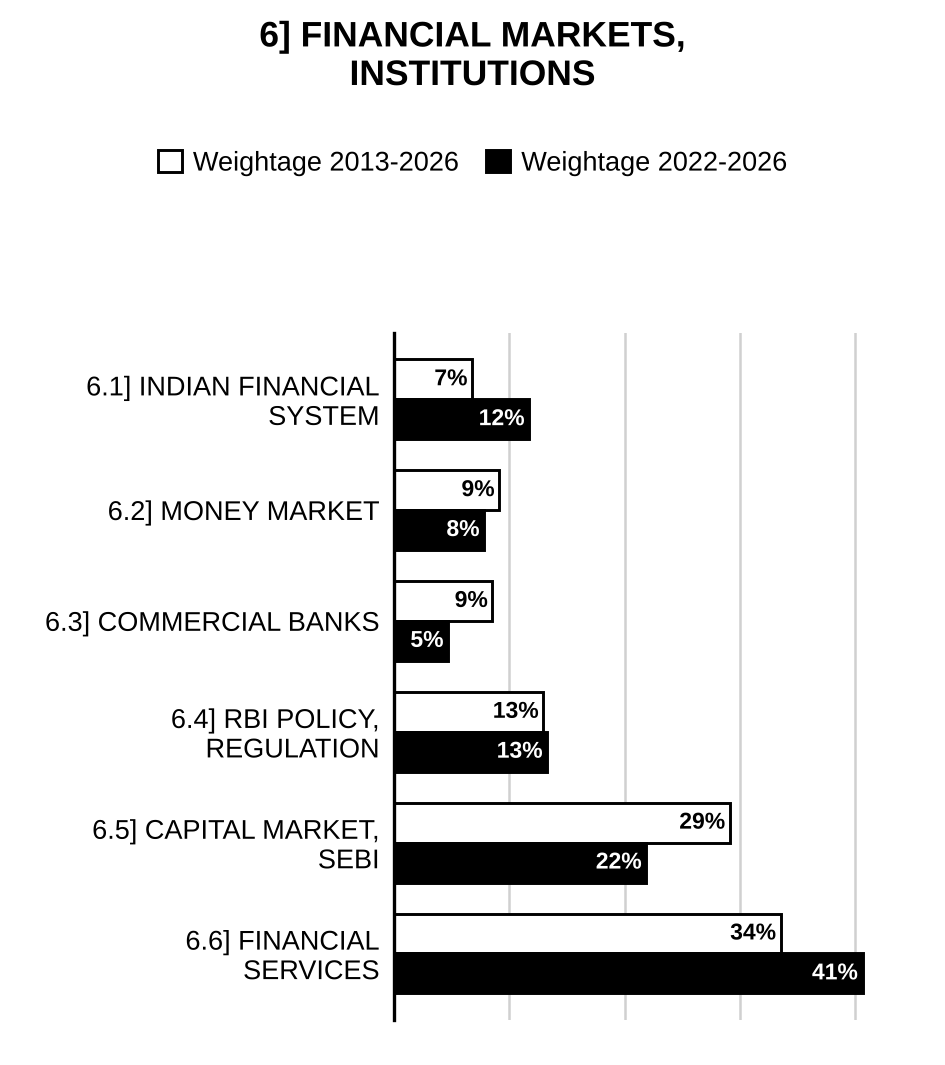
6.1] Indian financial system: an overview
9 questions
Explain the structure of Indian financial system. Discuss the emerging role of RBI in the changing global scenario in this 21st century. [2025/15m/8a]
Explain the key classification of the Indian financial system. Make a diagram that depicts the entire financial system and its key components. [2024/20m/8a]
Briefly explain any five risks faced by the financial institutions in India. [2022/10m/150w/5b]
Briefly explain the components of Indian financial system. [2020/10m/150w/5d]
“Financial markets can be classified based on types of financial claims, maturity of claims, claims representing new issues or outstanding issues, timing of delivery and nature of its organisation structure.” Summarise the classification in brief. [2018/10m/150w/5d]
What is the role of the World Bank in financing India’s development? [2004/20m/200w/5d]
Critically examine the role of IFCI in financing large industry. What has the valuations of this institution gone down in the recent years? [2000/30m/8a]
Examine the role of all-India term financing institutions in the development of the Indian capital market. [1995/20m/200w/5c]
Write a critical note on the working of the IDBI. Do you agree with the view that the Bank should gradually phase out its lending operations and pay greater attention to its promotional role? [1995/30m/8a]
6.2] Money markets
13 questions
Differentiate between capital market and money market in the context of Indian financial system. [2025/10m/150w/5c]
Distinguish between money market and capital market. Explain the present state of RBI policy for the money market. [2024/10m/150w/5b]
What is money market? Explain the features of a developed money market. [2022/15m/6c]
What is ‘Money Market’? Discuss its features and functions. [2019/15m/8b]
Distinguish between Money Market and Capital Market. [2017/10m/150w/5c]
What is Commercial Paper? Explain its significance and the pre-conditions for the issue of Commercial Paper. [2017/15m/7c]
Critically evaluate the functioning of primary and secondary markets in relation to (i) money market and (ii) capital market instruments. [2014/20m/8a]
“Rapid financial innovations have led to the emergence of several new near substitutes for money.”
Discuss at least two such instruments and analyse their impact on the monetary policy of RBI. [2013/15m/6a]
Write a note on Money Market and Capital Market in India. [2009/30m/8a]
Distinguish between Money Market and Capital Market. [2007/20m/200w/5c]
Explain the concept of Money Market. [2006/20m/200w/5b]
Guidelines issued by the Reserve Bank of India relating to commercial papers. [2001/20m/200w/5d]
List out the main deficiencies of Indian Money Market. [1998/20m/200w/5d]
6.3] Commercial banks and reforms in banking sector
17 questions
Discuss the role of commercial banks in the economic development of a country. [2022/15m/8b]
Discuss the key reforms in banking sector in line with BASEL norms. [2021/15m/8c]
Discuss the various functions of a commercial bank. [2019/15m/8c]
Write the important reforms that have taken place in the following sectors after 1991: (i) Banking Sector (ii) Primary and Secondary Stock Market (iii) External Financial Market. [2016/15m/6c]
Risks associated with variation between loan maturities and liability maturities of commercial banks and minimisation of these risks without affecting profitability. [2013/10m/150w/5a]
Classify various securities investment of commercial banks. Also mention how these are valued. Under what circumstances is migration of securities from one category to another allowed? [2013/10m/6c]
Discuss in brief the techniques of assets-liability management in a commercial bank. [2012/12m/150w/5c]
“Higher capital requirements might induce banks to seek higher returns in areas that are high risk or outside their core business”. Do you agree with this observation? Justify your answer with suitable examples. [2012/30m/7b]
Explain in detail the System of Consortium with your comments. [2006/30m/8a]
What is meant by inter-bank lending? How is it regulated and controlled? Discuss. [2004/30m/8b]
What are the causes for increasing non-performing assets in Indian financial institutions? How can the level of NPAs be reduced? [2002/20m/200w/5a]
What are the various forms of credit available to industries from banks? Point out their merits and limitations. [2001/30m/8b]
Consortium approach of inter-bank lending. [1999/30m/8a]
Discuss the existing inter-bank lending regulations. Suggest improvements, if any, in the existing regulations. [1997/30m/8a]
Once bearer instrument is always a bearer instrument. Explain. What are the protections available against paying banker in case of bearer instruments? [1996/20m/200w/1c]
State the circumstances in which a banker may, and when he must, refuse to honour a customer’s cheques. [1995/20m/200w/5d]
Discuss the objectives of nationalisation of commercial Banks in 1969. How far have these been achieved? [1995/60m/7]

Preparing for Prelims too?
Our UPSC Prelims Topic-wise PYQ eBook covers every Prelims question with detailed explanations, so you can see exactly where UPSC asks from.
View the BookDownload Free Sample6.4] RBI: monetary and credit policy; RBI as a regulator
15 questions
Discuss the monetary policy of the Reserve Bank of India over the years. Explain the tools of monetary policy available with the Reserve Bank of India. [2026/20m/6a]
Explain the structure of Indian financial system. Discuss the emerging role of RBI in the changing global scenario in this 21st century. [2025/15m/8a]
Distinguish between money market and capital market. Explain the present state of RBI policy for the money market. [2024/10m/150w/5b]
Explain the objectives of monetary policy of the RBI. [2023/10m/150w/5c]
Discuss the phases of operating procedures of monetary policy framework in India. [2021/15m/6c]
Explain the current Monetary Policy. [2016/10m/150w/5d]
Critically evaluate Reserve Bank of India and (i) its monetary policy and (ii) its credit policy. [2014/20m/8c]
“Rapid financial innovations have led to the emergence of several new near substitutes for money.”
Discuss at least two such instruments and analyse their impact on the monetary policy of RBI. [2013/15m/6a]
“Asset-based reserve requirement of financial institutions as against deposit-based reserve requirement of banks can go a long way in preventing slippage in monetary policy transmission.”
Critically analyse the statement and discuss the mechanism and modalities of the two systems. [2013/15m/6b]
Discuss the effectiveness of monetary policy of a Central Bank to control (i) Inflation, and (ii) Recession, citing examples from Indian experiences. [2011/15m/150w/1b]
Give a critical assessment of the monetary and credit policies of the Reserve Bank of India in recent years. [2005/30m/8b]
Critically evaluate the money and credit policy of Reserve Bank of India. [2004/30m/8a]
Highlight the existing monetary and credit policy of the Reserve Bank of India. [2002/20m/200w/5d]
Role of RBI in credit control. [2000/20m/200w/5d]
Supervision of banks by the Reserve Bank of India. [1999/20m/200w/5c]
6.5] Capital market and SEBI
30 questions
Discuss the reasons for the emergence of Innovative Debt Instruments. [2026/10m/150w/5d]
Differentiate between capital market and money market in the context of Indian financial system. [2025/10m/150w/5c]
Discuss the present state of Indian capital market. Illustrate the role of SEBI in regulating the markets in the changing international investment scenario. [2025/20m/7b]
“Indian capital markets are sound and well-structured under SEBI’s supervision.” Explain this statement. [2024/10m/150w/5d]
Discuss the leading financial market instruments and innovative debt instruments in the Indian financial system. Also give suitable examples. [2024/15m/7c]
What is capital market? Discuss the role of capital market in the economic development of a country. [2023/10m/150w/5d]
Briefly explain any five innovative debt instruments. [2021/10m/150w/5d]
Enumerate the methods of issue of securities in the primary market. [2020/10m/150w/5e]
What are the powers vested with the SEBI to protect the interests of investors in the stock market? [2020/15m/7c]
Distinguish between Primary Market and Secondary Market. [2019/10m/150w/5d]
Distinguish between Money Market and Capital Market. [2017/10m/150w/5c]
Discuss the role of SEBI in regulating the Capital Market. [2017/15m/6b]
Write the important reforms that have taken place in the following sectors after 1991: (i) Banking Sector (ii) Primary and Secondary Stock Market (iii) External Financial Market. [2016/15m/6c]
Examine various measures taken by SEBI for the development of Foreign Institutional Investors and Venture Capitalists. [2016/15m/7c]
Describe the nature of the following debt instruments: (i) Deep Discount Bonds (ii) Floating Rate Bonds (iii) Extendable Notes (iv) Junk Bonds. [2015/15m/6c]
Critically evaluate the functioning of primary and secondary markets in relation to (i) money market and (ii) capital market instruments. [2014/20m/8a]
Checks and balances in Algorithmic Trading as provided by SEBI. [2013/10m/150w/5c]
What is a Credit Forward Contract? [2013/5m/7a]
An investor thinks that the credit spread will widen to more than the current 250 basis points for an issue.
Assume the notional amount is ₹ 10 lakh and the risk factor is 5. What shall be the amount receivable/payable by the investor if credit spread on settlement date rises to 325 basis points or goes down to 190 basis points? [2013/20m/7b]
“An analysis of the performance of IPOs post-listing in the last three years shows that two-thirds of the public issues were trading below their listing price even after adjusting for the general decline in the market. This has resulted in investors losing money on their IPO investments.”
Discuss the reasons behind such a state of affairs and critically analyse various steps taken by SEBI to remedy the situation. [2013/15m/7d]
What is Exchangeable Debt? When and why do companies issue Exchangeable Debt? What is the likely impact on the price of underlying assets when such an issue is made? [2013/15m/8c]
What is contingent capital? Discuss the various instruments used to generate it. [2012/12m/150w/5a]
“SEBI has failed to effectively control the capital market in India.” Critically examine this statement. [2011/15m/150w/1c]
Write a note on Money Market and Capital Market in India. [2009/30m/8a]
Distinguish between Money Market and Capital Market. [2007/20m/200w/5c]
Describe the organisation, growth and weaknesses of stock exchanges in India. [2005/20m/200w/5c]
What is a new issue market? [2003/20m/200w/5c]
Discuss the powers and role of Securities and Exchange Board of India (SEBI). [2003/30m/7b]
Working of capital market in India. [1999/20m/200w/5b]
Write a note on SEBI guidelines relating to trading and settlement procedures in stock exchanges. [1996/30m/4b]
6.6] Financial services
32 questions
Discuss the role of credit rating agencies in India. [2026/10m/150w/5e]
Explain the process of financing by the venture capitalists in India. In this context, discuss the types of investment instruments used by them for financing. [2026/15m/7c]
“Investing in securities through mutual funds is a better choice than direct investment” – explain the statement. Also discuss the types of mutual funds prevalent in India. [2026/20m/8a]
Explain the concept of financial services. Discuss the concept of credit rating and its growing importance in Indian financial services. [2025/10m/150w/5e]
Discuss the role of insurance industry and IRDA in the economic development of the country. [2025/15m/8c]
“The insurance industry in India is growing very fast under the direction and control of IRDA.” In the light of this statement, discuss the emerging trends in life and health insurance. Also explain the government policy initiatives in this regard. [2024/15m/8b]
What is a mutual fund? Discuss the types of mutual fund prevalent in India. [2023/15m/6c]
What is credit rating? Discuss its objectives, functions and limitations. [2023/15m/7c]
What is venture capital? Explain the functions of venture capital for the development of economy. Also discuss the various stages of venture capital financing. [2023/15m/8c]
Explain the importance of venture capital financing (VCF) in promoting start-up enterprises. [2021/10m/150w/5e]
Discuss the role of IRDA in Indian insurance sector. [2021/15m/7c]
What do you mean by credit rating? State the credit rating methodology followed by CARE (Credit Analysis and Research) [2020/15m/8c]
“Investing in securities through Mutual Fund is a better choice than direct investment” – examine the statement. [2019/10m/150w/5e]
Explain the rating methodology used by CRISIL in debt rating. What symbols are used by CRISIL for determining the risk level of a debt instrument? [2018/10m/150w/5e]
Discuss the state of the venture capital industry in India. [2018/15m/8b]
Evaluate the role of Credit Rating Agencies. [2016/10m/150w/5e]
What are the various insurance sector reforms that have taken place in India during the period of liberalisation? [2016/15m/8c]
Write a note on the relevance of credit-rating for a power sector company. [2015/10m/150w/5b]
Explain the role of IRDA in regulating insurance business in India. [2015/15m/8a]
Banks are permitted to enter the insurance sector. Critically evaluate the current scenario of Bancassurance in India. [2014/10m/150w/5c]
How is venture capital different from traditional financing? What are the different types of venture capital funds? [2014/10m/8b]
Information ratio as developed by Treynor and Black. [2013/10m/150w/5d]
Discuss Sharpe’s ratio and Treynor’s ratio for evaluation of risk-return performance of Mutual Fund’s portfolio. [2012/12m/150w/5d]
Critically examine with illustrations the role of Credit Rating Agencies with particular reference to their ownership structure and corporate governance. [2012/20m/8b]
Evaluate the benefits of credit rating and the process involved therein. [2010/15m/150w/5d]
Why is venture capital needed in a country like India? Explain the present position of venture capital schemes launched by All India Financial Institutions. [2010/15m/8b(ii)]
Define lease financing. [2003/20m/200w/5b]
Explain the concept of Venture Capital and discuss its salient features in the Indian Context. [2003/30m/7a]
Nature and types of leasing. [2001/20m/200w/5c]
“The Unit Trust of India has emerged as the single largest reservoir of long term savings and an investment agency.” Elucidate. [1998/30m/8a]
What is Lease Financing? Discuss its essential features. [1997/30m/6a]
Evaluate the role of Life Insurance Corporation of India as a premier investment agency to Government of India. [1996/30m/4a]

Strengthen your GS papers
Our UPSC Mains Topic-wise & Year-wise PYQ eBook (2013–2026) maps every GS question to the syllabus, so you know what UPSC asks and how often.
View the BookDownload Free Sample« Previous: Financial Management | Next: Organisation Theory »
Back to: Commerce & Accountancy Optional PYQs – Topic-wise | Also see: Commerce & Accountancy Optional year-wise question papers
Last updated: 30 October 2026