
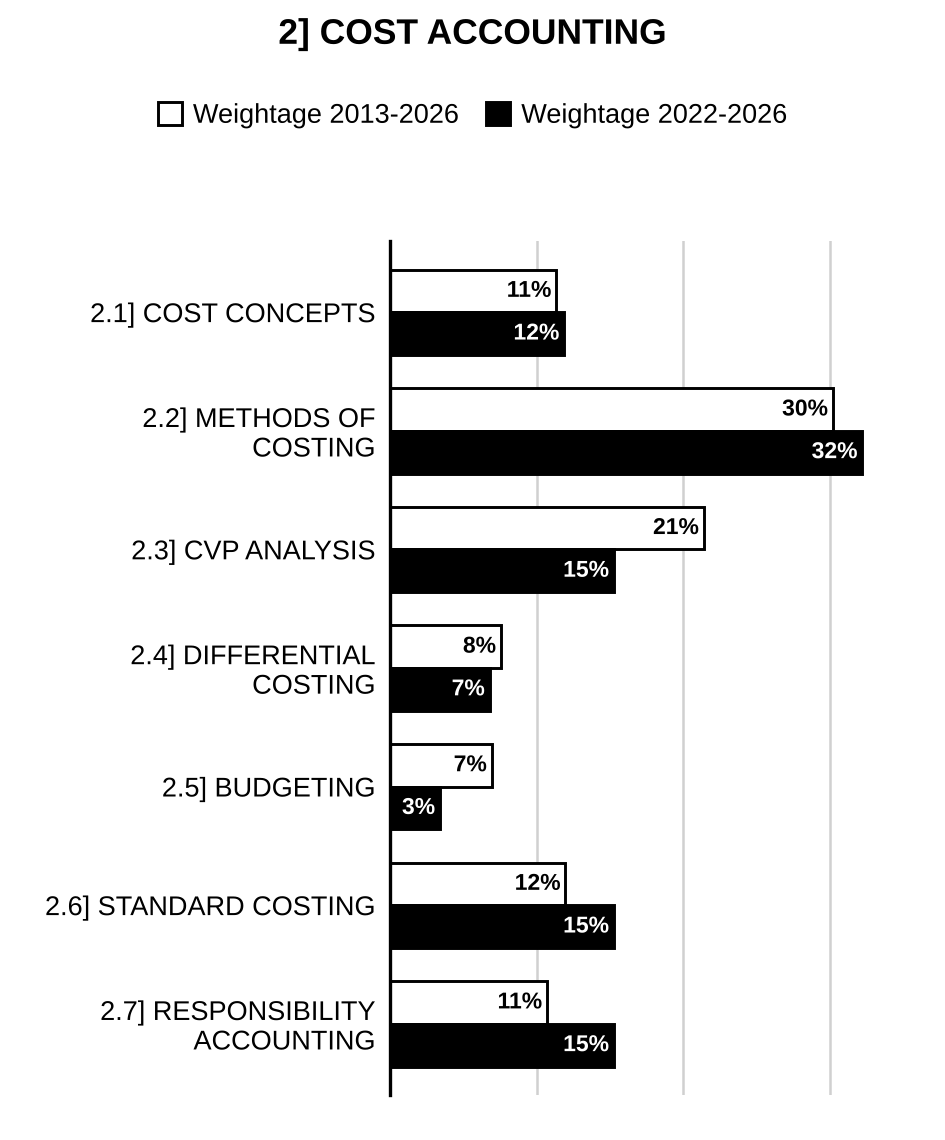
Here are all 122 Cost Accounting questions asked in UPSC Commerce & Accountancy Optional Paper I from 1995 to 2026, arranged under the 7 topics of the official syllabus. Within each topic the latest questions come first.
Each question ends with a code such as [2024/15m/3b] – the year, the marks, the word limit (where UPSC set one) and the question number in the paper.
2.1] Nature of cost accounting and cost concepts
23 questions
What is Cost Accounting? What are its objectives? How does it differ from Financial Accounting? [2025/10m/150w/1c]
“Cost Accounting is a system of foresight and not a post-mortem, it turns losses into profits, speeds up activities and eliminates waste.” Explain the statement along with your viewpoints. [2024/15m/3b]
“Cost Accounting is becoming more and more relevant in the emerging economic scenario in India.” Comment. [2023/10m/150w/1b]
What are sunk cost and opportunity cost? Explain with example. [2021/10m/150w/1c]
Explain the principles and steps in setting up a good costing system in a manufacturing organisation. [2021/15m/2b]
Explain with suitable examples how ‘Shut-down Cost’ is different from ‘Sunk Cost’. [2019/10m/150w/1d]
What are the costs used in managerial decision-making? Explain, in brief, their characteristics. [2018/10m/150w/1b]
Explain, in brief, the functions of cost accounting. [2018/10m/150w/1e]
How will you segregate fixed cost element from the semi-variable cost? Explain with examples. [2011/15m/150w/1d]
How would you classify the different items of cost for the purposes of disclosing these items in a ‘Cost-sheet’? Explain. [2010/15m/150w/1b]
From the following information given by XYZ Limited as on 30th June, 2010, prepare a Cost Statement showing (i) Cost of output–Total as well as per unit and (ii) Net Profit for the year: Information:
| Rs | |
| Sales | 49,000 |
| Purchase of raw materials | 15,000 |
| Direct wages | 15,000 |
| Rent and other works cost | 5,250 |
| Carriage inward | 250 |
| Stock at the beginning of the year: | |
| Raw materials | 2,500 |
| Finished goods (50 tons) | 3,000 |
| Stock at the end of the year: | |
| Raw materials | 2,750 |
| Factory overheads | 750 |
| Sales promotion expenses | 1,000 |
| Office expenses | 7,500 |
| Selling expenses | 2,000 |
Company produced 750 tons of products. The stock of finished goods at the end is 100 tons. It has to be valued at works cost. [2010/30m/2b]
What are the functions of Cost Accounting? [2006/20m/200w/1b]
A medium size firm is making large profits and they do not have a Cost Accounting Department. There is a proposal to employ a Cost Accountant. What would you consider to be his functions and how can he make himself useful to the management? [2005/20m/200w/1a]
A manufacturer uses 200 units of a component every month and he buys them entirely from an outside supplier. The order placing and receiving cost is Rs. 100 and annual carrying cost per unit is Rs. 12. From the given set of data, calculate the economic order quantity. P Ltd. uses three types of materials A, B and C for production of X, the final product. The relevant monthly data for components are as given below:
| A | B | C | |
| Normal usage (units) | 200 | 150 | 180 |
| Minimum usage (units) | 100 | 100 | 90 |
| Maximum usage (units) | 300 | 250 | 270 |
| Reorder quantity (units) | 750 | 900 | 720 |
| Reorder period (months) | 2 to 3 | 3 to 4 | 2 to 3 |
Calculate for each component: (i) reorder level; (ii) maximum level; (iii) minimum level; and (iv) average stock level. [2005/30m/2b]
Discuss the techniques of segregating semivariable cost into fixed and variable costs. [2004/20m/200w/1b]
The financial books have a specific purpose to serve and the information available through them has to be supplemented through other records. Discuss the necessity of keeping cost records. [2003/20m/200w/1a]
‘Segregation of semi-variable cost into fixed and variable components is not possible.’ Do you agree? If not, how do you solve the problem? [2000/20m/200w/1b]
“Major policy decisions in business are based on cost factors.” Comment on the possible used of cost information to management. [1998/20m/200w/1b]
What is ABC analysis? Discuss its uses in cost accounting. [1997/20m/200w/1b]
Discuss motion study, time study and work study. Give their suitable examples of real business world for costing purpose. [1997/30m/3a]
From the following particulars, compute a comprehensive machine hour rate: (i) Cost of the machine Rs. 2,00,000. (ii) Machine running hours 2040 hours per machine per annum including idle time of 40 hours due to routine repairs and maintenance and 20 hours due to breakdown of machine. (iii) Power consumption of the machine per hour: 20 units; rate of power per 100 units is Rs. 120. (iv) There are two operators in the shop and wages, workmen’s compensation, insurance etc. of an operator who is in charge of two machines is Rs. 24,000 per annum. (v) Rent and Taxes of the shop: Rs. 6,000 per annum. (vi) Insurance Premium for the machine: Rs. 500 per quarter. (vii) General lighting of the shop per month: Rs. 600. (viii) Repairs and maintenance expenses per month: Rs. 400 per machine. (ix) Shop Supervisor’s salary per month: Rs. 2500. (x) Other factory overheads allocated to the shop: Rs. 10,000 per annum. (xi) Supervisor devotes one-fifth of his time for supervising a machine. [1997/30m/3b]
Segregation of overheads into fixed and variable is however critical, it is needed for efficient cost control management. Discuss. [1996/20m/200w/5c]
What is semi-variable cost? Discuss the methods of segregating it into fixed and variable components. [1995/20m/200w/1b]
2.2] Methods of costing
20 questions
A manufacturer produces certain goods through three processes. Profit is not included in the process transferred but goods in godown are sold at cost plus 25% profit. In each process 5% of weight put in it is lost and 20% is scrapped, which from Process A and Process B realises ₹20 per ton from Process C ₹5 per ton. The details of production of three processes are given below:
| Particulars | Process A | Process A | Process B | Process B | Process C | Process C |
| ton | ₹ | ton | ₹ | ton | ₹ | |
| Material | 2000 | 20,000 | 1100 | 30,000 | 400 | 4,000 |
| Wages | 8,000 | 4,000 | 12,000 | |||
| Expenses | 12,000 | 6,000 | 4,000 | |||
| Passed to next process | 60% | 80% | – | |||
| Carried to Godown | 40% | 20% | 100% |
Prepare Process Accounts and Godown Accounts. [2026/15m/3b]
A by-product ‘Beta’ is derived in the course of manufacturing a product ‘Alpha’. The by-product is further processed for sale. From the following data available from the records, prepare an account showing the cost per kg of product ‘Alpha’ and the by-product ‘Beta’. The quantities produced during the period under consideration were–‘Alpha’ 100 kg and ‘Beta’ 50 kg. The selling price of ‘Beta’ was ₹ 120 per kg on which the profit earned was estimated at 30%:
| Joint Expenses (₹) | Separate Expenses – Alpha (₹) | Separate Expenses – Beta (₹) | |
| Materials | 10,000 | 6,000 | 500 |
| Labour | 7,000 | 5,000 | 2,000 |
| Overheads | 2,500 | 1,500 | 600 |
[2025/20m/4c]
What is job costing? How is it different from process costing? Explain. [2024/10m/150w/1e]
During the month of May 2024, total 2000 units were introduced into Process-I. The normal loss was estimated at 5% on input. At the end of the month, 1400 units had been produced and transferred to the next process, 460 units were incomplete and 140 units had been scrapped. It was estimated that incomplete units had reached a stage in production as follows:
| Material | 75% completed |
| Labour | 50% completed |
| Overheads | 50% completed |
The cost of 2000 units introduced was ₹ 5,800. Direct material introduced during the process amounted to ₹ 1,440. Production Overheads incurred were ₹ 1,670 and Direct Labour was ₹ 3,340. Each unit scrapped was realized at ₹ 1 each unit. The units scrapped have passed through the process, so were 100% completed as regards material, labour and overheads.
You are requested to prepare the following statements: (i) Statement of Equivalent Production; (ii) Statement of Cost and Evaluation; (iii) Process-I Account; and (iv) Abnormal Loss Account. [2024/20m/3a]
From the following information, prepare Process A/cs and calculate the actual profits earned by X Ltd. for the month of April 2022:
| Particulars | Processes A | Processes B | Processes C | Finished Stock |
| Opening Stock (in ₹) | 8,000 | 9,600 | 6,400 | 24,000 |
| Direct Material (in ₹) | 16,000 | 16,800 | 24,000 | |
| Direct Wages (in ₹) | 12,000 | 12,000 | 12,800 | |
| Overheads (in ₹) | 11,200 | 4,800 | 32,000 | |
| Closing Stock (in ₹) | 4,000 | 4,800 | 3,200 | 12,000 |
| Profit on Cost (%) | 25 | 25 | ||
| Inter-process Profit for Opening Stock (in ₹) | – | 1,600 | 1,600 | 8,800 |
Stocks in process are valued at prime cost and finished stock has been valued at price at which it received from Process–C. Sales during the period were ₹ 2,80,000. [2023/20m/3a]
What is Activity-Based Costing (ABC)? How does ABC system support corporate strategy? [2022/10m/150w/1b]
In a factory, the product passes through two processes, A and B. Loss of 5% is allowed in process A and 2% in process B. Nothing being realised by disposal of the wastage. During July, 2021, 10000 units of material costing ₹6 each were introduced in process A. The other costs were as follows:
| Process A (₹) | Process B (₹) | |
| Materials | – | 6,140 |
| Labour | 10,000 | 6,000 |
| Overheads | 6,000 | 4,600 |
The output was 9300 units from process A. The output of process B was 9200 units.
Prepare Process Accounts and Abnormal Loss/Gain Accounts. [2021/15m/3c]
What is meant by normal wastage and abnormal wastage? State how are they treated in process costing. [2020/15m/3c]
What is Activity Based Costing (ABC) system? How is it different from Traditional Costing System? Explain the Steps to implement ABC system. [2019/15m/3c]
The product of a company passes through three distinct processes to completion. From past experience, it is ascertained that the normal wastage in each process is as under:
| Process | Wastage | Sale value of wastage |
| A | 2% | 25 paise per unit |
| B | 4% | 50 paise per unit |
| C | 2.5% | 60 paise per unit |
The expenses were as follows:
| Particulars | Process A (₹) | Process B (₹) | Process C (₹) |
| Materials | 12,000 | 10,000 | 9,000 |
| Direct labour | 16,000 | 5,000 | 4,900 |
| Manufacturing expenses | 2,000 | 3,400 | 3,590 |
| Other factory expenses | 3,500 | 2,005 | 2,004 |
4,000 units were initially introduced in process A at a cost of ₹13,560. The output of each process was as under:
| Process | Output |
| A | 3,850 units |
| B | 3,600 units |
| C | 3,500 units |
Prepare process accounts and also work out the sale price per unit of finished stock so as to realize 20% profit on selling price. [2018/15m/2b]
A company manufacturing two products furnishes the following data for a year:
| Product | Annual Output (units) | Total Machine Hours | Total Number of Purchase Orders | Total Number of Set-ups |
| A | 5,000 | 20,000 | 160 | 20 |
| B | 60,000 | 1,20,000 | 384 | 44 |
The annual overheads are as under:
| ₹ | |
| Volume related activity costs | 5,50,000 |
| Set-up related costs | 8,20,000 |
| Purchase related costs | 6,18,000 |
You are required to calculate the cost per unit of each product ‘A’ and ‘B’ based on (i) Traditional method of charging overheads (ii) Activity based costing method [2017/15m/3a]
Define ‘Normal Wastage’, ‘Abnormal Wastage’ and ‘Abnormal Effectiveness’. State how these are treated in Process Costing. [2017/15m/4b]
The information given below has been taken from the costing records of a company in respect of Job No. 303:
| Materials | ₹ 4,010 |
| Wages: | |
| Dept. A | 60 hours @ ₹ 3 per hour |
| Dept. B | 40 hours @ ₹ 2 per hour |
| Dept. C | 20 hours @ ₹ 5 per hour |
| Overhead expenses for these departments were estimated as follows: | |
| Variable overheads: | |
| Dept. A | ₹ 5,000 for 5000 labour hours |
| Dept. B | ₹ 3,000 for 1500 labour hours |
| Dept. C | ₹ 2,000 for 500 labour hours |
| Fixed overheads | Estimated at ₹ 20,000 for 10,000 normal working hours. |
You are required to calculate the cost of Job No. 303 and also calculate the selling price to earn a profit of 25%. [2016/15m/4b]
Explain in brief the concept of ‘Activity Based Costing’. Give a numerical example. [2015/10m/150w/1a]
What is inter-process profit? Show the treatment of inter-process profit with an example. [2015/10m/150w/1e]
Distinguish between Job Costing and Process Costing. [2014/20m/4a]
Do you agree with the view that Activity Based Costing is not very practical and useful? Discuss its limitations. [2011/30m/2b]
A certain chemical process yields 75% of material introduced as main product and 20% as by-product, 5% being lost. In the process one unit of main product requires double the materials required for a unit of by-product. Further one unit of main product needs 1½ times the time needed for one unit of by-product. Overheads are absorbed in the ratio 3 : 1. During a month 4,000 units of raw materials at a cost of Rs. 68,000 were introduced. Wages and overheads incurred were Rs. 21,200 and Rs. 10,800 respectively and wastage realised Rs. 1,200. Ascertain the cost of both the products and prepare Process Account. [2009/30m/3b]
Activity Based Costing and its salient features. [2009/20m/200w/5d]
X Y Z Ltd. is engaged in the production of a commodity which is produced by 3 distinct processes. The process costs for the year ending 31st March, 1996 are as follows:
| Particulars | Rs. |
| Materials | 1,60,000 |
| Labour | 1,24,800 |
| Overheads | 62,400 |
The opening and closing work in progress is as follows:
| Element | Opening work in progress: Degree of completion | Opening work in progress: Amount Rs. | Closing work in progress: Degree of completion |
| Materials | 100% | 8,000 | 75% |
| Labour | 60% | 3,000 | 50% |
| Overhead | 50% | 9,000 | 40% |
There are 3,000 units of opening work in progress. 7,000 units are introduced in the process and 8,500 units are transferred to next process.
Prepare statement of equivalent production and statement of cost using FIFO method of valuation of inventory. [1996/30m/6b]
2.3] Cost-volume-profit relationship
24 questions
What is Profit-Volume ratio? How does it help in Profit planning? Explain with suitable examples. [2026/10m/150w/1a]
What do you understand by ‘marginal costing’? How is marginal costing useful for solving various managerial problems? [2026/10m/150w/1c]
It is observed that at a monthly sale of ₹ 1,20,000, a firm suffers an operating loss of ₹ 30,000. The management apprehends that any increase in sale will further rise the loss. However, the Accountant of the firm analyzed the situation based on cost, volume and profit, and showed that the firm may earn ₹ 30,000 operating profit by doubling the sale. Based on the above information, you are required to measure– (i) P/V ratio; (ii) monthly fixed costs; (iii) BEP; (iv) MOS for profit of ₹ 40,000; (v) profit for monthly sale of ₹ 3,00,000. [2025/15m/2b]
A newly setup manufacturing company is planning to produce a product that will be sold for ₹ 150 per unit. The demand of the product is estimated at 10000 units per year. The company has the choice of two machines (i.e., Machines–A and B), each of which has a capacity of producing 10000 units per year. Machine–A would have fixed costs of ₹ 4,00,000 per year and would yield a profit of ₹ 5,00,000 per year on sale of 10000 units. Machine–B would have fixed costs of ₹ 2,80,000 per year and would yield profit of ₹ 3,20,000 per year on sale of 10000 units. Variable costs behave linearly for both machines. Calculate the volume of sales at which the costs of two machines will be indifferent. [2023/15m/2b]
ABC company produces tables. An analysis of their accounting reveals–.
| Fixed cost | ₹1,00,000 for the year |
| Variable cost | ₹40 per table |
| Selling price | ₹140 per table |
| Capacity | 2000 tables per year |
(i) Find the break-even point (BEP).
(ii) Find the number of tables to be sold to get a profit of ₹60,000.
(iii) What will be the answer for (i) and (ii), if selling price changes to ₹120 per table?
(iv) If the company can manufacture 600 tables more per year with an additional fixed cost of ₹4,000, what should be the selling price to maintain the profit per table as (ii) above? [2021/20m/4a]
What do you mean by P/V ratio? How is it computed? What are its uses in BEP analysis? [2020/15m/3b]
Two manufacturing companies which have the following operating details, decide to merge:
| Particulars | Company X | Company Y |
| Capacity Utilization | 90% | 60% |
| Sales (₹ in lakh) | 540 | 300 |
| Variable Cost (₹ in lakh) | 396 | 225 |
| Fixed Cost (₹ in lakh) | 80 | 50 |
Assuming that the proposal is implemented, calculate:
(i) Break-even sales of the merged plants and capacity utilization at that stage.
(ii) Profit of the merged plant at 80% capacity utilization.
(iii) Sales of the merged plant to earn a profit of ₹ 75 lakh.
(iv) When the merged plant is working at a capacity to earn a profit of ₹ 75 lakh, what percentage increase in selling price is required to sustain an increase of 5% in fixed overhead. [2019/15m/2b]
Two manufacturing companies, which have the following operating details, decided to merge:
| Company No. 1 | Company No. 2 | |
| Capacity Utilization (in %) | 90 | 60 |
| Sales (₹ lakhs) | 540 | 300 |
| Variable Cost (₹ lakhs) | 396 | 225 |
| Fixed Cost (₹ lakhs) | 80 | 50 |
Assuming that the proposal is implemented, calculate:
(i) Break-even sales of the merged plant and the capacity utilization at that stage.
(ii) Profitability of the merged plant at 80% capacity utilization.
(iii) Sales turnover of the merged plant to earn a profit of ₹ 75 lakhs. [2016/15m/2b]
Cost and revenue information of A Ltd. is as follows: Contribution to Sales Ratio = 30%; Variable cost = ₹ 7 per unit; Break-even point is equal to 10,000 units. Find the following: • Company reduces the selling price by 10%, reduces the variable cost to ₹ 6 and spends ₹ 4,000 on advertisement. Find sales to earn a profit of ₹ 6,000. • Company increases the selling price by 20%; reduces the variable cost to ₹ 6 and spends ₹ 4,000 on advertisement. Find the break-even volume of sales. [2015/15m/2b]
An analysis of costs of Namya Polymer Ltd. led to the following information:
| Cost of Element | Variable Cost as % of Sales | Fixed Cost ₹ |
| (1) Direct Materials | 32% | – |
| (2) Direct Labour | 28% | – |
| (3) Factory Overheads | 12% | 1,89,900 |
| (4) Distribution Expenses | 5% | 58,400 |
| (5) Administration Expenses | 2% | 66,700 |
Budgeted Sales for the next year are ₹ 18,50,000. You are required to determine
(i) the break-even sales volume.
(ii) the profit at the budgeted sales volume.
(iii) the profit, if actual sales drop by 10 percent of budgeted sales.
(iv) the profit, if actual sales increase by 5 percent of budgeted sales. [2014/20m/2b]
Assumptions and limitations of Cost-Volume-Profit analysis. [2013/10m/150w/1c]
Define and distinguish between marginal and absorption costing with examples. What are their uses and limitations? [2013/15m/2b]
Explain the effect of absorption costing and marginal costing on net profit of a business firm. [2012/12m/150w/5e]
IGNOU conducts a special course on computer applications for a month during summer. For this purpose, an entrance examination held which is spread over four days, one examination per day. Each candidate is charged fee of Rs. 50 for taking up the entrance test. The following data was gathered for the past two years:– Statement of Revenue from the Entrance Test.
| 2007-08 Rs. | 2008-09 Rs. | |
| Gross Revenue collected | 1,00,000 | 1,50,000 |
| Cost: | ||
| Valuation | 40,000 | 60,000 |
| Question Booklets | 20,000 | 30,000 |
| Hall Rent @ Rs. 2000 per day | 8,000 | 8,000 |
| Honorarium to Administrator | 6,000 | 6,000 |
| Supervision charges (one Supervisor for every 100 candidates @ Rs. 50 per day) | 4,000 | 6,000 |
| General Administrative Overhead | 6,000 | 6,000 |
| Total Cost | 84,000 | 1,16,000 |
| Net Revenue | 16,000 | 34,000 |
You are required to compute:
(i) The budgeted net revenue if 4,000 candidates take up the entrance test in 2009-10.
(ii) The break-even number of candidates.
(iii) The number of candidates to be enrolled if the net revenue of Rs. 20,000 is desired. [2009/30m/3a]
Cost-Volume-Profit Analysis. [2009/20m/200w/5c]
What is the significance of ‘Contribution’ in marginal costing? Discuss the role played by ‘Contribution’ in profit maximization decisions. [2005/30m/2a]
Explain the meaning, utility and limitations of cost-volume-profit analysis. [2005/30m/3a]
“Business firms rarely operate at their breakeven points. Therefore, the breakeven analysis is of very limited use to management.” Comment in brief. [2004/30m/3a]
Distinguish between Marginal Costing and Historical Costing. How do you apply Marginal Costing technique in decision-making relating to make or buy? [2002/20m/200w/1c]
Do you agree with the view that the Cost-Volume-Profit Analysis is not a very useful tool of profit planning? Give reasons in support of your answer. [2002/30m/3a]
What is marginal costing? Explain with a suitable example. [2001/30m/3a]
A factory is engaged in manufacturing of plastic containers for domestic use. It produces only 15 kg capacity buckets and is currently in a position to utilise only 40% of the installed capacity which means production of 10,000 buckets in the current year. The cost break-up of producing each bucket is as follows:
| Particulars | Rs. |
| Material consumed for each unit | 10 |
| Labour cost per unit | 3 |
| Overheads per unit | 5 (60% fixed) |
The selling price is Rs. 20 per bucket.
If it is decided to work the factory at 50% capacity, the selling price falls by 3%. At 90% capacity, the selling price falls by 5%, accompanied by a similar fall in the prices of material.
With this information you are required to calculate the profit at 50% capacity and 90% capacity. Also calculate break-even point at these two capacities. [1999/60m/2]
XYZ Co. Ltd has annual fixed cost of Rs. 2,80,000. In 1997, sales amounted to Rs. 12,00,000 as compared with Rs. 9,00,000 in 1996 [?] and profit in 1997 was Rs. 84,000 higher than that in 1996. (i) At what level of sales does the company break even? (ii) Determine profit or loss on a forecast sales volume of Rs. 16,00,000. (iii) If there is a reduction in selling price by 10% in 1998 and company desires to earn the same amount of profit as in 1997, what would be the required sales volume? [1998/30m/3b]
The following details relate to a manufacturing company: Contribution margin of a product is Rs. 6 which is 30% of sales price. The annual fixed costs are Rs. 8,00,000 which include Rs. 1,20,000 towards depreciation. Find both BEP and cash break even point. Calculate number of units required to be sold to earn a net income of 10% of sales. [1996/30m/3b]

Preparing for Prelims too?
Our UPSC Prelims Topic-wise PYQ eBook covers every Prelims question with detailed explanations, so you can see exactly where UPSC asks from.
View the BookDownload Free Sample2.4] Incremental analysis / differential costing
13 questions
What do you understand by ‘marginal costing’? How is marginal costing useful for solving various managerial problems? [2026/10m/150w/1c]
Great Ocean Ltd. is currently buying a component from a local supplier @ ₹ 30 each. As the supply is irregular, the company is considering the following two proposals: (i) Buy and install a semi-automatic machine for manufacturing this component, which would involve an annual fixed cost of ₹ 18,00,000 and variable cost of ₹ 12 per manufactured component. (ii) Buy and install an automatic machine for manufacturing this component, incurring an annual fixed cost of ₹ 30,00,000 and variable cost of ₹ 10 per manufactured component. The annual requirement of the company is expected to be 5,00,000 units and the volume is expected to increase to 6,00,000 units thereafter. Would you recommend the automatic or semi-automatic machine? Justify your recommendation with necessary computations. [2022/15m/2b]
A B Ltd manufactures auto parts. The costs incurred for processing 1,00,000 units of a component are as follows:
| (₹ in lakhs) | |
| Direct material | 5 |
| Direct labour | 8 |
| Variable factory overhead | 6 |
| Fixed factory overhead | 5 |
The purchase price of the component is ₹22. The fixed overhead would continue to be incurred even if the component is bought from outside although there would be a reduction of ₹2,00,000.
Required:
(i) Should the part be made or bought when the present facility released remains idle in the event of purchase? and
(ii) If the released capacity can be rented out to another company for ₹1,50,000, what would be the decision? [2020/15m/2b]
Namya Ltd. wants to prepare the feasibility of manufacturing one of the components needed for its finished product. It has two options of purchasing from its present supplier or to manufacture it in-house.
Its present supplier has shown the willingness to provide at ₹125 per unit for the company’s requirement of 6000 units per year.
If the component is manufactured in-house, it requires equipments costing ₹10 lakh and is expected to have salvage value of ₹2 lakh after the expiry of five years. Additional fixed cost (excluding depreciation) are estimated to increase by ₹1 lakh per year. The variable cost of manufacturing each component will be ₹30 per unit. The company is subject to a 35 per cent tax rate. Its cost of capital is 15 per cent for this project. The company’s projected annual needs is at 7500 units per year for 5 years. The tax relevant rate of depreciation is 25 per cent based on WDV method.
Advise the company, whether it should continue buying from outside supplier or start its own manufacturing. Will your answer be different if the requirement of the company is only 6000 units per year?
| Year | 1 | 2 | 3 | 4 | 5 |
| The present value of ₹1 at 15% | 0.870 | 0.756 | 0.658 | 0.572 | 0.497 |
| The present value of an Annuity of ₹1 at 15% | 0.870 | 1.626 | 2.283 | 2.855 | 3.352 |
[2018/20m/7a]
How is Differential Cost Analysis helpful in decision-making? [2017/15m/2b]
The sales of a company’s products are slacking and budget sales of 1,50,000 units per year can only be met if the trade discount is raised from 25% to 30%. In case the discount is raised to 35%, the sales will increase by 20% over the budget for which production capacity exists. Indicate which of the two alternatives is more profitable. The real price of the product is Rs. 10 each. The cost of product is Rs. 6 of which Rs. 4 is variable. [2005/30m/3b]
A factory manufacturing readymade garments uses the cut pieces of cloth to manufacture dolls. The following cost information has been prepared to show that the manufacture of dolls results in a loss of ₹ 500. Hence there is a suggestion to discontinue the manufacture of dolls. What is your advice? Give reasons. Note: The cut pieces used in dolls will fetch a waste value of ₹ 1,000, if sold.
| Item | Ready-made Garments | Dolls | Total |
| Direct materials | ₹ 40,000 | ₹ 3,000 | ₹ 43,000 |
| Direct Labour | ₹ 6,500 | ₹ 600 | ₹ 7,100 |
| Other variable costs | ₹ 8,500 | ₹ 1,400 | ₹ 9,900 |
| Fixed overheads | ₹ 12,000 | ₹ 1,500 | ₹ 13,500 |
| Total | ₹ 67,000 | ₹ 6,500 | ₹ 73,500 |
| Sales value | ₹ 85,000 | ₹ 6,000 | ₹ 91,000 |
| Profit | ₹ 18,000 | ₹ 17,500 | |
| Loss | ₹ 500 |
[2003/30m/2b]
Distinguish between Marginal Costing and Historical Costing. How do you apply Marginal Costing technique in decision-making relating to make or buy? [2002/20m/200w/1c]
Bright Star Ltd. is operating at 60% of its installed capacity and producing 27,000 units which are sold in the domestic market at a selling price of ₹ 15 per unit. The marginal cost per unit is ₹ 12 per unit and the fixed cost amounts to ₹ 15,000. The company has received a foreign order for supply of 9,000 units at a price of ₹ 13.50 per unit. If the company produces and sells 36,000 units (27,000 + 9,000), it will have to spend nothing on additional fixed cost but its distribution cost in respect of foreign supplies will be @ ₹ 0.75 per unit. You are required to suggest the management on the issue, whether or not the order for foreign supplies at the reduced rate of ₹ 13.50 be accepted. What will be your recommendation if the demand is from a local buyer? [2002/30m/3b]
A manufacturing company produces three products viz. A, B and C in its three divisions. The production of C has shown loss continuously for the last three years. Management of the company is contemplating to close down the production of product C but before closing they seek your expert opinion. What would be your recommendations? Should the production of C be suspended or continued? You may make necessary assumption. [2000/30m/3a]
Cost is a crucial leg in the tripod of pricing decision as having the character of internal control. Elucidate. [1996/20m/200w/1a]
Examine the significance of shut down point in managerial decision making. What are the applications of differential costing in this regard? [1996/30m/6a]
The following particulars relate to a company which sells two products A and B in the same market:
| Product | Units Sold | Unit Price (Rs.) | Sales Value (Rs.) | Contribution per Re. of Sale (Rs.) | Contribution per unit (Rs.) | Materials used per unit (kg) | Machine hours per 100 units (Hrs.) |
| A | 1000 | 30 | 30,000 | 0.33 | 10 | 2 | 1.25 |
| B | 750 | 33.33 | 25,000 | 0.48 | 16 | 4 | 1.00 |
(i) Assuming that there are no limitations on production and sale, which of the two products should be sold to maximize profits?
(ii) Assuming that the company can have the maximum sale value of Rs. 55,000, which of the two products should be sold?
(iii) What would be the optimum sales-mix if both the products are sold and the market demand is not likely to exceed 2500 units of either or both the products?
(iv) Suppose the availability of raw materials is restricted to 3,000 kg, which product should be manufactured and sold?
(v) If the availability of machine time is limited to 8 hours per day only, which of the two products should be preferred? [1995/30m/2b]
2.5] Budgeting as a tool of planning and control
15 questions
Explain briefly the steps involved in preparing the budget for an industrial organization. [2022/10m/150w/1d]
Distinguish between cost control and cost reduction. [2020/10m/150w/1c]
What do you understand by budgeting? What are the essentials of effective budgeting system? What are its limitations? [2019/15m/3b]
Distinguish between the techniques of Cost Control and Cost Reduction and also explain their implications on decision-making. [2016/10m/150w/1b]
Discuss Zero Base Budgeting as a tool of planning and controlling. [2014/10m/150w/1b]
Distinguish between Cost Control and Cost Reduction. [2007/20m/200w/1b]
Explain the term Budgetary Control. How does it operate as a tool of management control? [2007/30m/3a]
The following informations relate to Good Luck Limited for the year 2005:
| Particulars | ₹ |
| Variable Expenses (at 50% of capacity) | |
| Materials | 21,70,000 |
| Labour | 20,40,000 |
| Other Expenses | 7,90,000 |
| Semi-Variable Expenses (at 50% of capacity) | |
| Repairs and Maintenance | 3,70,000 |
| Indirect Labour | 7,50,000 |
| Sales Department Salaries | 4,00,000 |
| Sundry Administrative Expenses | 2,80,000 |
| Fixed Expenses | |
| Salaries | 8,50,000 |
| Wages | 2,50,000 |
| Rent and Rates | 4,60,000 |
| Insurance | 3,50,000 |
| Depreciation | 5,40,000 |
| Sundry Administrative Expenses | 5,50,000 |
Assume that the fixed expenses remain constant for all levels of production, semi-variable expenses remain constant between 45% and 65% of capacity, increase by 10% between 65% and 80% of capacity and by 20% between 80% and 100% of capacity. Sales at various levels are:
| Capacity | 50% | 60% | 75% | 90% | 100% |
| Sales (₹ lakhs) | 100 | 120 | 150 | 180 | 200 |
Prepare a flexible budget for the year and forecast the profits at 60%, 75%, 90% and 100% of capacity. [2007/30m/3b]
Prepare a Flexible Budget from the following data made available in respect of half-yearly period and forecast the working results at 70%, 85% and 100% of capacity when the respective sales are Rupees 50 lakhs, Rupees 60 lakhs and Rupees 85 lakhs. While fixed expenses remain constant, semi-variable expenses also remain constant between 55% and 75% of capacity, increasing by 10% between 75% and 90% and 100% of capacity. The expenses at 60% capacity are as follows:
| Particulars | Rupees in lakhs |
| Semi-variable | |
| Maintenance and Repair | 1.25 |
| Indirect Labour | 5.00 |
| Sales Department Expenses | 1.50 |
| Sundry Overheads | 1.25 |
| Variable | |
| Materials | 12.00 |
| Labour | 13.00 |
| Other Expenses | 2.00 |
| Fixed | |
| Wages and Salaries | 4.20 |
| Rent Rates and Taxes | 2.80 |
| Depreciation | 3.50 |
| Sundry Overheads | 4.50 |
| 51.00 |
[2006/30m/2b]
How does budget differ from forecast? Discuss the relevance of budgetary control. [2004/30m/2a]
Explain the term Budgetary Control. On what factors does the success of such control depend? [2003/30m/4a]
Alpha Co. Ltd. are manufacturers of inverter batteries. They have planned to sell 96,000 batteries in the first quarter of 2002, 1,02,000 in the second quarter, 1,08,000 in the third quarter and 1,14,000 in the fourth quarter; and 1,26,000 in the first quarter of 2003. The opening stock was 16,000 at the beginning of the first quarter of 2002. According to the Company’s scheme of working there should be an inventory equal to of the planned sales of the next quarter. Give the production budget for each quarter of 2002. [2001/30m/3b]
Standard costing and Budgetary control. [1999/30m/3a]
Distinguish between cost control and cost reduction. Examine flexible budgetary control as a control technique. [1996/30m/3a]
Distinguish between budgets and budgetary control and discuss the objectives of the latter. [1995/30m/2a]
2.6] Standard costing and variance analysis
17 questions
Global ltd., produces an article by blending two basic raw materials. It operates a standard costing system and the following standards have been set for raw materials:
| Materials | Standard Mix | Standard rate per Kg |
| A | 40% | ₹8 |
| B | 60% | ₹6 |
The standard loss is processing is 15%. During April 2026 the company produced 3400 kg of finished output.
The position of stock and purchases for the month of April 2026 is as under:
| Material | Stock | Stock | Purchases during April | Purchases during April |
| 1.4.26 | 30.4.26 | Kg | Cost | |
| Kg | Kg | ₹ | ||
| A | 70 | 10 | 1600 | 6800 |
| B | 80 | 100 | 2400 | 6000 |
Analyse material variance. [2026/15m/4c]
Discuss the various variances in standard costing system. How are the material, labour and overhead variances different from one another? [2025/10m/150w/1d]
The following details have been extracted from the cost records of a company:
| Material: | 5 lbs @ ₹ 5 – ₹ 25 |
| Labour: | 4 Hrs @ ₹ 3 – ₹ 12 |
The production schedule for the month of January, 2022 required the completion of 7000 units; however 8100 units were actually produced during the month. Purchase of materials of 40000 lbs was made at a total invoice price of ₹ 1,65,000.
Production record for the month of January, 2022 revealed the following:
Materials requisitioned and used – 35800 lbs, Direct labour – 17200 Hrs – ₹ 59,400.
Calculate the appropriate material and labour variances. [2022/20m/4a]
“Standard costing is universally accepted as an effective instrument for controlling costs in industries.” In the light of this statement, explain the objectives of standard costing. [2018/10m/4c]
The Cost Accountant of a company was given the following information regarding the overheads for February, 2016: (1) Overhead cost variance: ₹ 1,400 adverse (2) Overhead volume variance: ₹ 1,000 adverse (3) Budgeted hours for February, 2016: 1,200 hours (4) Budgeted overheads for February, 2016: ₹ 6,000 (5) Actual rate of recovery of overheads: ₹ 8 per hour. You are required to assist him in computing the following for February, 2016: (i) Overhead expenditure variance (ii) Actual overheads incurred (iii) Actual hours for actual production (iv) Overhead capacity variance (v) Overhead efficiency variance (vi) Standard hours for actual production. [2016/20m/3a]
Modern Toys Ltd. had budgeted the following sales for the month of June:
| Toy – A | 9,000 units at ₹ 50 per unit |
| Toy – B | 6,500 units at ₹ 100 per unit |
| Toy – C | 12,000 units at ₹ 150 per unit |
As against this, the actual sales were as under:
| Toy – A | 10,000 units at ₹ 55 per unit |
| Toy – B | 7,000 units at ₹ 95 per unit |
| Toy – C | 11,000 units at ₹ 156 per unit |
The cost per unit of Toy A, B and C was ₹ 45, ₹ 85 and ₹ 130 respectively. Compute the different variances to explain the difference between the budgeted and actual profit. [2014/20m/2a]
PET Limited manufactures household food-grade containers of different sizes. It uses a special type of polyethylene sheet for making the body of the containers. The sheets are purchased in large sizes. A particular size of container requires 60 square inches of the polyethylene sheet. The cost of 1 square inch is Re. 0.50. While running a batch of 10,000 containers it is found that 6,50,000 square inches of sheets were consumed at Re. 0.60 per square inch. Show detailed calculations of (a) Total variance, (b) Price variance, (c) Quantity variance, (d) Pure price variance, and (e) Joint Price-quantity variance. [2012/25m/3a(i)]
On the basis of your findings prepare a report for top management who shall soon be deciding on bonuses for operating executives. Your report must contain evaluation of each variance. [2012/15m/3a(ii)]
The standard mix for each batch of 100 units of product A is:
| Material A | 6 kgs. @ Rs. 15 |
| Material B | 4 kgs. @ Rs. 10 |
During a month 10 batches were completed with actual consumption as follows:
| Material A | 63 kgs. @ Rs. 14 |
| Material B | 39 kgs. @ Rs. 11 |
Actual output during the month was 960 units. Calculate Material Cost Variances for detailed analysis and control. [2009/30m/7a]
In a manufacturing company, the standard quantity of material was fixed at 10 kg and the standard price was fixed at Rs. 2 per kg; The actual quantity consumed came to be 12 kg and the actual price paid was Rs. 1.90 per kg. You are required to calculate: (i) Material Cost Variance (ii) Material Rate Variance (iii) Material Usage Variance. [2004/30m/3b]
It is said that the success of a Standard Cost Accountancy System is dependent on the extent of responsibility which the top management assumes in correcting the conditions which cause variance from standards. Discuss the extent to which this responsibility should be delegated to lower levels and outline a method by which the performance of the individuals responsible can be watched. [2003/30m/2a]
The actual production was only 60 units, materials used 40 units of X and 60 units of Y. Calculate material yield variance.
| Material | Units | Rate | Total |
| X | 30 | ₹ 4 | ₹ 120 |
| Y | 70 | ₹ 3 | ₹ 210 |
[2003/30m/3b]
How does Standard Costing and Variance Analysis technique work as a cost reduction and cost control measure in any manufacturing firm? Explain clearly. [2002/30m/2a]
How are the standards for Labour Rate and Labour Efficiency fixed? Explain clearly. [2000/30m/3b]
Standard costing and Budgetary control. [1999/30m/3a]
“Setting of standard is the most vital and critical step in standard costing technique.” Elucidate. Show how the standards are fixed for Direct Material and Direct Labour. [1998/30m/3a]
During a certain period, the production plant of Nova Company Ltd worked for 9,926 hours against the allowed hours of 10,032. The normal capacity is 10,560 hours. The actual fixed overhead rate is Rs. 2 and fixed and variable expenses at normal capacity are Rs. 8,000 and Rs. 11,200 respectively. Actual factory overhead expenses are Rs. 18,540. Calculate overhead variances. [1996/20m/8c]
2.7] Responsibility accounting and divisional performance measurement
10 questions
What is Responsibility Accounting? How does it contribute in improving the organizational effectiveness? [2026/15m/4b]
Discuss the concept of a division as an independent profit centre. Compare the Rate of Return Method with the Residual Income Method of performance evaluation of a division. [2023/15m/4b]
Explain the concept and features of Responsibility Accounting. Discuss the steps involved in implementing such an Accounting System. [2022/15m/3c]
Briefly discuss the important methods of measuring divisional performance. [2020/15m/4b]
What is Responsibility Accounting? Explain the prerequisites and the problems in its implementation. [2019/15m/4b]
Define ‘Responsibility Centre’. Explain its various types. [2017/10m/150w/1c]
It is said that the success of a Standard Cost Accountancy System is dependent on the extent of responsibility which the top management assumes in correcting the conditions which cause variance from standards. Discuss the extent to which this responsibility should be delegated to lower levels and outline a method by which the performance of the individuals responsible can be watched. [2003/30m/2a]
How does responsibility accounting seek to establish a relationship between planning and controlling? [2001/20m/200w/1a]
“Responsibility Accounting is an important area in a management accountant’s work.” Explain this statement with reference to cost centres and revenue centres. [1999/60m/4]
Write a note on responsibility accounting. [1996/20m/200w/1d]

Strengthen your GS papers
Our UPSC Mains Topic-wise & Year-wise PYQ eBook (2013–2026) maps every GS question to the syllabus, so you know what UPSC asks and how often.
View the BookDownload Free Sample« Previous: Financial Accounting | Next: Taxation »
Back to: Commerce & Accountancy Optional PYQs – Topic-wise | Also see: Commerce & Accountancy Optional year-wise question papers
Last updated: 30 October 2026