
Here are all 111 Financial Accounting questions asked in UPSC Commerce & Accountancy Optional Paper I from 1995 to 2026, arranged under the 5 topics of the official syllabus. Within each topic the latest questions come first.
Each question ends with a code such as [2024/15m/3b] – the year, the marks, the word limit (where UPSC set one) and the question number in the paper.
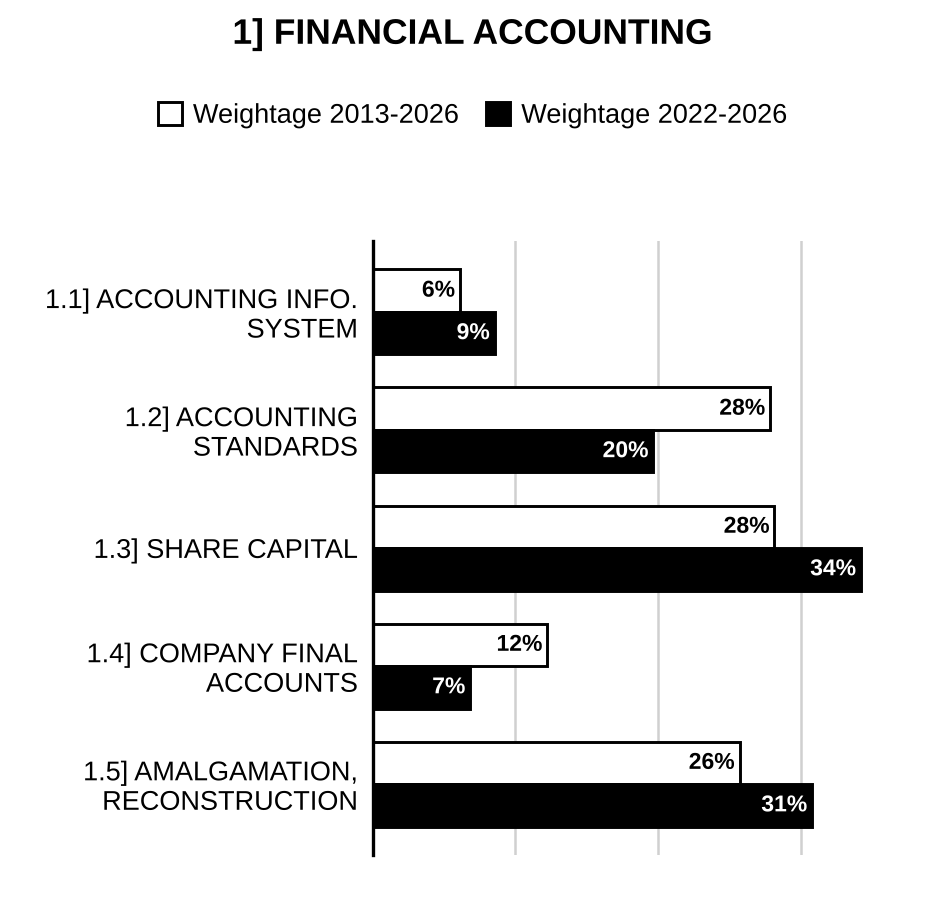
1.1] Accounting as a financial information system; impact of behavioural sciences
14 questions
What role does accounting play in a financial information system? What type of information can be derived from it? [2025/10m/150w/1b]
Discuss the impact of behavioural sciences on Accounting. [2022/15m/4b]
“Accounting is an information system for decision making.” Explain. State its characteristics. [2021/15m/4b]
‘Accounting is a language of business.’ Comment. [2014/10m/150w/1a]
Why do companies resort to ‘managing earnings’? Illustrate the techniques employed for this purpose. [2012/30m/6b]
Describe the basic information processing model of an accounting system. [2009/20m/200w/1a]
“Accounting is the language of business.” Discuss. [2006/20m/200w/1a]
What are accounting conventions? [2001/20m/200w/1b]
A company has indulged in massive advertising campaign spending a huge sum of Rs. 1 (one) crore during the current year against its usual yearly expenditure of Rs. 20,00,000. How would you deal with this type of expenditure in the annual accounts of the company? [2000/20m/200w/1a]
Human resources accounting techniques is based on Cost Accounting. [1999/20m/200w/1b]
“Historical cost has been described as one of the fundamental assumptions underlying financial accounting.” Elucidate. [1998/30m/2a]
Briefly explain the problems of accountants for rationalising different accounting concepts. Also explain how these problems are resolved by them. [1997/30m/2a]
Impact of inflation is more pronounced in fixed investment resources. Discuss. [1996/20m/200w/5a]
Accounting is a broad information system catering to the needs of a wide variety of people. Elucidate this statement bringing out the main divisions of Accounting. [1995/20m/200w/1a]
1.2] Accounting Standards
36 questions
(i) Explain in brief the principles of inventory valuation based on AS 2. (ii) Describe in brief the permissible methods of depreciation based on the relevant Accounting Standard. [2025/15m/2c]
Briefly explain the significance of Accounting Standard-7 (AS-7). [2024/10m/150w/1a]
Briefly explain the accounting treatment of Government Grants as per AS–12. [2023/10m/150w/1d]
Explain the term ‘Revenue’ as per AS-9. State the items not included in the term ‘Revenue’. When should revenue from sale of goods be recognized? [2022/15m/3b]
From the following Summary Cash Account of Z Ltd., you are required to prepare Cash Flow Statement for the year ended March 31, 2022 in accordance with AS-3 using the Direct method.
Summary Cash Account (for the year ended March 31, 2022) (₹ in ’000)
| ₹ | ₹ | ||
| Balance on 01/04/2021 | 100 | Payment to suppliers | 4,000 |
| Issue of Equity Shares | 600 | Purchase of fixed assets | 400 |
| Receipts from customers | 5,600 | Overhead expenses | 400 |
| Sale of fixed assets | 200 | Wages & Salaries | 200 |
| Taxation | 500 | ||
| Dividend | 100 | ||
| Repayment of bank loan | 600 | ||
| Balance on 31/03/2022 | 300 | ||
| 6,500 | 6,500 |
Note: The company does not have any cash equivalance. [2022/15m/7b]
Briefly explain the significance of Accounting Standard-3 (AS-3). [2021/10m/150w/1a]
What are the various components of cost of fixed assets? [2020/10m/150w/1b]
“Recognition of revenue presents two basic problems, namely timing and measurement”. Do you agree? How would you solve these two basic problems? [2019/10m/150w/1b]
Explain the nature and need for depreciation. Distinguish between straight line method and diminishing balance method of depreciation. What disclosures are required to be made in financial statements as per AS-6 on depreciation accounting? [2019/20m/4a]
Explain the concept and nature of accounting standards. Why are these needed? [2018/10m/150w/1a]
Explain, in brief, the main provisions of Indian Accounting Standards regarding cash flow statement. [2018/10m/3c]
State the provisions of Indian Accounting Standards regarding Foreign Exchange Transactions. [2017/10m/150w/1a]
Discuss the provisions of Indian Accounting Standards on Accounting for Depreciation. [2017/15m/3b]
Discuss the provisions of Indian Accounting Standards regarding the accounting treatment of Research and Development costs. [2016/10m/150w/1a]
State four items which are not to be included in determining the cost of inventories in accordance with Paragraph 6 of Accounting Standards 2 (Revised). [2016/15m/3b]
“Cash from operations (CFO) is not the same as profit after tax (PAT).” Do you agree with this statement? Give reasons using the Accounting Standard – 3. [2015/10m/150w/1b]
Differentiate between ‘Basic Earnings Per Share’ and ‘Diluted Earnings Per Share’ with reference to Indian Accounting Standard. [2015/10m/3c]
Write a short note on the provisions of Indian Accounting Standards regarding Inventories. [2014/10m/150w/1c]
Intangible assets and their treatment in the books of accounts of a firm. [2013/10m/150w/1b]
Provisions of Indian Accounting Standards regarding treatment of depreciation when an asset is revalued. [2013/10m/150w/1d]
What is revaluation reserve and how it is created? Discuss also the merits and demerits of such action. [2012/12m/150w/1b]
Discuss contingent liabilities with examples. Where would these items feature in the financial statements of a firm? What happens when bills are discounted by a firm? Show the journal entries for such transactions. [2012/12m/150w/1c]
Discuss how the following streams of revenues are recognised in an IT service company: (i) Software services (ii) Time and materials contracts (iii) Sale of user’s licenses. [2012/12m/150w/1d]
How do you use the concept of revenue recognition in the determination of income of a business concern? Explain, giving examples. [2011/15m/150w/1a]
Give your suggestions related to accounting standards on depreciation and inventories. [2011/15m/3b]
From the following details of a company, you are required to calculate ‘Earning Per Share’:
| Net profit (after tax) | Rs 2,00,000 |
| Preference share capital (Rs 100 each) | Rs 50,000 |
| Equity share capital (Rs 10 each) | Rs 1,50,000 |
Preference shares carry 10% dividend and are cumulative and participating to the extent of 50% of profits after paying dividend on equity shares of 25% and transfer of 10% of net profits (after tax) to General Reserves.
You are further informed that last year due to overall recessionary conditions prevailing in the industry, the Company suffered heavy losses, resulting into skipping the dividend on equity shares. [2010/15m/2a(i)]
Describe the disclosure requirements for amalgamation including additional disclosure, if any, for different methods of amalgamation as per AS-14. [2009/30m/2b]
Requirements of Accounting Standard-11 for Foreign Exchange Transactions. [2009/20m/200w/5a]
Diluted Earning per share. [2009/20m/200w/5b]
Explain Accounting Standard related to Depreciation Accounting. [2007/20m/200w/1a]
Making the Accounting Standards mandatory is likely to improve the accounting reporting practice to the benefit of the investors. Do you agree? Explain. [2002/20m/200w/1a]
Give the rationale of charging depreciation. [2001/20m/200w/1d]
Discuss the need for evolving accounting standards. What is their primary aim? [2001/30m/2a]
Accounting issues in foreign exchange transactions. [1999/20m/200w/1a]
Valuation of stock for accounting and audit purposes. [1999/20m/200w/1d]
Explain Accounting Standards. State main features of International Accounting Standards. [1997/20m/200w/1a]

Preparing for Prelims too?
Our UPSC Prelims Topic-wise PYQ eBook covers every Prelims question with detailed explanations, so you can see exactly where UPSC asks from.
View the BookDownload Free Sample1.3] Accounting for share capital transactions
25 questions
Explain the reasons and process of buy back of shares. [2026/15m/3c]
Sky Ltd. invited application for issuing 200000 Equity Shares of ₹ 10 each at a premium of ₹ 2 per share, payable as follows: ₹ 6 per share (including premium) on application and allotment; Balance on the first and final call. Applications for 600000 Equity Shares were received. Applications for 300000 shares were rejected and money refunded. Shares were allotted on pro rata basis to the remaining applicants. The first and final call was made and all the amount was received except on 2000 shares, which were forfeited and reissued at ₹ 7 per share. Pass necessary Journal Entries in the books of Sky Ltd. [2025/20m/3c]
Explain why the companies issue right shares. How are right shares different from bonus shares? [2024/10m/150w/1b]
A Ltd. furnishes the following Balance Sheet as at 31st March, 2024:
| Particulars | ₹ (in 000) | ₹ (in 000) |
| I – Equity and Liabilities: | ||
| 1. Shareholders’ Funds | ||
| (a) Share Capital | ||
| 6,00,000 Equity shares of ₹ 10 each fully paid up | 6,000 | |
| 40,000, 9% Preference shares of ₹ 100 each | 4,000 | 10,000 |
| (b) Reserves and Surplus | ||
| Capital Reserve | 20 | |
| Revenue Reserve | 8,000 | |
| Securities Premium | 1,000 | |
| Profit and Loss Account | 3,600 | 12,620 |
| 2. Non-Current Liabilities | ||
| 10% Debentures | 800 | |
| 3. Current Liabilities | ||
| Trade Payables | 80 | |
| Total | 23,500 | |
| II – Assets: | ||
| 1. Non-Current Assets | ||
| (a) Property, Plant and Equipment | 5,500 | |
| (b) Non-Current Investments (at cost) | 10,000 | 15,500 |
| 2. Current Assets | ||
| (a) Inventories | 2,000 | |
| (b) Trade receivables | 4,000 | |
| (c) Cash and Cash equivalents | 2,000 | 8,000 |
| Total | 23,500 |
The company passed a resolution to buy back 20% of its equity capital @ ₹ 15 per share. For this purpose, it sold its investments of ₹ 60 lakhs for ₹ 50 lakhs.
You are required to pass necessary journal entries in the books of A Ltd. and prepare Balance Sheet after buyback of shares. [2024/15m/2b]
What is meant by buyback of shares by companies? Explain the reasons and sources of buyback of shares. [2023/10m/150w/1a]
A Limited invited applications for 160000 shares of ₹ 10 each at a premium of ₹ 2.50 per share payable as follows:
| On Application–₹ 3 per share |
| On Allotment–₹ 4.50 per share (including premium) |
| On 1st Call–₹ 2 per share |
| On 2nd and Final Call–₹ 3 per share |
Applications were received for 340000 shares, out of which applications for 20000 shares were rejected and money refunded to them. The allotment was made pro rata to the remaining applicants. Money overpaid on application was used against allotment money due.
Kapil to whom 4000 shares were allotted failed to pay the allotment money and on his subsequent failure to pay the first call, his shares were forfeited.
Ramu, the holder of 2400 shares, failed to pay the two calls and his shares were forfeited after the final call.
Of the forfeited shares, 4800 shares were re-issued at the rate of ₹ 8 per share credited as fully paid, including the whole of Kapil’s forfeited shares.
You are required to give the necessary Journal Entries. [2023/20m/4a]
What are Sweat Equity Shares? Under what conditions can these shares be issued by a company? [2022/10m/150w/1a]
Discuss the importance of Employee Stock Option Plan (ESOP). [2021/10m/150w/1b]
What is right share? Explain its advantages. [2021/15m/3b]
Z Ltd issued a prospectus offering 2,00,000 equity shares of ₹10 each on the following terms:
| On application | ₹1 per share |
| On allotment (including premium of ₹2) | ₹5 per share |
| On first call (3 months after allotment) | ₹3 per share |
| On final call (3 months after first call) | ₹3 per share |
Application money was received for 3,27,000 shares on 23rd April and allotment made on 30th April was as under:
| Shares allotted | |
| (i) Allotment in full | 38,000 |
| (ii) Allotment of of shares applied for | 1,60,000 |
| (iii) Allotment of of shares applied for | 2,000 |
Cash amounting to ₹41,000 (for 41,000 shares applied for upon which no allotment was made) was returned to applicants forthwith. The amounts due were received on due dates except with the final call on 100 shares. These shares were forfeited on 15th November and reissued to A on the 16th on payment of ₹9 per share.
You are required to give the necessary journal entries (without narratives). [2020/20m/2a]
Explain why the companies buy back their own shares. How is it different from issue of bonus shares? [2019/10m/150w/1a]
RS Ltd. issued a prospectus inviting applications for 20,000 shares of ₹ 10 each at a premium of ₹ 2 per share payable as under:
| On Application | ₹ 2 |
| On Allotment | ₹ 5 (including premium) |
| On First call | ₹ 3 |
| On Second and Final call | ₹ 2 |
Applications were received for 30,000 shares and pro-rata allotment was made on the applications for 24,000 shares. Excess money paid on applications was utilised towards allotment money.
Kherwa, to whom 400 shares were allotted, failed to pay the allotment money. On her subsequent failure to pay the first call, her shares were forfeited.
Suri, the holder of 600 shares, failed to pay the two calls, and her shares were forfeited after the second call.
Out of these forfeited shares, 800 shares were reissued to Gopal, credited as fully paid for ₹ 9 per share, the whole of Kherwa’s shares being included.
Pass the necessary Journal entries in the books of RS Ltd. [2016/20m/2a]
Explain in brief the regulations of SEBI for Buy-back of shares by a company. [2015/10m/150w/5c]
ABC Ltd. invited applications for 1,00,000 equity shares of ₹ 100 each at a discount of 6% payable as under: On Application ₹ 25; On Allotment ₹ 34; On First and Final Call ₹ 35. The applications were received for 90,000 shares and all of these were accepted. All payments due were received except the first and final call on 1,000 shares, which were forfeited after doing all legal formalities. 500 shares out of them were re-issued at ₹ 90 each as fully paid-up. Pass entries in (i) the Cash Book and (ii) Journal Book of ABC Ltd. [2014/20m/3a]
Arvind Enterprises Ltd. had issued Debentures amounting to ₹ 100 lakh on 1st January 2008. The Debentures are to be redeemed on 31st December 2012. In terms of the issue the company is required to create a Debenture Redemption Reserve Fund. The Trustees of the issue expect to earn a net return of 10% p.a. on investment of the fund. (i) Ascertain the amount to be appropriated from profit every year to ensure full redemption of Debentures at the appropriate time. [2013/10m/2a(i)]
Draw up Debenture Redemption Fund Account for 5 years. [2013/15m/2a(ii)]
XYZ Ltd. offered for subscription 1 lakh shares of Rs. 10 each at a discount of Re. 1 per share. The subscription money shall be payable as follows:–.
| Application | Rs. 2.50 |
| Allotment | Rs. 4.00 |
| First and Final call | Rs. 2.50 |
The issue was fully subscribed. The entire amount of allotment money was received. When the company made the first and final call, amount from 100 shares was not received. Despite notices and reminders under Articles of Association no amount was forthcoming from the allottees. The company finally decided to forfeit these shares. Subsequently, the company reissued these shares at Rs. 9 per share, fully paid.
Pass necessary journal entries to record the above transactions. Show also an extract of Balance Sheet. [2012/30m/4b]
Pass necessary journal entries in the account books of a company from the following: Also mention the impact of each transaction on the Balance Sheet of the company. (i) Issue of Bonus shares in the ratio of 1 : 1. The share capital at the beginning of the year stood at ₹ 12,50,000. Adequate retained earnings in the form of general reserve and Profit & Loss (Cr.) were present on the date of Bonus issue. (ii) Company bought back its own 25,000 shares @ ₹ 135 each. Such shares have not been cancelled. Face value of each share is ₹ 10. (iii) Company’s net block amounted to ₹ 7,25,750. Management decide to revalue it at ₹ 9,50,000 and show it at revised value. (iv) An asset worth ₹ 62,500 was lost in fire and the company could realize ₹ 45,000 only from the insurance company. (v) Bad debts amounting to ₹ 15,500 were recovered during the year. (vi) Issue of 10,00,000 shares of ₹ 10 each at a premium of ₹ 65. (Money received by the company). [2011/30m/2a]
On 31st March, 2011, the Balance Sheet of ABC Ltd. stood as follows:
| ₹ | ₹ | ||
| Authorised Share Capital: 2,50,000 Shares of ₹ 10 each | 25,00,000 | Net Block | 9,50,000 |
| Issued, called up and paid up Capital: 1,30,000 Equity Shares of ₹ 10 each, ₹ 8 called up & paid up | 10,40,000 | Investments at cost | 8,50,000 |
| General Reserve | 6,50,000 | Current Assets | 4,27,000 |
| Profit & Loss (Cr.) | 2,50,000 | Bank and Cash Balances | 1,11,000 |
| Share Premium A/c | 1,75,000 | ||
| Assets Revaluation A/c | 1,00,000 | ||
| Investment Fluctuation Fund | 73,000 | ||
| Statutory Reserve | 25,000 | ||
| Other liabilities | 25,000 | ||
| 23,38,000 | 23,38,000 |
The company has passed necessary resolution and complied with other formalities to issue Bonus Shares to its shareholders in the ratio of 3 : 5. You are required to give effect to the Bonus scheme and show the Balance Sheet after issue of Bonus Shares. [2011/25m/4a]
Can a company issue sweat equity shares? Discuss various regulations for issue of such shares. [2011/15m/150w/5b]
What objectives prompt a company to opt for ‘buy-back’ of shares? Through what sources can such a company execute the scheme of ‘buy-back’? Examine. [2010/15m/150w/1a]
You being an advisor of a company are asked by your company to advise on the following: 1. Company desires to issue ‘bonus shares’ in lieu of dividend. 2. Whether the Company can use the balance to the credit of ‘Securities Premium Account’ for the issue of ‘bonus shares’? 3. Whether a reserve created for the purposes of ‘redemption of debentures’ can be used for the issue of ‘bonus shares’? Advise the Company. [2010/15m/4a(i)]
A limited company issued a prospectus inviting applications for 2,000 equity shares of Rs. 10 each at a premium of Rs. 2 per share payable as follows: On application Rs. 2; On allotment Rs. 5 (including premium); On first call Rs. 3; On second and final call Rs. 2. Applications were received for 3,000 shares and pro-rata allotment was made on the applications for 2,400 shares. Money overpaid on applications was employed on account of sum due on allotment. Shree, to whom 40 shares were allotted, failed to pay the allotment money and on her subsequent failure to pay the first call, her shares were forfeited. Pooja, the holder of 60 shares, failed to pay the two calls, and her shares were forfeited after second call. Of the shares forfeited, 80 shares were re-issued to Naman credited as fully paid @ Rs. 9 per share, the whole of Shree’s shares being included. Pass the necessary journal entries and prepare the cash book of the company. [2009/30m/2a]
What are preference shares? How are they redeemed? [2005/20m/200w/1b]
A Company offers to its shareholders the right to buy 2 shares of ₹ 130 each for every five share of ₹ 100 each held in the company. The market value of the share is ₹ 200 each. Calculate the value of Right. [2003/30m/6b]
1.4] Preparation and presentation of company final accounts
7 questions
From the following Trial Balance and other additional information furnished by AGN Ltd., prepare the Balance Sheet as at 31st March, 2025 as required by Schedule–III Division–I of the Companies Act, 2013 and show the Notes to Accounts below the Balance Sheet:
| Particulars | Debit (₹) | Credit (₹) |
| Equity Capital (Face Value of ₹ 100) | 20,00,000 | |
| Calls-in-Arrears | 2,000 | |
| General Reserve | 4,60,000 | |
| Loan from SBI (Long-term) | 3,00,000 | |
| Land | 4,00,000 | |
| Building | 8,00,000 | |
| Plant & Machinery | 11,00,000 | |
| Furniture | 1,20,000 | |
| Raw Materials | 1,00,000 | |
| Finished Goods | 4,00,000 | |
| Trade Receivables | 3,80,000 | |
| Advances (Short-term) | 90,000 | |
| Provision for Taxation | 1,38,000 | |
| Dividend Payable | 1,20,000 | |
| Profit & Loss A/c | 1,80,000 | |
| Loans (Unsecured) | 2,50,000 | |
| Trade Payables | 4,00,000 | |
| Cash at Bank | 3,86,000 | |
| Cash in Hand | 70,000 | |
| 38,48,000 | 38,48,000 |
Additional Information:
(i) 6000 Equity Shares were issued for consideration other than cash
(ii) Loan from SBI includes ₹ 8,000 for interest accrued but not due. The loan is secured by hypothecation of building
(iii) The cost of assets:
| ₹ | |
| Building | 9,60,000 |
| Plant & Machinery | 14,00,000 |
| Furniture | 1,80,000 |
(iv) Trade Receivables of ₹ 1,80,000 are due for 8 months [2025/20m/2a]
The following are the balances of Bhushan Co. Ltd. as on 31st March, 2016:
| Debit | ₹ | Credit | ₹ |
| Land & Buildings | 30,72,000 | Share Capital 4,00,000 shares @ ₹10 each | 40,00,000 |
| Plant & Machinery | 33,00,000 | ||
| Stock | 7,50,000 | 12% Debentures | 30,00,000 |
| Sundry Debtors | 8,70,000 | P/L A/c. | 2,62,500 |
| Goodwill | 2,50,000 | Bill Payable | 3,70,000 |
| Cash at Bank | 4,06,500 | Creditors | 4,00,000 |
| Calls in arrear | 75,000 | Sales | 41,50,000 |
| Interim Dividend paid | 3,92,500 | General reserve | 2,50,000 |
| Purchases | 18,50,000 | Bad Debt (Provision on 01.04.2015) | 35,000 |
| Preliminary Expenses | 50,000 | ||
| Wages | 9,79,800 | ||
| General Expenses | 68,350 | ||
| Salaries | 2,02,250 | ||
| Bad debts | 21,100 | ||
| Debentures interest paid | 1,80,000 | ||
| 1,24,67,500 | 1,24,67,500 |
The following additional information is available:
(a) Depreciate Plant & Machinery by 15%
(b) Write off ₹5,000 from Preliminary Expenses
(c) Half-year’s Debenture interest due
(d) Credit 5% provision on Debtors for doubtful debts
(e) Provide for Income Tax @ 50%
(f) Stock on 31st March 2016 was ₹9,50,000
(g) A claim of ₹25,000 for workmen’s compensation is being disputed by the company.
Prepare Final Accounts of the company. [2018/20m/4a]
Following table shows relevant financial items of X Ltd. as on 1st April, 2014:
| Items | ₹ |
| Intangible Assets | 50,000 |
| Inventories at cost | 1,00,000 |
| Share Capital (Face Value = ₹ 2 per share) | 50,000 |
| Cash and Bank balances | 1,50,000 |
| 10% Bonds | 25,000 |
| Receivables | 30,000 |
| Total Sources | 3,60,000 |
| Creditors | 25,000 |
| Plant (Net of depreciation) | 30,000 |
| Plant at cost | 50,000 |
Transactions during the year are given below:
(i) Sold 60% of the inventories on credit for ₹ 2,00,000.
(ii) Salary for the period paid fully ₹ 20,000.
(iii) Rent per year ₹ 10,000. Paid rent for three years.
(iv) Intangible assets amortized over next four years equally.
(v) Plant is 4 years old. Depreciation is charged using the Straight Line Method (SLM) (for both tax and accounting purposes).
(vi) Purchased shares of Y Ltd. worth ₹ 50,000 by issuing shares at ₹ 20 per share.
(vii) Redeemed Bonds on 31st March, 2014 (after the payment of interest) by issuing shares at the market price of ₹ 25 per share.
(viii) Paid off 60% of the creditors.
(ix) Tax paid @ 30% of profits.
Prepare Balance Sheets as at 1st April, 2014 and 31st March, 2015 along with Profit & Loss a/c and Cash a/c for the year ended on 31st March, 2015. [2015/30m/4a]
The following are the balances of Manohar Co. Ltd. as on 31st March, 2014:
| Debit | ₹ | Credit | ₹ |
| Premises | 30,72,000 | Share Capital | 40,00,000 |
| Plant | 33,00,000 | 12% Debentures | 30,00,000 |
| Stock (1-4-2013) | 7,50,000 | Profit and Loss A/c | 2,62,500 |
| Debtors | 8,70,000 | Bills Payable | 3,70,000 |
| Goodwill | 2,50,000 | Creditors | 4,00,000 |
| Cash and Bank | 4,06,500 | Sales | 41,50,000 |
| Calls in Arrear | 75,000 | General Reserve | 2,50,000 |
| Interim Dividend paid | 3,92,500 | Bad debts provision as on 1-4-2013 | 35,000 |
| Purchases | 18,50,000 | ||
| Preliminary Expenses | 50,000 | ||
| Wages | 9,79,800 | ||
| General Expenses | 68,350 | ||
| Salaries | 2,02,250 | ||
| Bad debts | 21,100 | ||
| Debenture Interest paid | 1,80,000 | ||
| 1,24,67,500 | 1,24,67,500 |
Additional Information:
(i) Depreciate Plant by 15%.
(ii) Write-off ₹ 5,000 from Preliminary Expenses.
(iii) Half year’s Debenture interest due.
(iv) Create 5% provision on Debtors for doubtful debts.
(v) Provide for Income Tax @ 35%.
(vi) Stock on 31st March, 2014 was ₹ 9,50,000.
(vii) A claim of ₹ 25,000 for workmen’s compensation is being disputed by the company.
Prepare Final Accounts of the company. [2014/30m/3b]
Following are the balances and other accounting information of SME and Co. as on 31st March 2012:–.
| Particulars | Amount (in Rs.) |
| Power and Fuel | 74,626 |
| Sundry Creditors | 1,13,400 |
| Cash in hand | 9,720 |
| Material Purchases | 7,22,025 |
| Misc. expenses | 24,000 |
| Sundry debtors | 2,61,000 |
| Drawings | 94,410 |
| Salaries | 2,23,972 |
| Stores and spares | 8,577 |
| Other consumables | 1,937 |
| Furniture and Fixtures (at depreciated value as on 1-4-2011) | 30,000 |
| Freehold land | 1,50,000 |
| Opening Stock | 1,03,680 |
| Carriage paid on sales | 57,600 |
| Bank balance | 47,340 |
| Sales | 17,78,040 |
| Materials returned | 9,000 |
| Wages | 1,88,640 |
| Building materials | 76,028 |
| Plant insurance | 10,800 |
| Capital | 12,78,000 |
| Closing Stock | 1,22,400 |
| Plant & Machinery (at depreciated value as on 1-4-2011) | 3,60,000 |
| Buildings (at depreciated value as on 1-4-2011) | 5,40,000 |
| Plant repairs | 10,125 |
| Carriage on purchases | 36,720 |
| Patents (at depreciated value as on 1-4-2011) | 1,35,000 |
| Sales returns | 12,240 |
Other Information:–
(1) Rates of depreciation on Plant and Machinery, Patents, Furniture and Fixtures and Buildings are 10%, 20%, 10% and 2% respectively.
(2) Unexpired insurance: Rs. 3,060.
(3) Salaries accrued but unpaid: Rs. 7,000.
(4) 5% of Debtors may not pay.
(5) Wages include Rs. 36,000 spent on construction of an annexe to Buildings completed on 30th June 2011.
Prepare a Trial Balance as on 31st March 2012 and draw up a Manufacturing and Profit and Loss Account for the year ended 31st March 2012. [2012/40m/2a]
The ledger balances extracted from the books of Prefect Public Ltd. for the year ended on 31st March, 2011 are as follows:
| ₹ | |
| Share Capital | 50,00,000 |
| 12% Debentures | 37,50,000 |
| Land & Building | 38,40,000 |
| Profit & Loss (Cr.) | 3,28,125 |
| Stock-in-trade (1-4-2010) | 9,37,500 |
| Sundry Debtors | 20,25,000 |
| Cash Balances | 3,12,500 |
| Purchases | 23,12,500 |
| Preliminary Expenses | 62,500 |
| Bills Payable | 4,62,500 |
| Interim Dividend | 4,90,000 |
| Wages | 12,50,000 |
| General Expenses | 1,05,000 |
| Salaries | 2,27,000 |
| Creditors | 5,00,000 |
| Sales | 50,50,000 |
| General Reserve | 2,75,000 |
| Bad debts provision (Cr.) | 55,000 |
| Bad debts | 35,000 |
| Interest on debentures | 2,25,000 |
| Capital loss written off | 4,00,000 |
| Calls in Arrears | 95,000 |
| Dividend Equalization Fund | 10,50,000 |
| Debenture Redemption Reserve | 20,00,000 |
| Unclaimed dividend | 5,625 |
Make adjustments for the following and prepare Balance Sheet, as per requirements of the Companies Act, 1956:
(i) Depreciate Land & Building by 10%.
(ii) Provide Bad debts Reserve @ 5%.
(iii) Write off preliminary expenses, ₹ 50,000.
(iv) Debenture interest for half-year due.
(v) Unsold stock, ₹ 12,50,000.
(vi) Provision for Tax @ 40%.
(vii) Contingent liability, ₹ 10,50,000. [2011/45m/3a]
Explain the disclosure norms of banking companies. What are the protections available against non-disclosure of assets and liabilities? [1996/20m/8b]
1.5] Amalgamation, absorption and reconstruction of companies
29 questions
Distinguish between Amalgamation in the nature of merger and Amalgamation in the nature of purchase. [2026/10m/150w/1b]
X ltd. and Y ltd. agreed to amalgamate and form a new company Z ltd. which will take over all the assets and liabilities of the two companies. In the case of X ltd., the assets and liabilities are to be taken over at book value for shares in Z ltd., at the rate of 5 shares in Z ltd., at 10% premium (i.e. ₹11 per share) for every 4 shares in X ltd. In the case of Y ltd.: (i) The debentures of Y ltd. would be paid off by the issue of an equal number of debentures in Z ltd. at a discount of 10%. (ii) The holders of 10% preference shares of Y ltd. would be allotted four, 12% preference shares of 100 each in Z ltd. for every five preference shares in Y ltd. (iii) The equity share holders would be allotted sufficient shares in Z ltd., to cover the balance on their accounts after adjusting assets values by reducing plants and machineries by 10% and providing 5% on sundry debtors. The summarised balance sheets of the two companies just prior to amalgamation were as follows:
| Liabilities | X ltd. | Y ltd. | Assets | X ltd. | Y ltd. |
| ₹ | ₹ | ₹ | ₹ | ||
| Equity share capital of ₹10 each | 8,00,000 | 10,00,000 | Plant and machinery | 16,00,000 | 16,00,000 |
| 10% Preference shares of ₹200 each | – | 6,00,000 | Stock | 1,30,000 | 1,20,000 |
| 14% Debentures | – | 4,00,000 | Debtors | 1,90,000 | 1,00,000 |
| Profit & Loss a/c | 10,00,000 | – | Profit & Loss a/c | – | 2,80,000 |
| Contingency Reserve | 1,00,000 | – | Bank | 1,30,000 | 80,000 |
| Creditors | 1,50,000 | 1,80,000 | |||
| 20,50,000 | 21,80,000 | 20,50,000 | 21,80,000 |
You are required to:
(i) Calculate the purchase consideration for X ltd. and Y ltd.
(ii) Show journal entries in the books of Y ltd.
(iii) Prepare balance sheet of Z ltd. [2026/20m/2a]
A Ltd. has acquired the business of B Ltd., whose Balance Sheet as at 31st March, 2024 is as under:
| Particulars | (₹) | (₹) |
| I – Equity and Liabilities: | ||
| 1. Shareholders’ Funds | ||
| (a) Equity Share Capital (₹ 100 each) | 16,00,000 | |
| 6% Preference Share Capital (₹ 100 each) | 8,00,000 | 24,00,000 |
| (b) Reserves and Surplus | ||
| Capital Reserve | 2,00,000 | |
| Profit and Loss Account | 1,00,000 | |
| Workmen Compensation Reserve (expected liability ₹ 10,000) | 16,000 | 3,16,000 |
| 2. Non-Current Liabilities | ||
| 6% Debentures | 4,00,000 | |
| 3. Current Liabilities | ||
| Trade Payables | 2,40,000 | |
| Other Current Liabilities (Interest payable on debentures) | 24,000 | 2,64,000 |
| Total | 33,80,000 | |
| II – Assets: | ||
| 1. Non-Current Assets | ||
| (a) Property, Plant and Equipment | ||
| Land and Building | 8,00,000 | |
| Plant and Machinery | 12,00,000 | 20,00,000 |
| (b) Intangible Assets | ||
| Goodwill | 4,80,000 | |
| Patents | 1,00,000 | 5,80,000 |
| 2. Current Assets | ||
| (a) Inventories | 3,00,000 | |
| (b) Trade receivables | 3,60,000 | |
| (c) Cash and Cash equivalents | 1,40,000 | 8,00,000 |
| Total | 33,80,000 |
A Ltd. was to take over all assets (except cash) and liabilities (except for interest due on debentures) and to pay the following amounts:
(i) ₹ 4,00,000, 7% Debentures (₹ 100 each) in A Ltd. for the existing debentures in B Ltd.; for the purpose, each debenture of A Ltd. is to be treated as worth ₹ 105.
(ii) For each preference share in B Ltd. ₹ 10 in cash and 9% preference shares of ₹ 100 each in A Ltd.
(iii) For each equity share in B Ltd. ₹ 20 in cash and one equity share in A Ltd. of ₹ 100 each having market value of ₹ 140.
(iv) Expenses of liquidation of B Ltd. are to be reimbursed by A Ltd. to the extent of ₹ 20,000. Actual expenses amounted to ₹ 25,000.
A Ltd. valued Land and Building at ₹ 11,00,000, Plant and Machinery at ₹ 13,00,000 and Patents at ₹ 40,000 of B Ltd. for the purpose of amalgamation.
Pass necessary journal entries in the books of A Ltd. and B Ltd. [2024/20m/2a]
The Balance Sheet of AB Ltd. as on March 31, 2022 is as under:
| Particulars | ₹ |
| I. Equity and Liabilities | |
| 1. Shareholders’ Funds: | |
| (a) Share Capital: | |
| 16000 Equity Shares of ₹ 100 each fully paid | 16,00,000 |
| (b) Reserves and Surplus | (–) 21,40,000 |
| 2. Non-Current Liabilities: | |
| 8% Debentures | 28,00,000 |
| Accrued Interest | 1,40,000 |
| 3. Current Liabilities: | |
| Sundry Creditors | 9,00,000 |
| Income Tax Liability | 20,000 |
| Total | 33,20,000 |
| II. Assets | |
| 1. Non-Current Assets: | |
| Land, Building and Machinery | 28,00,000 |
| 2. Current Assets: | |
| Stock | 2,00,000 |
| Sundry Debtors | 80,000 |
| Investments | 30,000 |
| Cash at Bank | 2,06,000 |
| Cash in Hand | 4,000 |
| Total | 33,20,000 |
The fixed assets are heavily overvalued. A scheme of reorganization was prepared and passed. The salient points of the scheme are the following:
(i) Each share shall be sub-divided into ten fully paid Equity Shares of ₹ 10 each
(ii) After such sub-division, each shareholder shall surrender to the company 90% of his holding, for the purpose of re-issue to debenture holders and creditors so far as required and otherwise for cancellation
(iii) Of those surrendered, 100000 Equity Shares of ₹ 10 each shall be converted into 8% Preference Shares of ₹ 10 each fully paid for debenture holders
(iv) The debenture holders’ total claim shall be reduced to ₹ 10,00,000. This will be satisfied by the issue of 100000 Preference Shares of ₹ 10 each fully paid
(v) The claim of sundry creditors shall be reduced by 80% and the balance shall be satisfied by allotting them Equity Shares of ₹ 10 each fully paid from the shares surrendered
(vi) Shares surrendered and not re-issued shall be cancelled
Assuming that the scheme is duly approved by all parties interested and by the Court, draft necessary Journal Entries and Balance Sheet of the company after the scheme has been carried into effect. [2023/20m/2a]
Balance Sheets of A Ltd. and B Ltd. as on March 31, 2021 are as follows:
| A Ltd. (₹) | B Ltd. (₹) | |
| I – Equity and Liabilities: | ||
| 1. Shareholder’s Funds | ||
| (a) Share Capital | ||
| Authorised Capital | ||
| Share of ₹ 100 each | 5,00,000 | – |
| Share of ₹ 10 each | – | 10,00,000 |
| Issued capital fully paid | 5,00,000 | 4,00,000 |
| (b) Reserve and Surplus | ||
| Capital Reserve | 1,00,000 | – |
| General Reserve | 35,000 | 4,00,000 |
| 2. Non-Current Liabilities | ||
| Secured Loans | – | 2,50,000 |
| Unsecured Loans | 1,00,000 | – |
| 3. Current Liabilities | ||
| Sundry Creditors | 1,55,000 | 1,80,000 |
| Total | 8,90,000 | 12,30,000 |
| II – Assets: | ||
| 1. Non-Current Assets | ||
| Fixed Assets | 4,00,000 | 8,00,000 |
| Goodwill | 40,000 | – |
| 2. Current Assets | ||
| Stock | – | 1,00,000 |
| Others | 4,50,000 | 3,30,000 |
| Total | 8,90,000 | 12,30,000 |
It was proposed that A Ltd. should be amalgamated in B Ltd. Following arrangements were accepted by both the companies:
(i) Goodwill of A Ltd. is considered as valueless.
(ii) Arrears of depreciation in A Ltd. amounted to ₹ 20,000.
(iii) The holder of every 2 shares in A Ltd. was to receive: (1) As fully paid at par, 10 shares in B Ltd.; and (2) So much cash as is necessary to adjust the right of the shareholders of both the companies in accordance with the intrinsic value of the shares as per their balance sheets subject to necessary adjustments with regard to goodwill and depreciation in A Ltd’s Balance Sheet.
You are required to: (I) Determine the composite of purchase consideration; and (II) Show the balance sheet after amalgamation. [2022/20m/2a]
X Ltd. and Y Ltd. were in telecom business. Both the companies took a decision to amalgamate and a new company XY Ltd. is to be formed with an authorized capital of ₹20,00,000 divided into 200000 equity shares of ₹10 each. The Balance Sheets of the companies as on 31.03.2021 were as under:
| Particulars | X Ltd. (₹) | Y Ltd. (₹) |
| I. Equity and Liabilities: | ||
| 1. Shareholders’ Fund: | ||
| (a) Share capital | 2,80,000 | 5,00,000 |
| (b) Reserves and Surplus (Profit and Loss A/c) | 60,000 | 3,10,000 |
| 2. Non-current liabilities: | ||
| 8% Secured Debentures | 2,20,000 | – |
| 3. Current Liabilities: | ||
| Trade Payables | 1,08,000 | 2,80,000 |
| Total | 6,68,000 | 10,90,000 |
| II. Assets: | ||
| 1. Non-current Assets: | ||
| Property, Plant and Equipment | 2,50,000 | 5,90,000 |
| 2. Current Assets: | ||
| (a) Inventories | 2,70,000 | 1,00,000 |
| (b) Trade Receivables | 88,000 | 2,84,000 |
| (c) Cash at Bank | 60,000 | 1,16,000 |
| Total | 6,68,000 | 10,90,000 |
The Assets and Liabilities of the existing companies are to be transferred at book value with the exception of some items detailed below:
(1) The debentures of X Ltd. are to be discharged by issue of 8% debentures of XY Ltd. at a premium of 10%
(2) Property, Plant and Equipment of Y Ltd. was valued at ₹6,10,000
(3) The Trade Receivables of X Ltd. are realised fully and bank balance of X Ltd. are to be retained by the liquidator and the Trade Payables are to be paid of the proceeds thereof
(4) Goodwill of X Ltd. was worth ₹1,00,000 and Y Ltd. was worth ₹3,00,000
You are required to–
(i) compute the basis on which shares in XY Ltd. will be issued at par to the shareholders of the existing companies;
(ii) draw up a Balance Sheet of XY Ltd. as at 1st April, 2021, the date of completion of amalgamation;
(iii) pass necessary Journal Entries including bank entries for closing the books of X Ltd. [2021/20m/2a]
The following information relates to Cloud Ltd as on 31.03.20X1:
| ₹ | |
| 2000 Equity shares of ₹100 each | 2,00,000 |
| 1000 6% Debentures of ₹100 each | 1,00,000 |
| Interest on Debenture outstanding | 12,000 |
| Trade Creditors | 50,000 |
| Fixed Assets | 2,00,000 |
| Current Assets | 65,000 |
| Fixed Assets revalued at | 1,06,000 |
| Current Assets revalued at | 48,000 |
The following scheme was duly agreed and approved by the court:
(i) The shares were sub-divided into shares of ₹5 each and 90 per cent of the shares were surrendered.
(ii) The total claims of debenture holders were reduced to ₹59,000 and in consideration of this, they were also allotted shares (out of surrendered shares) amounting to ₹20,000.
(iii) The creditors agreed to reduce their claims to ₹30,000, of which was satisfied by issue of equity shares out of those surrendered.
(iv) The shares surrendered but not re-issued were cancelled.
You are required to draft the necessary journal entries for the reconstruction. [2020/20m/4a]
Sun Ltd and Moon Ltd were amalgamated on and from April 01, 2019. A new company called Black-Hole Ltd was formed to take over the business of the above two companies. The balance sheets of Sun Ltd and Moon Ltd as on March 31, 2019 are given below: (₹ in lakhs)
| Particulars | Sun Ltd | Moon Ltd |
| (A) Liabilities: | ||
| (i) Share Capital: | ||
| Equity shares of ₹ 100 each | 2,000 | 1,600 |
| 15% preference shares of ₹ 100 each | 800 | 600 |
| (ii) Revaluation Reserve | 200 | 160 |
| (iii) General Reserve | 400 | 300 |
| (iv) Surplus Account | 160 | 120 |
| (v) 12% Debentures of ₹ 100 each | 192 | 160 |
| (vi) Current Liabilities | 408 | 190 |
| 4,160 | 3,130 | |
| (B) Assets: | ||
| (i) Fixed Assets | 2,400 | 2,000 |
| (ii) Current Assets, Loans and Advances | 1,760 | 1,130 |
| 4,160 | 3,130 |
Additional Information:
(1) Preference shareholders of Sun Ltd and Moon Ltd have received the same number of 15% preference shares of ₹ 100 each in the new company.
(2) 12% Debentures of Sun Ltd and Moon Ltd are discharged by the new company by issuing adequate number of 16% Debentures of ₹ 100 each to ensure that they continue to receive the same amount of interest.
(3) Black-Hole Ltd has issued 1.5 Equity shares for each Equity share of Sun Ltd and 1 Equity share for each Equity share of Moon Ltd. The face value of shares issued by Black-Hole Ltd is ₹ 100 each.
You are required to prepare the balance sheet of Black-Hole Ltd as on April 01, 2019 after the amalgamation has been carried out using the “Pooling of Interest Method”. [2019/20m/2a]
The following is the Balance Sheet of XYZ Ltd. as at 31st March 2017.
| Liabilities | ₹ | Assets | ₹ |
| 20,000 Equity shares of ₹100 each | 20,00,000 | Goodwill | 25,000 |
| Land & Buildings | 1,50,000 | ||
| Plant & Machinery | 3,00,000 | ||
| 12% Debenture | 5,00,000 | Furniture | 80,000 |
| Stock | 2,70,000 | ||
| Outstanding debentures interest | 1,20,000 | Debtors | 60,000 |
| Cash at Bank | 35,000 | ||
| Creditors | 3,00,000 | Preliminary expenses | 20,000 |
| Profit & Loss A/c. | 19,80,000 | ||
| 29,20,000 | 29,20,000 |
The following is the scheme of reconstruction:
(i) Equity shares are reduced by ₹95 per share. They are, then, consolidated into 10,000 equity shares of ₹10 each.
(ii) Debenture holders agree to forego outstanding debenture interest. As a compensation, 12% debentures are converted into 14% debentures, the amount remaining ₹5,00,000.
(iii) Creditors are given the option to either accept 50% of their claim in cash in full settlement or to convert their claim into equity shares of ₹10 each. Creditors for ₹2,00,000 opt for shares in satisfaction of their claims.
(iv) To make payment to creditors opting for cash payment and to augment working capital, the company issues 50,000 equity shares of ₹10 each at par, the entire amount being payable along with applications. The issue was fully subscribed.
(v) Land and Buildings are revalued at ₹2,00,000 whereas plant and machinery is to be written down to ₹2,10,000. A provision amounting to ₹5,000 is to be made for doubtful debts.
Pass necessary journal entries and prepare the company’s balance sheet immediately after the reconstruction. [2018/20m/2a]
Distinguish between Internal Reconstruction and External Reconstruction of Companies. [2017/10m/150w/1b]
The Balance Sheets of Rakesh Ltd. and Lokesh Ltd. as at 31.12.2013 were as follows:
| Liabilities | Rakesh Ltd. ₹ | Lokesh Ltd. ₹ | Assets | Rakesh Ltd. ₹ | Lokesh Ltd. ₹ |
| Equity Share Capital (Shares of ₹ 10 each) | 6,00,000 | 4,00,000 | Fixed Assets (other than Goodwill) | 5,00,000 | 3,50,000 |
| Reserves | 1,50,000 | 1,00,000 | Stock-in-trade | 95,000 | 75,000 |
| Profit and Loss A/c | 75,000 | 60,000 | Debtors | 1,40,000 | 1,00,000 |
| Sundry Creditors | 37,500 | 30,000 | Cash and Bank | 1,17,500 | 60,000 |
| Preliminary Expenses | 10,000 | 5,000 | |||
| 8,62,500 | 5,90,000 | 8,62,500 | 5,90,000 |
Rakesh Ltd. took over and absorbed Lokesh Ltd. as on 1.7.2014. No balance sheet of Lokesh Ltd. was prepared on the date of takeover, but the following information is made available to you:
(i) In the six months ended 30.6.2014 Lokesh Ltd. made a net profit of ₹ 60,000 after providing for depreciation at 10% per annum on fixed assets.
(ii) Rakesh Ltd. during that period made a net profit of ₹ 1,45,000 after providing for depreciation at 10% per annum on the fixed assets.
(iii) Both the companies had distributed dividends of 10% on 1.4.2014.
(iv) Goodwill of Lokesh Ltd. on the date of takeover was estimated at ₹ 25,000 and it was agreed that the stocks of Lokesh Ltd. would be appreciated by ₹ 15,000 on the date of takeover.
(v) Rakesh Ltd. to issue shares to Lokesh Ltd. on the basis of the intrinsic value of the shares on the date of takeover.
Prepare the Balance Sheet of Rakesh Ltd. after absorption. [2017/20m/2a]
Explain Pooling of Interest method of amalgamation of companies. [2016/10m/150w/1c]
Describe the disclosure requirements for amalgamation including additional disclosure, if any, for different methods of amalgamation as per AS-14. [2009/30m/2b]
What do you mean by Reconstruction of Company? State the essential features of internal reconstruction of a company. Does it necessarily involve reduction of capital? [2007/30m/2a]
The following particulars relate to Reliance Ltd.: (i) Average capital employed in the company ₹ 5,00,000. (ii) Net trading profits of the company for the past three years (after taxation) were ₹ 1,05,000, ₹ 94,000 and ₹ 1,10,000. (iii) Rate of expected return 15% per annum. (iv) Fair remuneration to the directors for their services ₹ 13,000 per annum. Calculate the goodwill on the following basis: (i) Five years’ purchase of the annual average of super-profits, (ii) Capitalisation of the annual average of super-profits at the reasonable return of 15% and (iii) An annuity of super-profits, taking the present value of annuity of one rupee for five years at 15% interest as ₹ 3.87. [2007/30m/2b]
Define Goodwill. Explain in detail different methods of valuation of goodwill. [2006/30m/2a]
What is Share as understood from Company Accounts? When and why does the question of valuation of share arise? What are the different methods of valuation of share? [2006/30m/3a]
Draft a comprehensive Capital Reduction Scheme taking into account appropriate imaginary figures. [2006/30m/3b]
Discuss the methods of valuation of shares. [2004/20m/200w/1a]
The following Balance Sheets of X Ltd. and Y Ltd. as on 31st December, 2003 are given below:
| X Ltd. | Y Ltd. | |
| Assets | Rs. | Rs. |
| Fixed Assets | 10,00,000 | 50,000 |
| Sundry Debtors | 2,90,000 | 1,50,000 |
| Stock | 4,80,000 | 2,10,000 |
| 1,000 shares in Y Ltd. | 1,50,000 | — |
| 3,000 shares in X Ltd. | — | 5,00,000 |
| Cash at Bank | 1,40,000 | 90,000 |
| 20,60,000 | 10,00,000 | |
| Liabilities | ||
| Fully paid Equity shares of Rs. 100 each | 15,00,000 | 5,00,000 |
| General Reserve | 2,00,000 | 1,00,000 |
| Profit & Loss A/c | 1,60,000 | 10,000 |
| 12% Debentures | — | 3,00,000 |
| Current Liabilities | 2,00,000 | 90,000 |
| 20,60,000 | 10,00,000 |
Y Ltd. traded in raw materials which were required by X Ltd. for manufacturing its products. Stock of X Ltd. includes Rs. 1,00,000 for purchases made from Y Ltd. on which the company made a profit of 20% on selling price, X Ltd. owed Rs. 40,000 to Y Ltd. in this respect. It was decided that X Ltd. should absorb Y Ltd. on the basis of intrinsic value of the shares of the two companies. Before absorption X Ltd. declared a dividend of 8%. X Ltd. also decided to revaluate the shares in Y Ltd. before recording entries relating to the absorption.
Show the journal entries in the books of X Ltd. to record the acquisition and prepare its Balance Sheet immediately thereafter. [2004/30m/2b]
What is Amalgamation of Companies? How does it differ from Absorption and Reconstruction of Companies? [2003/20m/200w/1b]
As on 31st March 2002, the Balance Sheet of X Ltd. stood as under: X Ltd. Balance Sheet as on 31st March, 2002.
| ₹ | ₹ | ||
| 3,00,000 shares of ₹ 10 each | 30,00,000 | Patents | 30,00,000 |
| Creditors | 35,00,000 | Plant & Machinery | 10,00,000 |
| Stock | 7,50,000 | ||
| Debtors | 12,50,000 | ||
| Cash Balances | 31,250 | ||
| Preliminary Expenses | 1,81,250 | ||
| Profit & Loss A/c | 2,87,500 | ||
| 65,00,000 | 65,00,000 |
The company has suffered losses in the past but has a promising future. Therefore, it has been resolved that the shareholders and creditors should make some sacrifice and the company be reconstructed for which the following scheme of reconstruction was drafted:
(i) The company will go into voluntary liquidation and a new company known as Y Ltd. is to be formed with an authorised capital of ₹ 50,00,000 divided into ₹ 10 per shares to take over the undertaking of the existing company.
(ii) Creditors will be discharged by Y Ltd. by making a cash payment of ₹ 8,75,000 and issue of 10.5% debentures of ₹ 17,50,000 only.
(iii) The shareholders of X Ltd. will be issued 3,00,000 shares of ₹ 10 each credited as ₹ 5 paid up and the balance of ₹ 5 per share will be paid by them on allotment.
(iv) Liquidation expenses amounting to ₹ 43,750 will be paid by X Ltd.
The above scheme was approved by all the concerned parties.
Prepare necessary ledger accounts to close the books of X Ltd. and also show the Balance Sheet as it would appear in the books of Y Ltd. just after the implementation of the scheme of reconstruction. [2002/30m/2b]
ABC Co. Ltd. decided to reconstruct their business. On the eve of reconstruction their Balance Sheet was as follows:
| Liabilities | Amount (Rs.) | Assets | Amount (Rs.) |
| Authorised Capital: | Patents | 25,00,000 | |
| 50,000 Preference Shares of Rs. 100 each | 50,00,000 | Building | 15,00,000 |
| 50,000 Equity Shares of Rs. 100 each | 50,00,000 | Plant and Machinery | 5,00,000 |
| Paid-up Capital: | Sundry Debtors | 7,00,000 | |
| 30,000 Preference Shares of Rs. 100 each fully paid | 30,00,000 | Stock | 8,60,000 |
| 25,000 Equity Shares of Rs. 100 each fully paid | 25,00,000 | Discount on issue of Shares | 39,000 |
| Sundry Creditors | 4,00,000 | Preliminary Expenses | 40,000 |
| Bills Payable | 3,00,000 | P & L A/c | 53,500 |
| Cash and Bank | 7,500 | ||
| 62,00,000 | 62,00,000 |
The reconstruction was carried out as per the following scheme:
(i) The number of Preference Shares remained the same but their paid-up amount was reduced to Rs. 50 per share.
(ii) The number of Equity Shares remained the same but their paid-up amount was reduced to Rs. 25 per share.
(iii) The amount available was used to write-off Preliminary Expenses, P & L A/c, Discount on Issue of Shares completely; and to write-off Rs. 5,00,000 on Buildings, Rs. 3,00,000 on Stock, and 20% on Plant and Machinery and on Sundry Debtors. The balance available was used to write-off Patents.
Journalise the above transactions and prepare the Balance Sheet as it would appear after reconstruction. [2001/30m/2b]
Explain the methods to calculate the consideration payable to a company which is absorbed by an existing company. [2000/30m/2a]
A Co. Ltd. agreed to be absorbed by the B Co. Ltd. On that date the Balance Sheet of A Co. Ltd. stood as under:
| Rs. | Rs. | ||
| Paid up capital 50,000 shares of Rs. 10 each | 5,00,000 | Fixed Assets | 4,12,500 |
| 12% Debentures | 2,50,000 | Goodwill | 1,00,000 |
| Creditors | 75,000 | Current Assets | 2,37,500 |
| Reserves and Surplus | 1,75,000 | Cash balance | 2,50,000 |
| 10,00,000 | 10,00,000 |
B Co. Ltd. agreed to take over the assets (exclusive of cash and goodwill) at the book values and pay Rs. 2,50,000 for goodwill. The purchase price was to be discharged by the allotment to A Co. Ltd. of 30,000 shares of Rs. 10 each in the capital of B Co. Ltd. at Rs. 12.50 per share and the balance in cash.
The A Co. Ltd. went into voluntary liquidation. Liquidation expenses amounted to Rs. 7,500.
Prepare the (i) Realization Account, (ii) Cash Account, (iii) B Co. Ltd. Account and (iv) Shareholders’ Account in the books of A Co. Ltd. Also show the opening journal entries in the books of B Co. Ltd. [2000/30m/2b]
Distinguish between amalgamation and absorption in regard to joint stock companies. [1998/20m/200w/1a]
The Balance Sheet of S. Co. Ltd. as on 31-12-1997 was as follows:
| Liability | Rs. | Assets | Rs. |
| 2,00,000 shares of Re. 1 each | 2,00,000 | Works & Properties | 1,80,000 |
| Sundry Liabilities | 40,000 | Liquid Assets | 20,000 |
| Profit & Loss A/c | 40,000 | ||
| 2,40,000 | 2,40,000 |
T. Co. Ltd. absorbed the S. Co. Ltd. and took over all the assets for Rs. 1,44,000, payable Rs. 1,00,000 in shares of Re. 1 each, and paid Rs. 44,000 in cash in order to enable S. Co. Ltd. to payoff its liabilities and cost of absorption.
Pass entries to close the books of S. Co. Ltd. and prepare Shareholders a/c, Realisation a/c and Bank a/c. [1998/30m/2b]
From the following information, calculate the value of Goodwill by five years’ purchase of Super profit method (simple and weighted) for a partnership firm. (i) Average capital employed in the business is Rs. 5,00,000. (ii) Net trading profits of the firm for the past three years were Rs. 80,000; Rs. 90,000 and Rs. 1,00,000. (iii) Rate of interest expected from capital having regard to the risk involved is 12 per cent. (iv) Fair remuneration to the partners for their service are Rs. 12,000 per annum, not charged to P. & L. A/c so far. (v) Assume anything if missing giving note thereof. [1997/30m/2b]
The paid-up share capital of a company consists of 1,000, 5% preference shares of Rs. 100 each and 20,000 equity shares of Rs. 10 each. In addition to the fixed dividend of 5%, the preference shareholders are also entitled to participate in the profits upto 4% after payment of a dividend of 10% on the equity shares. Any surplus profits are to be distributed among the equity shareholders. The average annual profits of the company are Rs. 50,000 after providing for depreciation and taxation. The company deems it necessary to transfer Rs. 3,000 every year to reserve funds. The normal return expected on preference shares is 8% and that on equity shares is 10%. You are required to work out the value of each preference share and equity share of the company. [1995/30m/4b]

Strengthen your GS papers
Our UPSC Mains Topic-wise & Year-wise PYQ eBook (2013–2026) maps every GS question to the syllabus, so you know what UPSC asks and how often.
View the BookDownload Free SampleNext: Cost Accounting »
Back to: Commerce & Accountancy Optional PYQs – Topic-wise | Also see: Commerce & Accountancy Optional year-wise question papers
Last updated: 30 October 2026