
Here are all 163 Anthropology, Human Evolution and Prehistory questions asked in UPSC Anthropology Optional Paper I from 1995 to 2026, arranged under the 8 topics of the official syllabus. Within each topic the latest questions come first.
Each question ends with a code such as [2024/15m/3b] – the year, the marks, the word limit (where UPSC set one) and the question number in the paper.
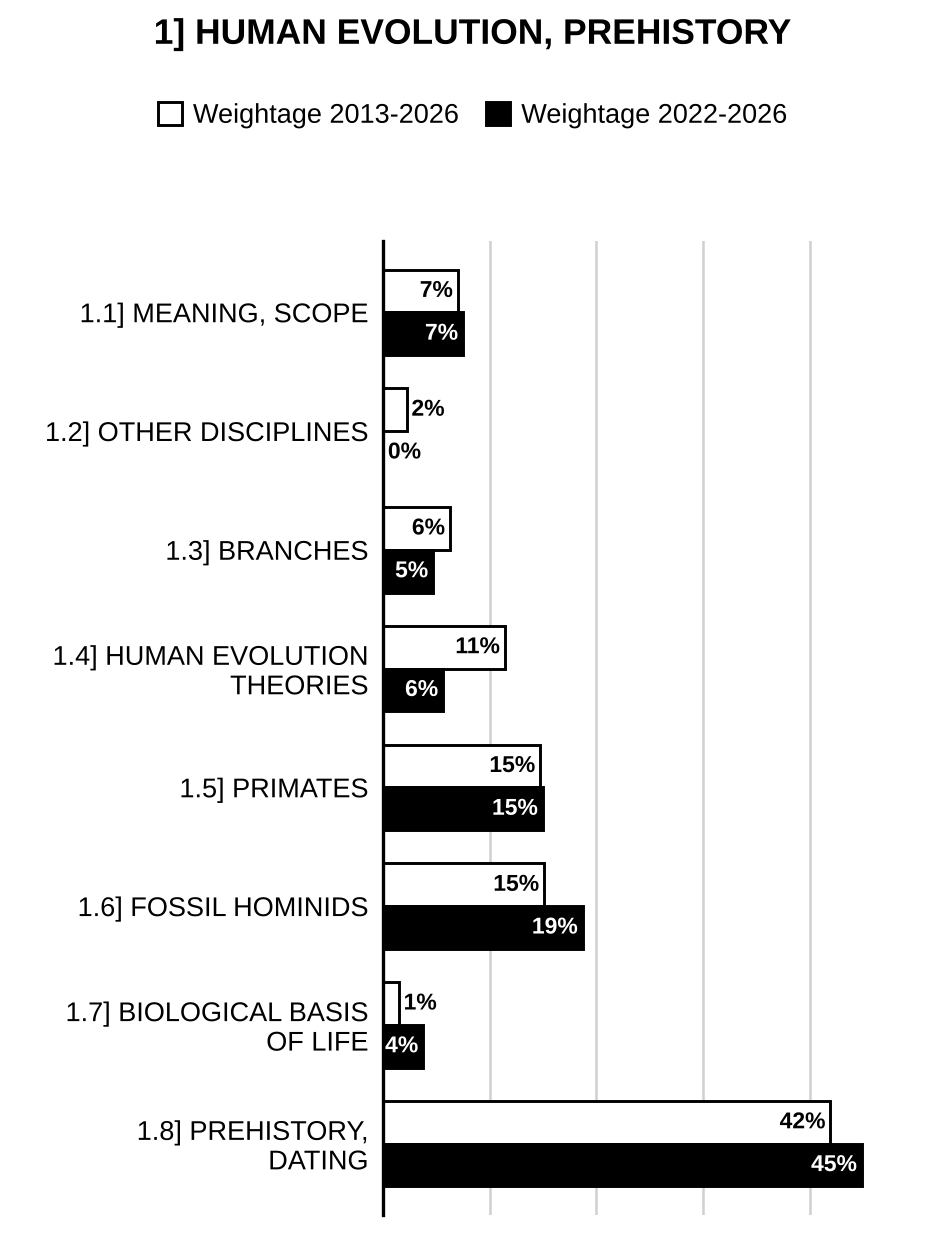
1.1] Meaning, scope and development of anthropology
7 questions
Anthropology provides a multidimensional understanding of human beings by bridging the gap between science and humanities. Elucidate. [2025/20m/4a]
“Anthropology is the systematic, objective and holistic study of human kind in all times and places”. Elaborate the argument. [2022/20m/2a]
Elaborate the scope of anthropology and elucidate its uniqueness in the field of other social sciences. [2021/20m/4a]
Write a short note on: The Relevance of Anthropology. [2018/10m/150w/1a]
Define Anthropology. Describe the major branches of Anthropology elaborating on any one branch. [2017/20m/6a]
Critically examine the role of anthropology in Contemporary India. [2014/15m/2a]
Write a short note on: Holistic and atomistic approach. [1998/25m/200w/11a]
1.2] Relationships with other disciplines
4 questions
Write a short note on: The relationship between Linguistics and Social-Cultural Anthropology. [2019/10m/150w/1a]
Write a short note on: Differences between Social Anthropology and Sociology. [2016/10m/150w/1a]
How do you situate Anthropology in Social Sciences? [2013/10m/150w/1a]
Discuss the relationship of anthropology with psychology and medicine. [1999/50m/2]
1.3] Main branches of anthropology, their scope and relevance
9 questions
“The agenda of biological anthropology became more scientific from the middle of the twentieth century.” Justify. [2025/15m/6b]
Write a short note on: Scope and relevance of Social and Cultural Anthropology. [2023/10m/150w/1a]
“The bio-cultural approach is the hallmark of Biological Anthropology.” Explain. [2021/10m/150w/1d]
How can synergising the core branches of anthropology reinvigorate the holistic spirit of the discipline? [2020/20m/8a]
Define Anthropology. Describe the major branches of Anthropology elaborating on any one branch. [2017/20m/6a]
Write a short note on: Archaeological Anthropology. [2015/10m/150w/1a]
Write a short note on: Major sub-divisions of Anthropology. [2014/10m/150w/1c]
Write a short note on: Biological Anthropology. [2008/20m/200w/1a]
Write a short note on: Biological Anthropology. [2002/20m/R1]
1.4] Human evolution and emergence of man
19 questions
Human evolution is a product of both biological and cultural factors. Elaborate. [2026/15m/3b]
Critically discuss the synergistic effect of biological and cultural factors in human evolution. [2024/15m/8c]
Explain the genetic mechanisms of micro and macro evolution. [2021/15m/3b]
Elucidate how Darwin and Post-Darwin theories of evolution resulted in the development of Synthetic theory of evolution. [2020/15m/3c]
Write a short note on: Implications of mutation in evolution. [2019/10m/150w/5b]
Explain the biological changes that made human beings capable of making culture. [2018/20m/2a]
Elucidate the biological and cultural factors in human evolution. [2016/15m/6a]
Elucidate the biological and cultural factors in Human Evolution. [2015/15m/2a]
Critically examine Darwin’s theory of evolution in understanding evolution. [2015/15m/6b]
Discuss how Neo-Darwinism integrated the fields of Genetics and Evolution. [2013/20m/250w/8a]
How ‘natural selection’ acts on variation? [2012/12m/150w/1a]
Write a short note on: Adaptive radiation in context of evolution. [2012/12m/150w/1e]
Write a short note on: Synthetic theory. [2011/15m/150w/1a]
Critically examine the synthetic theory of human evolution. [2010/30m/6b]
Write a short note on: Natural selection in humans. [2009/20m/200w/1b]
Discuss the modern theory of evolution with special reference to the concepts of gradualism and punctuationalism. [2008/60m/2]
What is Organic Evolution? Explain the theories of evolution. [2002/60m/R9]
Write a short note on: Molecular evolution. [1999/25m/200w/6c]
Discuss the gradualist view of evolutionary change vis-a-vis the punctuationalist view giving an example from primate evolution that supports one view or the other. [1997/50m/7]

Preparing for Prelims too?
Our UPSC Prelims Topic-wise PYQ eBook covers every Prelims question with detailed explanations, so you can see exactly where UPSC asks from.
View the BookDownload Free Sample1.5] Primates
23 questions
What are Strepsirhini Primates? Describe their geographical distribution and mention the characteristics that distinguish them from Haplorhini Primates. [2026/15m/6c]
Write a short note on: Smell as a signal among non-human primates. [2025/10m/150w/1d]
Discuss the Miocene hominoid remains and their significance in evolution. [2025/20m/2a]
What is hominization process? Discuss the major trends in human evolution with the help of suitable examples and illustrations. [2023/20m/3a]
Discuss different forms of primate social organisation. [2022/15m/2b]
Write a short note on: The losses and gains of erect posture. [2021/10m/150w/5b]
Write a short note on: Jane Goodall’s contributions in studying primate behaviour. [2020/10m/150w/1e]
Illustrate with examples the various types of locomotion patterns among the non-human primates. [2020/15m/4b]
Discuss the evolutionary significance of bipedalism and erect posture. [2019/20m/2a]
Write a short note on: Adaptive primate radiation. [2019/10m/150w/5a]
Bring out the comparative anatomical features of man and apes. Discuss their evolutionary significance. [2017/15m/6b]
Explain the skeletal changes due to erect posture and their implications. [2016/15m/8c]
Elucidate the skeletal differences between humans and chimpanzees. [2014/15m/7b]
Write a short note on: Role of primatology in Anthropological studies. [2013/10m/150w/5a]
Compare and contrast the skull of Gorilla and Man. [2012/20m/3a]
‘Man is a primate.’ Discuss. [2011/30m/2b]
What are the major craniofacial changes that occurred during Hominid evolution? Discuss. [2010/30m/3b]
List the major skeletal modifications in humans due to assumption of erect posture. [2009/30m/2b]
Write a short note on: Erect Posture. [2001/20m/R1]
Describe the range of locomotive behaviour of contemporary non-human primates and state how does it help in understanding the structural-functional correlations of their limb structure. [2000/60m/2]
‘Man can stand erect while anthropoid apes cannot.’ Discuss the anatomical changes that occurred in Man due to erect posture. [1998/50m/10]
Discuss primate locomotion with special reference to adaptations to arboreal life. [1996/50m/R11]
Write a short note on: Adaptive tradition in primates. [1995/25m/R2]
1.6] Fossil hominids: phylogenetic status, characteristics and geographical distribution
33 questions
Discuss the phylogenetic status, characteristic features, geographical distribution and lifeways of Paranthropus. [2026/20m/4a]
Write a short note on: Mitochondrial DNA and human evolution. [2025/10m/150w/5d]
Critically discuss the centrality of the African continent in the narrative of human evolution. [2025/15m/7c]
Discuss the geographical distribution of Homo erectus. Taking into account its physical features, where does it fit in human evolutionary line? [2024/20m/6a]
Discuss major species of Australopithecus discovered from South and East Africa. Describe the discovery, physical features and significance of Taung baby. [2023/20m/2a]
Should we still distinguish between ‘classic’ and ‘progressive’ Neanderthals? Discuss the controversy surrounding Neanderthal’s position in human evolution. [2022/15m/3c]
What are the physical and cultural characteristics of Homo erectus? Discuss its phylogenetic status. [2021/20m/2a]
Critically evaluate the contesting theories of the emergence and dispersal of modern Homo sapiens. [2020/20m/2a]
“Europeans are closer to Neanderthals.” Critically discuss in view of the African origin of humankind. [2019/15m/3b]
Write a short note on: Olduvai Gorge. [2019/10m/150w/5c]
Write a short note on: Rhodesian Man. [2016/10m/150w/5b]
Describe the salient characteristics and geographical distribution of Homo erectus. [2015/20m/6a]
Write a short note on: Asian Homo erectus. [2014/10m/150w/5d]
Comment briefly on the phylogenetic position of Australopithecines. [2012/10m/4c]
Write a short note on: Neanderthal Man. [2011/15m/150w/1b]
Describe major skeletal similarities and differences between Homo erectus and Homo sapiens. [2011/30m/2a]
Why are Neanderthals called Pre-modern humans? The Upper Palaeolithic period provides evidence of their coexistence with modern man. Discuss. [2010/30m/8a]
Write a short note on: Homo habilis. [2009/20m/200w/1a]
Distinguish between major categories of Australopithecines. How are Australopithecines different from apes? [2009/30m/2a]
Write a short note on: Homo erectus. [2007/20m/R1]
Write a short note on: Rhodesian Man. [2006/20m/R1]
Write a short note on: Australopithecus. [2005/20m/R1]
Write a short note on: Neanderthal Man. [2004/20m/R1]
Write a short note on: Homo Erectus. [2003/20m/R1]
Write a short note on: Fossil men. [1999/25m/200w/1b]
Write a short note on: Australopithecus. [1999/25m/200w/6a]
Write a short note on: Pithecanthropus erectus. [1998/25m/200w/1c]
Write a short note on: Biological evolution of early man. [1997/25m/200w/1b]
Write a short note on: Homo habilis. [1997/25m/200w/6b]
Discuss the geographic distribution and taxonomic issues concerning early hominids. Elucidate evidence in support of alternative positions. [1996/50m/R10]
Write a short note on: Homo sapiens sapiens. [1996/25m/R2]
Write a short note on: Homo erectus finds from Africa. [1995/25m/R3]
Discuss the question of single sources vs. multiple sources of the origin of Homo sapiens. Which one of the two hypotheses do you think is more tenable? Give reasons in support of your answer. [1995/50m/R9]
1.7] The biological basis of life
5 questions
Write a short note on: Distinguishing features of nuclear and mitochondrial DNA. [2026/10m/150w/5b]
Write a short note on: Gene expression. [2023/10m/150w/1e]
Write a short note on: Oncogenes. [2010/15m/150w/1c]
Write a short note on: Protein Synthesis. [2008/20m/200w/1b]
Write a short note on: Mutation. [1998/25m/200w/6b]
1.8] Prehistoric archaeology and prehistoric cultures
63 questions
Write a short note on: Ethnoarchaeology and classical archaeology. [2026/10m/150w/1e]
Give the distribution of Palaeolithic sites around the Himalayan and Sub-Himalayan areas, highlighting the typo-technologies of the tools. [2026/15m/3c]
Write a short note on: Thermoluminescence dating method. [2026/10m/150w/5e]
Write a detailed note on the characteristic features, chronology, geographical distribution, tool types and lifeways of Magdalenian cultural tradition of Europe. [2026/15m/7c]
Write a short note on: Osteodontokeratik culture and its makers. [2025/10m/150w/1c]
Write a note on Mousterian tool tradition, Mousterian culture and its makers. [2025/15m/4b]
Write a short note on: Fission track dating method and its applications. [2025/10m/150w/5c]
What are the major theories proposed in support of the origin of food production? How the change in subsistence economy brought revolution during this period? [2025/15m/7b]
Write a short note on: Harappan maritime trade. [2024/10m/150w/1b]
Describe the evidences of food production and domestication of animals with special reference to Mehrgarh. Throw light on its significance. [2024/15m/2b]
Discuss the Acheulian and Oldowan traditions of Indian Paleolithic cultures with suitable illustrations. [2024/15m/4b]
Write a short note on: Chronometric dating. [2024/10m/150w/5a]
Write a short note on: Cultural impact of Iron Age. [2023/10m/150w/1b]
Discuss the Paleolithic environment in light of available evidences with special reference to India. [2023/15m/2b]
Identify the major Mesolithic sites and describe the typo-technological features with special reference to India. [2023/15m/4c]
Write a short note on: Prehistoric significance of Rakhigarhi. [2023/10m/150w/5b]
Write a short note on: Mesolithic rock art in Indian subcontinent. [2022/10m/150w/1b]
Discuss with suitable examples the typo-technological problems in Indian palaeolithic industry with reference to environmental hypotheses. [2022/15m/2c]
Enumerate the evidence of animal domestication in Indian microlithic industry. [2022/15m/3b]
Write a short note on: Thermoluminescence (TL) dating. [2021/10m/150w/1e]
Describe the features of early farming cultures and Neolithic of the Near East. [2021/15m/2c]
Discuss the salient features of different traditions of European Mesolithic. [2021/15m/3c]
Write a short note on: Natufian culture. [2020/10m/150w/1a]
Differentiate between Lower Palaeolithic culture and Middle Palaeolithic culture with suitable examples. [2020/15m/2c]
Write a short note on: Relative Dating Methods. [2019/10m/150w/1e]
Elucidate Mesolithic culture and associated rock art with examples from India. [2019/15m/2c]
Discuss briefly the major traditions in the Upper Palaeolithic culture of Europe. [2019/15m/3c]
Discuss with examples the Megalithic culture of India in the archaeological context. [2019/20m/8a]
Write a short note on: Town Planning of Harappan Culture. [2018/10m/150w/1c]
Give an account of the consequences of food production of Neolithic culture. [2018/15m/3b]
Describe the culture related to Homo erectus. [2018/15m/4b]
Explain the impact of discovery of iron technology on contemporary society. [2018/15m/6c]
Describe the principles of radiocarbon dating. Mention its limitations. [2018/15m/7b]
Give an account of the field methods used in the study of Archaeological Anthropology. [2018/15m/8c]
Write a short note on: Salient features of Mesolithic culture. [2017/10m/150w/5b]
What are dating methods? Discuss one absolute method and one relative method in detail. [2017/15m/6c]
Delineate the salient features of Chalcolithic cultures. [2016/15m/2a]
Write a short note on: Neolithic Cultures of India. [2016/10m/150w/5c]
Write a short note on: Palaeolithic culture. [2015/10m/150w/5a]
Describe the absolute dating methods in Archaeology, highlighting the importance of each method. [2014/15m/8b]
Describe the Neolithic culture of India. [2014/15m/8c]
Write a short note on: Carbon-14 method of dating. [2013/10m/150w/1e]
Give a broad outline of Palaeolithic culture emphasizing upon its tool technology. [2013/20m/250w/6a]
Write a short note on: Relative dating methods. [2012/12m/150w/1d]
Discuss the typology and distribution of Upper Palaeolithic cultures in India. [2012/20m/3b]
Write a short note on: Importance of chronology in prehistory. [2010/15m/150w/1b]
What stage is known as the incipient stage of food production? Point out major features of this cultural stage. Illustrate your answer with suitable examples from a specific area in the old world. [2010/30m/2a]
Point out the differences in the concepts of classical evolutionism and neo-evolutionism in socio-cultural anthropology. Which stage of prehistoric culture is known as Cultural Revolution and why? [2010/30m/2b]
Write a short note on: Culture of Homo erectus. [2010/15m/150w/5a]
Write a short note on: Neolithic. [2007/20m/R2]
Write a short note on: Lower Paleolithic Culture. [2006/20m/R2]
Write a short note on: Microlith. [2005/20m/R2]
Write a short note on: Chalcolithic Culture. [2004/20m/R2]
Write a short note on: Neolithic Culture. [2002/20m/R2]
Write a short note on: Mesolithic culture in India. [2001/20m/R2]
Write a short note on: Copper-Bronze Age. [2000/20m/200w/1b]
Write a short note on: Carbon dating method. [1999/25m/200w/1c]
Describe any chalcolithic site in India with particular reference to industry and town planning. [1999/50m/4]
Neolithic is a ‘self-sufficient food producing economy.’ Critically examine this expression. [1998/50m/2]
Write a short note on: Problems of dating in Prehistoric Archaeology. [1997/25m/200w/1c]
Write a short note on: Radiometric methods of dating fossils. [1996/25m/R3]
What is the neolithic phase of culture in Europe called revolution? Describe its distinctive features. [1995/50m/R10]
Write a short note on: Chronometric dating methods. [1995/25m/R4]

Strengthen your GS papers
Our UPSC Mains Topic-wise & Year-wise PYQ eBook (2013–2026) maps every GS question to the syllabus, so you know what UPSC asks and how often.
View the BookDownload Free SampleNext: Culture, Society, Marriage, Family and Kinship »
Back to: Anthropology Optional PYQs – Topic-wise | Also see: Anthropology Optional year-wise question papers
Last updated: 30 October 2026