
Here are all 86 Mechanics and Fluid Dynamics questions asked in UPSC Mathematics Optional Paper II from 2008 to 2026, arranged under the 5 topics of the official syllabus. Within each topic the latest questions come first.
Each question ends with a code such as [2024/10m/1a] – the year, the marks and the question number in the paper.
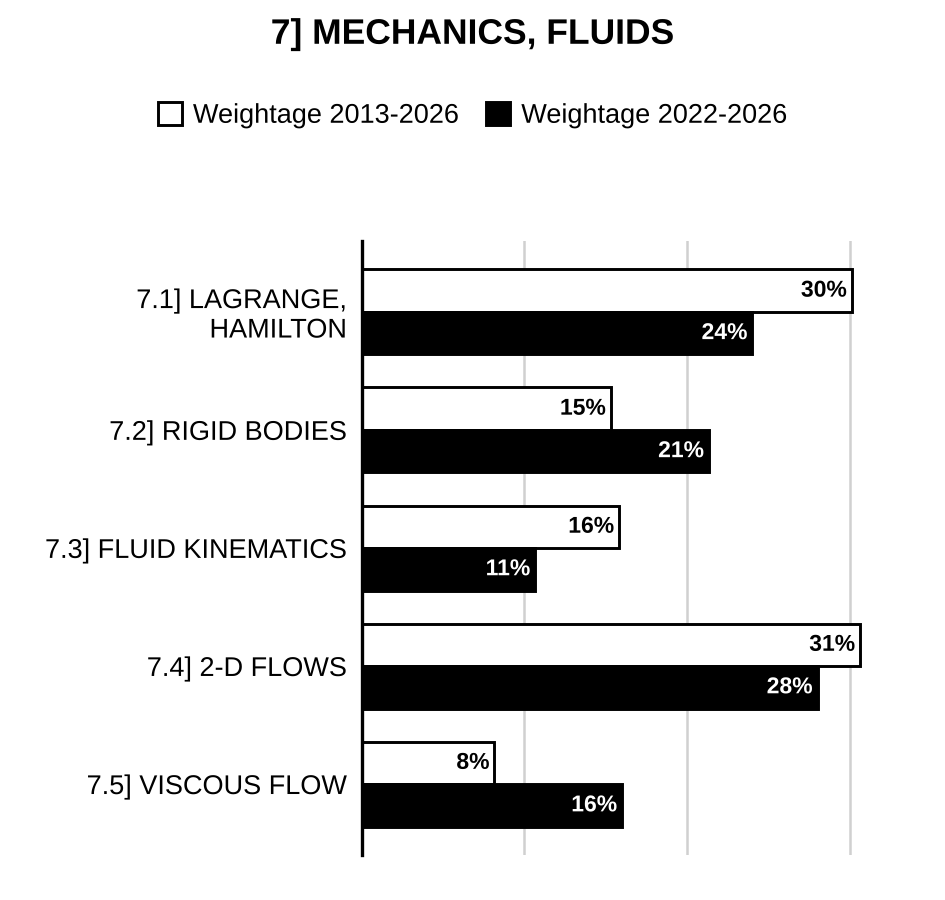
7.1] Lagrangian and Hamiltonian mechanics
22 questions
A smooth uniform rod, say , of length and mass is pivoted at one end to a fixed point . The rod is inclined at an angle with the downward vertical line and the plane makes an angle with a fixed vertical plane. A bead of mass slides smoothly on the rod and is connected to by a light elastic string of modulus and natural length . Show that the kinetic energy of the system is given by , where is the stretched length of the string, and derive the equations of motion. [2026/20m/7c]
A bead of mass slides on a frictionless wire in the shape of a cycloid given by , , . Find the Lagrangian function. Hence show that the equation of motion can be written as where . [2025/10m/5d]
A particle of mass moves in a force field of potential Find the Hamiltonian and the Hamilton’s equations in spherical polar coordinates . [2025/10m/8c(i)]
Consider the Lagrangian where and are constants. Find the Hamiltonian and Hamilton’s equations of motion. Identify the system. [2025/10m/8c(ii)]
A planet of mass is revolving around the sun of mass . The kinetic energy and the potential energy of the planet are given by and , where are the polar coordinates of the planet at time , is the gravitational constant and is the major axis of the ellipse (the path of the planet). Find the Hamiltonian and the Hamilton equations of the planet’s motion. [2023/10m/5d]
A mechanical system with 2 degrees of freedom has the Lagrangian where , , , are constants. Find the parameter so that under the transformation the Lagrangian in terms of , will not contain the product term . Find the Lagrange’s equations w.r.t. and independent of parameter . [2023/20m/6c]
A particle at a distance from the centre of force moves under the influence of the central force , where is a constant. Obtain the Lagrangian and derive the equations of motion. [2022/10m/5d]
A particle is constrained to move along a circle lying in the vertical -plane. With the help of the D’Alembert’s principle, show that its equation of motion is , where is the acceleration due to gravity. [2021/10m/5d]
Obtain the Lagrangian equation for the motion of a system of two particles of unequal masses connected by an inextensible string passing over a small smooth pulley. [2021/15m/6c]
By writing down the Hamiltonian, find the equations of motion of a particle of mass constrained to move on the surface of a cylinder defined by , is a constant. The particle is subject to a force directed towards the origin and proportional to the distance of the particle from the origin given by , is a constant. [2020/20m/6c]
Using Hamilton’s equation, find the acceleration for a sphere rolling down a rough inclined plane, if be the distance of the point of contact of the sphere from a fixed point on the plane. [2019/15m/7a]
Suppose the Lagrangian of a mechanical system is given by where , , , , are constants and . Write down the Lagrangian equations of motion and identify the system. [2018/20m/6c]
The Hamiltonian of a mechanical system is given by, , where , are the constants. Solve the Hamiltonian equations and show that constant. [2018/20m/7c]
Two uniform rods , , each of mass and length , are smoothly hinged together at and move on a horizontal plane. At time , the mass centre of the rods is at the point referred to fixed perpendicular axes , in the plane, and the rods make angles with . Prove that the kinetic energy of the system is Also derive Lagrange’s equations of motion for the system if an external force with components along the axes acts at . [2017/20m/6c]
Consider a single free particle of mass , moving in space under no forces. If the particle starts from the origin at and reaches the position at time , find the Hamilton’s characteristic function as a function of . [2016/10m/5c]
A hoop with radius is rolling, without slipping, down an inclined plane of length and with angle of inclination . Assign appropriate generalized coordinates to the system. Determine the constraints, if any. Write down the Lagrangian equations for the system. Hence or otherwise determine the velocity of the hoop at the bottom of the inclined plane. [2016/15m/8b]
Solve the plane pendulum problem using the Hamiltonian approach and show that is a constant of motion. [2015/15m/6b]
A Hamiltonian of a system with one degree of freedom has the form where , , are constants, is the generalized coordinate and is the corresponding generalized momentum. (i) Find a Lagrangian corresponding to this Hamiltonian. (ii) Find an equivalent Lagrangian that is not explicitly dependent on time. [2015/20m/7c]
Find the equation of motion of a compound pendulum using Hamilton’s equations. [2014/10m/5e]
Two equal rods and , each of length , smoothly jointed at , are suspended from and oscillate in a vertical plane through . Show that the periods of normal oscillations are where . [2013/15m/8a]
Obtain the equations governing the motion of a spherical pendulum. [2012/12m/5d]
A sphere of radius and mass rolls down a rough plane inclined at an angle to the horizontal. If be the distance of the point of contact of the sphere from a fixed point on the plane, find the acceleration by using Hamilton’s equations. [2010/30m/8a]
7.2] Moment of inertia and rigid body motion
21 questions
A uniform heavy solid hemisphere of radius ‘‘ is held at rest with its base vertical and its curved surface in contact with a horizontal plane. If the hemisphere is released when the plane is rough enough to prevent slipping, show that the angle that the base makes with the horizontal at time , is such that . [2026/10m/5e]
Calculate the moment of inertia of a uniform solid cylinder of mass , radius and length with respect to a set of axes passing through the centre of the cylinder, where -axis is the axis of the cylinder and is the constant density at any point of the cylinder. Also find for which the moment of inertia about – or -axis will be minimum for a given mass of the cylinder. [2025/15m/6c]
A rough uniform board of mass and length rests on a smooth horizontal plane and a man of mass walks on it from one end to the other. Find the distance covered by the board during this time. [2024/10m/5d]
Find the moment of inertia of a quadrant of an elliptic disk , of mass about the line passing through its centre and perpendicular to its plane. Given that the density at any point is proportional to . [2024/15m/6c]
A perfectly rough ball is at rest within a hollow cylindrical roller. The roller is drawn along a level path with uniform velocity . Let and be the radii of the ball and the roller respectively. If , then show that the ball will roll completely round the inside of the roller. [2023/15m/7b]
Find the moment of inertia of a right circular solid cone about one of its slant sides (generator) in terms of its mass , height and the radius of base as . [2022/15m/6c]
Prove that the moment of inertia of a triangular lamina about any axis through in its plane is where is the mass of the lamina and , are respectively the length of perpendiculars from and on the axis. [2020/10m/5e]
A uniform rod , of length , free to turn about its end , revolves with angular velocity about the vertical through , and is inclined at a constant angle to ; find the value of . [2019/10m/5c]
A circular cylinder of radius and radius of gyration rolls without slipping inside a fixed hollow cylinder of radius . Show that the plane through axes moves in a circular pendulum of length . [2019/20m/6c]
Show that the moment of inertia of an elliptic area of mass and semi-axis and about a semi-diameter of length is . Further, prove that the moment of inertia about a tangent is , where is the perpendicular distance from the centre of the ellipse to the tangent. [2017/10m/5e]
Calculate the moment of inertia of a solid uniform hemisphere , with mass about the -axis. [2015/10m/5e]
Four solid spheres , , and , each of mass and radius , are placed with their centres on the four corners of a square of side . Calculate the moment of inertia of the system about a diagonal of the square. [2013/10m/5e]
A pendulum consists of a rod of length and mass ; to one end of which a spherical bob of radius and mass is attached. Find the moment of inertia of the pendulum : (i) about an axis through the other end of the rod and at right angles to the rod. [2012/15m/8a(i)]
about a parallel axis through the centre of mass of the pendulum. [Given : The centre of mass of the pendulum is above the centre of the sphere.]. [2012/15m/8a(ii)]
Let be the radius of the base of a right circular cone of height and mass . Find the moment of inertia of that right circular cone about a line through the vertex perpendicular to the axis. [2011/12m/5e]
The ends of a heavy rod of length are rigidly attached to two light rings which can respectively slide on the thin smooth fixed horizontal and vertical wires and . The rod starts at an angle to the horizon with an angular velocity and moves downwards. Show that it will strike the horizontal wire at the end of time [2011/30m/8a]
A uniform lamina is bounded by a parabolic arc of latus rectum and a double ordinate at a distance from the vertex. If , show that two of the principal axes at the end of a latus rectum are the tangent and normal there. [2010/12m/5e]
The flat surface of a hemisphere of radius is cemented to one flat surface of a cylinder of the same radius and of the same material. If the length of the cylinder be and the total mass be , show that the moment of inertia of the combination about the axis of the cylinder is given by : [2009/12m/5e]
A perfectly rough sphere of mass and radius , rests on the lowest point of a fixed spherical cavity of radius . To the highest point of the movable sphere is attached a particle of mass and the system is disturbed. Show that the oscillations are the same as those of a simple pendulum of length [2009/30m/8a]
A circular board is placed on a smooth horizontal plane and a boy runs round the edge of it at a uniform rate. What is the motion of the centre of the board ? Explain. What happens if the mass of the board and boy are equal ? [2008/12m/5e]
A uniform rod of mass and length has its middle point fixed and a mass is attached to one of its extremity. The rod, when in a horizontal position is set rotating about a vertical axis through its centre with an angular velocity . Show that the heavy end of the rod will fall till the inclination of the rod to the vertical is . [2008/30m/8a]

Preparing for Prelims too?
Our UPSC Prelims Topic-wise PYQ eBook covers every Prelims question with detailed explanations, so you can see exactly where UPSC asks from.
View the BookDownload Free Sample7.3] Kinematics and equations of fluid motion
15 questions
The velocity potential of a flow is given by Determine the streamlines. [2024/10m/5e]
Let the velocity field satisfy the equations of motion for inviscid incompressible flow, where is a constant. Determine the pressure associated with this velocity field. [2024/20m/7c]
The velocity components of an incompressible fluid in spherical polar coordinates are , where is a constant. Show that the velocity is of the potential kind. Find the velocity potential and the equations of the streamlines. [2022/10m/5e]
Show that , ( constant) is a possible incompressible fluid motion. Determine the streamlines. Is the kind of the motion potential? If yes, then find the velocity potential. [2021/20m/7c]
A sphere of radius , whose centre is at rest, vibrates radially in an infinite incompressible fluid of density , which is at rest at infinity. If the pressure at infinity is , so that the pressure at the surface of the sphere at time is [2019/15m/8b]
For an incompressible fluid flow, two components of velocity are given by , . Determine the third component so that they satisfy the equation of continuity. Also, find the -component of acceleration. [2018/10m/5c]
A stream is rushing from a boiler through a conical pipe, the diameters of the ends of which are and . If and be the corresponding velocities of the stream and if the motion is assumed to be steady and diverging from the vertex of the cone, then prove that where is the pressure divided by the density and is constant. [2017/15m/7c]
If the velocity of an incompressible fluid at the point is given by then prove that the liquid motion is possible and that the velocity potential is . Further, determine the streamlines. [2017/15m/8c]
Does a fluid with velocity possess vorticity, where is the velocity in the Cartesian frame, and ? What is the circulation in the circle ? [2016/10m/5b]
The space between two concentric spherical shells of radii , is filled with a liquid of density . If the shells are set in motion, the inner one with velocity in the -direction and the outer one with velocity in the -direction, then show that the initial motion of the liquid is given by velocity potential where , the coordinates being rectangular. Evaluate the velocity at any point of the liquid. [2016/20m/7b]
Prove that the necessary and sufficient condition that the vortex lines may be at right angles to the stream lines are where and are functions of , , , . [2013/10m/5d]
Show that is a possible form for the velocity potential for an incompressible fluid motion. If the fluid velocity as , find the surfaces of constant speed. [2012/30m/8b]
In an incompressible fluid the vorticity at every point is constant in magnitude and direction; show that the components of velocity , , are solutions of Laplace’s equation. [2010/12m/5f]
An infinite mass of fluid is acted on by a force per unit mass directed to the origin. If initially the fluid is at rest and there is a cavity in the form of the sphere in it, show that the cavity will be filled up after an interval of time . [2009/30m/8b]
If the velocity potential of a fluid is , then show that the stream lines lie on the surfaces , being a constant. [2008/12m/5f]
7.4] Two-dimensional and axisymmetric flow
24 questions
A simple source of strength is fixed at the origin in a uniform stream of incompressible fluid moving with velocity . Find out the velocity potential at any point of the stream where and is the angle makes with the direction . Find the differential equation of the stream lines and show that they lie on the surface . [2026/10m/5d]
Suppose that there is an infinitely long cylinder of radius ‘‘ placed in a uniform stream having velocity . Then using Milne-Thomson’s circle theorem, what will be its complex velocity potential ? If in addition, a circulation round the cylinder of is produced, find out the stagnation points. Do they produce a lifting tendency in the vertical direction ? Explain how. [2026/15m/6c]
A source and a sink of equal strength are placed at points within a fixed circular boundary . Show that the streamlines are given by where is a constant and . [2025/10m/5e]
Suppose an infinite liquid contains two parallel, equal and opposite rectilinear vortices at a distance . Show that the streamlines relative to the vortex are given by the equation where is a constant, the origin is the middle point of the join, and the line joining the vortices is the axis of . [2024/20m/8c]
In a fluid motion, there is a source of strength placed at and two sinks of strength are placed at and . Find the streamlines. [2023/10m/5e]
Two point vortices each of strength are situated at and a point vortex of strength is situated at the origin. Show that the fluid motion is stationary and also find the equations of streamlines. If the streamlines, which pass through the stagnation points, meet the -axis at , then show that . [2022/20m/7c]
Verify that is the complex potential of a steady flow of fluid about a circular cylinder, where the plane is a rigid boundary. Find also the force exerted by the fluid on unit length of the cylinder. [2022/20m/8c]
What arrangements of sources and sinks can have the velocity potential ? Draw the corresponding sketch of the streamlines and prove that two of them subdivide into the circle and the axis of . [2021/10m/5e]
Show that for the complex potential , the streamlines and equipotential curves are circles. Find the velocity at any point and check the singularities at . [2021/20m/8c]
A velocity potential in a two-dimensional fluid flow is given by . Find the stream function for this flow. [2020/15m/7c]
Two sources of strength are placed at the points . Show that at any point on the circle , the velocity is parallel to the -axis and is inversely proportional to . [2020/15m/8c]
Two sources, each of strength , are placed at the points , and a sink of strength at origin. Show that the stream lines are the curves , where is a variable parameter. Show also that the fluid speed at any point is , where , and are the distances of the points from the sources and the sink, respectively. [2019/20m/8c]
For a two-dimensional potential flow, the velocity potential is given by . Determine the velocity components along the directions and . Also, determine the stream function and check whether represents a possible case of flow or not. [2018/15m/8b]
A simple source of strength is fixed at the origin in a uniform stream of incompressible fluid moving with velocity . Show that the velocity potential at any point of the stream is , where and is the angle which makes with the direction . Find the differential equation of the streamlines and show that they lie on the surfaces . [2016/15m/6b]
Consider a uniform flow in the positive -direction. A cylinder of radius is located at the origin. Find the stream function and the velocity potential. Find also the stagnation points. [2015/10m/5d]
In an axisymmetric motion, show that stream function exists due to equation of continuity. Express the velocity components in terms of the stream function. Find the equation satisfied by the stream function if the flow is irrotational. [2015/20m/8c]
Given the velocity potential , determine the streamlines. [2014/20m/7c]
If fluid fills the region of space on the positive side of the -axis, which is a rigid boundary and if there be a source at the point and an equal sink at and if the pressure on the negative side be the same as the pressure at infinity, show that the resultant pressure on the boundary is where is the density of the fluid. [2013/15m/8b]
If rectilinear vortices of the same strength are symmetrically arranged as generators of a circular cylinder of radius in an infinite liquid, prove that the vortices will move round the cylinder uniformly in time . Find the velocity at any point of the liquid. [2013/20m/8c]
A rigid sphere of radius is placed in a stream of fluid whose velocity in the undisturbed state is . Determine the velocity of the fluid at any point of the disturbed stream. [2012/12m/5e]
An infinite row of equidistant rectilinear vortices are at a distance apart. The vortices are of the same numerical strength but they are alternately of opposite signs. Find the Complex function that determines the velocity potential and the stream function. [2011/30m/8b]
When a pair of equal and opposite rectilinear vortices are situated in a long circular cylinder at equal distances from its axis, show that the path of each vortex is given by the equation being measured from the line through the centre perpendicular to the joint of the vortices. [2010/30m/8b]
Two sources, each of strength are placed at the points , and a sink of strength is at the origin. Show that the stream lines are the curves : where is a variable parameter. Show also that the fluid speed at any point is , where , and are the distances of the points from the sources and the sink. [2009/12m/5f]
Let the fluid fills the region (right half of 2d plane). Let a source be at and equal sink at , . Let the pressure be same as pressure at infinity i.e. . Show that the resultant pressure on the boundary (-axis) is being the density of the fluid. [2008/30m/8b]
7.5] Viscous flow: Navier-Stokes equation
4 questions
A viscous incompressible fluid is filled between two concentric cylinders of radius , . The flow is steady and no body forces are taken into consideration. Discuss and formulate the velocity of the fluid if : (i) the inner cylinder is given angular velocity while the outer one is held at rest; (ii) the outer cylinder is rotated with angular velocity while the inner one is held at rest. [2026/20m/8c]
Show that for an incompressible steady flow with constant viscosity, the velocity components , with , satisfy the equation of motion in the absence of body force. Given that , and are constants. [2025/20m/7c]
Determine under what conditions the velocity field , , is a solution to the Navier-Stokes momentum equations. Assuming that the conditions are met, determine the resulting pressure distribution, when is up and the external body forces are , . [2023/20m/8c]
Find Navier-Stokes equation for a steady laminar flow of a viscous incompressible fluid between two infinite parallel plates. [2014/20m/8c]

Strengthen your GS papers
Our UPSC Mains Topic-wise & Year-wise PYQ eBook (2013–2026) maps every GS question to the syllabus, so you know what UPSC asks and how often.
View the BookDownload Free Sample« Previous: Numerical Analysis and Computer Programming
Back to: Mathematics Optional PYQs – Topic-wise | Also see: Mathematics Optional year-wise question papers
Last updated: 30 October 2026