
Here are all 86 Partial Differential Equations questions asked in UPSC Mathematics Optional Paper II from 2008 to 2026, arranged under the 4 topics of the official syllabus. Within each topic the latest questions come first.
Each question ends with a code such as [2024/10m/1a] – the year, the marks and the question number in the paper.
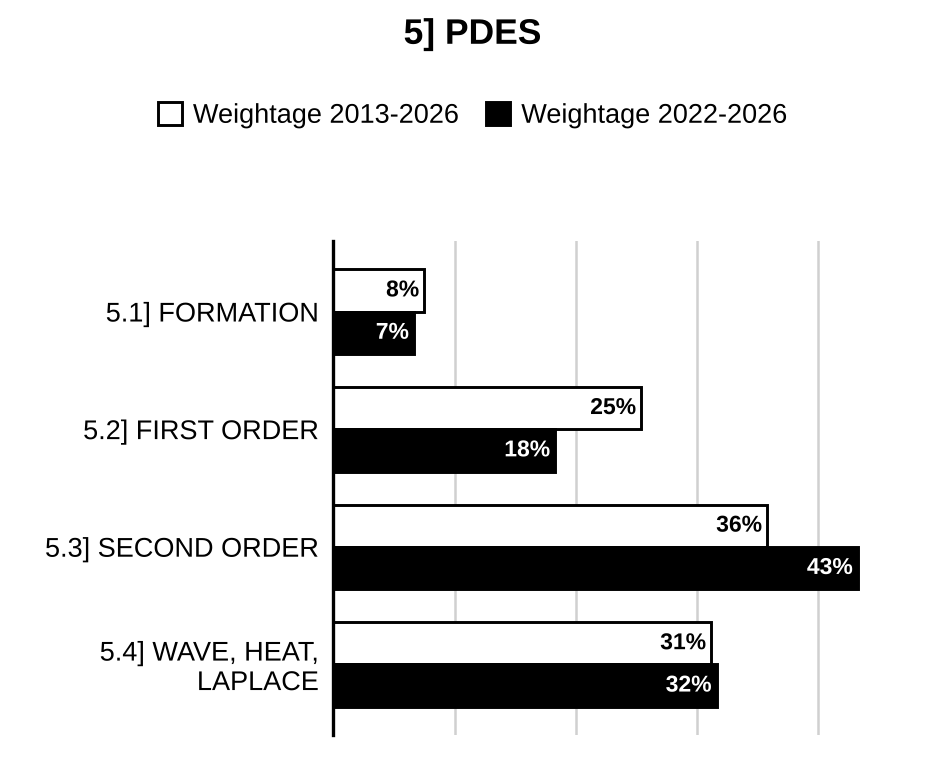
5.1] Formulation of PDEs
9 questions
By eliminating the arbitrary functions and from , form partial differential equation. [2023/10m/5a]
It is given that the equation of any cone with vertex at is . Find the differential equation of the cone. [2022/10m/5a]
Obtain the partial differential equation by eliminating arbitrary function from the equation . [2021/10m/5a]
Form a partial differential equation by eliminating the arbitrary functions and from and specify its nature (elliptic, hyperbolic or parabolic) in the region , . [2020/10m/5a]
Form a partial differential equation of the family of surfaces given by the following expression : . [2019/10m/5a]
Find the partial differential equation of the family of all tangent planes to the ellipsoid : , which are not perpendicular to the plane. [2018/10m/5a]
Form a partial differential equation by eliminating the arbitrary functions and from . [2013/10m/5a]
Show that the differential equation of all cones which have their vertex at the origin is . Verify that this equation is satisfied by the surface . [2009/12m/5a]
Form the partial differential equation by eliminating the arbitrary function given by : [2009/6m/5b(i)]
5.2] First order PDEs
22 questions
Find the integral surface of the equations . [2026/10m/5a]
Find the complete integral of ; , . [2025/15m/7a]
Find the characteristics of the partial differential equation and determine the integral surface which passes through , . [2025/15m/8a]
Find the integral surface of the following quasi-linear equation which passes through the curve , and through the circle , . [2024/15m/7a]
Find a complete integral of the partial differential equation by using Charpit’s method. [2021/15m/8a]
Find the integral surface of the partial differential equation : that contains the curve : , on it. [2020/15m/6a]
Find the solution of the partial differential equation : which passes through the -axis. [2020/15m/7a]
Solve the first order quasilinear partial differential equation by the method of characteristics : in with on . [2019/15m/6a]
Find the general solution of the partial differential equation : , where , , and find its integral surface that passes through the curve : , , . [2018/15m/6a]
Find a complete integral of the partial differential equation [2017/15m/6a]
Find the general equation of surfaces orthogonal to the family of spheres given by . [2016/10m/5a]
Find the general integral of the partial differential equation [2016/10m/5e]
Determine the characteristics of the equation , and find the integral surface which passes through the parabola . [2016/15m/6a]
Solve the partial differential equation where and . [2015/10m/5a]
Solve for the general solution , where and . [2015/15m/6a]
Find the surface which intersects the surfaces of the system orthogonally and which passes through the circle , . [2013/15m/6b]
Solve the partial differential equation . [2012/20m/6a]
Solve the PDE [2011/12m/5b]
Solve the following partial differential equation by the method of characteristics. [2010/20m/6a]
Find the integral surface of : which passes through the curve : , . [2009/6m/5b(ii)]
Find the general solution of the partial differentia. equation and also find the particular solution which passes through the lines , . [2008/12m/5a]
Find complete and singular integrals of using Charpit’s method. [2008/15m/6b]

Preparing for Prelims too?
Our UPSC Prelims Topic-wise PYQ eBook covers every Prelims question with detailed explanations, so you can see exactly where UPSC asks from.
View the BookDownload Free Sample5.3] Second order linear PDEs
33 questions
Reduce the partial differential equation to canonical form and hence solve it. [2026/20m/6a]
Solve the partial differential equation where , , . [2026/15m/7a]
Find the solution of the equation , where and . [2025/10m/5a]
Show that if and are arbitrary functions of their respective arguments, then , is a solution of where . [2024/10m/5a]
Solve the partial differential equation by transforming it to the canonical form. [2024/15m/8a]
Find the surface passing through the two lines and , and satisfying the partial differential equation . [2023/15m/6a]
Reduce the partial differential equation to canonical form. [2023/15m/8a]
Find the general solution of the partial differential equation where and . [2022/15m/7a]
Reduce the following partial differential equation to a canonical form and hence solve it : [2022/15m/8a]
Find the general solution of the partial differential equation where and . [2021/15m/7a]
Form a partial differential equation by eliminating the arbitrary functions and from and specify its nature (elliptic, hyperbolic or parabolic) in the region , . [2020/10m/5a]
Solve the partial differential equation : [2020/10m/5d]
Reduce the following second order partial differential equation to canonical form and find the general solution : [2019/20m/7c]
Solve the partial differential equation : where , . [2018/15m/7a]
Solve , where [2017/10m/5a]
Reduce the equation to canonical form and hence solve it. [2017/15m/7a]
Solve the partial differential equation [2016/15m/7a]
Solve , where and . [2015/10m/5b]
Reduce the second-order partial differential equation into canonical form. Hence, find its general solution. [2015/15m/8a]
Solve the partial differential equation . [2014/10m/5a]
Reduce the equation to canonical form. [2014/15m/6a]
Reduce the equation to its canonical form when . [2013/10m/5b]
Solve where and denote and . [2013/15m/6a]
Solve the partial differential equation [2012/12m/5a]
Solve the PDE [2011/12m/5a]
Find the surface satisfying and touching along its section by the plane . [2011/20m/6a]
Solve the [2010/12m/5a]
Find the surface satisfying the and the conditions that when and when . [2010/12m/5b]
Reduce the following 2nd order partial differential equation into canonical form and find its general solution [2010/20m/6b]
Find the characteristics of : where and have their usual meanings. [2009/15m/6a]
Solve : where and represent and . [2009/15m/6b]
Find general solution of the particle differential equation : where , . [2008/12m/5b]
Reduce to canonical form. [2008/15m/6c]
5.4] Wave, heat and Laplace equations
22 questions
Two-dimensional harmonic equation in plane polar coordinates takes the form : Deduce that it has solutions of the form , where , , are constants. Determine if it satisfies the two-dimensional harmonic equation in the region , and satisfies the conditions : (i) remains finite as , (ii) on . [2026/15m/8a]
Solve for a rectangular plate subject to the boundary conditions [2025/20m/6a]
Show that the solution of the two-dimensional Laplace’s equation subject to the boundary condition , , along with for and can be written in the form [2024/20m/6a]
Solve the partial differential equation subject to the conditions [2023/20m/7c]
Solve the heat equation , , subject to the conditions [2022/20m/6a]
Solve the wave equation subject to the conditions [2021/20m/6a]
One end of a tightly stretched flexible thin string of length is fixed at the origin and the other at . It is plucked at so that it assumes initially the shape of a triangle of height in the – plane. Find the displacement at any distance and at any time after the string is released from rest. Take, . [2020/20m/8a]
A thin annulus occupies the region , . The faces are insulated. Along the inner edge the temperature is maintained at , while along the outer edge the temperature is held at , where is a constant. Determine the temperature distribution in the annulus. [2018/20m/8c]
Let be a closed curve in -plane and let denote the region bounded by the curve . Let If is prescribed at each point of and is prescribed on the boundary of , then prove that any solution , satisfying these conditions, is unique. [2017/10m/5d]
Given the one-dimensional wave equation where , is the constant tension in the string and is the mass per unit length of the string. (i) Find the appropriate solution of the above wave equation. (ii) Find also the solution under the conditions , for all and , , , . [2017/20m/8a]
Find the temperature in a bar of silver of length 10 cm and constant cross-section of area 1 cm. Let density g/cm, thermal conductivity cal/(cm sec C) and specific heat cal/g C. The bar is perfectly isolated laterally, with ends kept at C and initial temperature C. Note that follows the heat equation , where . [2016/20m/8a]
Find the solution of the initial-boundary value problem [2015/15m/7a]
Find the deflection of a vibrating string (length , ends fixed, ) corresponding to zero initial velocity and initial deflection [2014/15m/7a]
Solve , , , given that (i) , (ii) , (iii) , for all [2014/15m/8a]
A tightly stretched string with fixed end points and is initially at rest in equilibrium position. If it is set vibrating by giving each point a velocity , find the displacement of the string at any distance from one end at any time . [2013/20m/6c]
A string of length is fixed at its ends. The string from the mid-point is pulled up to a height and then released from rest. Find the deflection of the vibrating string. [2012/20m/6b]
The edge of a circular plate is kept at temperature . The plate is insulated so that there is no loss of heat from either surface. Find the temperature distribution in steady state. [2012/20m/7b]
Solve satisfying the boundary conditions [2011/20m/6b]
Obtain temperature distribution in a uniform bar of unit length whose one end is kept at C and the other end is insulated. Also it is given that , . [2011/20m/6c]
Solve the following heat equation [2010/20m/6c]
A tightly stretched string has its ends fixed at and . At time , the string is given a shape defined by , where is a constant, and then released. Find the displacement of any point of the string at time . [2009/30m/6c]
Find the steady state temperature distribution in a thin rectangular plate bounded by the lines , , and . The edges , and are kept at temperature zero while the edge is kept at C. [2008/30m/6a]

Strengthen your GS papers
Our UPSC Mains Topic-wise & Year-wise PYQ eBook (2013–2026) maps every GS question to the syllabus, so you know what UPSC asks and how often.
View the BookDownload Free Sample« Previous: Linear Programming | Next: Numerical Analysis and Computer Programming »
Back to: Mathematics Optional PYQs – Topic-wise | Also see: Mathematics Optional year-wise question papers
Last updated: 30 October 2026