
Here are all 89 Vector Analysis questions asked in UPSC Mathematics Optional Paper I from 2008 to 2026, arranged under the 3 topics of the official syllabus. Within each topic the latest questions come first.
Each question ends with a code such as [2024/10m/1a] – the year, the marks and the question number in the paper.
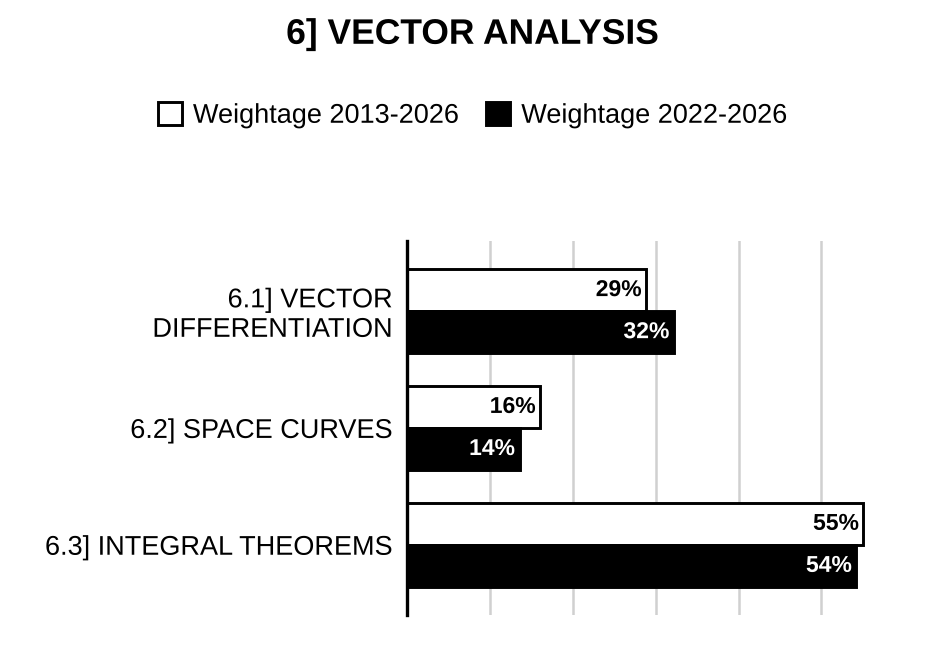
6.1] Vector differentiation
34 questions
For a scalar point function and a vector point function , prove that If and , then verify the above identity for and . [2026/10m/8c(i)]
If , then show that [2026/10m/8c(ii)]
If , and , then show that , and are coplanar. [2025/10m/5e]
Find the absolute value of the directional derivative of at the point in the direction of the tangent to the curve , at . [2025/10m/6c(i)]
If , , and , then show that and . [2025/10m/6c(ii)]
At any time (in seconds), the coterminous edges of a variable parallelepiped are represented by the vectors What is the rate of change of the vectorial area of the parallelogram, whose coterminous edges are and ? Also find the rate of change of the volume of the parallelepiped at second. [2024/10m/5c]
If then find the values of the derivative of the vector function w.r.t. at and . [2023/10m/5e]
For a scalar point function and vector point function , prove the identity . Also find the value of and then verify stated identity. [2023/15m/8c]
Show that is irrotational. Also find such that . [2022/10m/5e]
Show that , where . [2021/10m/5e]
For what value of , , is the vector field irrotational? Hence, express as the gradient of a scalar function . Determine . [2020/10m/5c]
Find the directional derivative of the function along the tangent to the curve , , at the point . [2019/10m/5e]
Let . Show that . [2018/12m/8a]
For what values of the constants , and the vector is irrotational. Find the divergence in cylindrical coordinates of this vector with these values. [2017/10m/5d]
The position vector of a moving point at time is . Find the components of acceleration in the directions parallel to the velocity vector and perpendicular to the plane of and at time . [2017/10m/5e]
Prove that the vectors , , can form the sides of a triangle. Find the lengths of the medians of the triangle. [2016/10m/5b]
Find such that and . [2016/10m/8a]
Find the angle between the surfaces and at . [2015/10m/5e]
Find the value of and so that the surfaces and may intersect orthogonally at . [2015/12m/6c]
A vector field is given by Verify that the field is irrotational or not. Find the scalar potential. [2015/12m/7c]
Calculate and find its expression in terms of and , being the distance of any point from the origin, being a constant and being the Laplace operator. [2013/10m/8a]
If find the value of at . [2012/12m/5e]
For two vectors and given respectively by and determine : (i) and (ii) . [2011/10m/5e]
If and are two scalar fields and is a vector field, such that find the value of [2011/10m/5f]
Examine whether the vectors , and are coplanar, where , and are the scalar functions defined by : [2011/15m/8a]
If be the position vector of a point, find the value(s) of for which the vector is (i) irrotational, (ii) solenoidal. [2011/15m/8c]
Find the directional derivative of at the point in the direction of a unit vector which makes an angle of with the -axis. [2010/12m/5e]
Show that the vector field defined by the vector function is conservative. [2010/12m/5f]
Prove that where is a scalar function. [2010/20m/6c]
Show that where . [2009/12m/5e]
Find the directional derivative of— (i) at along -axis; (ii) at in the direction of . [2009/12m/5f]
Find the constant and so that the surface will be orthogonal to the surface at the point . [2008/12m/5e]
Show that is a conservative force field. Find the scalar potential for and the work done in moving an object in this field from to . [2008/12m/5f]
Prove that where . Hence find such that . [2008/12m/8a]

Preparing for Prelims too?
Our UPSC Prelims Topic-wise PYQ eBook covers every Prelims question with detailed explanations, so you can see exactly where UPSC asks from.
View the BookDownload Free Sample6.2] Curves in space
14 questions
Determine , , , and for the parabola , where is a constant. Here , , , and denote unit tangent vector, unit principal normal vector, unit binormal vector, curvature and torsion respectively. [2026/15m/6c]
Let be a plane curve , where and have second-order derivatives. Show that the curvature at a point is given by What is the value of torsion at any point of this curve? [2024/5m/5e(i)]
Show that the principal normals at two consecutive points of a curve do not intersect unless torsion is zero. [2024/5m/5e(ii)]
If the tangent to a curve makes a constant angle with a fixed line, then prove that the ratio of radius of torsion to radius of curvature is proportional to . Further prove that if this ratio is constant, then the tangent makes a constant angle with a fixed direction. [2023/15m/7c]
Find the radius of curvature and radius of torsion of the helix , , . [2019/15m/7b]
Find the angle between the tangent at a general point of the curve whose equations are , , and the line . [2018/10m/5b]
Find the curvature and torsion of the curve [2018/12m/7b]
Find the curvature vector and its magnitude at any point of the curve . Show that the locus of the feet of the perpendicular from the origin to the tangent is a curve that completely lies on the hyperboloid . [2017/16m/7a]
Find the curvature vector at any point of the curve , . Give its magnitude also. [2014/10m/5e]
Show that the curve lies in a plane. [2013/10m/5e]
A curve in space is defined by the vector equation . Determine the angle between the tangents to this curve at the points and . [2013/10m/8b]
Derive the Frenet-Serret formulae. Define the curvature and torsion for a space curve. Compute them for the space curve Show that the curvature and torsion are equal for this curve. [2012/20m/8a]
Find for the curve [2010/12m/5c]
Show that for the space curve the curvature and torsion are same at every point. [2008/15m/8b]
6.3] Integral theorems
41 questions
Given and is the surface , bounded by , , and . Evaluate . [2026/10m/5e]
If , then evaluate , where is the surface of a unit cube with two opposite corners at and respectively. Hence verify the divergence theorem. [2026/15m/7b]
Verify Green’s theorem in the plane for , where is the boundary of the region bounded by the curves and . [2025/15m/7b]
Verify Gauss’s divergence theorem for , taken over the rectangular parallelopiped . [2025/15m/8b]
State Stokes’ theorem and verify it for the vector field over the surface , which is the upwardly oriented part of the cylinder , for , . [2024/20m/7c]
Using Gauss divergence theorem, evaluate the integral over the region bounded by the cylinder and the planes and . [2024/15m/8b]
Evaluate the integral , where is the upper part of the surface above the plane and bounded by the -plane. Hence, verify Gauss-Divergence theorem. [2023/20m/6c]
Verify Green’s theorem in the plane for , where is the boundary curve of the region defined by , , . [2022/15m/6c]
Verify Stokes’ theorem for over the plane surface : lying in the first octant. [2022/20m/7a]
Using Gauss’ divergence theorem, evaluate , where and is the cylinder formed by the surfaces , , . [2022/15m/8c]
Evaluate , where is an arbitrary closed curve in the -plane and . [2021/15m/6c]
Verify Gauss divergence theorem for taken over the region in the first octant bounded by and . [2021/20m/7a]
Using Stokes’ theorem, evaluate , where and is the surface of the paraboloid above the -plane. Here, is the unit outward normal vector on . [2021/15m/8c]
For the vector function , where , calculate from to along the following paths : (i) (ii) Straight lines joining to , then to and then to (iii) Straight line joining to Is the result same in all the cases? Explain the reason. [2020/15m/6b]
Verify the Stokes’ theorem for the vector field on the surface which is the part of the cylinder for , ; is oriented upwards. [2020/20m/7a]
Evaluate the surface integral for and is the surface of the sphere above the -plane. [2020/15m/8b]
Find the circulation of round the curve , where and is the curve from to and the curve from to . [2019/15m/6b]
State Gauss divergence theorem. Verify this theorem for , taken over the region bounded by , and . [2019/15m/8c(i)]
Evaluate by Stokes’ theorem , where is the curve , . [2019/5m/8c(ii)]
If is the surface of the sphere , then evaluate using Gauss’ divergence theorem. [2018/12m/6d]
Evaluate the line integral using Stokes’ theorem. Here is the intersection of the cylinder and the plane . The orientation on corresponds to counterclockwise motion in the -plane. [2018/13m/8b]
Let . Integrate over the region in the first quadrant bounded by the curves and using Green’s theorem. [2018/13m/8c]
Evaluate the integral : where and is a surface of the cylinder , , using divergence theorem. [2017/9m/8c(i)]
Using Green’s theorem, evaluate the counterclockwise where and and the curve is the boundary of the region . [2017/8m/8c(ii)]
Prove that [2016/10m/8b]
Evaluate , where is the rectangle with vertices , , , . [2015/12m/8c]
Evaluate by Stokes’ theorem where is the curve given by , , starting from and then going below the -plane. [2014/20m/6c]
By using Divergence Theorem of Gauss, evaluate the surface integral , where is the surface of the ellipsoid , , and being all positive constants. [2013/15m/8c]
Use Stokes’ theorem to evaluate the line integral , where is the intersection of the cylinder and the plane . [2013/15m/8d]
Verify Green’s theorem in the plane for where is the closed curve of the region bounded by and . [2012/20m/8b]
If , evaluate where is the surface of the sphere above the -plane. [2012/20m/8c]
If , calculate the double integral over the hemisphere given by [2011/15m/8b]
Verify Gauss’ Divergence Theorem for the vector taken over the cube [2011/15m/8d]
Use the divergence theorem to evaluate where and is the boundary of the region bounded by the paraboloid and the plane . [2010/20m/7c]
Verify Green’s theorem for the path of integration being the boundary of the square whose vertices are , , and . [2010/20m/8c]
Evaluate where is the outer side of the part of the sphere in the first octant. [2009/20m/4b]
Find the work done in moving the particle once round the ellipse , under the field of force given by [2009/20m/8a]
Using divergence theorem, evaluate where and is the surface of the sphere . [2009/20m/8b]
Find the value of taken over the upper portion of the surface and the bounding curve lies in the plane , when [2009/20m/8c]
Evaluate along the curve , from to if [2008/15m/8c]
Evaluate where and is the surface of the cylinder bounded by , and . [2008/15m/8d]

Strengthen your GS papers
Our UPSC Mains Topic-wise & Year-wise PYQ eBook (2013–2026) maps every GS question to the syllabus, so you know what UPSC asks and how often.
View the BookDownload Free Sample« Previous: Dynamics and Statics | Next: Algebra »
Back to: Mathematics Optional PYQs – Topic-wise | Also see: Mathematics Optional year-wise question papers
Last updated: 30 October 2026