
Maithili Literature Optional PYQs Topic-wise for UPSC Mains (2009–2026) are listed below unit by unit, in the order of the official syllabus – 921 questions in all. Click any unit to open all its previous year questions, arranged topic-wise with the latest first.
Want full papers instead? Open the Maithili Literature Optional year-wise question papers for Paper 1 and Paper 2, or the official syllabus.
Want the trends behind these questions? See the Maithili Literature Optional PYQ analysis: marks by unit, repeated questions and a paper-wise analysis for every year from 2020 to 2026.
Paper I
| Unit | Topic (click to open PYQs) | Sub-topics | Questions | Link |
|---|---|---|---|---|
| 1 | मैथिली भाषाक इतिहास | 7 | 224 | Click here → |
| 2 | मैथिली साहित्यक इतिहास | 6 | 131 | Click here → |
| 3 | आधुनिक कालमे साहित्यिक विधाक विकास | 10 | 105 | Click here → |
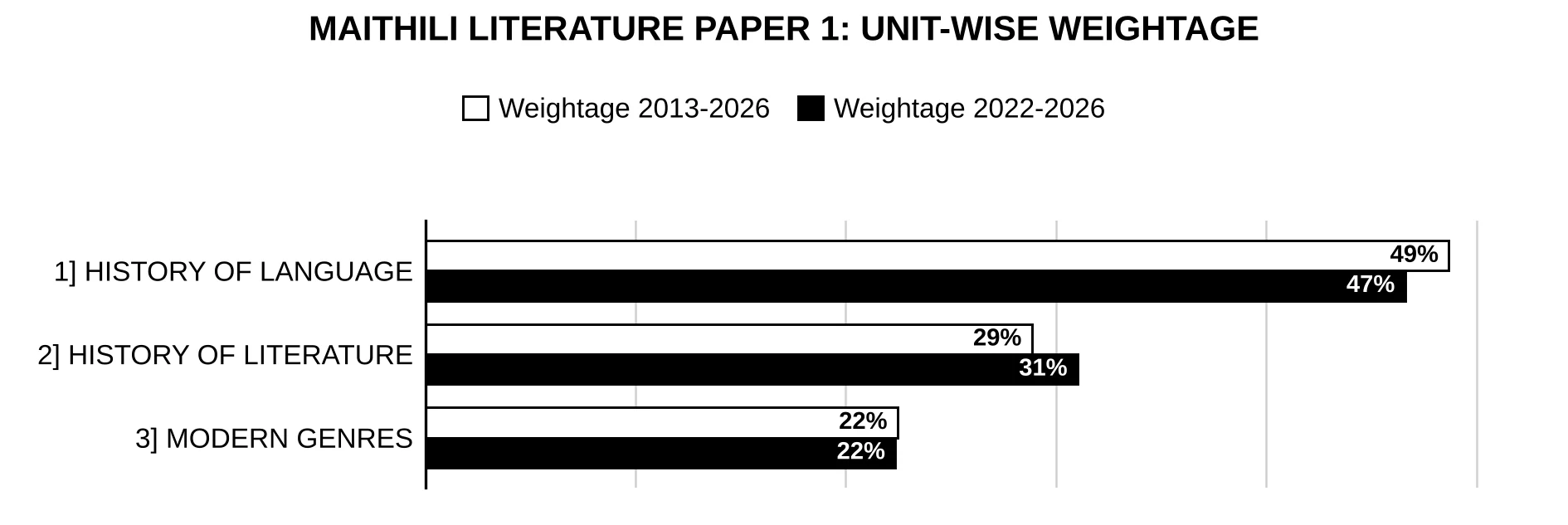
Trend: The history of the Maithili language (Unit 1) carries about half of the marks (49% over 2013–2026, 47% in 2022–2026), the history of Maithili literature about 29% (31% recently) and the development of modern genres about 22%. In the language unit, the origin and development of Maithili through Sanskrit, Prakrit and Avahattha (1.2) is by far the most-asked topic (36%, 29% recently), followed by the Indo-European family (1.1), dialects (1.4) and pronoun and verb (1.7). In literary history, Vidyapati and his tradition (2.4), pre-Vidyapati literature (2.3) and medieval drama (2.5) take about a fifth to a quarter each. Among the modern genres, journals (3.10), prabandha-kavya (3.1) and the novel (3.3) lead over 2013–2026; in the last five years the novel comes first and prabandha-kavya has fallen to 9%.

Preparing for Prelims too?
Our UPSC Prelims Topic-wise PYQ Book covers every Prelims question with detailed explanations, so you can see exactly where UPSC asks from. Now available as a hard copy and an eBook.
Buy Hard Copy on AmazonBuy eBook (PDF)Paper II
| Unit | Topic (click to open PYQs) | Sub-topics | Questions | Link |
|---|---|---|---|---|
| 1 | खण्ड क: काव्य | 9 | 228 | Click here → |
| 2 | खण्ड ख: गद्य | 7 | 227 | Click here → |
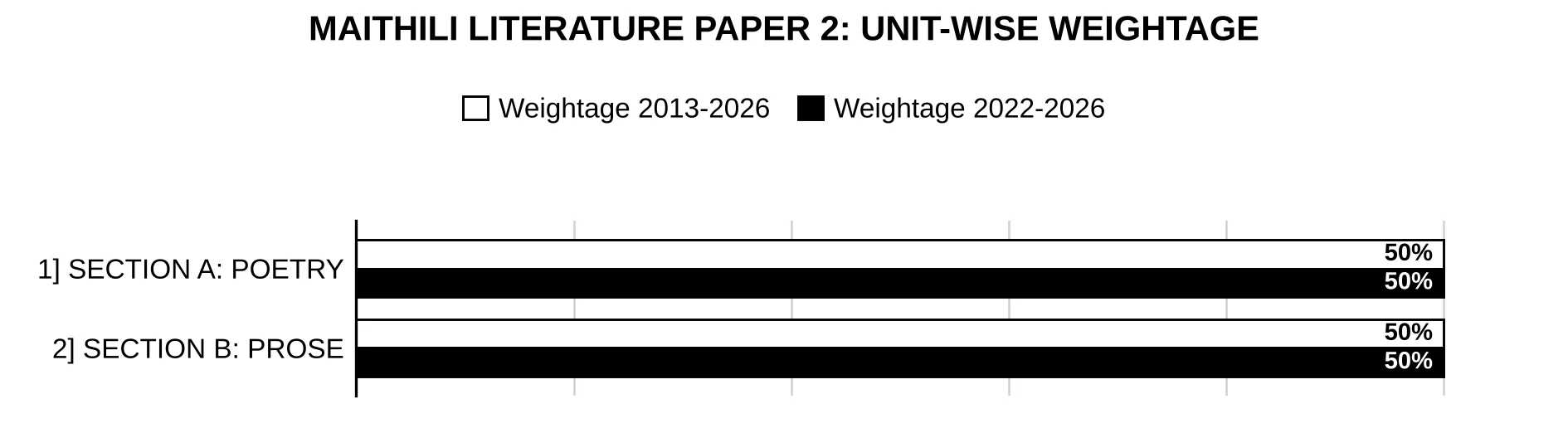
Trend: Poetry and prose carry equal marks by design (50% each), and every prescribed text is asked almost every year, so the marks are spread evenly. In the poetry section each text takes about 9–14%, with Vidyapati (1.1) slightly ahead and Chanda Jha’s Sundarkand (1.4) close behind; in the prose section ‘कथा-संग्रह’ (2.7) and ‘कृति राजकमलक’ (2.6) lead with 16–18%, and Rajkamal’s stories come first in 2022–2026.
More questions
Other questions (outside the present syllabus) – 7 questions
Frequently asked questions
How many Maithili Literature Optional PYQs are there?
There are 921 Maithili Literature Optional questions from 2009 to 2026, across Paper I and Paper II, arranged under 5 units of the official syllabus. A question that covers two topics is listed under both.
Which Maithili Literature Optional units are asked most often?
By number of questions – खण्ड क: काव्य (Paper II, 228); खण्ड ख: गद्य (Paper II, 227); मैथिली भाषाक इतिहास (Paper I, 224); मैथिली साहित्यक इतिहास (Paper I, 131). The weightage graphs on these pages compare the share of marks across periods.
What does a code like [2024/15m/3b] after a question mean?
It gives the year, the marks, the word limit (where UPSC set one) and the question number in the paper. So [2024/15m/3b] is Question 3(b) of the 2024 paper, worth 15 marks.
Where can I download the full Maithili Literature Optional question papers?
Every available paper is free as a PDF on our Maithili Literature Optional year-wise question papers page, for both Paper 1 and Paper 2.
How should we use these PYQs in our preparation?
Read the syllabus for a unit first, then go through its questions, starting with the most recent years. In Paper II, read each prescribed text in the original and note which passages and themes UPSC returns to. Practise writing answers within the word limit and time.
How this collection is organised
Units follow the official syllabus – Paper 1: 1 मैथिली भाषाक इतिहास, 2 मैथिली साहित्यक इतिहास, 3 आधुनिक कालमे साहित्यिक विधाक विकास; Paper 2: 1 खण्ड क: काव्य and 2 खण्ड ख: गद्य, with each prescribed author and text as a topic of its own (for example Paper 2 – 1.4 चन्दा झा, ‘मिथिलाभाषा रामायण’). Topic names are given in Maithili.
Every passage printed for सप्रसंग व्याख्या is placed under the prescribed text it is taken from. Where the paper does not name the source, it has been identified editorially from the passage itself; a few attributions among the modern poems and stories remain open to correction.
Questions on writers in Paper 1 are placed under the period, tradition or genre they belong to (for example मनबोध under विद्यापति आ हुनक परम्परा, and चन्दा झा under प्रबन्ध-काव्य).
Some questions cover more than one topic. We’ve kept such questions in each topic of relevance.
Graphs at the start of each paper show the weightage of every unit in that paper, and graphs for each unit show the weightage of its topics. Weightage is the share of marks asked from a unit or topic, compared for 2013–2026 (white bars) and the last five years, 2022–2026 (black bars). A question placed under two topics has its marks split equally between them.
Each of the topicwise question is suffixed by a question code like this [2024/10m/150w/1a]. This code indicates a) year in which the question was asked, b) maximum marks the question carried, c) prescribed word limit (where UPSC set one, e.g. 150w) and, d) the question number in actual paper, in given order.
Until 2012, each paper carried 300 marks (60 per question); since 2013 each paper carries 250 marks (50 per question). Where a question offered more parts than were to be answered (“any three” of four in 2009 and 2010), every part is included with its own marks.
The 2009–2011 and 2014–2026 papers are transcribed from scans of the UPSC question papers; for 2012 and 2013 only re-typeset copies of the papers could be found, and these were used. Every page was transcribed and then checked a second time by an independent reader against the scan. The wording, spelling and punctuation are as printed, including the papers’ own misprints; the 2018 scans are of low resolution, and the few characters that could not be read with certainty are marked [?]. Question and part labels printed in Devanagari (क, ख …) are given as (a), (b) …
Spotted an error? Use the “Report an Error” box at the end of any page – we review every report and update the page.

Strengthen your GS papers
Our UPSC Mains Topic-wise & Year-wise PYQ Book (2013–2026) maps every GS question to the syllabus, so you know what UPSC asks and how often. Now available as a hard copy and an eBook.
Buy Hard Copy on AmazonBuy eBook (PDF)Last updated: 2 November 2026