
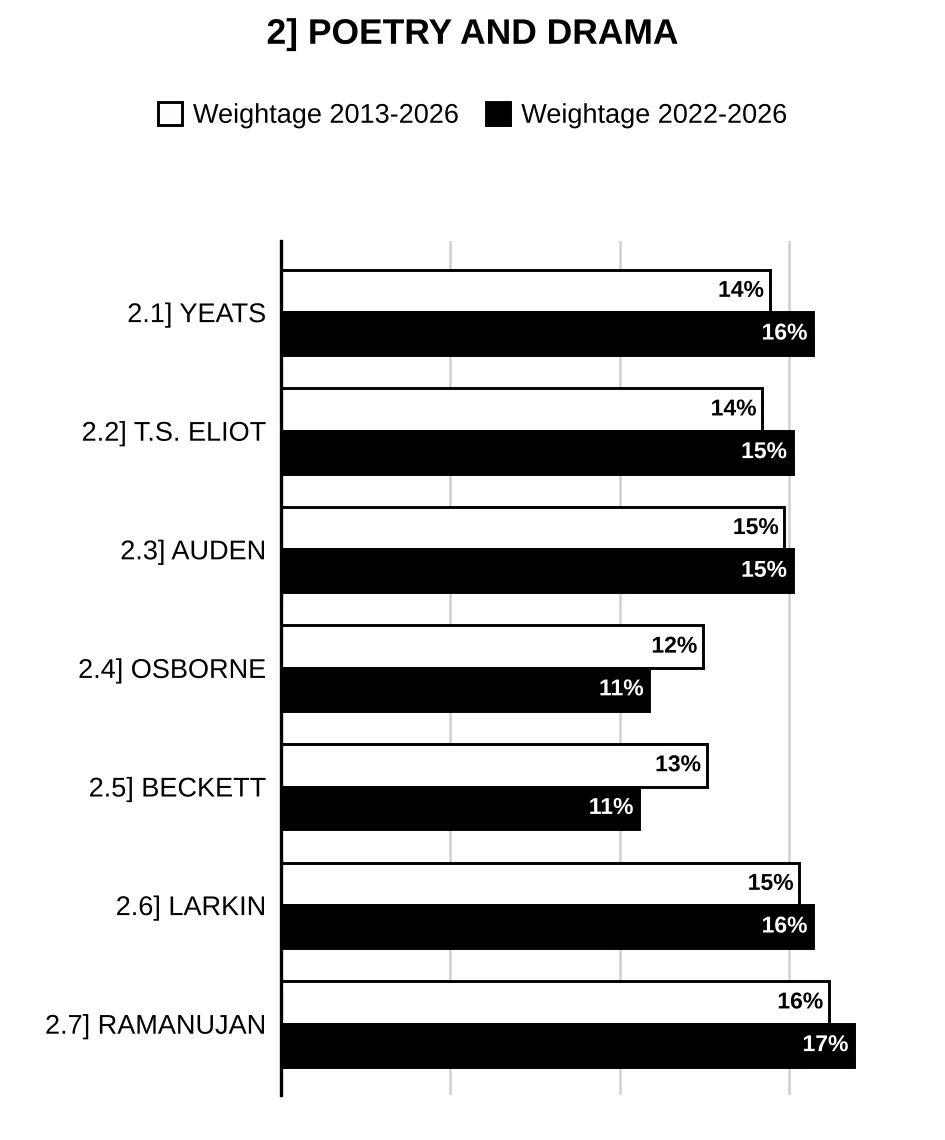
Here are all 195 questions on Texts: poetry and drama (section a) asked in UPSC English Literature Optional Paper II (2009–2026), arranged under the 7 topics of this unit. Within each topic the latest questions come first.
Each question ends with a code such as [2024/15m/3b] – the year, the marks, the word limit (where UPSC set one) and the question number in the paper.
2.1] William Butler Yeats
31 questions
Critically comment in about 150 words on each of the following: Fish, flesh, or fowl commend all summer long.
Whatever is begotten, born, and dies.
Caught in that sensual music all neglect
Monuments of unageing intellect.
(W.B. Yeats) [2026/10m/150w/1a]How does the myth of Leda’s rape in Yeats’s “Leda and the Swan” symbolize the social milieu of early twentieth-century Europe? [2026/15m/2a]
Critically comment in about 150 words on each of the following: And may her bridegroom bring her to a house.
Where all’s accustomed, ceremonious;
For arrogance and hatred are the wares
Peddled in the thoroughfares.
(W.B. Yeats) [2025/10m/150w/1a]Comment on W.B. Yeats’ apocalyptic and prophetic enunciations contained in the prescribed poems. [2025/15m/2b]
Critically comment in about 150 words on each of the following: … somewhere in sands of the desert.
A shape with lion body and the head of a man,
A gaze blank and pitiless as the sun,
Is moving its slow thighs, while all about it
Reel shadows of the indignant desert birds.
(W.B. Yeats) [2024/10m/150w/1a]Bring out the dichotomy between body and soul presented by W.B. Yeats in the poems “Sailing to Byzantium” and “Byzantium”. [2024/15m/2a]
Critically comment in about 150 words each on the following: Hearts with one purpose alone.
Through summer and winter seem
Enchanted to a stone
To trouble the living stream.
(Yeats) [2023/10m/150w/1a]“Yeats’ purpose was to ‘write out the heart of the Irish common people’.” Comment on this statement with reference to some of the poems prescribed for your study. [2023/15m/2a]
Critically comment in about 150 words each on the passages, focussing on the context: Too long a sacrifice.
Can make a stone of the heart.
O when may it suffice?
(W. B. Yeats) [2022/10m/150w/1a]In the poem The Second Coming, W. B. Yeats integrates history and mythology into an organic whole. Substantiate your answer with suitable examples from the poem. [2022/20m/4c]
Critically comment in about 150 words each on the following passages focussing on the context: Though Hamlet rambles and Lear rages,.
And all the drop scenes drop at once
Upon a hundred thousand stages,
It cannot grow by an inch or an ounce.
(W.B. Yeats) [2021/10m/150w/1a]How are “Sailing to Byzantium” and “Byzantium” associated with each other? Show how this relatedness contributes to establishing W.B. Yeats as a myth-maker. [2021/15m/4a]
Critically comment in about 150 words each on the following passages: Marbles of the dancing floor.
Break bitter furies of complexity,
Those images that yet
Fresh images beget,
That dolphin-torn, that gong-tormented sea.
(Yeats) [2020/10m/150w/1a]Discuss W.B. Yeats as a symbolist and romantic poet with specific reference to the poems in the syllabus. [2020/15m/2a]
Critically comment in about 150 words each on the following passages: A shudder in the loins engenders there.
The broken wall, the burning roof and tower
And Agamemnon dead.
(Yeats) [2019/10m/150w/1a]Discuss the paradox in Yeats’ idea, expressed in his ‘Last Poems’, that world history was spiralling out of control towards an apocalyptic close, yet it is not a matter for despair, but one for rejoicing. [2019/15m/2a]
Critically comment on the following in about 150 words each, focusing on the context: The best lack all conviction, while the worst.
Are full of passionate intensity.
(W.B Yeats) [2018/10m/150w/1c]Explicate the significance of symbols used by Yeats with reference to the poems, Easter 1916, The Second Coming and Byzantium. [2018/15m/3a]
A shape with lion body and the head of a man,.
A gaze pitiless and blank as the sun,
Is moving its slow thighs, while all about it
Reel shadows of the indignant desert birds.
(W. B. Yeats) [2017/10m/150w/1c]Analyze Yeats’ use of myth as a means of giving shape and significance to his vision of the world. [2017/15m/2a]
Critically comment in about 150 words on the following passages, in their contexts: O chestnut-tree, great rooted blossomer,.
Are you the leaf, the blossom or the bole?
O body swayed to music, O brightening glance,
How can we know the dancer from the dance?
(Yeats) [2016/10m/150w/1a]Discuss how Yeats asserts the transcendence of art over the fleeting and carnal nature of mortal existence in his Byzantium poems. [2016/15m/2a]
Critically comment on the following passages in their contexts in about 150 words each:– All changed, changed utterly:
A terrible beauty is born.
(W.B. Yeats) [2015/10m/150w/1a]All Yeats touched he turned into symbols: Ireland, Byzantium, Maud Gonne, The Easter Rising, The Tower – Discuss. [2015/20m/2c]
Prophetic overtones in ‘The Second Coming’ [2014/10m/150w/1d]
Yeats’s fancy for an aristocratic life of elegance and leisure in “A Prayer for My Daughter” [2013/10m/1b]
Spiritus Mundi in the Second Coming as a storehouse of the world’s phantasmagoria. [2012/12m/1b]
In his later poems Yeats foreshadowed in a prophetic way the modern political situation and the death wish of modern culture. Explain with reference to some poems of W. B. Yeats. [2012/30m/7a]
Realities as perceived by the poet in “Among School Children”. [2011/15m/1a]
Yeats’ preoccupation with old age and death in The Tower. [2010/20m/1b]
Leda’s violation as a transformation into a wider human tragedy in Leda and the Swan. [2009/20m/1a]

Preparing for Prelims too?
Our UPSC Prelims Topic-wise PYQ Book covers every Prelims question with detailed explanations, so you can see exactly where UPSC asks from. Now available as a hard copy and an eBook.
Buy Hard Copy on AmazonBuy eBook (PDF)2.2] T.S. Eliot
30 questions
Critically comment in about 150 words on each of the following: Do I dare.
Disturb the universe?
In a minute there is time
For decisions and revisions which a minute will reverse.
(T.S. Eliot) [2026/10m/150w/1b]How does T.S. Eliot’s “Journey of the Magi” explore the themes of alienation, regret and powerlessness? [2026/15m/2b]
Critically comment in about 150 words on each of the following: The trilling wire in the blood.
Sings below inveterate scars
Appeasing long forgotten wars.
(T.S. Eliot) [2025/10m/150w/1b]Eliot’s “The Love Song of J. Alfred Prufrock” explores the psychological chaos and alienation associated with modernism. Discuss. [2025/15m/2a]
Critically comment in about 150 words on each of the following: … There was a Birth, certainly,.
We had evidence and no doubt. I had seen birth and death,
But had thought they were different; this Birth was
Hard and bitter agony for us, like Death, our death.
(T.S. Eliot) [2024/10m/150w/1b]T.S. Eliot exploits the potential of myth and history to comment on his contemporary society.
Analyse the statement in reference to the poems prescribed in the syllabus. [2024/15m/2b]Critically comment in about 150 words each on the following: For I have known them all already, known them all:
Have known the evenings, mornings, afternoons,
I have measured out my life with coffee spoons;
I know the voices dying with a dying fall
Beneath the music from a farther room.
(Eliot) [2023/10m/150w/1b]“To be conscious is not to be in time.” Comment on this line by Eliot from Burnt Norton. [2023/15m/2b]
Critically comment in about 150 words each on the passages, focussing on the context: I had seen birth and death,.
But had thought they were different; this Birth was
Hard and bitter agony for us, like Death, our death.
(T. S. Eliot) [2022/10m/150w/1b]The Love Song of J. Alfred Prufrock has been interpreted in multiple ways; but it still remains an elusive poem. Discuss. [2022/15m/2a]
Critically comment in about 150 words each on the following passages focussing on the context: At the still point of the turning world. Neither flesh nor fleshless;.
Neither from nor towards; at the still point, there the dance is,
But neither arrest nor movement. And do not call it fixity,
Where past and future are gathered.
(T.S. Eliot) [2021/10m/150w/1b]Eliot’s references to time and space in his poetry reflect more a mental association than an image of conscious reality. Discuss with illustrations from some of the poems in the syllabus. [2021/15m/2a]
Critically comment in about 150 words each on the following passages: All this was a long time ago, I remember,.
And I would do it again, but set down
This set down
This: were we led all that way for
Birth or Death?
(Eliot) [2020/10m/150w/1b]T.S. Eliot’s renditions of the “mind of Europe” are profoundly problematic insofar as they retrieve selective pasts. Would you agree? Give examples from the poems in the syllabus. [2020/15m/2b]
Critically comment in about 150 words each on the following passages: Time present and time past.
Are both perhaps present in time future,
And time future contained in time past.
(Eliot) [2019/10m/150w/1b]“Personification of nature, allusions to Greek mythology and the imagery of death – these devices dominate Eliot’s poetry.” Elucidate. [2019/15m/2b]
Critically comment on the following in about 150 words each, focusing on the context: With an alien people clutching their gods.
I should be glad of another death.
(T.S. Eliot) [2018/10m/150w/1b]The Love Song of J. Alfred Prufrock epitomizes the frustrations and inertia of the modern era. Justify the statement. [2018/20m/2c]
Let us go then, you and I,.
When the evening is spread out against the sky
Like a patient etherised upon a table.
(T. S. Eliot) [2017/10m/150w/1b]“Eliot’s poetry arises from the focusing of a powerful mind upon a deeply troubled spirit.” Discuss with reference to the poems you have studied. [2017/15m/2b]
Critically comment in about 150 words on the following passages, in their contexts: I had seen birth and death,.
But had thought they were different; this Birth was
Hard and bitter agony for us, like Death, our death.
(Eliot) [2016/10m/150w/1b]How does Eliot convey modern man’s chaotic existence through the complex shifts of the past and present moments in his “The Love Song of J. Alfred Prufrock”? [2016/15m/2b]
Critically comment on the following passages in their contexts in about 150 words each:– I have heard the mermaids singing, each to each.
I do not think that they will sing to me.
(T.S. Eliot) [2015/10m/150w/1b]Discuss Eliot’s religious-philosophical reflections on time and consciousness in “Burnt Norton”. [2015/15m/3b]
Life, death dichotomy in ‘Journey of the Magi’ [2014/10m/150w/1c]
The comically self-aware persona in “The Love Song of J. Alfred Prufrock” [2013/10m/1a]
“The time theme of T. S. Eliot’s poems is real, exactly as birth, death and love are real”. Elucidate with reference to his poems. [2012/30m/3a]
Autobiographical musings in “Burnt Norton”,. [2011/15m/1b]
Prufrock’s struggle to find a proper emotion for the occasion he wants to celebrate. [2010/20m/1a]
Journey of the Magi as a literal epiphany that disturbs or disorients aged eyewitnesses. [2009/20m/1b]
2.3] W.H. Auden
31 questions
Critically comment in about 150 words on each of the following: Was he free? Was he happy? The question is absurd:
Had anything been wrong, we should certainly have heard.
(W.H. Auden) [2026/10m/150w/1c]Assess how far W.H. Auden’s assertion that “Poetry makes nothing happen” is true. [2026/15m/3a]
Critically comment in about 150 words on each of the following: There is no such thing as the State.
And no one exists alone;
Hunger allows no choice
To the citizen or the police;
We must love one another or die.
(W.H. Auden) [2025/10m/150w/1c]Analyse W.H. Auden’s poetry as a blend of ‘historical context with modern critique.’ [2025/15m/3a]
Critically comment in about 150 words on each of the following: That girls are raped, that two boys knife a third,.
Were axioms to him, who’d never heard
Of any world where promises were kept,
Or one could weep because another wept.
(W.H. Auden) [2024/10m/150w/1c]Discuss W.H. Auden’s engagement with contemporary social, political and religious issues in reference to some of his poems prescribed for your study. [2024/15m/3a]
Critically comment in about 150 words each on the following: He was married and added five children to the population.
Which our Eugenist says was the right number for a parent of his generation
And our teachers report that he never interfered with their education.
Was he free? Was he happy? The question is absurd:
Had anything been wrong, we should certainly have heard.
(Auden) [2023/10m/150w/1c]Analyse W. H. Auden’s poetry as a fusion of ‘the private and public worlds’. [2023/15m/3a]
Critically comment in about 150 words each on the passages, focussing on the context: About suffering they were never wrong,.
The old Masters: how well they understood
Its human position: how it takes place
While someone else is eating or opening a
window or just walking dully along;
(W. H. Auden) [2022/10m/150w/1d]W. H. Auden’s poems deal with a wide variety of themes that enrich his poetic style. Discuss with reference to the poems prescribed in the syllabus. [2022/15m/4a]
Critically comment in about 150 words each on the following passages focussing on the context: The maps at his disposal were out of date.
And the Census Returns almost certainly incorrect,
But there was no time to check them, no time to inspect
Contested areas.
(W.H. Auden) [2021/10m/150w/1c]W.H. Auden’s “Mundus et Infans” is a treatise on love. Do you agree? Give reasons for your answer. [2021/15m/3a]
Critically comment in about 150 words each on the following passages: Barbed wire enclosed an arbitrary spot.
Where bored officials lounged (one cracked a joke)
And sentries sweated for the day was hot:
(Auden) [2020/10m/150w/1c]“I should repeat that neither the private person of the poet, his psychology, nor his so-called social viewpoint are to come into question here: what matters is the poem itself as a philosophical sundial of history.” Analyse the poetry of W.H. Auden in the context of this statement. [2020/15m/3a]
Critically comment in about 150 words each on the following passages: Was he free? Was he happy? The question is absurd:
Had anything been wrong, we should certainly have heard.
(Auden) [2019/10m/150w/1c]Even while depicting the modern man suffering from negation and despair due to totalitarian rulers and war-mongering governments, Auden speaks about an affirming flame of human connectedness and concern. Elaborate. [2019/15m/3a]
Critically comment on the following in about 150 words each, focusing on the context: In the nightmare of the dark.
All the dogs of Europe bark.
And the living nations wait,
Each sequestered in its hate.
(W.H. Auden) [2018/10m/150w/1a]Auden’s The Shield of Achilles is a critique of contemporary culture. Elucidate. [2018/15m/2a]
And the expensive delicate ship that must have seen.
Something amazing, a boy falling out of the sky,
Had somewhere to get to and sailed calmly on.
(W. H. Auden) [2017/10m/150w/1a]How does Auden use the mythical past to illuminate contemporary experiences in Musée des Beaux Arts and The Shield of Achilles? [2017/15m/3b]
Critically comment in about 150 words on the following passages, in their contexts: Let the Irish vessel lie.
Emptied of its poetry.
(W.H. Auden) [2016/10m/150w/1c]Show how W.H. Auden views order and universal patterns of human existence with particular reference to his “The Unknown Citizen” and “September 1, 1939”. [2016/15m/3a]
Critically comment on the following passages in their contexts in about 150 words each:– Was he free? Was he happy? The question is absurd:
Had anything been wrong, we should certainly have heard.
(W.H. Auden) [2015/10m/150w/1c]Auden asserts in “The Memory of W.B. Yeats” that poetry is a purely aesthetic and not an ethical or religious practice. Discuss. [2015/15m/2a]
Explain how Auden captures the essence of human life through the rhetorical device ekphrasis describing Bruegel’s painting of the fall of Icarus in the poem ‘Musée des Beaux Arts’. [2014/15m/3b]
Consider Auden as a critic of W. B. Yeats in his poem on him. [2014/15m/3c]
The thematic rhymes in Section 3 of “In Memory of W. B. Yeats” [2013/10m/1c]
W. H. Auden’s Musee des Beaux Arts, that resonates with the poetic narratives of art of the Romantic and Victorian period. [2012/12m/1a]
Ideological posturing in “September 1, 1939”. [2011/15m/1c]
The Shield of Achilles and the poet’s handling of dark premonition. [2010/20m/1c]
September 1, 1939 as a poem that fails due to its ‘incurable dishonesty’. [2009/20m/1c]
2.4] John Osborne
21 questions
To what extent does the revolutionary impact of Look Back in Anger lie, not only in its themes, but also in its language and dramatic expression? [2026/15m/4a]
How does Jimmy Porter’s anger function as both a critique of post-war British society and a manifestation of personal inadequacies in John Osborne’s play “Look Back in Anger”? [2025/15m/4a]
Analyse critically the depiction of a woman in the institution of marriage by Osborne in the play Look Back in Anger. [2024/15m/4b]
Analyse Jimmy’s relationship with Helena and Alison. What does his relationship with the two women reveal about his personality? [2023/15m/4a]
John Osborne brought authenticity into contemporary English theatre through the effective use of the vernacular and naturalistic characterisation. Comment. [2022/15m/2b]
Analyse the major themes discussed in the play Look Back in Anger. [2022/15m/3a]
Post-war literature not only reflected disillusionment, social injustice and negation of life but, at the same time, portrayed dissent and protest also. Analyse John Osborne’s Look Back in Anger in the light of the above statement. [2021/20m/2c]
With special reference to the prescribed texts, discuss the portrayal of human relationships in post World War II English drama. [2021/20m/3c]
While Look Back in Anger represents the problems of working-class life, it is conservative in its representation of women within that milieu. Would you agree? Give reasons. [2020/15m/4a]
Do you think marriage as an institution is critiqued in Osborne’s Look Back in Anger? [2019/20m/3c]
“It would be wrong to seek Look Back in Anger’s politics in the content of Jimmy’s monologues. Instead, the politics is in their form: specifically, in their passionate articulacy.” Justify this claim. [2019/15m/4a]
Comment on the ending of Look Back in Anger. Does it look like being where we started or, is there indeed a hopeful note? [2018/15m/2b]
Do you find the angry young man, Jimmy Porter’s attitude towards the society credible? Is it fully worked out and resolved in the drama? Give reasons for your answer. [2018/20m/4c]
“Jimmy Porter is a permanent human type –the self-flagellating solitary in self-inflicted exile from his own misery.” Write your views about this description of Jimmy. [2017/15m/4a]
“Though Look Back in Anger is an eloquent testament of alienated youth, it is more a Strindbergian study of a marriage steeped in love and hate.” Elaborate. [2016/15m/4a]
Discuss how Jimmy’s frenetic quest for real life destroys the lives of those to whom he is closest. [2015/15m/4a]
Consider Look Back in Anger as Osborne’s comment on domestic culture and the alienation of the post-War youth. [2014/20m/4a]
What is the relevance of Colonel Redfern to Osborne’s critique of the British Empire? [2014/15m/4c]
Jimmy Porter as a spokesman of Britain’s new educated class with its anxieties and frustrations. [2012/12m/1e]
Is Jimmy Porter a parody of a “cult hero”? Explain. [2011/30m/4b]
What is ‘Kitchen-sink realism’? Comment on this phenomenon in the light of Look Back in Anger. [2010/40m/4a]
2.5] Samuel Beckett
22 questions
Discuss how Waiting for Godot by Samuel Beckett represents a convergence between avant-garde and popular culture. [2026/15m/4b]
In Waiting for Godot, how does Beckett use ‘absence’ to challenge traditional notions of time, purpose and meaning? [2025/20m/4c]
Illustrate the characteristic features of Absurd Theatre with special reference to the play Waiting for Godot. [2024/20m/4c]
“Beckett captures ‘the endless, tedious nature of human experience itself, where actions do not always have a goal or meaning’.” Discuss the statement with reference to the play, Waiting for Godot. [2023/20m/4c]
Samuel Beckett’s Waiting for Godot is often mentioned as a play that falls into both the modern and post-modern genres. Evaluate. [2022/15m/3b]
Does the play Waiting for Godot create hope or hopelessness in the readers? Substantiate your answer with suitable examples from the play. [2022/15m/4b]
With special reference to the prescribed texts, discuss the portrayal of human relationships in post World War II English drama. [2021/20m/3c]
Absurd theatre reflects the existential dilemma and the irrationality of life. Examine this statement with a critical analysis of Beckett’s Waiting for Godot. [2021/20m/4c]
Waiting for Godot is a profound meditation on the triad of arrival, waiting, and death, with emphasis on the despair yet necessity of waiting. Discuss. [2020/20m/4c]
“Waiting for Godot is essentially a joke on the whole theatrical experience, an extended invitation to the audience to get up and leave. Nothing is going to happen, the play keeps telling us.” Discuss. [2019/20m/4b]
Beckett called Waiting for Godot a ‘tragicomedy’. Do you agree with this classification? If not, how would you classify the play? [2018/15m/4a]
Discuss the view that Waiting for Godot is “an image of Beckett’s intuition that nothing really ever happens in man’s existence”. [2017/20m/4b]
Discuss the significant differences between Act 1 and Act 2 of Waiting for Godot, despite the apparent repetition and the presence of the same characters in both acts. [2016/20m/4b]
What do the images, “Astride of a grave and a difficult birth; down in the hole, lingeringly, the gravedigger puts on the forceps; we have time to grow old” suggest in Waiting for Godot? [2015/15m/2b]
The characters in Waiting for Godot go on; in the universe of this play “go on” leads no where – Elucidate. [2015/20m/4c]
The ‘asymmetrical symmetry’ of the structure of Waiting for Godot. [2014/10m/150w/1e]
What do you think is the symbolic significance of the Pozzo-Lucky relationship? [2014/15m/4b]
How does Beckett exploit the metaphor of life as theatre in Waiting for Godot? [2013/25m/3a]
Read the drama/poetry passages below and answer the questions that follow: He spits. E moves to the centre, halts with his back to auditorium.
E: Charming spot (He turns, advances to front, halts facing the auditorium)
Inspiring prospects (He turns to V) Let’s go.
V: We can’t.
E: Why not?
V: We are waiting for G.
E: (Despairingly), Ah ! (Pause) You’re sure it was here?
V: What?
E: That we were to wait.
V: He said by the tree. (They look at the tree) Do you see any others?
E: What is it?
V: I don’t know. A willow.
E: Where are the leaves?
V: It must be dead.
E: No more weeping.
V: Or perhaps it’s not the season.
E: Looks to me more like a bush.
V: A shrub
E: A bush
V: A – What are you insinuating? That we’ve come to the wrong place.
E: He should be here.
V: He didn’t say for sure he’d come.
E: And if he doesn’t come?
V: We will come back tomorrow.
E: And then the day after tomorrow.
V: Possibly.
E: And so on.
V: The point is.
E: Until he comes.
V: You’re merciless.
E: We came here yesterday.
V: Ah no, there you’re mistaken.
E: What did we do yesterday?
V: What did we do yesterday?
E: Yes.
V: Why…. (Angrily) Nothing is certain when you’re about.
E: In my opinion we were here.
V: (Looking round) You recognise the place?
E: I didn’t say that.
V: Well?
E: That makes no difference.
V: All the same….that tree…. (turning round the auditorium)….that bog.
(i) Identify the key areas of conflict in the conversation by focusing on the opposites.
(ii) Comment on the style of minimal language used by the dramatist.
(iii) How does the scene reflect an absurdity?
(iv) How does the playwright succeed in subverting the audiences’ comfortable illusions?
(v) How do the characters express a universal theme through their conversation? [2012/30m/5a]What crisis of modern humanist values becomes the major concern of Waiting For Godot? [2011/30m/3b]
If Waiting for Godot is considered to be a play on the absurdity of exploring life for meaning, examine if there is a standpoint for this exploration. [2010/20m/4b]
How does Beckett achieve his artistic goals in his Waiting for Godot by the use of minimalism and reductionism? [2009/60m/3]
2.6] Philip Larkin
30 questions
Critically comment in about 150 words on each of the following: In the hollows of afternoons.
Young mothers assemble
At swing and sandpit
Setting free their children.
(Philip Larkin) [2026/10m/150w/1d]Discuss Philip Larkin’s statement that “deprivation is for me what daffodils were for William Wordsworth”, with reference to his poetic vision. [2026/15m/3b]
Critically comment in about 150 words on each of the following: All the unhurried day,.
Your mind lay open like a drawer of knives.
(Philip Larkin) [2025/10m/150w/1d]Philip Larkin’s poems of disgust and despair hid a wounded romantic temperament behind a mask of irony. Elucidate. [2025/15m/3b]
Critically comment in about 150 words on each of the following: Only one ship is seeking us, a black-.
Sailed unfamiliar, towing at her back
A huge and birdless silence. In her wake
No waters breed or break.
(Philip Larkin) [2024/10m/150w/1d]Critically examine Philip Larkin’s portrayal of the turmoils of post-war scenario in the poems prescribed in your syllabus. [2024/15m/3b]
Critically comment in about 150 words each on the following: For you would hardly care.
That you were less deceived, out on that bed,
Than he was, stumbling up the breathless stair
To burst into fulfillment’s desolate attic.
(Larkin) [2023/10m/150w/1d]Comment on the themes and concerns in Larkin’s poetry. [2023/15m/3b]
Critically comment in about 150 words each on the passages, focussing on the context: Always too eager for the future, we.
Pick up bad habits of expectancy.
(Philip Larkin) [2022/10m/150w/1e]Nostalgia for earlier Britain and its pastoral ways of life dominate the spirit of Movement Poetry. Substantiate with reference to the poetic collection of Philip Larkin. [2022/20m/3c]
Critically comment in about 150 words each on the following passages focussing on the context: Slums, years, have buried you. I would not dare.
Console you if I could.
(Philip Larkin) [2021/10m/150w/1d]“Larkin is the poet of the emotionally underprivileged, of the vast majority of mankind for whom life is a progressive disillusionment.” In the light of this statement, examine the poems of Philip Larkin that are part of the syllabus. [2021/15m/3b]
Critically comment in about 150 words each on the following passages: Their beauty has thickened.
Something is pushing them
To the side of their own lives.
(Larkin) [2020/10m/150w/1d]Philip Larkin’s poetry tentatively explores the possibility of positive meaning in life. Elucidate the statement with a few illustrations from the prescribed poems. [2020/15m/3b]
Critically comment in about 150 words each on the following passages: Ah, solving that question.
Brings the priest and the doctor
In their long coats
Running over the fields.
(Larkin) [2019/10m/150w/1d]Did Larkin deserve the tag The Times gave him as Britain’s greatest post-war writer? Evaluate his merits and demerits as a poet. [2019/15m/3b]
Critically comment on the following in about 150 words each, focusing on the context: Yet still they leave us holding wretched stalks.
Of disappointment, for, though nothing balks
Each big approach, leaning with brasswork prinked
Each rope distinct.
(Philip Larkin) [2018/10m/150w/1d]“Larkin combines wistful sadness, amusement, respect for the commonplace and a deep compassion.” Discuss with reference to some of his poems. [2018/15m/3b]
That how we live measures our own nature,.
And at his age having no more to show
Than one hired box should make him pretty sure
He warranted no better, I don’t know.
(Philip Larkin) [2017/10m/150w/1d]“The saddest heart in the post-war super-market.” Is this assessment borne out in the poems of Philip Larkin that you have studied? [2017/15m/3a]
Critically comment in about 150 words on the following passages, in their contexts: Only one ship is seeking us, a black.
Sailed unfamiliar, towing at her back
A huge and birdless silence.
(Larkin) [2016/10m/150w/1d]“I have no belief in ‘tradition’ or a common myth-kitty or casual allusions in poems to other poems or poets.” How is this attitude reflected in Philip Larkin’s poetry? [2016/15m/3b]
Critically comment on the following passages in their contexts in about 150 words each:– This was Mr. Bleaney’s room. He stayed.
The whole time he was at the Bodies, till
They moved him.
(Philip Larkin) [2015/10m/150w/1d]Examine Philip Larkin’s bleak view of human life and relationship with reference to his poems. [2015/15m/3a]
“I think the impulse to preserve lies at the bottom of all art.” Philip Larkin, though a nihilist, thus builds up against nothingness. Elucidate. [2014/20m/3a]
Was Philip Larkin, the poet troubled by the socio-economic imbalances in post-World War II Britain? Substantiate. [2013/25m/3b]
Philip Larkin belongs to the Movement Poets who wrote intelligible and empirical poems. Substantiate with reference to Larkin’s poems. [2012/30m/8b]
Cynicism in Philip Larkin’s poetry. [2011/15m/1d]
Comment on the elements of modern English poetry in Philip Larkin’s poems prescribed for your study. [2010/20m/2b]
The England of false cheer and drab recreation as portrayed in Larkin’s Afternoons. [2009/20m/1d]
2.7] A.K. Ramanujan
31 questions
Critically comment in about 150 words on each of the following: a house that leaned.
slowly through our growing
years on a bent coconut
tree in the yard.
Being the burning type,
he burned properly
at the cremation
(A.K. Ramanujan) [2026/10m/150w/1e]Analyse how A.K. Ramanujan’s poems depict the negotiation between heritage and modernity in the formation of postcolonial identity. [2026/20m/2c]
Critically comment in about 150 words on each of the following: A beggar once came with a violin.
to croak out a prostitute song
that our voiceless cook sang
all the time in our backyard.
(A.K. Ramanujan) [2025/10m/150w/1e]On the basis of your readings of A.K. Ramanujan’s poems, trace the elements of quintessential Indian ethos contained therein. [2025/20m/2c]
Critically comment in about 150 words on each of the following: under the bridges with patches.
of repair all over them
the wet stones glistening like sleepy
crocodiles, the dry ones
shaven water-buffaloes lounging in the sun
The poets only sang of the floods.
(A.K. Ramanujan) [2024/10m/150w/1e]Bring out the elements of Indian sensibility as reflected in A.K. Ramanujan’s poems prescribed in your syllabus. [2024/15m/4a]
Critically comment in about 150 words each on the following: Sister-in-law.
and I were rather blank, cut-outs
fitted to our respective
slots in a room
really nowhere as the two of you
got down to the floor to draw
blueprints of a house from memory
(Ramanujan) [2023/10m/150w/1e]Write a note on the confessional element in Ramanujan’s poetry. [2023/15m/4b]
Critically comment in about 150 words each on the passages, focussing on the context: But someone told me.
he got two lines
in an inside column
of a Madras newspaper
(A. K. Ramanujan) [2022/10m/150w/1c]A. K. Ramanujan has earned praise for his craftsmanship. What features of his writing style mark him out as one of the most talented in Indo-Anglican poetry? [2022/20m/2c]
Critically comment in about 150 words each on the following passages focussing on the context: with every lunge of the swing.
she felt him
in the lunging pits
of her feeling;
(A.K. Ramanujan) [2021/10m/150w/1e]Critically evaluate the poems of A.K. Ramanujan as a conflict between tradition and modernity and rootedness and rootlessness. [2021/15m/4b]
Critically comment in about 150 words each on the following passages: The new poets still quoted.
the old poets, but no one spoke
in verse
of the pregnant woman
drowned, with perhaps twins in her,
kicking at blank walls
even before birth.
(Ramanujan) [2020/10m/150w/1e]A.K. Ramanujan’s poems are perfectly balanced between critique and nostalgia for lost pasts and homelands. Discuss with reference to the poems in the syllabus. [2020/15m/4b]
Critically comment in about 150 words each on the following passages: Only the Egyptians had it right:
their kings had sisters for queens
to continue the incests
of childhood into marriage.
(Ramanujan) [2019/10m/150w/1e]Though Ramanujan, as an emigré poet, wrote about the home left behind with a remote passion and irony, how relevant are his experiences to a contemporary Indian in a globalized and hyperconnected world? [2019/15m/4c]
Critically comment on the following in about 150 words each, focusing on the context: And he left us.
A changed mother
And more than
One annual ritual.
(A.K. Ramanujan) [2018/10m/150w/1e]“It is the synthesis of Ramanujan’s perception of the external world with the world of his inner imaginative response which lends an extraordinary meaning to his poems.” Discuss with reference to the poems prescribed for study. [2018/15m/4b]
A beggar once came with a violin.
to croak out a prostitute song
that our voiceless cook sang
all the time in our backyard.
(A. K. Ramanujan) [2017/10m/150w/1e]What is your impression about A. K. Ramanujan’s depiction of his own personal Indian past in his poetry? Is it nostalgia or rejection? [2017/15m/4c]
Critically comment in about 150 words on the following passages, in their contexts: Nothing stays out: daughters.
get married to short-lived idiots;
sons who run away come back
(A.K. Ramanujan) [2016/10m/150w/1e]“A.K. Ramanujan’s poetry is born out of the dialectical interplay between his Indian and American experience on the one hand, and that between his sense of his own self and all experiences on the other.” Explain. [2016/15m/4c]
Critically comment on the following passages in their contexts in about 150 words each:– The new poets still quoted.
the old poets, but no one spoke in verse
of the pregnant woman.
(A.K. Ramanujan) [2015/10m/150w/1e]The mother figuring in Ramanujan’s poem becomes a representative of all that is left behind, lost and never found. Discuss. [2015/15m/4b]
Analyze the themes of ‘hybridity’ and ‘transculturation’ in Ramanujan’s poetry. [2014/20m/2b]
Examine the use of nature imagery in Ramanujan’s poetry. [2014/10m/2c]
To what extent have Indian traditions of thought influenced A. K. Ramanujan’s poetry? [2013/25m/2b]
How does A. K. Ramanujan represent in his poems kaleidoscopic patterns of the Indian panorama and culture. [2012/30m/3b]
Read the drama/poetry passages below and answer the questions that follow: Father, when he passed on.
left dust
on a table full of papers
left debts and daughters
a bed-wetting grandson
named by the toss
of a coin after him,
a house that leaned
slowly through our growing
years on a bent coconut
tree in the yard.
Being the burning type,
he burned properly
at the cremation
as before, easily
and at both ends,
left his eye coins
in the ashes that didn’t
look one bit different
several spinal discs, rough,
some burned to coal, for sons
to pick gingerly
and throw as the priest
said, facing east
where three rivers met
near the railway station;
no long-standing headstone
with his full name and two dates
to hold in their parentheses
everything he didn’t quite
manage to do himself,
like his caesarian birth
in a brahmin ghetto
and his death by heart-
failure in the fruit market.
But some one told me
he got two lines
in an inside column
of a Madras newspaper
sold by the kilo
exactly four weeks later
to street hawkers
who sell it in turn
to the small groceries
where I buy salt,
coriander,
and jaggery
in newspaper cones
that I usually read
for fun, and lately
in the hope of finding
these obituary lines.
And he left us
a changed mother
and more than
one annual ritual.
(i) How does the narrator describe his father?
(ii) Which are the subliminal expressions that reveal the attitude of the narrator?
(iii) Comment on the imagery and irony expressed.
(iv) How does the apparent simplicity express subtleties of thought?
(v) Identify the poet and comment on his style of poetry. [2012/30m/5b]Is self-critique a salient feature of A. K. Ramanujan’s poetry? Substantiate. [2011/30m/3a]
How does A. K. Ramanujan show that Indian cultural traditions are indissolubly plural, and often conflicting? Examine at least two of his poems at some length. [2009/60m/4]

Strengthen your GS papers
Our UPSC Mains Topic-wise & Year-wise PYQ Book (2013–2026) maps every GS question to the syllabus, so you know what UPSC asks and how often. Now available as a hard copy and an eBook.
Buy Hard Copy on AmazonBuy eBook (PDF)« Previous: Topics and movements (1900–1990) · Next: Texts: fiction (section b) »
Back to: English Literature Optional PYQs – Topic-wise
Last updated: 2 November 2026