
Here are all 86 questions on Critical analysis of unseen passages asked in UPSC English Literature Optional Paper I (2009–2026), with the latest questions first.
Each question ends with a code such as [2024/15m/3b] – the year, the marks, the word limit (where UPSC set one) and the question number in the paper.
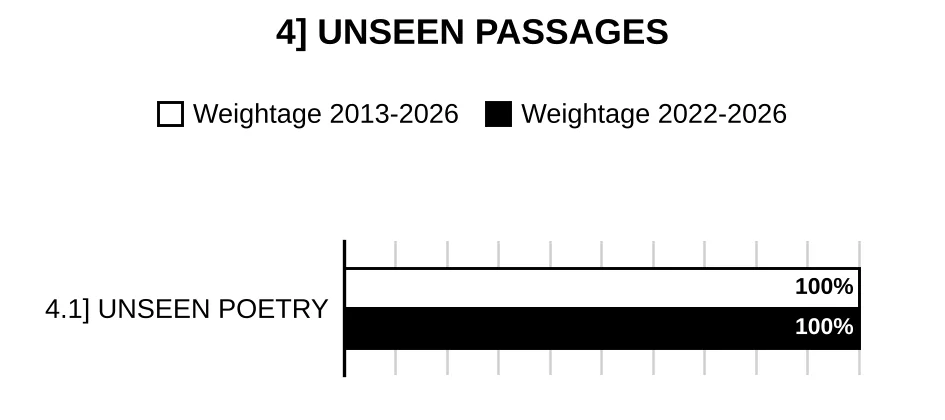
86 questions
Analyse the following poem critically and answer all the questions that follow: Explain the symbolism of the sea. [2026/10m/5a]
Analyse the following poem critically and answer all the questions that follow: What is the poet mourning? [2026/10m/5b]
Analyse the following poem critically and answer all the questions that follow: What does the poet invest his hopes in? [2026/10m/5c]
Analyse the following poem critically and answer all the questions that follow: Explain the phrase “ignorant armies clash by night”. [2026/10m/5d]
Analyse the following poem critically and answer all the questions that follow: How does the poet build the mood of the poem? Comment on the imagery of the poem. [2026/10m/5e]
Read the given poem critically and answer all the questions that follow: What is the main message or moral lesson of the poem? How does the speaker emphasize this throughout the poem? [2025/10m/5a]
Read the given poem critically and answer all the questions that follow: How does the speaker define self-respect, and why is it so important to him? [2025/10m/5b]
Read the given poem critically and answer all the questions that follow: How does the poet use repetition to emphasize key ideas of the poem? [2025/10m/5c]
Read the given poem critically and answer all the questions that follow: Which lines stand out the most to you, and why? How do they contribute to the overall theme of the poem? [2025/10m/5d]
Read the given poem critically and answer all the questions that follow: How would you relate the message of this poem to modern society, especially in a world influenced by social media or public image? [2025/10m/5e]
Study the following poem and answer the questions that follow: What does the poet say about biological life-force in the poem? [2024/10m/5a]
Study the following poem and answer the questions that follow: Explain the imagery used in the poem. [2024/10m/5b]
Study the following poem and answer the questions that follow: Critically comment on the poet’s sense of time and space. [2024/10m/5c]
Study the following poem and answer the questions that follow: “as if long deep.
burial had made them hasty”
Who are ‘them’ referred to here? Why do you think they appear to be ‘hasty’? [2024/10m/5d]Study the following poem and answer the questions that follow: Comment on the poetic diction and the figurative language used in the poem. [2024/10m/5e]
Study the following poem and answer the questions which follow: “And let that page come out of you–.
Then, it will be true.”
Comment on the teacher’s instruction. [2023/10m/5a]Study the following poem and answer the questions which follow: How does the young man describe himself in the next lines? [2023/10m/5b]
Study the following poem and answer the questions which follow: What does the poet mean by “we two–you, me, talk on this page”? [2023/10m/5c]
Study the following poem and answer the questions which follow: I feel and see and hear, Harlem, I hear you:
……………………………..
(I hear New York, too.) Explain. [2023/10m/5d]Study the following poem and answer the questions which follow: Analyse the poem from the perspective of the Harlem Renaissance. [2023/10m/5e]
Study the following poem and answer all the questions which follow: Recurrent motifs and persistent images in this poem reveal a central theme. What is it? [2022/10m/5a]
Study the following poem and answer all the questions which follow: How does the poet play with the paradox of transience and eternity? [2022/10m/5b]
Study the following poem and answer all the questions which follow: What is the function of art foregrounded by the poem? [2022/10m/5c]
Study the following poem and answer all the questions which follow: What does the river signify? [2022/10m/5d]
Study the following poem and answer all the questions which follow: Comment on the poetic diction and style that makes the poem so singular in its appeal. [2022/10m/5e]
Study the following poem and answer all the questions which follow: What are the two toys mentioned in the poem? What do they represent? [2021/10m/5a]
Study the following poem and answer all the questions which follow: How do alliteration, consonance and assonance create movement in the poem? [2021/10m/5b]
Study the following poem and answer all the questions which follow: What is the tone of the poem? [2021/10m/5c]
Study the following poem and answer all the questions which follow: How is the idea of waiting expressed in the poem? [2021/10m/5d]
Study the following poem and answer all the questions which follow: Explain what the poet wants to convey through the allusion to Queen Victoria in the final stanza. [2021/10m/5e]
Study the following poem and answer all the questions which follow: The word ‘balance’ occurs many times in the poem. What is its significance and what does it contribute to the whole meaning? [2020/10m/5a]
Study the following poem and answer all the questions which follow: What is the effect of the contrasts in the poem? [2020/10m/5b]
Study the following poem and answer all the questions which follow: Does the mood of the poem change at any point? If so, what is the contribution of these changes to the poem as a whole? [2020/10m/5c]
Study the following poem and answer all the questions which follow: The poem is about coming to a decision. Trace various stages of this decision by examining the changes in mood and argument. [2020/10m/5d]
Study the following poem and answer all the questions which follow: Identify the metre of the poem. How does it suggest repetition and progression? [2020/10m/5e]
Study the following poem and answer all the questions which follow: What is the theme of the poem? [2019/10m/5a]
Study the following poem and answer all the questions which follow: What is the mood of the poem–one of hope or despair? [2019/10m/5b]
Study the following poem and answer all the questions which follow: Give a critical estimate of the imagery used in the poem. [2019/10m/5c]
Study the following poem and answer all the questions which follow: What does the poet mean by saying the following?
“Now round us spreads the watery plain–
Oh might our marges meet again!” [2019/10m/5d]Study the following poem and answer all the questions which follow: What is the attitude of the poet towards God? [2019/10m/5e]
Study the following poem and answer all the questions which follow: What is the theme of this poem? [2018/10m/5a]
Study the following poem and answer all the questions which follow: What kind of person is the speaker? [2018/10m/5b]
Study the following poem and answer all the questions which follow: What is the speaker’s purpose in celebrating ‘men like them’? [2018/10m/5c]
Study the following poem and answer all the questions which follow: Comment on the language of the poem and the use of figures of speech. What effect is gained by the use of this kind of language? [2018/10m/5d]
Study the following poem and answer all the questions which follow: What is the meaning of the final line–“I’ll dig with it”? [2018/10m/5e]
Study the following poem and answer all the questions which follow. Each answer should be in around 60-80 words. How does the poet evoke the images of his beloved in the first stanza? [2017/10m/80w/5a]
Study the following poem and answer all the questions which follow. Each answer should be in around 60-80 words. What sort of person, do you think, is the speaker of the poem? [2017/10m/80w/5b]
Study the following poem and answer all the questions which follow. Each answer should be in around 60-80 words. How does the poet help the reader understand the theme of his poem through skillful use of diction and concrete language? [2017/10m/80w/5c]
Study the following poem and answer all the questions which follow. Each answer should be in around 60-80 words. How does the poet present a portrait of decaying and dying youth and beauty? [2017/10m/80w/5d]
Study the following poem and answer all the questions which follow. Each answer should be in around 60-80 words. Comment on the poet’s use of passionate, evocative and expressive vocabulary. [2017/10m/80w/5e]
Study the following poem and answer all the questions which follow. Each answer should be in around 60-80 words: What is the poet’s view of art and beauty? [2016/10m/80w/5a]
Study the following poem and answer all the questions which follow. Each answer should be in around 60-80 words: How does the poet describe human existence? [2016/10m/80w/5b]
Study the following poem and answer all the questions which follow. Each answer should be in around 60-80 words: What does the poet appear to desire from life? [2016/10m/80w/5c]
Study the following poem and answer all the questions which follow. Each answer should be in around 60-80 words: Describe the images created in the poem,. [2016/10m/80w/5d]
Study the following poem and answer all the questions which follow. Each answer should be in around 60-80 words: Comment on the rhyme scheme of the poem and the purpose it serves. [2016/10m/80w/5e]
Study the following poem and answer the questions which follow. Each answer should be in around 60-80 words: Consider the implications of the line – “Give me more love, or more disdaine”; and comment. [2015/10m/80w/5a]
Study the following poem and answer the questions which follow. Each answer should be in around 60-80 words: What sort of person, do you think, is the speaker of the poem? [2015/10m/80w/5b]
Study the following poem and answer the questions which follow. Each answer should be in around 60-80 words: Critically comment on the imagery of ‘The Torrid’ and “the frozen Zone”. [2015/10m/80w/5c]
Study the following poem and answer the questions which follow. Each answer should be in around 60-80 words: Explain the lines –.
“Give me a storme; if it be love,
Like Danae in that golden showre
I swimme in pleasure;” [2015/10m/80w/5d]Study the following poem and answer the questions which follow. Each answer should be in around 60-80 words: Explain –.
“and he’s possest
Of Heaven, that’s but from Hell releast”: [2015/10m/80w/5e]Study the following poem and answer the questions which follow. Each answer should be in about 150 words:– What sort of person do you think, is the speaker of the poem? [2014/10m/150w/5a]
Study the following poem and answer the questions which follow. Each answer should be in about 150 words:– Do you think self-effacing persons are popular in society? [2014/10m/150w/5b]
Study the following poem and answer the questions which follow. Each answer should be in about 150 words:– What is the speaker’s attitude towards fame and publicity? [2014/10m/150w/5c]
Study the following poem and answer the questions which follow. Each answer should be in about 150 words:– Why does the speaker of the poem want not to be “somebody”? [2014/10m/150w/5d]
Study the following poem and answer the questions which follow. Each answer should be in about 150 words:– Comment critically on the image of the frog in the bog. [2014/10m/150w/5e]
Study the following poem and answer the questions which follow. Each answer should be in around 60–80 words:– Examine the imagery of the second stanza. [2013/10m/80w/5a]
Study the following poem and answer the questions which follow. Each answer should be in around 60–80 words:– What do the lovers imply when they say ‘so must it always be’? [2013/10m/80w/5b]
Study the following poem and answer the questions which follow. Each answer should be in around 60–80 words:– What is meant by saying that the toad (in stanza 5) ‘dreams away the past’? [2013/10m/80w/5c]
Study the following poem and answer the questions which follow. Each answer should be in around 60–80 words:– What is implied by the line ‘No gate is fast, no door is fast’? [2013/10m/80w/5d]
Study the following poem and answer the questions which follow. Each answer should be in around 60–80 words:– Consider the implications of the title ‘Vanity’. [2013/10m/80w/5e]
This question has two poems (a) and (b). Read them carefully and answer the questions at the end of each poem in about 80-100 words each: I found this jawbone at the sea’s edge:
There crabs, dogfish, broken by the breakers or tossed
To flap for half an hour and turn to a crust,
Continue the beginning. The deeps are cold:
In that darkness, camaraderie does not hold:
Nothing touches, but clutching, devours. And the jaws
Before they are satisfied or their stretched purpose
Slacken, go down; go grawn bare. Jaws
Eat and are finished and the jawbone comes to the beach.
This is the sea’s achievement: with shells,
Vertebrae, claws, carapaces, skulls.
Time in the sea eats its tail, thrives,
Casts these indigestibles, the spars of purpose
That failed far from the surface. None grow rich
In the sea. This curved jawbone did not laugh
But gripped, gripped, and is now a cenotaph
(i) Explain these lines:
(a) To flap for half an hour and turn to a crust,
Continue the beginning.
(b) Nothing touches, but clutching, devours. [2012/5m/100w/5a(i)]
(ii) Explain these lines:
(a) ….the spars of purpose
That failed far from the surface.
(b) But gripped, gripped, and is now a cenotaph. [2012/5m/100w/5a(ii)]
(iii) Comment on the image–“Time in the sea eats its tail”. [2012/5m/100w/5a(iii)]
(iv) What poetic effect is gained by the use of half-rhymes in this poem? [2012/5m/100w/5a(iv)]
(v) Critically comment on the language of the poem. [2012/5m/100w/5a(v)]
(vi) What, according to the poet, is “the sea’s achievement”? [2012/5m/100w/5a(vi)]This question has two poems (a) and (b). Read them carefully and answer the questions at the end of each poem in about 80-100 words each: “The first that died was little Jane;.
In bed she moaning lay,
Till God released her of her pain,
And then she went away.
‘So in the churchyard she was laid,
And all the summer dry,
Together round her grave we played,
My brother John and I.
‘And when the ground was white with snow,
And I could run and slide,
My brother John was forced to go,
And he lies by her side.
‘How many are you then, said I,
If they two are in heaven?’
The little maiden did reply,
‘O master ! we are seven.’
‘But they are dead; those two are dead !
Their spirits are in heaven !’
Twas throwing words away; for still
The little maid would have her will,
And said, ‘Nay, we are seven !’
(i) What is the function of the modifier ‘little’ in line 1? [2012/6m/100w/5b(i)]
(ii) What does the poet say about the materialist elements of the girl and the landscape? [2012/8m/100w/5b(ii)]
(iii) How does the poet describe the girl’s own life and the death of her siblings? [2012/8m/100w/5b(iii)]
(iv) Does the poet make his presence felt in the poem? Critically analyse this. [2012/8m/100w/5b(iv)]Study the following poem and answer the questions which follow. Each answer should be in around 60 words. Critically respond to the images: “this grandson of fishes” and “this nephew of snails”. [2011/10m/60w/5a]
Study the following poem and answer the questions which follow. Each answer should be in around 60 words. Explicate the images: “black stones” and “white stones”. [2011/10m/60w/5b]
Study the following poem and answer the questions which follow. Each answer should be in around 60 words. What does the poet suggest in the line “He moves toward the animal, the animal with furry head !”? [2011/10m/60w/5c]
Study the following poem and answer the questions which follow. Each answer should be in around 60 words. Comment on the expressions “this long man” and “dragging a great tail into the darkness”. [2011/10m/60w/5d]
Study the following poem and answer the questions which follow. Each answer should be in around 60 words. How does the image, “darkness” play a significant role in the building up of the theme? [2011/10m/60w/5e]
Study the following poem and answer the questions which follow. Each answer should be in around 60 words. What are the images of ‘the serpents rising with spiral motions’, ‘man sleeping inside a jewel’ and ‘fire passing up through the soles of my feet’ associated with? Would you call them ‘mystic images’? [2011/10m/60w/5f]
Study the following poem and answer the questions which follow: each answer should be around 60 words. Paraphrase the poem in 6-8 sentences. [2010/10m/60w/5i]
Study the following poem and answer the questions which follow: each answer should be around 60 words. What is the theme of the poem? [2010/10m/60w/5ii]
Study the following poem and answer the questions which follow: each answer should be around 60 words. Identify the speaker and the claims made by the speaker of the poem. [2010/10m/60w/5iii]
Study the following poem and answer the questions which follow: each answer should be around 60 words. What is the relationship between the woman and the speaker? [2010/10m/60w/5iv]
Study the following poem and answer the questions which follow: each answer should be around 60 words. Explain the words “Now I am a lake”. [2010/10m/60w/5v]
Study the following poem and answer the questions which follow: each answer should be around 60 words. Comment on the meaning of the last two lines. [2010/10m/60w/5vi]
Study the following poems and answer the questions which follow. Each answer should be in around 50 words: The gray sea and the long black land;.
And the yellow half-moon large and low;
And the startled little waves that leap
In fiery ringlets from their sleep,
As I gain the cove with pushing prow,
And quench its speed in the slushy sand.
Then a mile of warm sea-scented beach;
Three fields to cross till a farm appears;
A tap at the pane, the quick sharp scratch
And blue spurt of a lighted match,
And a voice less loud, thro’ its joys and fears,
Than the two hearts beating each to each !
(i) Comment on the background of the poet’s experience.
(ii) Analyse the poetic devices used in the poem.
(iii) Examine the poet’s treatment of love. [2009/30m/50w/5a]Study the following poems and answer the questions which follow. Each answer should be in around 50 words: We stood by a pond that winter day,.
And the sun was white, as though chidden of God,
And a few leaves lay on the starving sod;
– They had fallen from an ash, and were gray.
Your eyes on me were as eyes that rove
Over tedious riddles of years ago;
And some words played between us to and fro
On which lost the more by our love.
The smile on your mouth was the deadest thing
Alive enough to have strength to die;
And a grin of bitterness swept thereby
Like an ominous bird a-wing….
Since then, keen lessons that love deceives,
And wrings with wrong, have shaped to me
Your face, and the God-curst sun, and a tree,
And a pond edged with grayish leaves.
(i) What is the similarity between nature and the woman addressed in the poem?
(ii) Analyse the significance of “smile” and “bitterness” in the third stanza of the poem.
(iii) What does the poet feel at the end of the poem – disillusionment or hope? Give reasons for your answer. [2009/30m/50w/5b]

Preparing for Prelims too?
Our UPSC Prelims Topic-wise PYQ Book covers every Prelims question with detailed explanations, so you can see exactly where UPSC asks from. Now available as a hard copy and an eBook.
Buy Hard Copy on AmazonBuy eBook (PDF)
Strengthen your GS papers
Our UPSC Mains Topic-wise & Year-wise PYQ Book (2013–2026) maps every GS question to the syllabus, so you know what UPSC asks and how often. Now available as a hard copy and an eBook.
Buy Hard Copy on AmazonBuy eBook (PDF)« Previous: Texts: fiction (section b) · Next: Topics and movements (1900–1990) »
Back to: English Literature Optional PYQs – Topic-wise
Last updated: 2 November 2026