
Use this list of Fifteenth and Early Sixteenth Century: Society and Culture History Optional PYQs to see how UPSC has examined this part of the syllabus between 1995 and 2026.
Fifteenth and Early Sixteenth Century: Society and Culture – History Optional PYQs (1995–2026)
19.1] Regional cultures specificities
1. Why should the sixteenth century be regarded as the period of Indian Renaissance? [2015/15m/7b]
2. Bhakti and mysticism of Lal Ded emerged as a social force in Kashmir. Comment. [2013/10m/150w/5e]
3. Discuss the Caurapancashika and Jain styles of paintings. Can the Caurapancashika style truly be called the precursor of pothi format? [2012/12m/150w/5d]
19.2] Literary traditions
1. “Religious themes inspired a large section of literature in provincial languages in late medieval India.” Comment. [2025/10m/150w/5a]
2. The Vaishnava Bhakti tradition of the fifteenth century contributed to the flourishing of provincial literature. Discuss with appropriate examples. [2022/20m/8c]
3. What was the role of Sufi Folk literature in the diffusion of Islam in India in general and in Deccan in particular? [2018/15m/7c]
4. Evaluate Jonaraja’s account of the reign of Zain-ul-Abidin. [2016/10m/5c]
5. Make an estimate of Rana Kumbha as a patron of literature and art. [2015/20m/7a]

Preparing for Prelims too?
Our UPSC Prelims Topic-wise PYQ eBook covers every Prelims question with detailed explanations, so you can see exactly where UPSC asks from.
View the BookDownload Free Sample6. Why should the sixteenth century be regarded as the period of Indian Renaissance? [2015/15m/7b]
7. Comment on: Growth of regional languages and literature during the medieval period. [1995/20m/200w/6c]
19.3] Provincial architecture
1. Discuss the contributions of Bahmani Sultans to the development of Indo-Islamic architecture. [2024/20m/8a]
19.4] Society, culture, literature and the arts in Vijayanagara Empire
1. From the Portuguese merchant Domingo Paes’ description of Krishnadevaraya’s reign, assess the socio-economic and cultural uniqueness of the Vijayanagara Empire. [2026/15m/7a]
2. Amuktamalyada dwells much upon the relationship of fort, Brahmanas and dispersed tribal groups. Comment. [2020/15m/6b]
3. Discuss how Vijayanagar empire became the cultural capital of the south? [2019/10m/150w/5a]
4. Discuss social dynamics in the Vijayanagara empire. [2010/20m/200w/5b]
5. Write a short essay on: Architecture of the Vijayanagara empire. [2000/20m/200w/5a]
Summary of Fifteenth and Early Sixteenth Century: Society and Culture PYQs (1995–2026)
| Total questions (1995–2026) | 16 (15 unique – a few questions are listed under more than one sub-topic) |
| Total marks asked | 232 (unique questions) |
| Questions in last 5 years (2022–2026) | 4 |
| Most recent year asked | 2026 |
| Sub-topics | 4 (19.1 to 19.4) |
The earliest question here dates from 1995 and the latest from 2026; UPSC has drawn on this unit in 14 of the 32 years. In the last five years (2022–2026), 4 questions were set from it.
Official Syllabus
19. The Fifteenth and Early Sixteenth Century – Society and Culture
- Regional cultures specificities.
- Literary traditions.
- Provincial architectural.
- Society, culture, literature and the arts in Vijayanagara Empire.
Source: UPSC Civil Services Examination 2026 notification.
Where this unit stands in Medieval India
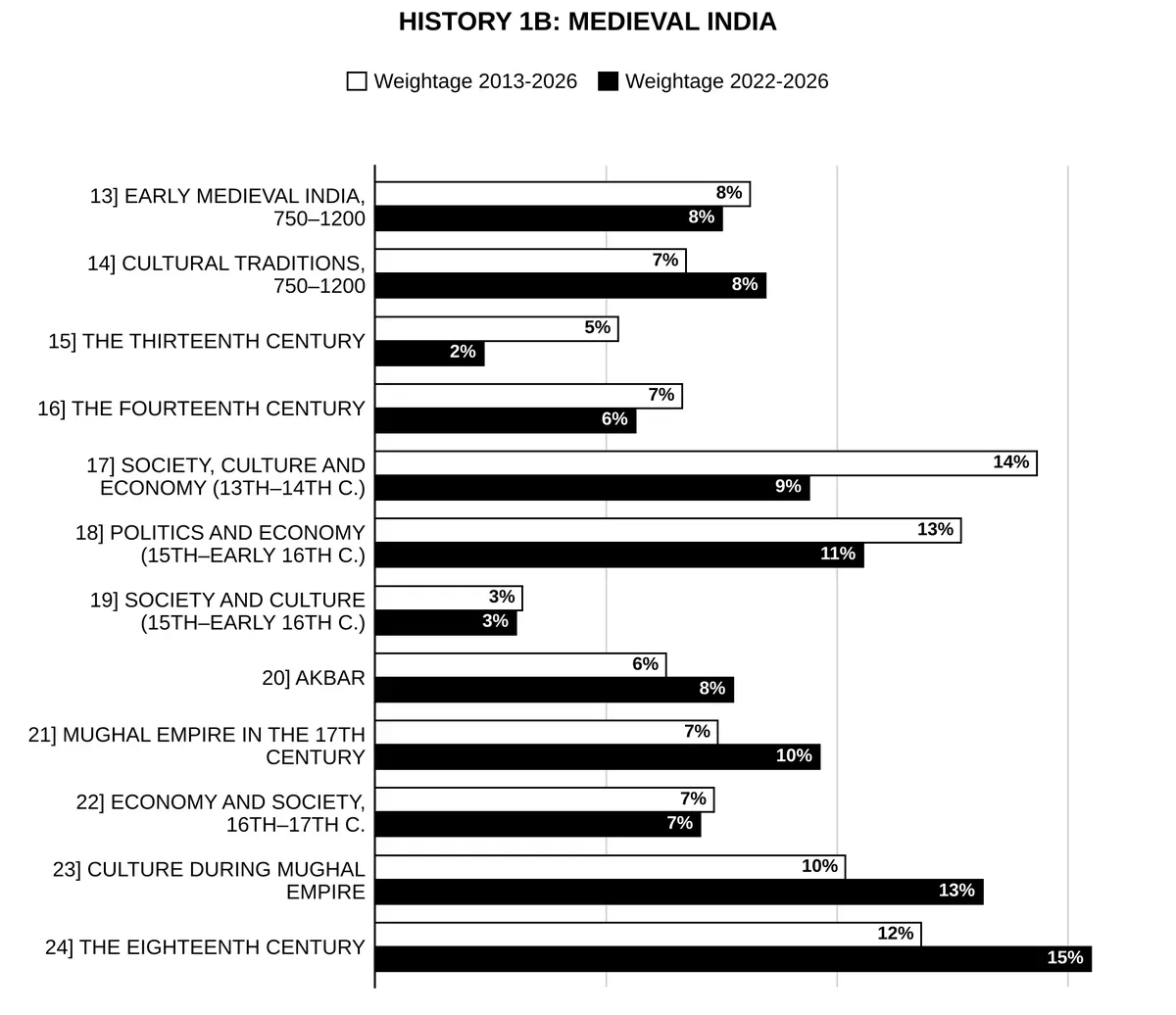
Fifteenth and Early Sixteenth Century: Society and Culture accounted for about 3% of the marks asked in Medieval India in 2022–2026, the same as 3% over 2013–2026, ranking 11th of the 12 units in the section by recent weightage.
How to use these PYQs
- Read the syllabus line in the box above alongside the questions and mark which phrases UPSC keeps returning to; those are the areas to prepare first.
- Questions run from the latest year to the oldest, so read the top of each list first for the current pattern, then use older ones for practice of content.
- Use the question code to set the length of your practice answer – marks and word limit tell you how much depth UPSC expected.
Frequently Asked Questions
How many History Optional questions have been asked from Fifteenth and Early Sixteenth Century: Society and Culture?
This collection lists 16 question entries from Fifteenth and Early Sixteenth Century: Society and Culture (unit 19 of Paper 1) between 1995 and 2026, of which 15 are unique questions; the rest are listed under more than one sub-topic. They were asked in 14 of the 32 years and 4 came in 2022–2026.
When was Fifteenth and Early Sixteenth Century: Society and Culture last asked in History Optional?
Most recently in 2026, with 1 question (2026/15m/7a). Before that, it was asked in 2025.
Where can I find all History Optional PYQs topic-wise?
All units of Paper 1 and Paper 2, the map question and the earlier-syllabus questions are linked from History Optional PYQs Topic-wise (1995–2026).
Next: Akbar – History Optional PYQs (1995–2026) »
Back to: History Optional PYQs Topic-wise (1995–2026) | Also see: History Optional year-wise question papers (1995–2026)