
Economy and Society in the 16th and 17th Centuries History Optional PYQs from 1995 to 2026 are compiled here exactly as UPSC set them in the Mains examination, sorted by syllabus topic.
Economy and Society in the 16th and 17th Centuries – History Optional PYQs (1995–2026)
22.1] Population, agricultural and craft production
1. “From Asia to Europe, from head to foot, everyone was clothed in Indian textiles.” Qualify this statement with a critical account of India’s foreign trade with special reference to textiles. [2026/15m/7c]
2. Critically assess the role of imperial Karkhanas in Mughal India. How did they reflect the ideological and functional imperatives of the Mughal State? [2025/10m/150w/5c]
3. “An important feature of agriculture in Mughal India has been the large number of crops raised by the peasants.” Illustrate by giving examples. [2018/15m/6b]
4. Will it not be correct to say that the rural economy in Mughal India was relatively self-sufficient? [2015/15m/8b]
5. “India had been for hundreds of years the Lancashire of the Eastern world.” Critically examine this view. [2014/15m/8c]
6. Discuss different types of Karkhanas in Mughal India. How was the production organized in the Karkhanas? [2010/20m/200w/5c]
7. Write a short essay on: Estimates of population of Mughal India. [2009/20m/200w/5d]
8. Delineate the striking features of agricultural and craft production during the sixteenth and seventeenth centuries in India. How did they impact the social fabric of the country? [2008/60m/7]
9. Do you agree with the view that the advent of the Turks and the Mughals in India heralded many changes in the means of production? Give reasons in support of your answer. [1995/60m/8]
22.2] Towns, commerce with Europe through Dutch, English and French companies: a trade revolution
1. “From Asia to Europe, from head to foot, everyone was clothed in Indian textiles.” Qualify this statement with a critical account of India’s foreign trade with special reference to textiles. [2026/15m/7c]
2. Examine the process of urbanization caused by the establishment of European trading companies in India. [2024/15m/8c]
3. Trade and commerce in the Mughal Empire brought about the integration of the Indian subcontinent into a single market. Comment. [2022/15m/8a]

Preparing for Prelims too?
Our UPSC Prelims Topic-wise PYQ eBook covers every Prelims question with detailed explanations, so you can see exactly where UPSC asks from.
View the BookDownload Free Sample4. The emergence of early capitalism in the Mughal period was primarily due to urbanisation and commercialisation. Comment. [2019/20m/7a]
5. “India had been for hundreds of years the Lancashire of the Eastern world.” Critically examine this view. [2014/15m/8c]
6. Give a sketch of Indian trade with Europe during the Mughal period. [2013/10m/150w/5c]
7. Medieval Indian towns were merely an extension of villages. Comment. [2012/12m/150w/5b]
8. Critically evaluate various approaches to study medieval Indian towns. [2010/20m/200w/5d]
9. Examine the factors which were responsible for opening and development of European trade in India during the 16th and 17th centuries. [2006/60m/8]
10. Give your opinion on the urban development in India during the Mughal times. [2005/60m/6]
22.3] Indian mercantile classes; banking, insurance and credit systems
1. Trade and commerce in the Mughal Empire brought about the integration of the Indian subcontinent into a single market. Comment. [2022/15m/8a]
2. The emergence of early capitalism in the Mughal period was primarily due to urbanisation and commercialisation. Comment. [2019/20m/7a]
3. Analyse the Mughal monetary system and examine their policy of minting of coins. [2014/20m/6c]
22.4] Conditions of peasants, condition of women
1. Evaluate the impact of Mughal revenue administration on the agrarian structure of North India. To what extent did it bring continuity and change in the rural socio-economic fabric? [2025/20m/7c]
2. Assess the condition of peasantry during 13th to 17th centuries C.E. [2017/15m/8b]
3. Will it not be correct to say that the rural economy in Mughal India was relatively self-sufficient? [2015/15m/8b]
4. On the basis of the accounts of Europeans bring out the agrarian crisis of the 17th century CE India. [2013/20m/7a]
5. State the structure of medieval village society in Northern India. What were the passive forms of resistance of the peasants in the medieval period? [2012/30m/8a]
6. Delineate the striking features of agricultural and craft production during the sixteenth and seventeenth centuries in India. How did they impact the social fabric of the country? [2008/60m/7]
22.5] Evolution of the Sikh community and the Khalsa Panth
1. “The principles of Sikhism represented a harmonious blend of Islamic and Indic religious beliefs and practices.” Comment. [2025/10m/150w/5d]
2. Discuss the transformation of Sikh community from a Nirguna Bhakti sect into a politico-military organization. [2021/15m/6a]
3. The religion of the Sikhs was the main force of their unity. Comment. [2017/10m/150w/5e]
4. Write a short essay on: Evolution of the Khalsa Panth. [2008/20m/200w/5d]
Summary of Economy and Society in the 16th and 17th Centuries PYQs (1995–2026)
| Total questions (1995–2026) | 32 (26 unique – a few questions are listed under more than one sub-topic) |
| Total marks asked | 602 (unique questions) |
| Questions in last 5 years (2022–2026) | 8 (6 unique) |
| Most recent year asked | 2026 |
| Sub-topics | 5 (22.1 to 22.5) |
The earliest question here dates from 1995 and the latest from 2026; UPSC has drawn on this unit in 18 of the 32 years. In the last five years (2022–2026), 8 questions were set from it.
Official Syllabus
22. Economy and Society in the 16th and 17th Centuries
- Population, Agricultural and craft production.
- Towns, commerce with Europe through Dutch, English and French companies: a trade revolution.
- Indian mercantile classes. Banking, insurance and credit systems.
- Conditions of peasants, Condition of Women.
- Evolution of the Sikh community and the Khalsa Panth.
Source: UPSC Civil Services Examination 2026 notification.
Where this unit stands in Medieval India
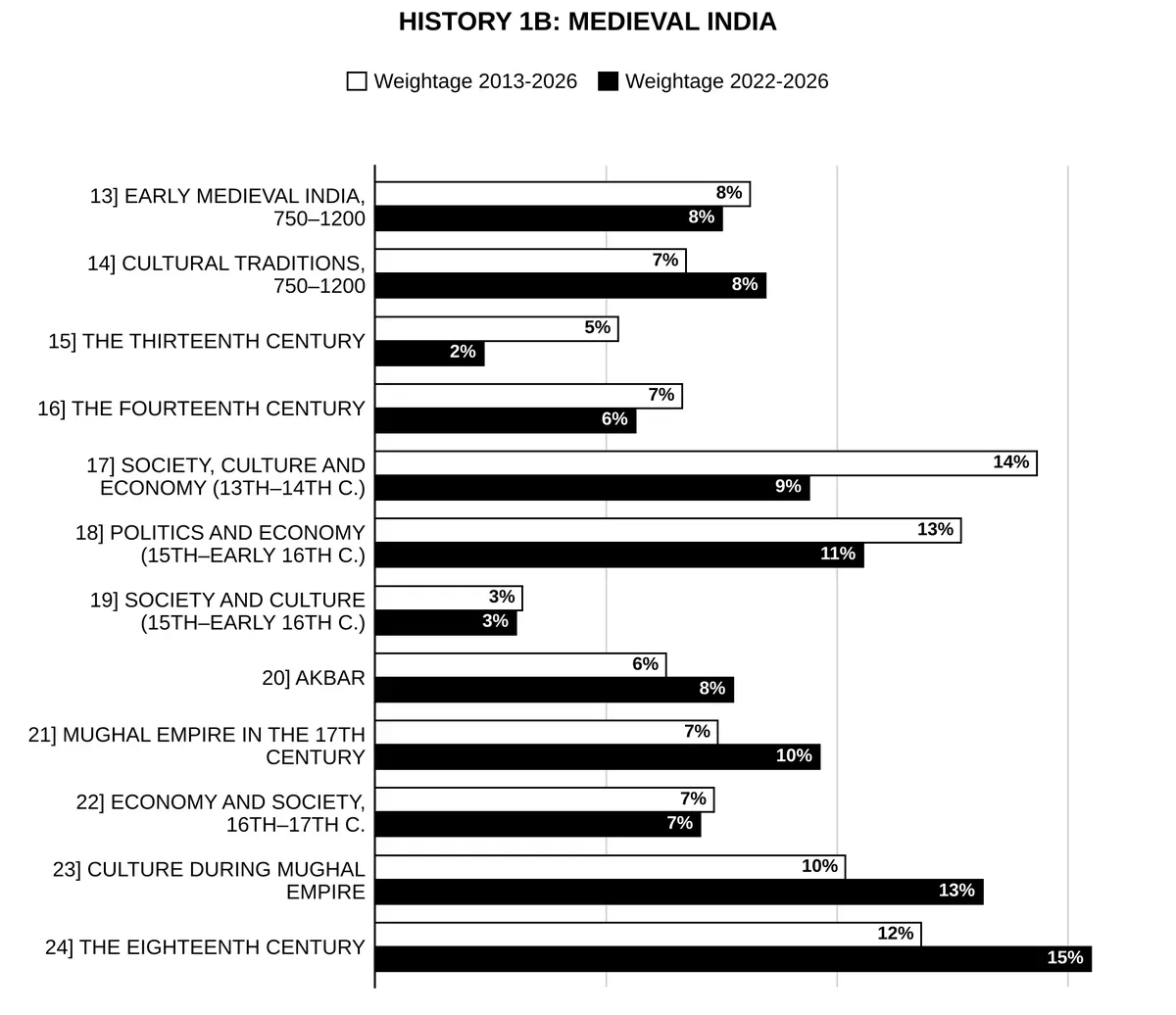
Economy and Society in the 16th and 17th Centuries accounted for about 7% of the marks asked in Medieval India in 2022–2026, the same as 7% over 2013–2026, ranking 9th of the 12 units in the section by recent weightage.
How to use these PYQs
- Read the syllabus line in the box above alongside the questions and mark which phrases UPSC keeps returning to; those are the areas to prepare first.
- Questions run from the latest year to the oldest, so read the top of each list first for the current pattern, then use older ones for practice of content.
- Use the question code to set the length of your practice answer – marks and word limit tell you how much depth UPSC expected.
Frequently Asked Questions
How many History Optional questions have been asked from Economy and Society in the 16th and 17th Centuries?
This collection lists 32 question entries from Economy and Society in the 16th and 17th Centuries (unit 22 of Paper 1) between 1995 and 2026, of which 26 are unique questions; the rest are listed under more than one sub-topic. They were asked in 18 of the 32 years and 8 came in 2022–2026.
When was Economy and Society in the 16th and 17th Centuries last asked in History Optional?
Most recently in 2026, with 1 question (2026/15m/7c). Before that, it was asked in 2025.
Where can I find all History Optional PYQs topic-wise?
All units of Paper 1 and Paper 2, the map question and the earlier-syllabus questions are linked from History Optional PYQs Topic-wise (1995–2026).
« Previous: Mughal Empire in the Seventeenth Century – History Optional PYQs (1995–2026)
Next: Culture during Mughal Empire – History Optional PYQs (1995–2026) »
Back to: History Optional PYQs Topic-wise (1995–2026) | Also see: History Optional year-wise question papers (1995–2026)