
This page brings together all Indian Response to British Rule History Optional PYQs asked in UPSC Civil Services Mains from 1995 to 2026, arranged topic-wise. It is unit 7 of Paper 2, Section A – Modern India, with 31 questions, the latest from 2026.
Indian Response to British Rule – History Optional PYQs (1995–2026)
7.1] Peasant movements and tribal uprisings in the 18th and 19th centuries
1. In what ways did the tribal and peasant uprisings of the 19th century contribute to the rise and growth of nationalism in India? Examine. [2025/20m/4b]
2. The historical significance of tribal and peasant uprisings in India ‘lies in that they established strong and valuable traditions of resistance to British rule’. Discuss. [2023/20m/3b]
3. Critically examine: ‘Penetration of outsiders — called dikus by the Santhals — completely destroyed their familiar world, and forced them into action to take possession of their lost territory’. [2022/10m/150w/1d]
4. Do you feel that the Santhal Hool (rebellion) 1855–56, was the most effective tribal movement in pre-1857 India? [2020/10m/2c]
5. Critically examine: “… the Kol Insurrection was mainly a war of the tribal inhabitants of Chotanagpur against the non-tribal settlers and service-holders.” [2019/10m/150w/1d]
6. How far is it correct to say that the 19th century tribal uprisings are a part of subaltern nationalism? [2016/20m/3b]
7. Critically examine: “The Indigo Revolt of 1859–60 holds a very significant place in our history of national liberation movement. For the first time in the history of our anti-colonial struggle, its two independent currents—spontaneous peasant resistance and constitutional agitation in defence of the peasantry—came into mutual contact.” [2015/10m/150w/1c]
8. “The Santhal hool began in July 1855. The core of the movement was economic, the basic cause of the uprising was agrarian discontent.” — Elucidate. [2012/30m/3b]
9. “Tribals revolted more often and far more violently than any other community including peasants in India.” Elaborate. [2011/30m/3b]
10. Comment on: ‘The tribal and peasant rebellion laid the foundation of the revolt of 1857’. [2001/20m/200w/1b]
11. Tribal movements should be viewed as “History from below”. Discuss the objects and nature of the movements in 19th century India. [1997/60m/3]

Preparing for Prelims too?
Our UPSC Prelims Topic-wise PYQ eBook covers every Prelims question with detailed explanations, so you can see exactly where UPSC asks from.
View the BookDownload Free Sample7.2] The Great Revolt of 1857
1. Why was the Great Revolt of 1857 confined only to North India? How did it change the character of British rule in the subcontinent? Explain. [2024/20m/2b]
2. The British rule had differential impact on the Indian society. Describe in what ways the Indians responded to the Revolt of 1857. [2022/20m/3b]
3. For long, the Revolt of 1857, has been mistaken to be a mere mutiny of the Indian sepoys in the Bengal army. However, its causes need to be searched for not only in the dissatisfaction of the army, but in a long drawn process of fundamental social and economic change that upset the peasant communities. Discuss. [2020/20m/2b]
4. “The Mutiny of 1857 was much more than a Mutiny of Sepoys and much less than a National Rebellion.” Comment. [2016/10m/150w/1d]
5. Critically examine: “The military, feudal and traditional overtones of the Revolt of 1857 were overshadowed by its nationalist or proto-nationalist character.” [2014/10m/150w/1c]
6. “In 1857, the rebel sepoys showed a remarkable centripetal tendency to congregate at Delhi.” Do you agree? Substantiate. [2011/30m/3a]
7. Comment on: “The annexation of Awadh shook the loyalty of the Sepoys, as it was for them an ultimate proof of untrustworthiness of the British.” [2009/20m/200w/1d]
8. “The Revolt of 1857 seemed to call the very presence of the British into question. What it did not do was reverse these changes”. [2007/20m/200w/1a]
9. Comment on: ‘Whatever might have been its original character, it (Rebellion of 1857) soon became a symbol of challenge to the mighty British power in India.’ [2005/20m/200w/1b]
10. Comment on: ‘The tribal and peasant rebellion laid the foundation of the revolt of 1857’. [2001/20m/200w/1b]
11. Do you believe that the uprising in 1857 was nationalist in nature? If not, what was its character? [1999/60m/2]
12. Examine the nature of the Revolt of 1857 and indicate the manifold changes in British civil and military administration of India after 1857. [1998/60m/3]
7.3] Shift in the character of peasant uprisings in the post-1857 period
1. Critically examine: After 1857, “the peasants emerged as the main force in agrarian movements.” [2023/10m/150w/1b]
2. The root of the whole question behind the Indigo Revolt ‘is the struggle to make the raiyats grow indigo plants without paying them the price of it’. Analyse. [2023/10m/2c]
3. Critically examine: “The peasant movements of the second half of the nineteenth century lacked a positive conception of an alternative society — a conception which would unite the people in a common struggle on a wide regional and all-India plane and help develop long-term political developments.” [2012/12m/150w/1c]
7.4] Peasant movements of the 1920s and 1930s
1. Was the Moplah Rebellion in Malabar an expression of anti-landlord and anti-foreign discontent? Discuss. [2026/20m/2b]
2. Was the Moplah Rebellion in Malabar an expression of anti-landlord and anti-foreign discontent? Discuss. [2018/20m/2a]
3. Discuss the nature of peasant movements under the Kisan Sabhas during 1920–1940. [2017/10m/3c]
4. Analyze the nature of peasant movements during the nationalist phase and bring out their shortcomings. [2015/20m/4a]
5. Comment on: The 1921 Moplah rebellion was “in essence an expression of long-standing agrarian discontent which was intensified by the religious and ethnic identity.” [2000/20m/200w/1d]
Summary of Indian Response to British Rule PYQs (1995–2026)
| Total questions (1995–2026) | 31 (30 unique – a few questions are listed under more than one sub-topic) |
| Total marks asked | 652 (unique questions) |
| Questions in last 5 years (2022–2026) | 8 |
| Most recent year asked | 2026 |
| Sub-topics | 4 (7.1 to 7.4) |
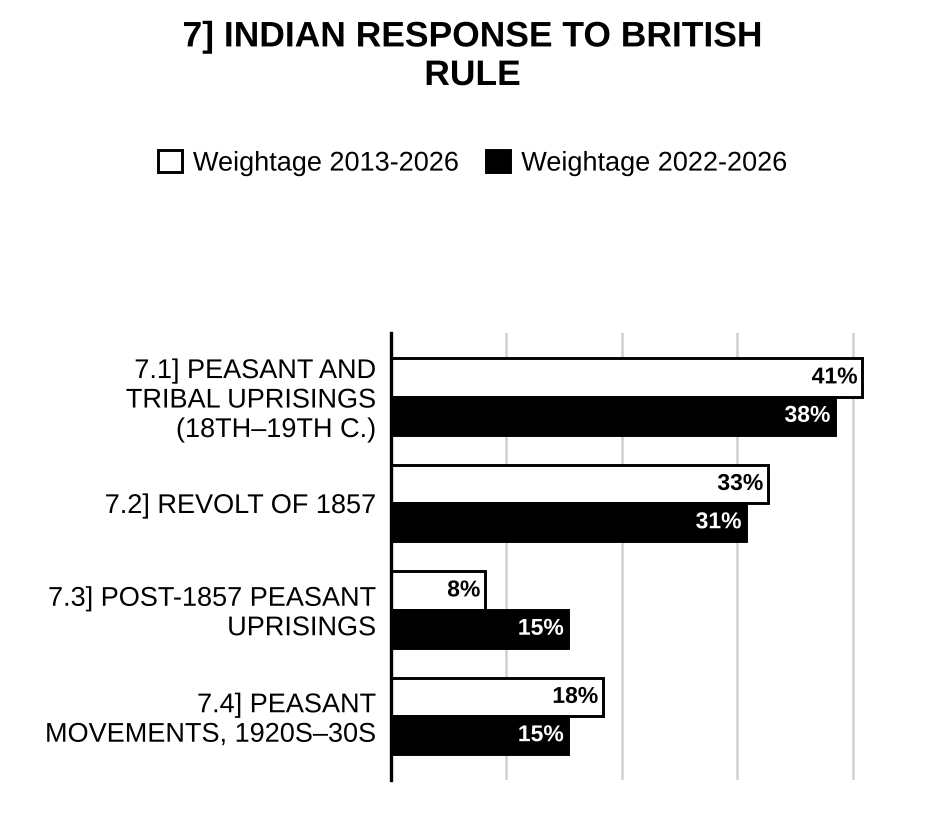
The earliest question here dates from 1997 and the latest from 2026; UPSC has drawn on this unit in 22 of the 32 years. In the last five years (2022–2026), 8 questions were set from it.
Official Syllabus
7. Indian Response to British Rule: Peasant movement and tribal uprisings in the 18th and 19th centuries including the Rangpur Dhing (1783), the Kol Rebellion (1832), the Mopla Rebellion in Malabar (1841–1920), the Santal Hul (1855), Indigo Rebellion (1859–60), Deccan Uprising (1875) and the Munda Ulgulan (1899–1900); The Great Revolt of 1857 – Origin, character, causes of failure, the consequences; The shift in the character of peasant uprisings in the post-1857 period; the peasant movements of the 1920s and 1930s.
Source: UPSC Civil Services Examination 2026 notification.
Where this unit stands in Modern India
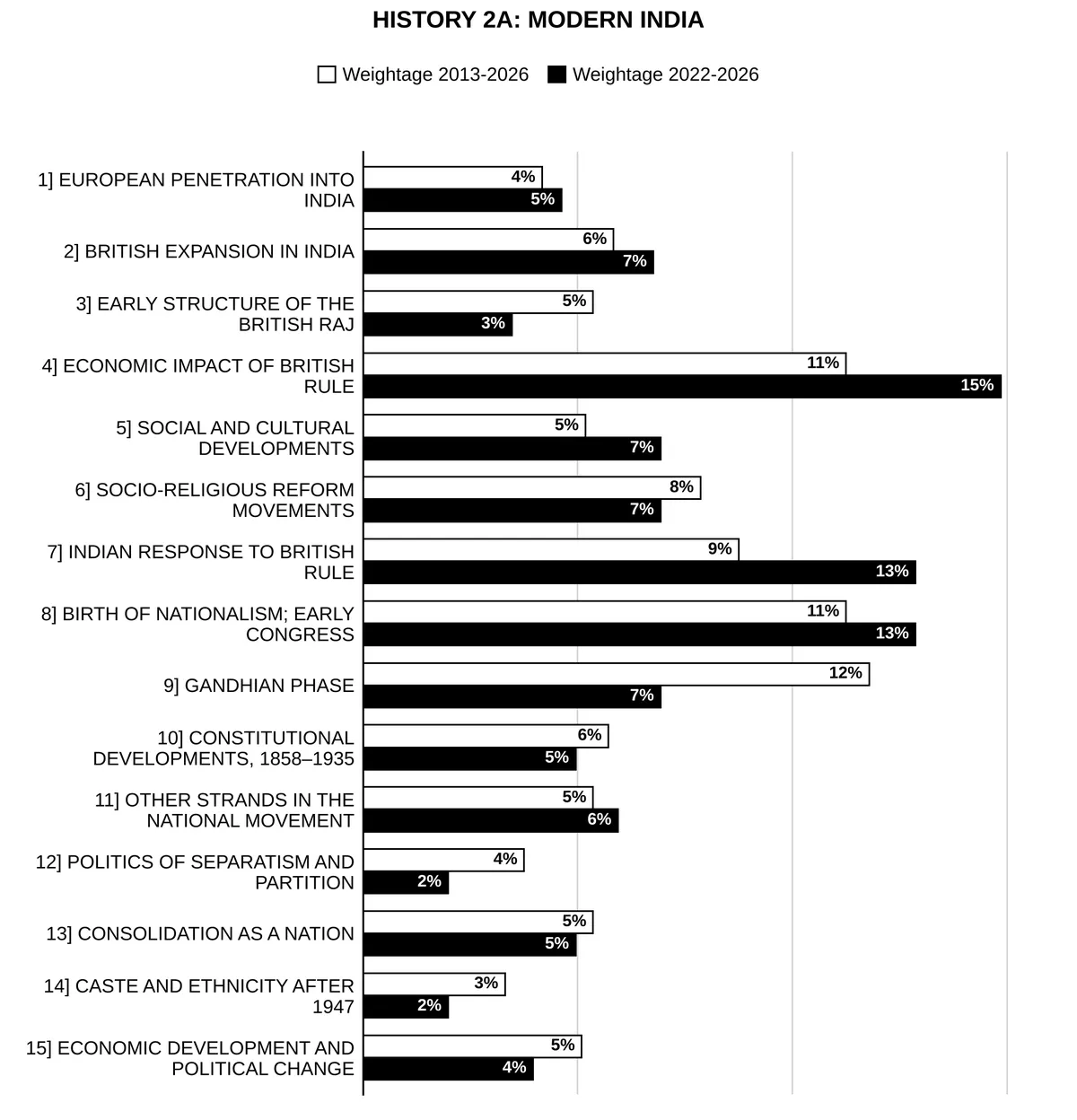
Indian Response to British Rule accounted for about 13% of the marks asked in Modern India in 2022–2026, up from 9% over 2013–2026, ranking 3rd of the 15 units in the section by recent weightage.
How to use these PYQs
- Read the syllabus line in the box above alongside the questions and mark which phrases UPSC keeps returning to; those are the areas to prepare first.
- Questions run from the latest year to the oldest, so read the top of each list first for the current pattern, then use older ones for practice of content.
- Use the question code to set the length of your practice answer – marks and word limit tell you how much depth UPSC expected.
Frequently Asked Questions
How many History Optional questions have been asked from Indian Response to British Rule?
This collection lists 31 question entries from Indian Response to British Rule (unit 7 of Paper 2) between 1997 and 2026, of which 30 are unique questions; the rest are listed under more than one sub-topic. They were asked in 22 of the 32 years and 8 came in 2022–2026.
When was Indian Response to British Rule last asked in History Optional?
Most recently in 2026, with 1 question (2026/20m/2b). Before that, it was asked in 2025.
Where can I find all History Optional PYQs topic-wise?
All units of Paper 1 and Paper 2, the map question and the earlier-syllabus questions are linked from History Optional PYQs Topic-wise (1995–2026).
« Previous: Social and Religious Reform Movements – History Optional PYQs (1995–2026)
Next: Birth of Indian Nationalism and the Early Congress – History Optional PYQs (1995–2026) »
Back to: History Optional PYQs Topic-wise (1995–2026) | Also see: History Optional year-wise question papers (1995–2026)