
Birth of Indian Nationalism and the Early Congress History Optional PYQs from 1995 to 2026 are compiled here exactly as UPSC set them in the Mains examination, sorted by syllabus topic.
Birth of Indian Nationalism and the Early Congress – History Optional PYQs (1995–2026)
8.1] Factors leading to the birth of Indian Nationalism; politics of association
1. Critically examine: “No educated Indian has ever forgotten the lesson of Ilbert Bill.” [2026/10m/150w/1b]
2. Do you think that the Indian National Movement was a ‘multi class movement’ which represented the anti-imperialist interests of all classes and strata? Give reasons in support of your answer. [2022/20m/3a]
3. What were the various ways in which nationalism manifested itself in India during colonial rule? [2021/20m/2b]
4. Critically examine: “In the initial stages, when Indian nationalism was immature, just sprouting, it found expression in many liberal religio-reform movements.” [2020/10m/150w/1b]
5. Discuss the extent to which the Indian Renaissance movement contributed towards the rise of nationalist consciousness. [2010/30m/3b]
6. Comment on: ‘Rabindranath Tagore’s nationalism was based on a Catholic internationalism.’ [2003/20m/200w/1d]
7. Comment on: “India broke her British fetters with Western hammers”. [2002/20m/200w/1b]
8. Examine the economic and social factors which led to the rise of Indian nationalism in the second half of the nineteenth century. [2001/60m/3]
9. To what extent was the emergence of the Congress in 1885 the culmination of a process of political awakening that had its beginning in the 1870s? [2000/60m/4]
10. Comment on: The Indian Middle Class firmly believed that “Britain had imposed a colonial economy on India which had impoverished the country.” [1999/20m/200w/1d]
11. Comment on: India broke her British fetters with western hammers. [1997/20m/200w/1d]
8.2] Foundation of the Indian National Congress; the Safety-valve thesis
1. Critically examine: Alan Hume’s ultimate aim in encouraging the foundation of the Indian National Congress was to provide a ‘Safety Valve’ for the release of growing Indian discontent. [2026/10m/150w/1e]
2. Why has the ‘safety valve theory’ related to the foundation of the Indian National Congress been thoroughly discredited by recent researchers? Analyze. [2025/20m/3b]
3. In its political behaviour the Indian National Congress in its early career was never a radical organisation, besides the founders of the Congress involved A.O. Hume in their project. Do these facts verify that the Congress was founded as a ‘Safety valve’? Explain. [2020/20m/3a]
4. Critically examine: “The ‘safety-valve thesis’ does not adequately explain the birth of the Indian National Congress in 1885.” [2014/10m/150w/1d]
5. To what extent was the emergence of the Congress in 1885 the culmination of a process of political awakening that had its beginning in the 1870s? [2000/60m/4]

Preparing for Prelims too?
Our UPSC Prelims Topic-wise PYQ eBook covers every Prelims question with detailed explanations, so you can see exactly where UPSC asks from.
View the BookDownload Free Sample8.3] Programme, objectives and social composition of the early Congress
1. “In my belief, congress is to tottering to its fall and one of my great ambitions which in India is to assist it to a peaceful demise.” Comment. [2026/10m/2c]
2. Discuss the policies and programmes of the early nationalists (moderates). To what extent they were able to fulfil the aspirations of the people? [2022/20m/4a]
3. Can methods and policies of the moderates be referred to as ‘political mendicancy’? [2018/10m/4c]
4. “Politics remained for the bulk of the Moderates very much a part-time affair. The Congress was not a political party, but an annual three-day show …” Elucidate. [2014/20m/3a]
5. “At the dawn of the twentieth century Lord Curzon, the Viceroy of India, was full of hostility towards the Indian National Congress and he confidentially reported to the Secretary of State in November 1900: My own belief is that the Congress is tottering to its fall, and one of my greatest ambitions while in India is to assist it to a peaceful demise.” Examine. [2013/25m/3a]
6. Analyse the social composition of the early Congress leadership. [2009/30m/3b]
8.4] The Moderates and Extremists
1. Political extremism in colonial India often converged with cultural nationalism, but not always. — Comment. [2024/20m/3a]
2. Discuss the policies and programmes of the early nationalists (moderates). To what extent they were able to fulfil the aspirations of the people? [2022/20m/4a]
3. “In the divided and contestable space of Indian politics, Gandhiji could claim for himself a centrist position because he alienated neither and tactically combined the goal of the moderates with the means of the extremists.” Discuss. [2020/20m/4a]
4. Can methods and policies of the moderates be referred to as ‘political mendicancy’? [2018/10m/4c]
5. “Politics remained for the bulk of the Moderates very much a part-time affair. The Congress was not a political party, but an annual three-day show …” Elucidate. [2014/20m/3a]
6. “The Anti-Partition Agitation (1909) had an economic character in Bengal unlike the Extremist Agitation in Maharashtra which had a religious character.” Examine. [2014/20m/3b]
7. Trace the factors which led to a split in the Indian National Congress in 1907. What was its impact on the course of the nationalist movement? [2003/60m/3]
8.5] Partition of Bengal (1905) and the Swadeshi Movement
1. The Swadeshi movement of 1905 anticipated many of the tactics that were later developed during the Gandhian mass movement. — Critically examine. [2024/20m/4a]
2. How would you explain the major trends of the Swadeshi Movement in Bengal? [2019/20m/3a]
3. Explain “Constructive Swadeshi” characterised by atmashakti (self-reliance), which propelled the Swadeshi Movement in Bengal. [2016/10m/150w/1e]
4. “The Anti-Partition Agitation (1909) had an economic character in Bengal unlike the Extremist Agitation in Maharashtra which had a religious character.” Examine. [2014/20m/3b]
5. Comment on: Curzon’s partition of Bengal gave the unwitting initiative to events of magnitude and returned many years later to port with the cargo of freedom. [1997/20m/200w/1c]
6. Comment on: “India after 1905 had new interests and objectives and compelled new lines of policy.” [1996/20m/200w/1d]
8.6] The beginning of revolutionary extremism in India
1. Critically examine: In the first decade of the 20th century, the atmosphere was ripe for the emergence of revolutionary groups to fill up the vacant space in the political map of the country. [2021/10m/150w/1e]
2. Critically examine: “The very idea of the bomb and the secret society, and of propaganda through action and sacrifice were imports from the West.” [2015/10m/150w/1d]
3. Describe the changing nature of revolutionary activities in India between 1905–1946. [2008/60m/4]
4. Examine the causes of the rise and progress of revolutionary movements in India from 1905 to 1931. [2003/60m/4]
Summary of Birth of Indian Nationalism and the Early Congress PYQs (1995–2026)
| Total questions (1995–2026) | 39 (34 unique – a few questions are listed under more than one sub-topic) |
| Total marks asked | 815 (unique questions) |
| Questions in last 5 years (2022–2026) | 9 (8 unique) |
| Most recent year asked | 2026 |
| Sub-topics | 6 (8.1 to 8.6) |
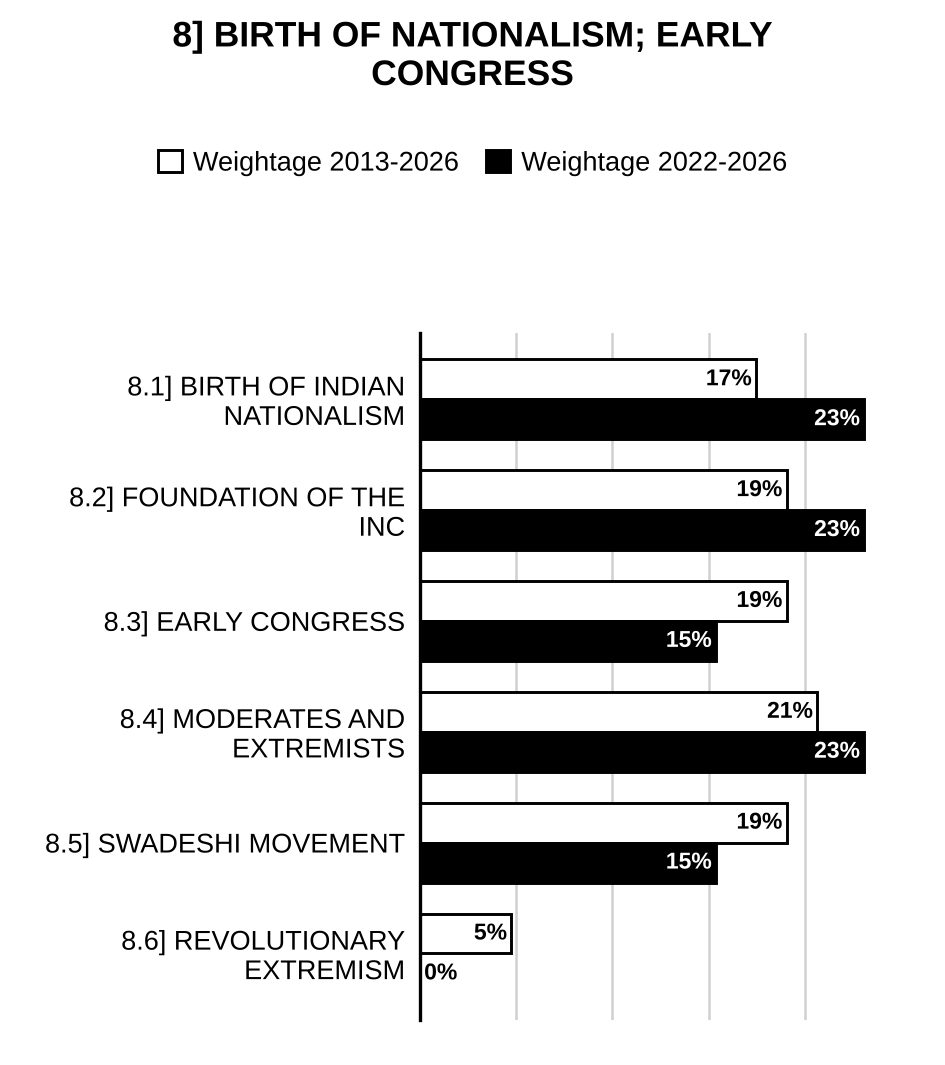
The earliest question here dates from 1996 and the latest from 2026; UPSC has drawn on this unit in 22 of the 32 years. In the last five years (2022–2026), 9 questions were set from it.
Official Syllabus
8. Birth of Indian Nationalism and the Early Congress: Factors leading to the birth of Indian Nationalism; Politics of Association; The Foundation of the Indian National Congress; The Safety-valve thesis relating to the birth of the Congress; Programme and objectives of Early Congress; the social composition of early Congress leadership; the Moderates and Extremists; The Partition of Bengal (1905); The Swadeshi Movement in Bengal; the economic and political aspects of Swadeshi Movement; The beginning of revolutionary extremism in India.
Source: UPSC Civil Services Examination 2026 notification. The notification gives no title for this unit; the short title used here is editorial.
Where this unit stands in Modern India
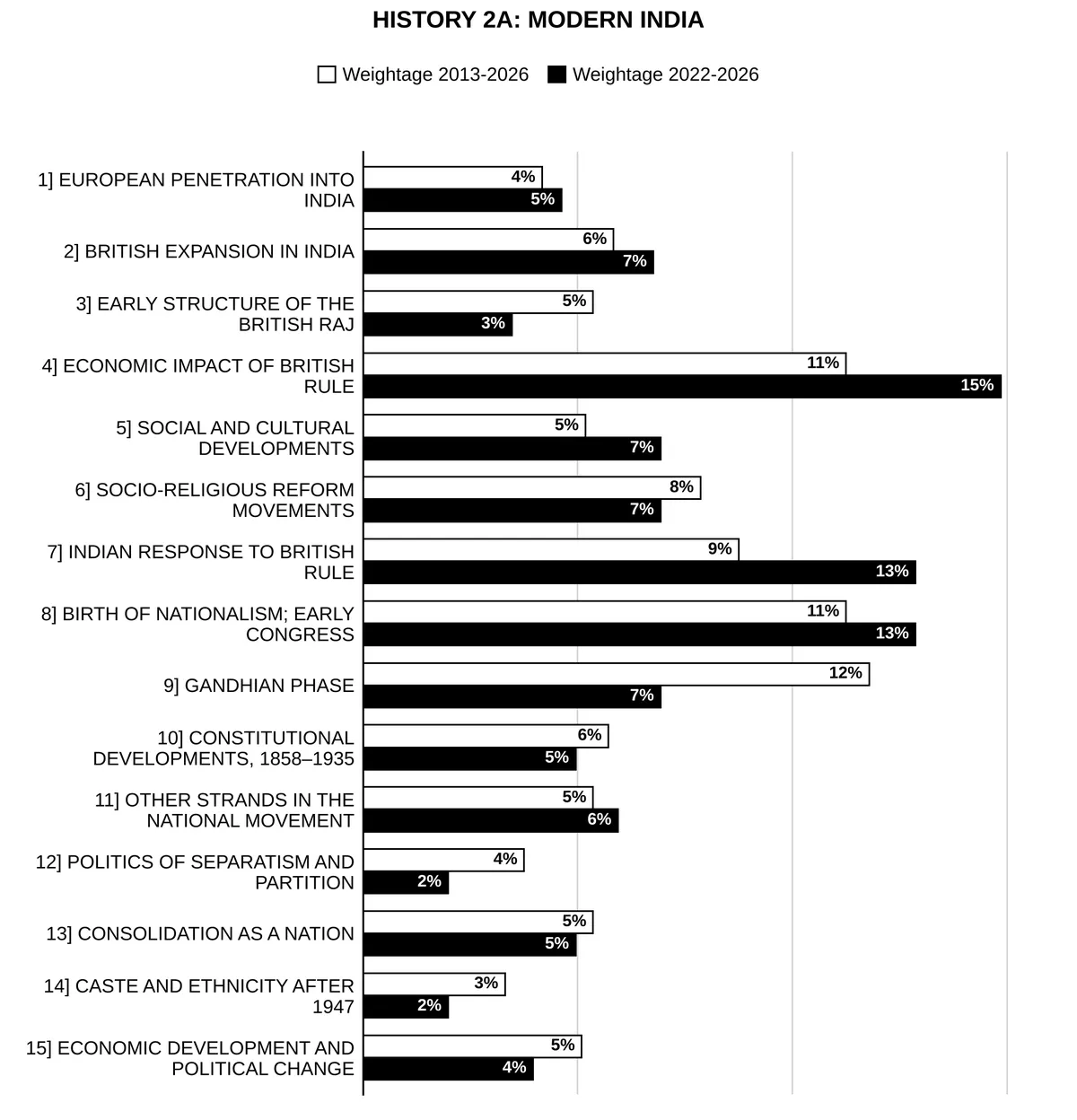
Birth of Indian Nationalism and the Early Congress accounted for about 13% of the marks asked in Modern India in 2022–2026, up from 11% over 2013–2026, ranking 2nd of the 15 units in the section by recent weightage.
How to use these PYQs
- Compare the questions with the official syllabus wording above – themes that recur across years deserve the deepest notes.
- Give priority to the recent questions (2013 onwards follow the present 250-mark paper pattern); use the pre-2013 questions to test your depth of content.
- Practise answers within the word limit shown in the question code (for example 150w or 250w) and under timed conditions, then revise them after a week.
Frequently Asked Questions
How many History Optional questions have been asked from Birth of Indian Nationalism and the Early Congress?
This collection lists 39 question entries from Birth of Indian Nationalism and the Early Congress (unit 8 of Paper 2) between 1996 and 2026, of which 34 are unique questions; the rest are listed under more than one sub-topic. They were asked in 22 of the 32 years and 9 came in 2022–2026.
When was Birth of Indian Nationalism and the Early Congress last asked in History Optional?
Most recently in 2026, with 3 questions (2026/10m/150w/1b, 2026/10m/150w/1e, 2026/10m/2c). Before that, it was asked in 2025.
Where can I find all History Optional PYQs topic-wise?
All units of Paper 1 and Paper 2, the map question and the earlier-syllabus questions are linked from History Optional PYQs Topic-wise (1995–2026).
« Previous: Indian Response to British Rule – History Optional PYQs (1995–2026)
Next: Gandhian Phase of the National Movement – History Optional PYQs (1995–2026) »
Back to: History Optional PYQs Topic-wise (1995–2026) | Also see: History Optional year-wise question papers (1995–2026)