
Every question in this collection of Revolution and Counter-Revolution History Optional PYQs (1995–2026) is given below with its year, marks and question number. It is unit 21 of Paper 2, Section B – World History, with 46 questions, the latest from 2026.
Revolution and Counter-Revolution – History Optional PYQs (1995–2026)
21.1] 19th century European revolutions
1. “The July Revolution of 1830 marked a significant turning point in the advancement of liberalism and constitutionalism in France.” Analyse. [2026/10m/150w/5e]
2. Critically examine: “The Revolutions of 1848 were shaped by the ideas of democracy and nationalism.” [2023/10m/150w/5c]
3. What were the causes and consequences of the revolutionary upsurge of the 1840s in Europe? [2021/20m/6b]
4. “The 1848 revolutions frightened the crowned heads of Europe and caused several to abdicate. Those who remained were cognizant of the threats posed by liberalism, nationalism and socialism.” Comment. [2020/10m/6c]
5. Do you subscribe to the view that the Greek War of Independence was mired in contrasts of the best and the worst episodes? How did it affect the Concert of Europe? [2019/20m/8a]
6. Discuss how agrarian crisis accompanied by severe industrial depression triggered the Revolutions of 1848. [2017/10m/6c]
7. What is Metternich system? Assess its impact on Europe. [2016/10m/150w/5b]
8. Critically examine: “The whole episode that is known as the July Revolution (1830) was fought and won not for the establishment of an extreme democracy but to get rid of the aristocratic and clericalist attitude of the restored Bourbons.” [2015/10m/150w/5c]
9. “The language of narrow nationalism held at Frankfurt destroyed the German Revolution; as the fatal idea of aggrandisement of the House of Savoy destroyed the Italian Revolution.” Discuss. [2014/20m/8b]
10. Comment on: “Most of the European Revolutions of 1848 were nationalist as well as popular insurrections against foreign rule and repressive policy of Metternich.” [2008/20m/200w/5b]

Preparing for Prelims too?
Our UPSC Prelims Topic-wise PYQ eBook covers every Prelims question with detailed explanations, so you can see exactly where UPSC asks from.
View the BookDownload Free Sample21.2] The Russian Revolution of 1917–1921
1. Lenin was the brilliant strategist of the socialist revolution. Substantiate. [2026/20m/7b]
2. Revolutions, whether in Russia (1917) or in China (1949), are a disastrous way of transforming a country. Comment. [2021/10m/7c]
3. How did Stalin build on Lenin’s legacy of Bolshevik Revolution and introduce new elements of totalitarianism to transform USSR as a superpower? [2020/20m/8a]
4. Examine the statement that “the danger of ‘Bolshevism’ dominated not only the history of the years immediately following the Russian Revolution of 1917 but the entire history of the world since that date”. [2017/20m/7a]
5. How did Lenin achieve an abrupt transition from a Monarchical autocratic to a Socialist State? [2016/20m/7a]
6. Critically examine: “If the 1917 Bolshevik Revolution in Russia (that resulted in the creation of the Union of Soviet Socialist Republics or Soviet Union) inaugurated an international competition for the hearts and minds of people all over the globe, the Chinese Revolution raised the stakes of that struggle.” [2013/10m/150w/5d]
7. “The impact of the French Revolution (1789) was initially confined to Europe, but, that of the Russian Revolution (1917) was global.” — Critically review. [2012/30m/6a]
8. Account for the overthrow of the Tsarist regime in Russia. [2009/30m/8a]
9. Comment on: ‘The Russian Revolution (1917) was an economic explosion hastened by the stupidities of the autocratic Government.’ [2005/20m/200w/5d]
10. Examine the causes of the Russian Revolution of 1917 and indicate its significance in world history. [2003/60m/7]
11. “Stalinist Russia was a despotic regime.” Critically examine this view. [1999/60m/7]
12. In Russia, Lenin was “the father of socialism, organizer of the revolution and the founder of the new Russian society.” Examine the statement. [1998/60m/8]
21.3] Fascist Counter-Revolution, Italy and Germany
1. “The Acerbo law played a crucial role in strengthening Mussolini’s hold on power by undermining democratic institutions in Italy.” Examine. [2026/20m/8a]
2. “By the time of 1932 elections, Germany’s ruling classes began to feel that the only way to escape from a deep economic crisis was to hand over political power to a totalitarian agency.” Explain. [2025/20m/7a]
3. The social and political landscape of Europe after the first world war was uniquely suited to the rise of Fascism. Discuss. [2024/20m/6b]
4. Discuss how Fascism was a response to the post-war situation arising out of political instability, thwarted nationalist hopes and fears of the spread of communism? [2022/20m/6b]
5. Examine the circumstances which led to the overthrow of democracy and the establishment of Fascist dictatorship in Italy. [2017/20m/8a]
6. Discuss the main characteristics of Fascism. [2007/60m/7]
7. Comment on: “A clever conqueror will always impose his demands on the conquered by instalments.” [2006/20m/200w/5d]
8. What were the weaknesses and difficulties of the Weimar Republic? How did Hitler succeed in establishing his dictatorship? [2004/60m/7]
9. Comment on: ‘The roots of the rise of Fascism lay in Peace Treaties.’ [2003/20m/200w/5b]
10. Trace the rise and growth of the New European Society in the inter-war period. [1999/60m/6]
11. Trace the growth of militarism in Japan in the inter-war years. What international reaction did it provoke? [1997/60m/8]
12. Comment on: “There was an element of system in Hitler’s foreign policy. His outlook was continental.” [1995/20m/200w/5d]
13. “Corporate State” was Mussolini’s answer to socio-political problems of his country. Elucidate. [1995/60m/8]
21.4] The Chinese Revolution of 1949
1. Critically examine: The new regime in China addressed the peasant question by instituting wholesale land redistribution, which was carried out swiftly and ruthlessly. [2024/10m/150w/5d]
2. Revolutions, whether in Russia (1917) or in China (1949), are a disastrous way of transforming a country. Comment. [2021/10m/7c]
3. In the Chinese Revolution of 1949, the elements of communism and nationalism were discernible. Explain the statement in the light of Mao’s strategy which was different from that of Lenin. [2018/20m/8a]
4. “The failure of Kuomintang against the communist onslaught was unimaginable and it was Mao Tse-tung whose tenacity and innovative approach had accomplished the unthinkable.” Discuss. [2015/20m/7b]
5. Critically examine: “If the 1917 Bolshevik Revolution in Russia (that resulted in the creation of the Union of Soviet Socialist Republics or Soviet Union) inaugurated an international competition for the hearts and minds of people all over the globe, the Chinese Revolution raised the stakes of that struggle.” [2013/10m/150w/5d]
6. “The announcement of the creation of the Peoples’ Republic of China on October 1, 1949 by Mao Zedong ended the civil war between the Chinese Communist Party (CCP) and the Nationalist Party (KMT).” — Elaborate. [2012/30m/8a]
7. Critically evaluate: “All long marches begin with small steps.” [2010/20m/200w/5b]
8. Critically analyse the causes and results of the Chinese Revolution of 1949. [2006/60m/7]
9. Discuss the circumstances leading to the Chinese Revolution of 1949 and analyse its significance. [2005/60m/7]
10. Examine the circumstances in China in the years 1945–49. What did the United States do to resolve the conflict between the Nationalists and the Communists there? [2002/60m/7]
11. Comment on: With the proclamation in Nanking of a Chinese Republic with Sun-Yat-Sen as the President in 1911, “the old China wilted rapidly.” [1999/20m/200w/5d]
Summary of Revolution and Counter-Revolution PYQs (1995–2026)
| Total questions (1995–2026) | 46 (44 unique – a few questions are listed under more than one sub-topic) |
| Total marks asked | 1260 (unique questions) |
| Questions in last 5 years (2022–2026) | 8 |
| Most recent year asked | 2026 |
| Sub-topics | 4 (21.1 to 21.4) |
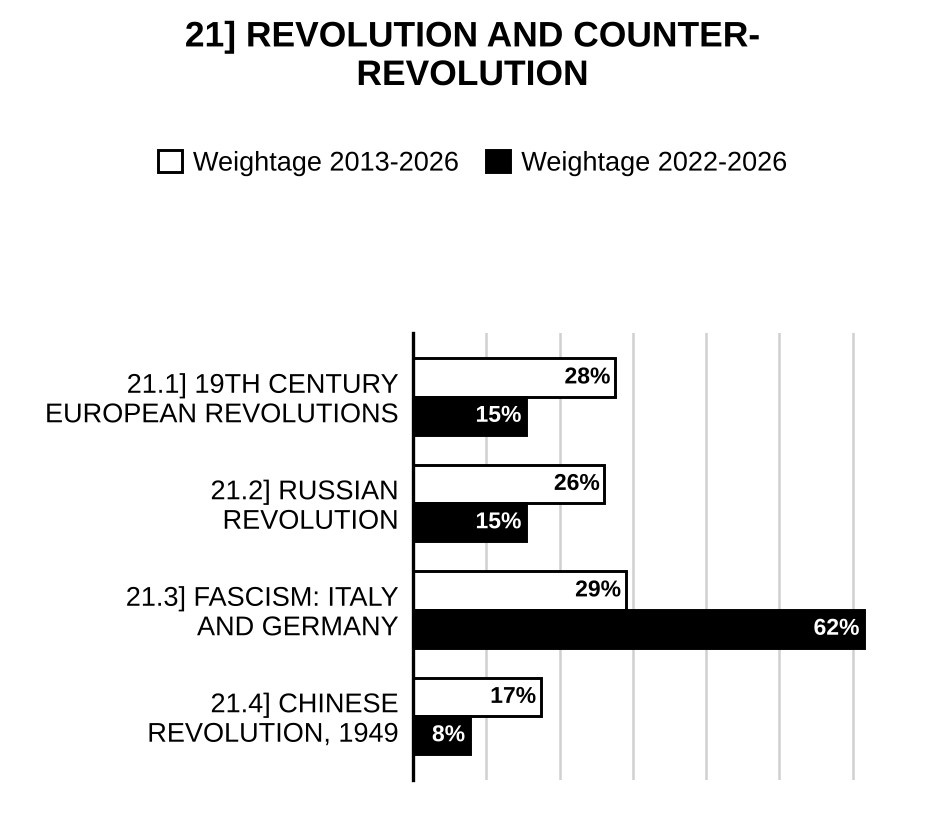
The earliest question here dates from 1995 and the latest from 2026; UPSC has drawn on this unit in 28 of the 32 years. In the last five years (2022–2026), 8 questions were set from it.
Official Syllabus
21. Revolution and Counter-Revolution
- (i) 19th Century European revolutions.
- (ii) The Russian Revolution of 1917–1921.
- (iii) Fascist Counter-Revolution, Italy and Germany.
- (iv) The Chinese Revolution of 1949.
Source: UPSC Civil Services Examination 2026 notification.
Where this unit stands in World History
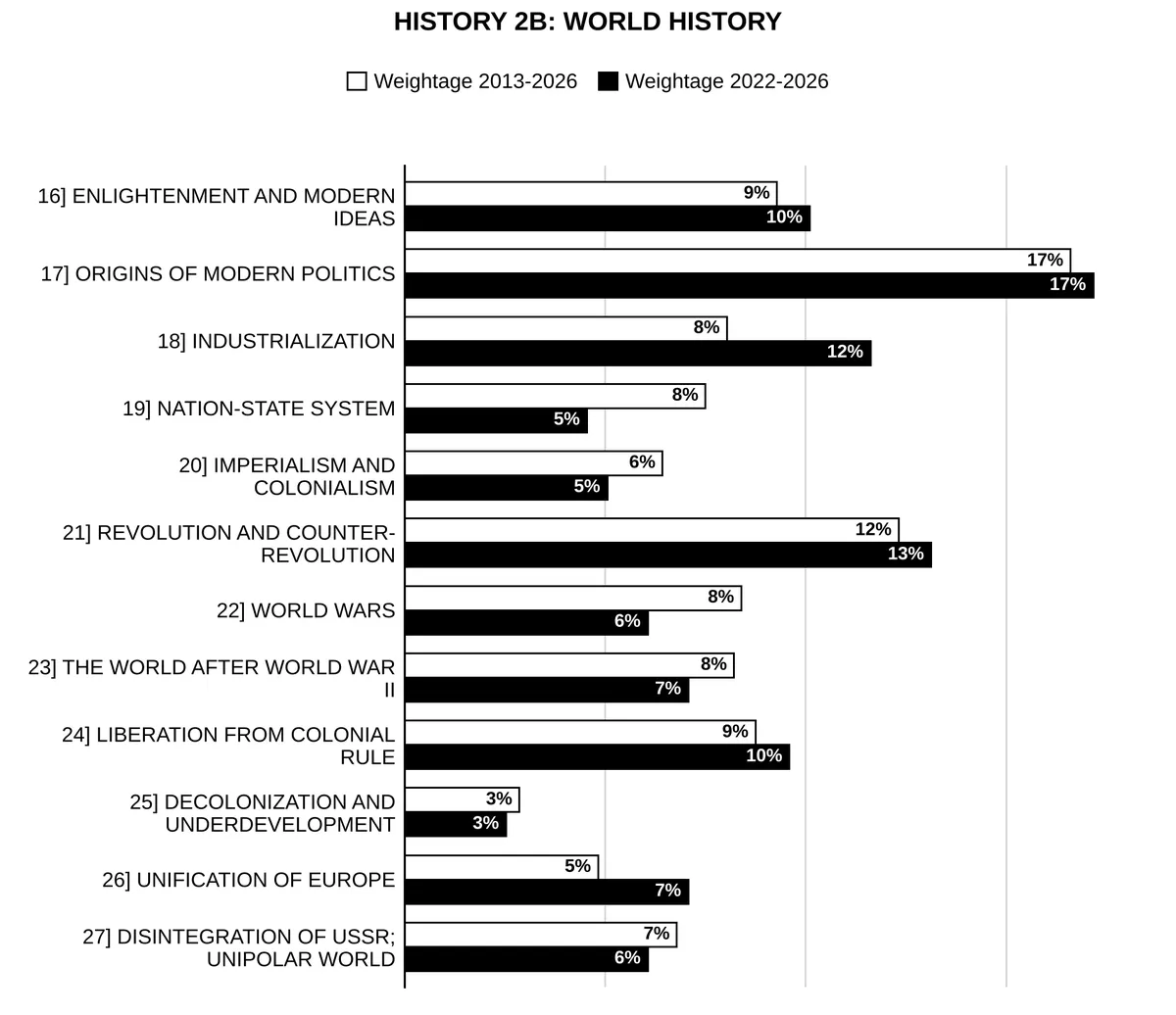
Revolution and Counter-Revolution accounted for about 13% of the marks asked in World History in 2022–2026, up from 12% over 2013–2026, ranking 2nd of the 12 units in the section by recent weightage.
How to use these PYQs
- Map every question to a phrase of the official syllabus shown above; recurring phrases show where UPSC’s interest lies.
- Start with the latest questions at the top of each list to see how UPSC frames this unit today; the older 60-mark questions are still useful for depth and content.
- Write timed answers to a few questions every week, keeping to the marks and word limit in each code, and revisit questions you found difficult.
Frequently Asked Questions
How many History Optional questions have been asked from Revolution and Counter-Revolution?
This collection lists 46 question entries from Revolution and Counter-Revolution (unit 21 of Paper 2) between 1995 and 2026, of which 44 are unique questions; the rest are listed under more than one sub-topic. They were asked in 28 of the 32 years and 8 came in 2022–2026.
When was Revolution and Counter-Revolution last asked in History Optional?
Most recently in 2026, with 3 questions (2026/10m/150w/5e, 2026/20m/7b, 2026/20m/8a). Before that, it was asked in 2025.
Where can I find all History Optional PYQs topic-wise?
All units of Paper 1 and Paper 2, the map question and the earlier-syllabus questions are linked from History Optional PYQs Topic-wise (1995–2026).
« Previous: Imperialism and Colonialism – History Optional PYQs (1995–2026)
Next: World Wars – History Optional PYQs (1995–2026) »
Back to: History Optional PYQs Topic-wise (1995–2026) | Also see: History Optional year-wise question papers (1995–2026)