
This page brings together all Disintegration of Soviet Union and Rise of the Unipolar World History Optional PYQs asked in UPSC Civil Services Mains from 1995 to 2026, arranged topic-wise.
Disintegration of Soviet Union and Rise of the Unipolar World – History Optional PYQs (1995–2026)
27.1] Factors leading to the collapse of Soviet Communism and Soviet Union, 1985–1991
1. Discuss critically the salient features of Mikhail Gorbachev’s domestic reforms. [2025/20m/7b]
2. Discuss, how the policies adopted by Mikhail Gorbachev were responsible for the disintegration of the USSR? [2022/20m/7b]
3. Review the policy of Glasnost adopted by Gorbachev. [2018/10m/8c]
4. “By 1980s, the Communist System of Soviet Union was incapable of maintaining the country’s role as a Superpower.” Substantiate. [2017/20m/8b]
5. “By the 1980s, the Communist system of the Soviet Union was incapable of maintaining the country’s role as a Superpower.” Elucidate. [2013/25m/7b]
6. Critically evaluate: “The essence of Perestroika is for people to feel they are the country’s master.” — Gorbachev. [2010/20m/200w/5c]
7. “By the 1980s, the Communist system of the Soviet Union was incapable of maintaining the country’s role as a Superpower.” Explain this statement. [2007/60m/8]
8. Analyse the factors for the collapse of Soviet Communism and Soviet Union during 1985–1991. [2004/60m/8]
9. Discuss the main factors leading to the collapse of the Soviet Union. [2002/60m/8]
27.2] Political changes in East Europe 1989–2001
1. Critically examine: The revolutions of 1989 did not simply destroy governments; they also ended an ideology. [2024/10m/150w/5e]
2. Critically examine: “The collapse of Berlin Wall on 9 November, 1989 brought new meaning to the idea of cooperation in Europe.” [2017/10m/150w/5e]
3. In what way did the political changes in Soviet Union influence the events in Eastern Europe during the closing decades of the 20th century? [2016/20m/8b]
4. Critically evaluate: “The collapse of Berlin Wall in 1989 brought new ideas of co-operation in Europe.” [2011/20m/200w/5c]
5. Examine the challenges confronted by the proponents of European unity after the collapse of Soviet Empire in Eastern Europe. [2011/30m/8b]
6. Assess the significance of the political developments that took place in Eastern Europe during 1989–2001. [2008/60m/8]

Preparing for Prelims too?
Our UPSC Prelims Topic-wise PYQ eBook covers every Prelims question with detailed explanations, so you can see exactly where UPSC asks from.
View the BookDownload Free Sample27.3] End of the Cold War and US ascendancy in the world as the lone superpower
1. Critically examine: “The supremacy of USA after the end of Cold War had its challenges as well.” [2023/10m/150w/5e]
2. The impact of the end of the Cold War and the emergence of the US as the lone superpower has been both, good and bad. Discuss. [2021/20m/8b]
3. A new configuration of power emerged in world politics after the end of the cold war. Analyse how USA managed to become the sole superpower. [2020/20m/8b]
4. What factors contributed to the emergence of a unipolar world? [2016/10m/150w/5e]
5. Critically examine: “With the Cold War over and the Soviet Union gone, the face of international diplomacy has undergone a metamorphosis.” [2012/12m/150w/5e]
6. Account for the factors that brought about the end of the Cold War. [2008/60m/7]
7. Analyse the factors leading to the end of the Cold war and account for the U.S. ascendancy in the world. [2003/60m/8]
Summary of Disintegration of Soviet Union and Rise of the Unipolar World PYQs (1995–2026)
| Total questions (1995–2026) | 22 |
| Total marks asked | 637 |
| Questions in last 5 years (2022–2026) | 4 |
| Most recent year asked | 2025 |
| Sub-topics | 3 (27.1 to 27.3) |
The earliest question here dates from 2002 and the latest from 2025; UPSC has drawn on this unit in 18 of the 32 years. In the last five years (2022–2026), 4 questions were set from it.
Official Syllabus
27. Disintegration of Soviet Union and the Rise of the Unipolar World
- (i) Factors leading to the collapse of Soviet Communism and Soviet Union, 1985–1991.
- (ii) Political Changes in East Europe 1989–2001.
- (iii) End of the Cold War and US Ascendancy in the World as the lone superpower.
Source: UPSC Civil Services Examination 2026 notification.
Where this unit stands in World History
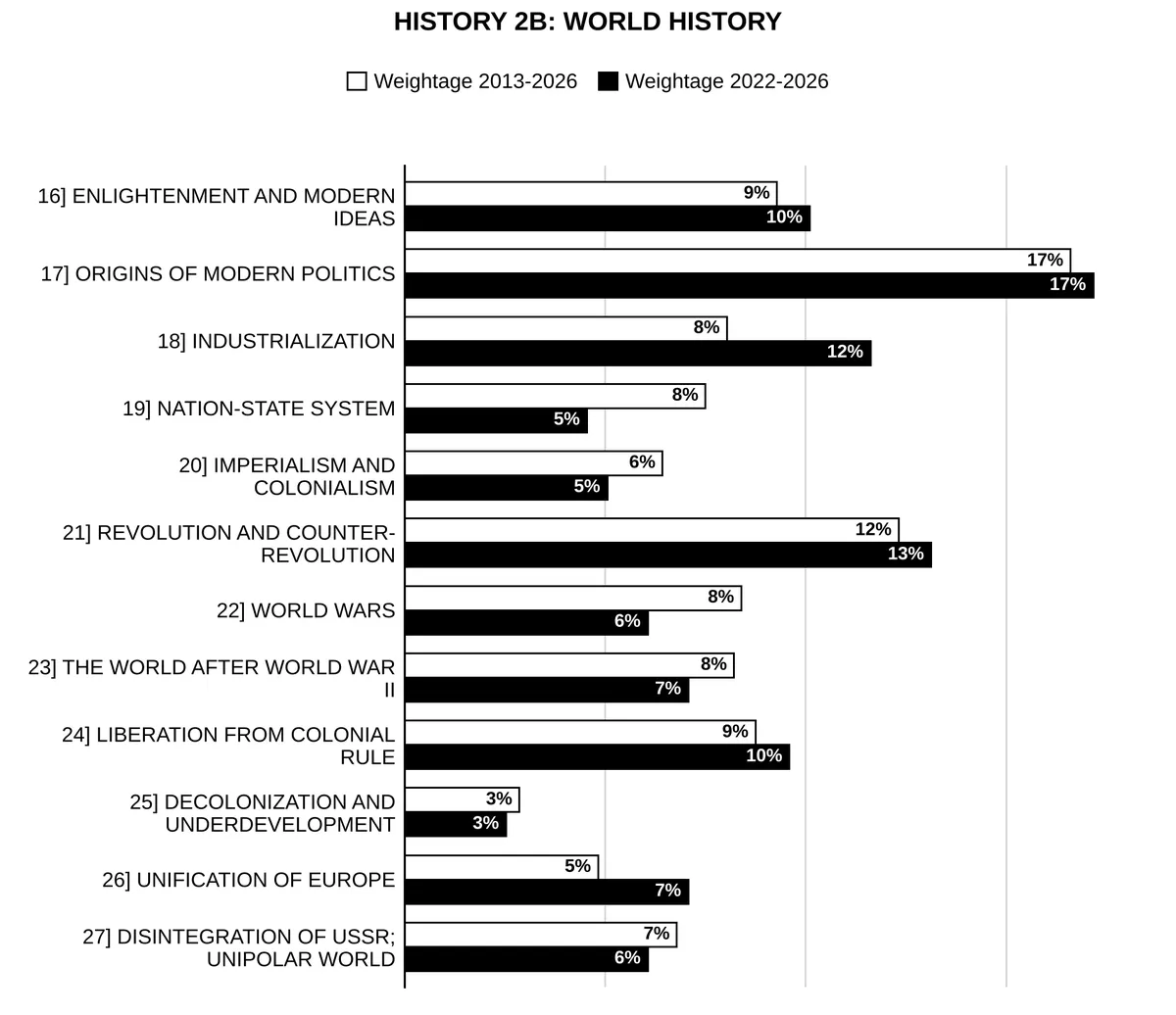
Disintegration of Soviet Union and Rise of the Unipolar World accounted for about 6% of the marks asked in World History in 2022–2026, down from 7% over 2013–2026, ranking 8th of the 12 units in the section by recent weightage.
How to use these PYQs
- Map every question to a phrase of the official syllabus shown above; recurring phrases show where UPSC’s interest lies.
- Start with the latest questions at the top of each list to see how UPSC frames this unit today; the older 60-mark questions are still useful for depth and content.
- Write timed answers to a few questions every week, keeping to the marks and word limit in each code, and revisit questions you found difficult.
Frequently Asked Questions
How many History Optional questions have been asked from Disintegration of Soviet Union and Rise of the Unipolar World?
This collection lists 22 question entries from Disintegration of Soviet Union and Rise of the Unipolar World (unit 27 of Paper 2) between 2002 and 2025. They were asked in 18 of the 32 years and 4 came in 2022–2026.
When was Disintegration of Soviet Union and Rise of the Unipolar World last asked in History Optional?
Most recently in 2025, with 1 question (2025/20m/7b). Before that, it was asked in 2024.
Where can I find all History Optional PYQs topic-wise?
All units of Paper 1 and Paper 2, the map question and the earlier-syllabus questions are linked from History Optional PYQs Topic-wise (1995–2026).
« Previous: Unification of Europe – History Optional PYQs (1995–2026)
Next: History Optional Earlier Syllabus Questions (1995–2012) »
Back to: History Optional PYQs Topic-wise (1995–2026) | Also see: History Optional year-wise question papers (1995–2026)