
Here are all 267 Probability questions asked in UPSC Statistics Optional Paper I from 1995 to 2026, arranged under the 6 topics of the official syllabus. Within each topic the latest questions come first.
Each question ends with a code such as [2024/15m/3b] – the year, the marks, the word limit (where UPSC set one) and the question number in the paper.
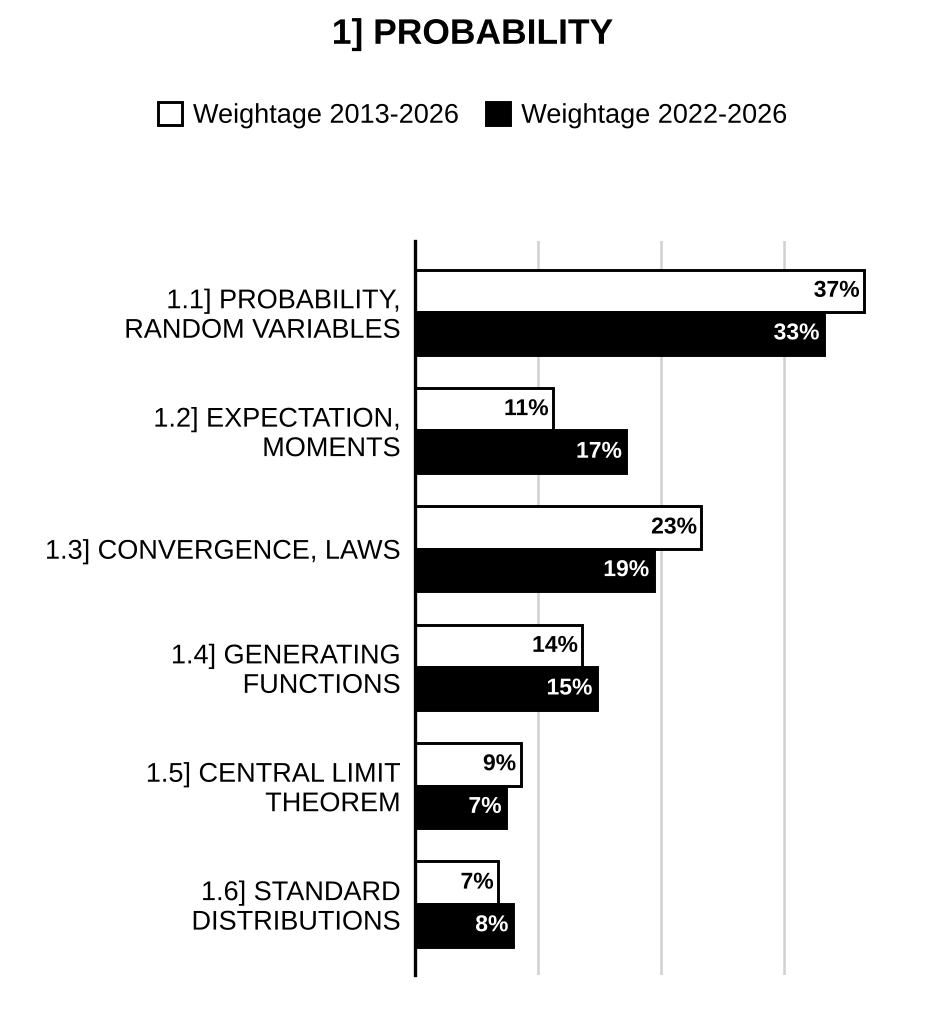
1.1] Probability spaces and random variables
105 questions
Show that for events [2026/7m/1a(i)]
For two mutually exclusive events and , show that [2026/3m/1a(ii)]
Let the joint probability mass function of and be Find– (i) the marginal probability mass functions of and ; (ii) . [2026/10m/1b]
The time required, in hours, to repair a car at a garage is a random variable with probability density function (p.d.f.) Find the value of . Obtain the probabilities that for a car which arrives now at the garage– (1) is at least one but less than three; (2) is more than two. [2026/9m/2b(i)]
Let be the probability density function of a continuous random variable . Write the cumulative distribution function of and find [2026/6m/2b(ii)]
Let follow uniform distribution on and let . Find the distribution of . [2026/5m/2c(i)]
Let , and be three pairwise independent events such that and . Prove that . [2025/10m/1a]
Let be a continuous random variable having probability density function Find the cumulative distribution function of and hence find probability density function of . [2025/20m/2a]
Let the joint probability density function of be Compute the following: (i) (ii) (iii) [2025/15m/2c]
Two events and are such that , and . Evaluate the following: [2024/5m/1a(i)]
[2024/5m/1a(ii)]
Suppose the joint probability function of two random variables and is Compute the following: [2024/5m/1b(i)]
[2024/5m/1b(ii)]
Out of 1000 persons born, only 900 reach the age of 15 years, and out of every 1000 who reach the age of 15 years, 950 reach the age of 50 years. Out of every 1000 who reach the age of 50 years, 40 die in one year. Accordingly, what is the probability that a person would attain the age of 51 years? [2023/10m/1a]
Let be a continuous random variable with probability density function: Obtain the cumulative distribution function of and hence find the value of . [2023/10m/1b]
Let be three mutually independent standard exponential variates and . Then (i) determine the joint distribution of and . (ii) find out the marginal probability density functions of and . (iii) examine the mutual independence of and , and give your comment. [2023/20m/2a]
In a certain recruitment test, there are multiple choice questions. There are four possible options to each question, out of which one is correct. The probability of knowing correct option for an intelligent student is 90%, while it is 20% for a weaker student. An intelligent student ticks the correct option. What is the probability that he was guessing? [2023/10m/3a(ii)]
An unbiased six-sided die is thrown twice. Let denote the smaller of the scores obtained. Then show that the probability mass function (p.m.f.) of is given by: [2022/10m/1c]
Each Sunday a fisherman visits one of three possible locations near his home: he goes to the sea with probability , to a river with probability , or to a lake with probability . If he goes to the sea there is an 80% chance that he will catch fish; corresponding figures for the river and the lake are 40% and 60% respectively. (i) Find the probability that, on a given Sunday, he catches fish. (ii) If, on a particular Sunday, he comes home without catching anything, determine the most likely place that he has been to. [2022/15m/2b]
An insurance company studies a sample of 150 policy-holders. There are three categories of policies: auto, home and medical. The following results are obtained about the policies held by the policy-holders: (i) 30 have only home insurance (ii) 10 have only medical insurance (iii) 98 have auto insurance, but not all three types of insurance (iv) 27 have medical insurance, but not all three types of insurance (v) 13 have auto and medical insurance Given that a policy-holder has medical insurance, calculate the probability that he has home insurance. [2021/10m/1b]
Let (i) Obtain the marginal distribution of and conditional distribution of given . (ii) Find . (iii) Use (ii) to find . [2021/15m/4b]
An insurer offers a health plan to the employees of a large company. As part of this plan, individually any employee may choose exactly two or none of the supplementary coverages A, B and C. The proportions of the company employees that choose coverage A, B and C are , and respectively. Determine the probability that a randomly chosen employee will choose no supplementary coverage. [2020/10m/1a]
Let and be iid random variables with . Find . [2020/10m/1b]
The random variable takes values on the interval . Given that , , , . Find . [2020/15m/2b]
Suppose a coin is tossed three times. If denotes the number of heads on first toss and is the total number of heads, then write down the probability distribution of . [2019/10m/1a]
(i) An accounts manager in a company classifies 75% of customers as ‘good credit’ and the rest as ‘risky credit’ depending on their ‘credit rating’. Customers in the ‘risky’ category allow their accounts to go overdue 50% of the time on average, whereas those in the ‘good’ category allow their accounts to become overdue only 10% of the time. What percentage of overdue accounts are held by customers in the ‘risky credit’ category? (ii) Suppose that two chess players played games and it was seen that the probability that Player I would win is 0.30, the probability that Player II would win is 0.45, and the probability that the game would end in a draw is 0.25. If these two chess players played 10 games, find the probability that Player I wins 6 games, Player II wins 2 games, and the remaining 2 games would be drawn. [2019/15m/3c]
A random variable has the following probability function:
| Value of | 0 | 1 | 2 | 3 | ||
| 0.15 | 0.25 | 0.35 |
(i) Find the value of . (ii) Obtain the distribution function and draw its graph. [2019/15m/4b]
We have a bag with 3 coins in it. One of them is a fair coin, but the others are biased trick coins. When flipped the three coins come up ‘heads’ with probability 0.5, 0.6, 0.1 respectively. If one of these coins is picked at random and flipped three times, (i) What is ? (ii) Assuming that occurred, what is the probability of having chosen a fair coin? Here denote Heads and Tails respectively. [2018/10m/1a]
Consider two independent and identically distributed uniform random variables. Derive the distribution of . Comment on . [2018/10m/1c]
The joint density of , is Find the marginal distributions of , and the conditional distribution of given . [2018/20m/2a]
Ten percent of a certain population suffer from a serious disease. Two independent tests are given to a person suspected of the disease. Each test gives a correct diagnosis 90% of the time. Find the probability that the person really suffers from the disease, given that– (i) both tests are positive; (ii) only one test is positive. [2017/10m/1a]
Let be a continuous random variable with the probability density function Find the cumulative distribution function and the probability density function of . [2017/10m/1b]
In a community of potential voters, are for abortion and are against it. Suppose that a vote is taken to determine the will of the majority with regard to legalizing abortion. If random persons of these potential voters do not vote, what is the probability that those against abortion will win? [2017/15m/2c]
is the time that a customer takes from getting on line at a service desk in a bank to completion of service and is the time to wait in line before reaching the service desk . The joint probability density function of is given by Let and . Find the joint probability density function of and . Are and independently distributed? Give reason. [2017/20m/3a]
Let and be independent and identically distributed random variables each having probability density function Find the cumulative distribution function and probability density function of . [2017/15m/3b]
Let be a probability distribution function of a discrete random variable. Prove that the functions and are also probability distribution functions. [2016/10m/1b]
What is the probability of an even number of successes in independent Bernoulli trials? [2016/15m/2a]
You bought a box of lightbulbs from a shop. You know that the bulbs are all either short-life bulbs with a mean life of 500 hours or long-life bulbs with a mean life of 2500 hours, but you cannot tell which, because there was no label on the box. As you have not shopped at this shop before, you initially have no opinion as to whether you have been sold long-life bulbs or the cheaper alternative. After approximately 300 hours you find that 5 bulbs are alive. Assuming that the life of an individual lightbulb has an exponential distribution, how would you now assess the probability that you bought long-life bulbs? [2016/20m/2b]
Let the probability that a family has exactly children be . Assume that a child can be a boy or a girl with equal probability. (i) Obtain the probability that a family has exactly boys. (ii) Given that a family has at least one boy, what is the probability that there are two or more children in that family? [2015/10m/1a]
Let be the cumulative distribution function (cdf) given by Find the set of discontinuity points of and express as a mixture of its discrete and continuous parts. [2015/20m/4a]
If for the events and , and then show that , if and only if . Likewise, , if and only if . [2014/10m/1a]
Three digits 1, 2 and 3 are written down in random order. What is the probability that at least one digit will occupy its proper place? [2014/10m/1b]
In the course of an experiment with a particular brand of DDT on flies, it is found that 80% are killed in the first application. Those which survive develop a resistance, so that the percentage of survivors killed in any later application is half that in the preceding application. Thus 40% of the survivors of the first application would succumb to the second, 20% of the survivors of the first two applications would succumb to the third, and so on. Find the probability that (i) a fly will survive four applications. (ii) it will survive four applications, given that it has survived the first one. [2013/10m/1a]
The joint distribution of two random variables and has the pdf Derive the marginal distribution of and the conditional distribution of given . [2013/10m/1b]
A tyre manufacturing company has three production units , and which produce respectively 50%, 30% and 20% of the entire production. Unit is known to produce 5% defectives, unit produces 3% defectives and unit produces 1% defectives. What percentage of items in the entire produce is defective? If an item is found to be defective, what is the probability that it was produced at unit ? [2012/12m/1a]
A bivariate random vector is specified by Obtain (i) the p.d.f. (ii) the marginal p.d.f’s and (iii) the conditional p.d.f’s. When will and be independent? [2012/12m/1b]
Of the under-5 children in a locality, 20% are malnourished but not immunised, while 40% are immunised but not malnourished. If 30% are neither immunised nor malnourished, what percentage of the under-5 children of the locality are malnourished? [2011/12m/1a]
For a discrete random variable Find the probability mass function of . [2011/12m/1b]
Suppose every packet of the biscuit NICE contains a coupon bearing one of the letters N, I, C or E with equal probability. A customer who has all the four letters, wins a free packet. A housewife buys 8 such packets. What is the probability that she wins (i) one free packet and (ii) two free packets? [2011/12m/1c]
The joint probability density function of is given by Compute (i) , (ii) and (iii) . Also derive the regression equation of on . [2011/20m/3c]
5% residents of a locality are earning more than Rs 10 lakhs per annum. The percentage of single earner in the family among those earning more than Rs 10 lakhs per annum is 80%, whereas percentage of single earner among others (earning less than Rs 10 lakhs per annum) is 50%. A randomly selected resident of that locality was found to be single earner. What is the probability that he earns more than Rs 10 lakhs per annum? [2010/12m/1a]
is a triangle in plane with vertices , and . Let denote the area of intersection of and the set . Does define a cumulative distribution function? If yes, find the joint probability density function. [2010/12m/1b]
Two players and decide to play a series of at most 7 games. A player who wins 4 games wins the series. If both the players have equal chance of winning a game and wins the first two games, what is the probability that will win the series? [2010/12m/1c]
Cumulative distribution function (c.d.f.) of a random variable is Find such that we can write , where and are c.d.f. of continuous and discrete random variables respectively. Find and . [2010/20m/2a]
The joint probability density function of random variables and is given as Comment on independence and correlation between and . [2010/20m/2b]
The joint probability density function of and is Derive the distribution of . [2010/20m/3a]
and are i.i.d. random variables with common probability mass function Obtain the probability distribution of . Also derive . [2009/20m/2a]
In every box of a certain cereal is a picture of a football player. A full set is represented by m players. Find the probability that n (> m) boxes of cereal must be purchased to obtain a full set of pictures. [2007/12m/1a]
A random variable X has the following distribution:
| 0 | 0 |
| 1 | |
| 2 | |
| 3 | |
| 4 | |
| 5 | |
| 6 | |
| 7 |
Find k and determine the distribution function of X. [2007/12m/1b]
Let (X, Y) be a two-dimensional non-negative continuous random variable having the joint density Derive the density function of [2007/20m/2c]
Given that A, B, C are events with A and C mutually exclusive, B and C independent and , , & , calculate: (i) (ii) [?] (iii) (iv) [2006/12m/1a]
Independent trials consisting in rolling of two fair dice are performed. What is the probability that an outcome of 5 appears before an outcome of 7, where the outcome of a roll is the sum of the dice? [2006/12m/1c]
Let X, Y, Z be independent and uniformly distributed over (0, 1). Compute . [2006/20m/2b]
An unbiased coin is tossed three times. Write down the sample space of this experiment. Define a random variable on this sample space and also its probability distribution. [2005/12m/1a]
The random variables are distributed independently with p.d.f. Determine the probability [2005/12m/1b]
are random samples from a uniform distribution over (0, 1). Find the p.d.f. of . [2005/20m/2c]
Let X be an absolutely continuous random variable with p.d.f. and distribution function . Show that has distribution. [2004/12m/1a]
Let X be a random variable with p.m.f. , , , , . Obtain the distribution of . [2004/12m/1c]
For the three mutually exclusive events A, B, C, the following probabilities are given , , . Calculate and comment about result. [2003/12m/1a]
State the properties of the probability density function of a random variable X. Examine whether the following f(x) is a probability density function. Also evaluate : Where is a constant. [2003/12m/1c]
The joint probability density function of two random variables X and Y is Find (i) and (ii) Marginal distributions of X and Y. [2003/20m/2b]
Let X be a random variable having standard Cauchy’s distribution. Obtain the probability density function of and identify the resulting distribution. [2003/20m/2c]
If and , then show that [2002/12m/1a]
Let be i.i.d. geometric random variables with parameter p. Show that the p.m.f. of the smallest order statistic is also geometric with parameter [2002/20m/2a]
Choose the correct answer for (i), (ii) and (iv) and answer (iii). (i) A, B and C are three arbitrary events. The expression for the event that “only A occurs” in terms of A, B, C is (ii) A coin is tossed three times in succession. If A is an event that there are at least two heads and B is the event that 1st throw gives head, the probability is………………. [1/8, 5/8, 3/8] (iii) State Neyman-Pearson Lemma for testing a simple hypothesis against a simple alternative. (iv) An estimate based on a sample of size n is called an asymptotically unbiased estimate of if……… ……. [2001/12m/1a]
Match X with Y:
| X | Y |
| (i) Random experiment | (a) Characteristic function |
| (ii) Sufficient | (b) Non-parametric method |
| (iii) Inversion theorem | (c) Probability theory |
| (iv) Kolmogorov test for goodness of fit | (d) Estimate |
[2001/12m/1b]
Supply the missing word(s) (i) If A and B are independent events then the conditional probability is equal to………….. (ii) If , then the binomial distribution is …………….. (iii) If a hypothesis specifies the value of all the parameters of a density function, it is called ……………. (iv) Methods which are not concerned with testing or estimating the parameters of a density function of a given type are called…………. [2001/12m/1c]
A random experiment consists in taking two balls out of a bag containing 3 white and 2 black balls. Write down the corresponding sample space, enumerating all the elementary events and their probabilities. [2001/15m/2i]
A bag contains four red and six black balls. One ball is taken out a random, without noting its colour. A second ball is then taken out of the remaining balls in the bag at random and found to be black. What is the conditional probability that the first ball taken out was also black? [2001/15m/3iii]
State and prove Baye’s theorem. [1999/20m/1a]
An urn contains r red and w white balls, k balls are drawn from the urn and kept aside without noticing their colour. From the remaining balls one ball is drawn. What is the probability that it is red? [1999/15m/1b]
Let F be the distribution function of a random variable X. Show that F can have at most countably many discontinuities. [1999/25m/1c]
An urn contains 5 white and 3 black balls, a second urn contains 6 white and 5 black balls. A ball is randomly transferred from the first urn to the second and then from the second to first urn. If a ball is now selected randomly from the first urn, find the probability that it is white. [1998/15m/1a]
Describe a priori probabilities, likelihoods and posterior probabilities in defining the Bayes theorem. Explain why, in spite of its easy deductibility from the postulates of probability, it has been the subject of such extensive controversy. [1998/10m/1b]
A sportsman’s chance of shooting an animal at a distance is . He fires when and if he misses he reloads and fires when . If he misses at distance nr, the animal escapes. Calculate the odds against the sportsman. [1998/15m/1c]
(i) For n events show that (ii) If p be the probability that none of the n events occurs, then [1998/20m/1d]
Let X and Y be jointly distributed with p.d.f. Find marginals conditional distributions and correlation coefficient. [1998/20m/2b]
If the probability of hitting a target is and if 6 shots are fired, what is the conditional probability of the target being hit at least twice assuming that at least one hit is already scored? [1998/10m/2c(ii)]
Do the following functions define distribution functions of random variables? [1998/10m/4a(i)]
Justify your answer in each case. [1998/10m/4a(ii)]
A postman delivers 5 letters at random to 5 different addresses in a locality. What is the probability that none of the letters is correctly delivered? [1997/15m/1a]
A certain water-supply system consists of three pumping stations and a destination. Each pumping station has probability of being operable at a specified time . If the stations are operable or failed independently of one another and if the stations are connected as shown below, find the probability that water is available to the destination at time .
[Figure: network diagram. Source (dot with arrow) on the left feeds a vertical junction line from which three parallel paths run left to right towards a vertical junction line on the right, which leads by an arrow to Destination. Top path: arrow to station 1 (circle labelled 1), then on to the right junction. Middle path: arrow from the source junction to station 3 (circle labelled 3); from station 3 two lines branch out, one going up to station 1 and one going down to station 2. Bottom path: arrow to station 2 (circle at the bottom, label partly hidden in the source; read as 2), then on to the right junction. Arrows on the right junction point from the top and bottom paths towards the Destination outlet. So water reaches the destination through station 1 or station 2; station 1 and station 2 are each fed either directly from the source or through station 3.] [1997/25m/1b]
State Bayes’ theorem and explain its significance. [1997/10m/1c]
A pair of fair dice are rolled as long as necessary for a sum of two scores of 7 to turn up. Assuming that 7 does not appear on the first throw, what is the probability that more than two throws will be necessary? [1997/10m/1d]
(i) For n events show that (ii) Let be a non-decreasing sequence of events. State that [1996/26m/1a]
An urn contains R red and W white balls. Balls are drawn one by one without replacement. If is the event that a red ball is drawn for the first time on the draw, then determine . Let p be the proportion of red balls in the urn before the first draw. Show that [1996/20m/1b]
Explain clearly why there must be a mistake in each of the following statements: (i) The probability that a student will get an ‘A’ in a statistics course is 0.32 and the probability that he or she will get either an ‘A’ or a ‘B’ is 0.27. (ii) A company is working on the construction of two shopping centers. The probability that the larger one will be completed on time is 0.35 and the probability that both will be completed on time is 0.42. [1996/14m/1c]
State and prove Bayes’ theorem. [1996/20m/2a]
If two random variables have the joint density find the probabilities that (i) both random variables will take on values less than 1. (ii) the sum of the values taken on by both will be less than 1. [1996/20m/2b]
What is a random experiment? Consider the random experiment “a die is rolled n times”. Define the associated sample space and state the number of elementary events in it. What is the event that “number 1 shows at least once”? How many elementary events are there in this event? [1995/25m/1a]
A fair die is rolled twice. Let A be the event that the first throw shows a number and B the event that the second throw shows at least 4. Describe the event and find . [1995/15m/1b]
A point is picked at random from the unit square . Find the probability that the point (i) lies in the circle with centre and radius , (ii) lies at most a unit distance from the origin (0, 0). [1995/20m/1c]
When is a random variable said to be of the discrete type? What is the pmf of such a random variable? Define the corresponding distribution function. Give an example of such a random variable. [1995/20m/2a]
Let (X, Y) be jointly distributed with pdf Find all the marginal and conditional density functions. [1995/20m/2b]
Do the following functions define distribution functions of random variables? (i) (ii) [?] Justify your answer in each case. [1995/16m/3c]
1.2] Expectation and moments
24 questions
Let the joint probability density function of and be Find– (i) the marginal probability density functions of and ; (ii) and ; (iii) and ; (iv) covariance between and ; (v) correlation coefficient between and . [2026/20m/3a]
The joint probability mass function of two random variables be Evaluate the following: (i) , (ii) , (iii) [2025/15m/2b]
Let probability of obtaining Head on a biased coin be and be the number of heads obtained in a sequence of 25 independent tosses of the coin. The same coin is tossed again number of times independently and we obtain heads. Compute . [2025/20m/3a]
If have the joint probability density function then find the regression curve of on and comment on the nature of the curve. [2025/8m/6a(ii)]
Let the joint probability density function of two random variables and be Compute the following: [2024/10m/2a(i)]
[2024/10m/2a(ii)]
Let and be independent random variables with exponential distribution having respective means and , . Find . [2022/10m/1a]
Let and be independent and identically distributed exponential random variables with mean . Define Find . [2021/10m/1c]
Let (i) Obtain the marginal distribution of and conditional distribution of given . (ii) Find . (iii) Use (ii) to find . [2021/15m/4b]
Let uniform distribution. Define . Find . [2020/15m/3b]
If the random variable follows normal distribution , then find the expectation of , where and denote the cumulative distribution function and probability density function respectively of , the standard normal distribution. [2017/15m/4b]
A box contains tickets numbered 1 to . A boy draws tickets from the box randomly. If be the numbers of tickets drawn, what is ? [2016/10m/1a]
For a continuous non-negative random variable with , show that for . where . Evaluate the conditional expectation for the exponential model specified by . [2012/20m/2b]
The joint probability density function of random variables and is given as Comment on independence and correlation between and . [2010/20m/2b]
2 sets of cards, both numbered from 1 to , are randomly matched. Find and where is the number of matches realised. [2009/12m/1b]
The daily demand (in kg) of fish of a certain variety upto 12 noon with a retailer follows exponential law with mean 25. He makes a profit of Rs. 20 on an average for each kg he is able to sell by 12 noon, and incurs a loss of Rs. 10 on an average for each kg that remains unsold after 12 noon. What is the optimum daily stock he should procure? [2009/20m/4a]
(i) Obtain the mean and the variance of the exponential distribution. (ii) Write down the reproductive property of the Poisson distribution. (iii) If x and y have unit variances and correlation 0.4, find the correlation between and (iv) When is a statistic called the best unbiased estimate of a parameter? [2001/12m/1e]
Define expectation of a random variable (r.v.). Show that if X is a non-negative r.v. with distribution function F then provided the expectation exists. [2000/8m/2a(i)]
If X is an integer-valued random variable, prove that . Prove the corresponding result for a non-negative continuous random variable. [1999/25m/3a]
A man with n keys wants to open his door and tries the keys independently and at random. Only one key fits the door. Find the mean and variance of the number of trials required to open the door if unsuccessful keys are not eliminated from further selections. [1999/15m/3b]
(i) What is the relationship between standard deviation and mean deviation of the data 11, 15, 19 and 23 [?]? (ii) if X and Y are symmetric show that [1998/10m/2a]
Let X and Y be jointly distributed with p.d.f. Find marginals conditional distributions and correlation coefficient. [1998/20m/2b]
Let X and Y be jointly distributed with pdf Find the correlation coefficient between X and Y. [1997/20m/2a]
An urn contains 3 red and 2 white balls. A random sample of two balls is drawn with replacement. Let if the first ball drawn is white and if the first ball drawn is red. Let if the second ball drawn is white and if the second ball drawn is red. Find the conditional expectation . [1995/20m/2c]
1.3] Convergence and laws of large numbers
57 questions
A random variable has the probability density function where is a positive integer. Using Chebyshev’s inequality, show that [2026/10m/1c]
Let be a sequence of independent random variables such that Check whether the weak law of large numbers (WLLN) holds for this sequence or not. [2026/5m/2c(ii)]
Let is a sequence of independent and identically distributed random variables with mean and variance , and assume . Show that WLLN does not hold for sequence of random variables. [2024/10m/1c]
Let be iid variates. Find the limiting distribution of [2024/15m/2c]
Let be a sequence of mutually independent random variables such that , for any . Derive the condition on under which the sequence obeys WLLNs. [2023/10m/1c]
Give an example to prove or disapprove the following: for any sequence of events defined on a probability space . [2023/15m/2b]
Let be a sequence of random variables and be a degenerate random variable. Examine whether ‘ converges in distribution to ’ implies ‘ converges in probability to ’. [2023/15m/2c]
If is a random variable with finite variance, show that [2023/10m/3a(i)]
(i) How large a sample must be taken in order that the probability will be at least 0.90 that the sample mean will be within 0.4 – neighbourhood of the population mean, provided the population standard deviation is 2? (ii) Examine whether the weak law of large numbers holds for the sequence of independent random variables defined as follows: [2022/15m/3a]
Let be independent and identical random variables. Determine if the following sequences converge in probability: (i) (ii) [2021/15m/3b]
For a geometric distribution , show that Chebyshev’s inequality gives , while the actual probability is . [2020/10m/1c]
.
(i) Obtain characteristic function of uniform distribution . [2020/5m/4b(i)]
(ii) Let be a sequence of independent random variables such that Show that converges in law to a uniform distribution. State the result you have used. [2020/10m/4b(ii)]
Prove that if and only if . [2019/10m/1b]
Let be a sequence of random variables and . Prove that a necessary and sufficient condition for the sequence to satisfy the weak law of large numbers is that [2018/15m/3b]
(i) Let be equal to the total obtained in tosses of a symmetric die. Estimate an upper bound for (ii) Let have the density function, for , Check whether converges to zero in probability. [2018/15m/3c]
If , , then show that (i) (ii) (iii) , provided . [2018/20m/4a]
Let be a sequence of independent and identically distributed random variables with common probability function Check whether obeys the (i) strong law of large numbers and (ii) weak law of large numbers. [2017/10m/1c]
State and prove Chebyshev’s inequality. Hence or otherwise, prove that (i) and (ii) , if is any positive random variable having both mean and variance equal to . [2017/15m/2b]
Consider a sequence of random variables , where , . Does the sequence of distribution functions converge to a distribution function? [2016/15m/4c]
Define convergence in distribution and in mean. Let be a sequence of independent random variables such that Show that in distribution. [2015/10m/1b]
The probability density function of a random variable is given by Find the probability that will take on a value within two standard deviations of the mean () and compare it with the lower bound provided by the Chebychev’s Inequality. [2014/20m/2a]
For a random variable with probability density function where is an integer, show that [2014/15m/2b]
Define convergence in probability and convergence in distribution of a sequence of random variables. Show that convergence of to in probability implies convergence of to in distribution. Is the converse also true? [2014/15m/3c]
State the strong law of large numbers. Decide whether the strong law of large numbers holds for the sequence of mutually independent random variables with distribution [2013/15m/4b]
Show that for a sequence of random variables , convergence in probability implies convergence in distribution. Is the converse true? Substantiate your answer. [2012/20m/2c]
For the sequence of random variables and Check if the sequence obeys the weak law of large numbers and the central limit theorem. [2011/20m/4a]
Explain convergence in th mean and convergence almost sure. Check various modes of the convergence for , where ’s are independently distributed as follows: where and [2010/20m/3b]
State (without proof) Tchebychev’s inequality. How many times a fair coin must be tossed in order that the relative proportion of heads lie between 0·4 and 0·6 with probability at least 0·9? (Upper 5% and 10% points of standard normal variate are 1·645 and 1·282 respectively.) [2009/12m/1c]
Explain, with one illustration of each, convergence in distribution and convergence in probability for a sequence of random variables. State the relation between these two. [2007/12m/1c]
Examine if WLLN and CLT hold for the sequence of mutually independent random variables , where [2007/20m/2b]
Define various modes of convergence of a sequence of random variables. Prove that convergence almost surely implies convergence in probability. [2006/20m/2c]
State and prove Chebyshev’s inequality. The random variable X takes values with probabilities 1/8, 3/4, 1/8 respectively. Compute and compare it with Chebyshev’s bound. [2005/20m/2b]
Let be i.i.d. random variables with common p.d.f. Show that the weak law of large numbers holds for the sequence. [2004/12m/1b]
If X is any non-negative integer valued variate and ‘a’ is any positive number, show that and verify the inequality when X follows Poisson distribution with parameter. [2004/20m/2a]
Let be a sequence of distribution functions defined by Does converge in distribution to X? If so, identify the distribution function of X. Also, examine whether For any k as . [2004/20m/2b]
State the conditions for the existence of weak law of large numbers. Examine whether weak law of large numbers holds for the mean of a sequence of independent variates X with [2003/20m/2a]
Let be a sequence of random variables with p.m.f. . Show that . [2002/12m/1b]
State the Weak Law of Large Numbers and write necessary and sufficient conditions for its validity. [2001/15m/3ii]
Define convergence in probability (P), convergence in mean and convergence in distribution (D). Show that convergence in e mean implies convergence in probability and convergence in probability implies convergence in distribution. [2000/12m/2a(ii)]
Explain the concept of strong and weak laws of large numbers. State and prove Khintchin’s WLLN. [2000/12m/2b(ii)]
Explain the concept of Central Limit Theorems (CLT). Let be a sequence of uniformly distributed random variables over . Test whether SLLN, WLLN and CLT hold for . [2000/16m/2c]
State and prove Borel-Cantelli lemma. [1999/20m/2c]
Define convergence in distribution and convergence in probability for a sequence of random variables. State possible inter-relations and illustrate. [1999/20m/4a]
is a sequence of independent random variables with where . Prove that the law of large numbers holds for this sequence if . [1999/20m/4c]
State and prove Kolmogorov’s inequalities and explain its uses. [1998/20m/3a]
Verify the following: (i) (ii) [1998/20m/3b]
State and prove the Borel-Cantelli lemma and express its significance. [1998/20m/3c]
Explain central limit theorem and weak law of large numbers for a sequence of i.i.d random variables. State Lindeberg-Levy theorem. [1998/20m/4c]
Suppose that the number of airplanes arriving at a certain airport in any 20-minute period obeys a Poisson probability law with mean 100. Determine lower bound for the probability that the number of airplanes arriving in a given 20-minute period will be between 80 and 120. [1997/16m/3a]
Examine whether the following sequences of independent r.v.’s obey the WLLN: (i) (ii) [1997/28m/3b]
State and prove Kolmogorovs inequality and explain its use. [1997/16m/3c]
Show that [1997/15m/4a]
State and prove Markov’s theorem for WLLN. [1996/20m/3a]
Verify the following: (i) (ii) , for some [1996/20m/3b]
(i) State Kolmogorov’s SLLN for a sequence of independent random variables. (ii) Verify whether the following sequence of independent random variables obey the SLLN: [1996/20m/3c]
State and prove the Borel-Cantelli lemma. [1995/28m/3a]
Verify whether the following sequences of independent random variables satisfy the WLLN: (i) , (ii) , [1995/16m/3b]

Preparing for Prelims too?
Our UPSC Prelims Topic-wise PYQ eBook covers every Prelims question with detailed explanations, so you can see exactly where UPSC asks from.
View the BookDownload Free Sample1.4] Generating and characteristic functions
38 questions
Find the moment generating function (m.g.f.) of a random variable with probability density function (p.d.f.) Using this m.g.f., find and . [2026/10m/2a(i)]
Let be the characteristic function of a random variable . Using the inversion formula, find the probability density function of . [2026/10m/2a(ii)]
If and are non-negative independent random variables and their joint moment generating function is given by ; , then show that . [2025/10m/1b]
Find the distribution function of random variable , for which the characteristic function is Also compute in terms of , where [2024/15m/2b]
Let moment generating function of random variable exist in the neighbourhood of zero and if then find the values of the following: [2024/10m/3a(i)]
; and [Use ]. [2024/10m/3a(ii)]
If is a random variable with characteristic function then obtain the corresponding probability density function. [2022/15m/3c]
(i) State the sufficient conditions for a function to be a characteristic function. (ii) Investigate if the following functions are characteristic functions: 1. 2. Justify your answer. [2021/15m/2c]
State inversion theorem on characteristic function. Hence, find the density function corresponding to the characteristic function [2020/15m/3c]
.
(i) Obtain characteristic function of uniform distribution . [2020/5m/4b(i)]
(ii) Let be a sequence of independent random variables such that Show that converges in law to a uniform distribution. State the result you have used. [2020/10m/4b(ii)]
Let be three independent random variables with common pdf Let . Find mgf of . Using mgf, find and . [2019/10m/1e]
How can you find out the discontinuity points of distribution of a random variable if the characteristic function is given to you? Hence find the c.d.f. of a random variable whose characteristic function is . [2015/20m/2a]
If denotes the characteristic function (ch.f.) of a random variable with distribution function , show that is a characteristic function. Hence find its corresponding distribution function. [2013/20m/2a]
For the Laplace distribution find the moment generating function. [2013/15m/2b]
A random variable has the probability density function Derive the expression for its characteristic function. [2011/20m/2a]
State (without proof) the inversion theorem relating to the characteristic function of a continuous random variable. Use this theorem to obtain the probability density function of a random variable having the characteristic function . [2011/20m/2b]
Define probability generating function (pgf) of a discrete random variable. Let be a random variable with p.m.f. Set and define . Show that , , where is the pgf of . [2009/20m/3a]
For the geometric distribution find the p.g.f. Hence find the mean and variance. [2007/20m/2a]
State Inversion theorem. Find the distribution to which the characteristic function corresponds. [2006/12m/1b]
For any integer-valued random variable X, show that where is the probability generating function of X. [2006/20m/2a]
Find the characteristic function of where X has the p.i.f. [2005/12m/1c]
The characteristic function of a random variable X is . Find the distribution of X. [2004/20m/2c]
Define characteristic function . State its properties. Examine whether the following relations are characteristic function: (i) (ii) [2003/12m/1b]
Show that, for any characteristic function , [2002/12m/1c]
Let X be a standard normal variate with p.d.f. Find the characteristic function of X. [2002/20m/2b]
Match X with Y:
| X | Y |
| (i) Random experiment | (a) Characteristic function |
| (ii) Sufficient | (b) Non-parametric method |
| (iii) Inversion theorem | (c) Probability theory |
| (iv) Kolmogorov test for goodness of fit | (d) Estimate |
[2001/12m/1b]
(i) Obtain the probability generating function of the Poisson distribution. (ii) Write the probability mass function of the negative binomial distribution. (iii) Define a Uniformly Most Powerful Test (UMPT). (iv) Write the expression for ASN function in sequential probability ratio test (SPRT). [2001/12m/1d]
Obtain the Moment Generating Function of the standard Normal distribution. [2001/15m/4iv]
Let be bivariate probability generating function (PGF) of (X, Y). Find the marginal PGF of X and Y. Find also the PGF of X + Y. Examine whether X and Y are independent. [2000/12m/1a]
Apply a suitable inversion theorem to obtain the probability density function of the random variable whose characteristic function is given by [2000/12m/1b]
State a necessary and sufficient condition for a function on a real line to be the characteristic function of a random variable. Prove that it is necessary. [2000/12m/2b(i)]
Show that a distribution is symmetric about the origin iff its characteristic function is real-valued and even. [1999/20m/3c]
Discuss discrete and continuous random variable with examples. Indicate the distributions for the flowing moment generating functions [1998/20m/2c(i)]
Let X be an integer-valued random variable with probability generating function (pgf) . If , where a and b are non-negative integers, then find the pgf of Y. Hence obtain and . [1997/20m/2c]
Define the probability generating function of a random variable. Find the pgf of a geometric distribution and hence find its mean and variance. [1996/20m/4a]
State the properties of a characteristic function and show that it is uniformly continuous. [1996/15m/4b]
Define the characteristic function of a random variable. Determine the characteristic function of a Poisson variable. Are the following functions characteristic functions? (i) (ii) (iii) for all t. [1995/20m/4a]
State the condition when the moment sequence of a random variable defines a unique distribution. A random variable X has moments about origin given by , where . Show that the pdf is given by . [1995/20m/4b]
1.5] Central limit theorem
18 questions
A manufacturer produces items with mean weight 100 g and variance 16 g. For a sample of 64 items, find , using central limit theorem (CLT). is the sample mean of 64 items. [2026/5m/2c(iii)]
If be a sequence of i.i.d. random variables, then find the value of [use , , ]. [2025/10m/1c]
Determine whether the sequence of mutually independent random variables , in which obeys Central Limit Theorem (CLT) or not. [2023/15m/3b]
Using Central Limit Theorem, show that [2022/10m/1b]
Let be independent and identical Poisson random variables with parameter 1. Use central limit theorem to establish for large value of positive integer . [2021/20m/2a]
Show that every Bernoulli sequence of random variables obeys the central limit law. [2019/15m/2b]
Using central limit theorem, show that [2018/10m/1e]
If 20 random numbers are selected independently from the interval , what is the approximate probability that the sum of these numbers is at least 8? [2016/15m/2c]
Let be a Poisson , , . Use the Central Limit Theorem to find the smallest such that [2015/15m/2b]
Examine whether the central limit theorem holds for the sequence of random variables with [2012/12m/1c]
For the sequence of random variables and Check if the sequence obeys the weak law of large numbers and the central limit theorem. [2011/20m/4a]
Examine if WLLN and CLT hold for the sequence of mutually independent random variables , where [2007/20m/2b]
State Liapounov’s form of central limit theorem. Let be a sequence of independent Bernoulli variables with Show that obeys central limit theorem. [2002/20m/2c]
Explain the concept of Central Limit Theorems (CLT). Let be a sequence of uniformly distributed random variables over . Test whether SLLN, WLLN and CLT hold for . [2000/16m/2c]
State and prove Lindeberg-Levi central limit theorem. [1999/20m/4b]
Explain central limit theorem and weak law of large numbers for a sequence of i.i.d random variables. State Lindeberg-Levy theorem. [1998/20m/4c]
State the Lindeberg-Levy central limit theorem. If are i.i.d r.v.’s. with common pdf then find the asymptotic distribution of [1997/25m/4c]
State and prove the Lindeberg-Levy central limit theorem. [1996/25m/4c]
1.6] Standard distributions
25 questions
If follows bivariate normal , then obtain (A) (B) (C) and (D) Correlation between and . [2025/12m/6a(i)]
has bivariate normal distribution . Show that and are independent if and only if . [2024/6m/6a(i)]
If follows , obtain , given and , and represents the area under the standard normal curve from to . [2024/6m/6a(ii)]
If follows , what will be the distribution of ? [2024/4m/6a(iii)]
(i) Let the joint probability density function of and be where is a constant. Find and the correlation coefficient between and . (ii) If are independent random variables such that then obtain the value of . [2022/15m/4b]
Let the joint probability density function of and be where is a constant. Find: (i) and (ii) and (iii) Correlation between and . Also identify the distributions of and . [2019/15m/3b]
(i) An accounts manager in a company classifies 75% of customers as ‘good credit’ and the rest as ‘risky credit’ depending on their ‘credit rating’. Customers in the ‘risky’ category allow their accounts to go overdue 50% of the time on average, whereas those in the ‘good’ category allow their accounts to become overdue only 10% of the time. What percentage of overdue accounts are held by customers in the ‘risky credit’ category? (ii) Suppose that two chess players played games and it was seen that the probability that Player I would win is 0.30, the probability that Player II would win is 0.45, and the probability that the game would end in a draw is 0.25. If these two chess players played 10 games, find the probability that Player I wins 6 games, Player II wins 2 games, and the remaining 2 games would be drawn. [2019/15m/3c]
If and be two independent standard normal variables, show that the distribution of the ratio is Cauchy with probability density function [2016/10m/1c]
Let the probability function of and be Prove that . [2014/15m/4c]
Derive the regression equation of on , when and jointly follow trinomial distribution with parameters , and . Tube lights of a certain brand are graded as III, II or I according as they fail during the first 6000 hours and the next 6000 hours or survive the first 12000 hours respectively. 12 such new tube lights are put to life-testing simultaneously. 5 of them are found to be of grade III. How many of the remaining are expected to be of grade I? [2011/20m/8b]
In a two-tier competitive examination, only candidates with a minimum score of in the preliminary examination are allowed to sit for the main examination. The score distribution in the preliminary examination can be assumed to be normal with mean and s.d. . Derive the expressions for the mean and the variance of scores in the preliminary examination of the candidates sitting for the main examination. [2009/12m/1a]
For the Pareto distribution with distribution function derive the p.d.f. Also obtain its harmonic mean and variance. [2009/20m/4b]
The joint p.d.f. of and is given by Find the correlation coefficient between and , as also the regression equation of on . [2009/20m/7a]
X follows an exponential distribution with parameter . Prove the following relations: (i) (ii) [2005/20m/2a]
(i) Obtain the mean and the variance of the exponential distribution. (ii) Write down the reproductive property of the Poisson distribution. (iii) If x and y have unit variances and correlation 0.4, find the correlation between and (iv) When is a statistic called the best unbiased estimate of a parameter? [2001/12m/1e]
8 unbiased coins are tossed once. Find the probability that there are at least 7 heads. [2001/15m/2ii]
An unbiased coin is tossed till 3 heads are obtained. Find the expected value of the number of tosses. [2001/15m/3i]
Write the probability density function of Beta distribution of first kind. Find the value of its r-th moment about origin. [2001/15m/4iii]
Prove that [1999/20m/2a]
and are independent random variables with Poisson distribution. Find the conditional distribution of given . [1999/20m/2b]
Define negative binomial distribution and state its deductions. What will be the limiting distribution? [1998/20m/4b]
Let X be a binomial random variable with parameters n and p. If Y is a random variable defined by , find the probability function Y, and [1997/20m/2b]
Show that under certain conditions (to be precisely stated) the Poisson distribution tends to the normal distribution. [1997/20m/4b]
Show that under suitable conditions the binomial distribution approaches the Poisson distribution. [1996/20m/2c]
Give an example where a negative binomial distribution is appropriate. Give its pmf and determine the mean and variance of the distribution. [1995/20m/4c]

Strengthen your GS papers
Our UPSC Mains Topic-wise & Year-wise PYQ eBook (2013–2026) maps every GS question to the syllabus, so you know what UPSC asks and how often.
View the BookDownload Free SampleNext: Statistical Inference »
Back to: Statistics Optional PYQs – Topic-wise | Also see: Statistics Optional year-wise question papers
Last updated: 31 October 2026