
Here are all 98 Mining Geology questions asked in UPSC Geology Optional Paper II from 1995 to 2026, arranged under the 4 topics of the official syllabus. Within each topic the latest questions come first.
Each question ends with a code such as [2024/15m/3b] – the year, the marks, the word limit (where UPSC set one) and the question number in the paper.
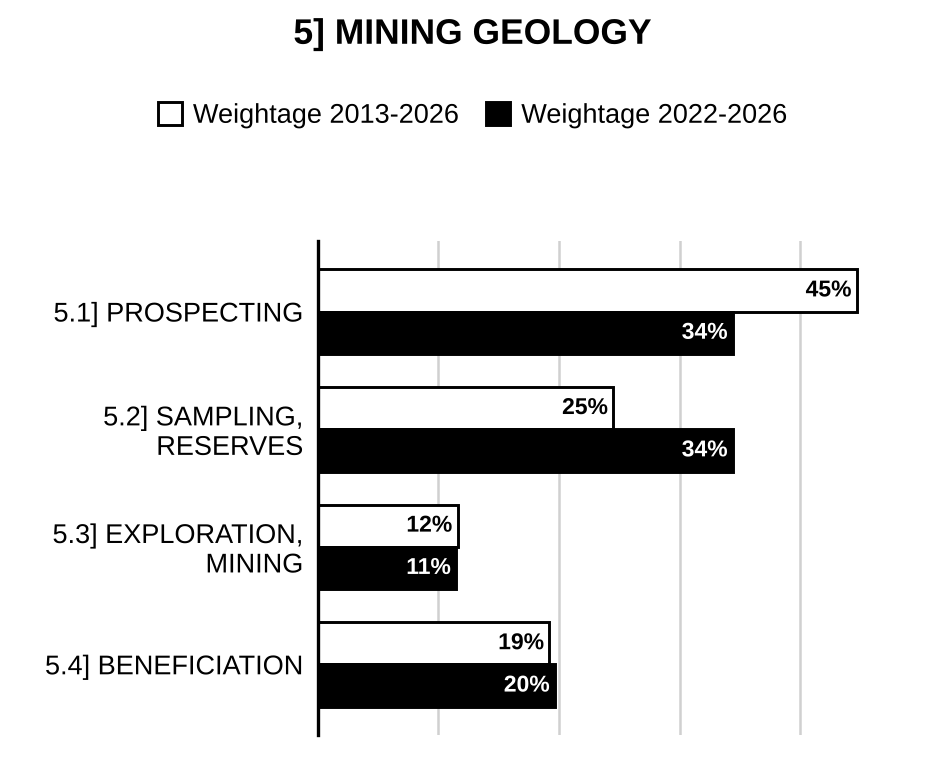
5.1] Prospecting
44 questions
Discuss the different types of prospecting methods used for locating metallic mineral deposits. [2026/10m/150w/5c]
What do you understand by ‘pathfinder’ elements? What are the elements/ions used in the prospecting of sulphides of epigenetic origin, porphyry copper deposit and sulphide deposits in general? [2025/10m/150w/5c]
Define gravitation. What are the corrections necessary to obtain the absolute value of gravity while using gravity method in mineral exploration? [2025/10m/150w/5d]
Discuss the direct and indirect geochemical methods used for prospecting of hydrocarbon deposits. [2025/20m/7a]
What are the physiological and morphological changes of the plants helpful in geobotanical prospecting of copper, manganese and uranium deposits? Add a note on commonly found plant indicators for zinc. [2025/15m/7b]
What is the difference between prospecting and exploration? Explain the various techniques of sampling. [2024/10m/150w/5c]
Give an account of external changes in flora due to the presence of anomalous concentration of base metal in a terrain. [2023/20m/7a]
How is geochemical anomaly recognised from frequency distribution plot of concentration of indicator elements in samples collected during a bedrock geochemical survey? [2022/15m/7c]
What are geophysical methods of exploration? How is gravity method useful in mapping the metallic ores? [2021/10m/150w/5c]
What are the factors which influence the mobility of elements in near-surface environment? How does understanding the mobility of elements help in choosing indicator elements for a geochemical exploration programme? [2020/20m/7a]
Explain the seismic methods of mineral prospecting. [2020/10m/7c]
What are the types of samples collected and analysed in geochemical exploration programmes? Which one of these samples is generally preferred and why is it preferred? [2018/10m/5c]
What are the surface manifestations of mineral deposits useful in mineral prospecting? [2018/10m/5d]
What is path-finder element in geochemical exploration? Explain the selection of path-finder elements and their application with suitable examples. [2018/20m/7a]
What are the field evidences of mineralization which can be useful in mineral prospecting? [2017/10m/5c]
What are the criteria based on which indicator elements are selected for geochemical exploration of mineral deposits? Describe any two methods of interpreting geochemical data for recognition of geochemical anomaly. [2017/20m/7a]
What are the common methods adopted for resistivity survey in an area? Describe briefly their field procedures and working principle. Also discuss advantages – disadvantages of the methods. [2016/20m/7a]
Briefly describe the principles and applications of self-potential and induced polarization methods of electrical prospecting. [2015/10m/5c]
Write a note on air-borne magnetic survey and its advantage over ground based magnetic survey. [2015/10m/6c]
Describe the methods of geochemical prospecting and the geological conditions in which these methods are adopted. [2015/15m/7c]
Describe the geochemical and geobotanical methods of prospecting and their applications. [2014/10m/5b]
“Gossans are the signboard of sulphide mineralization.” Justify the statement citing an example of Rajpur-Dariba areas of Rajasthan. [2014/15m/6a]
What are the common methods of resistivity survey? Discuss working principle and field procedures involved in resistivity survey. Comment briefly on advantages and disadvantages of various configurations. [2014/15m/7a]
With suitable examples, define indicator and pathfinder elements in geo-chemical prospecting. Discuss mobility of elements in near surface environment. [2013/20m/7b]
Compare and contrast the corrections used in gravity and magnetic methods of mineral prospecting. [2013/15m/7c]
Write on geophysical methods of exploration of oil deposits. [2012/12m/5c]
Comment on application of air-borne survey in mineral exploration. [2012/12m/5d]
Biogeochemical and geobotanical prospecting of sulphide minerals. [2011/10m/5e]
Self-potential and induced-potential methods of prospecting. [2011/10m/5f]
What are the different types of mineral deposits, where (i) Magnetic (ii) Self-potential (iii) Resistivity and (iv) Gravity methods of Geophysical prospecting are applied. [2010/15m/150w/5b]
Enumerate in detail hydrogeochemical and biogeochemical prospecting methods. How Pedogeochemical prospecting helps in prospecting mineral deposits? Add a note on geochemical sampling. [2010/30m/7b]
Enumerate the various corrections that are necessary for reduction of gravity field data in any exploration programme. [2009/20m/200w/5b]
With suitable examples, define indicator and pathfinder elements in geochemical prospecting. Discuss element mobility, as a result of various processes of dispersion. [2009/30m/7b]
Geobotanical method of Ore Prospecting. Add suitable Indian examples. [2007/20m/200w/5c]
Reflection and refraction seismic methods of ore body location. [2005/20m/200w/5c]
What is understood by Airborne Magnetic Survey? With the help of suitable diagrams, describe its utility as a suitable geophysical exploration method. [2005/60m/7]
Discuss the methods of geophysical prospecting defining their principle and parameters. Describe any one method and its applications. [2004/60m/7]
Describe the methods of geological prospecting giving their applications and limitations. Add a note on geobotanical prospecting methods. [2003/60m/7]
Describe the methods of geochemical prospecting. [2001/60m/7]
Exploration techniques applied to mineral deposits. [2000/20m/8b]
Guides for mineral search. [1999/20m/200w/5d]
Guides to ore deposits. [1996/20m/200w/5c]
Describe geophysical methods of exploration. [1996/60m/7]
Gossans. [1995/20m/200w/5a]
5.2] Sampling and reserve estimation
25 questions
A mineral deposit has an estimated volume of 2 million cubic metres. The average density of the ore is 2.5 tonnes per cubic metre. The average grade of the mineral is 3% Cu. Calculate the proven reserves in tonnes and the amount of copper in these reserves. [2026/15m/6c]
Describe Sampling. Add a note on common geological sampling methods. [2026/15m/7a]
Explain the ore reserve estimation procedure. How are the tonnage and grade of an ore deposit calculated? [2026/15m/7b]
What do you understand by ‘tonnage factor’? Discuss the geometric and graphic methods used in reserve calculation. [2025/15m/7c]
What is the difference between prospecting and exploration? Explain the various techniques of sampling. [2024/10m/150w/5c]
What is the difference between a sample and a specimen? [2024/5m/7a(i)]
Describe the classification of mineral reserves. [2024/5m/7a(ii)]
Explain the Kriging method for estimating ore reserve. [2023/10m/150w/5c]
In a bauxite exploration, 12 vertical boreholes were drilled in square grid pattern along 3 E-W traverses, at an interval of 100 m. Thickness of bauxite and assay value determined from borehole samples are given in the above table. Density of bauxite is . Calculate the tonnage and average grade of bauxite in the ore body by extended area method.
| Borehole No. | Thickness (m) | Assay (wt.% ) | Borehole No. | Thickness (m) | Assay (wt.% ) |
| 1 | 4.2 | 43.2 | 7 | 5.6 | 32.4 |
| 2 | 5.6 | 40.4 | 8 | 6.8 | 30.6 |
| 3 | 6.4 | 36.2 | 9 | 3.2 | 46.3 |
| 4 | 6.0 | 38.5 | 10 | 4.0 | 41.2 |
| 5 | 3.5 | 44.8 | 11 | 3.8 | 36.5 |
| 6 | 5.0 | 35.6 | 12 | 4.4 | 33.7 |
[2022/20m/7a]
Lead (Pb) mineralization zone is drawn in the given diagram with nomenclature. The related data is also provided in the table. Calculate the average grade of lead (Pb) in percentage.
[Figure: Sketch (Scale: 1″=10′) of a hatched, irregular, gently inclined tabular lead (Pb) mineralization zone of varying width, rising from lower left to upper right between two parallel straight lines. Four sample channels drawn as thick dark bands across the zone are labelled S–1, S–2, S–3 and S–4 from left to right. Below the zone, dimension arrows along the length mark the successive zones of influence L–1, L–2, L–3 and L–4 (L–4 extending to the right end of the zone).]
| Sample No. | Zone of Influence, L (ft) | Width, W (ft) | W × L (ft²) | % Pb |
| S–1 | 6.0 | 3.5 | 21.00 | 7.1 |
| S–2 | 7.5 | 2.5 | 18.75 | 7.5 |
| S–3 | 10.0 | 3.0 | 30.00 | 6.9 |
| S–4 | 12.5 | 3.5 | 43.75 | 8.9 |
[2021/10m/150w/5a]
A vein-type copper ore body trending E–W with 90° dip and having strike length of 150 m is exposed on the surface. Four trenches are made across the ore body at constant interval, including one trench each at E and W end of the ore body. Thickness of the ore body and assay value measured from the trenches are given in the table. Assuming that the ore body extends up to a depth of 50 m, and the specific gravity of the ore is 2.8, calculate the tonnage, grade and total copper content of the ore body.
| Trench number (E to W) | Thickness of ore body (m) | Assay (wt.% Cu) |
| 1 | 2.5 | 1.2 |
| 2 | 2.1 | 1.6 |
| 3 | 1.6 | 2.0 |
| 4 | 1.8 | 1.5 |
[2020/20m/7b]
What is meant by pitch and plunge of an ore body? Calculate average grade of a Pb-ore body from the given data: Sample 1 20 cm × 2.8% Pb Sample 2 40 cm × 2.5% Pb Sample 3 12 cm × 3.2% Pb Cut off grade is 2.4% Pb Minimum stopping width 1.0 m.
[Figure: Sketch of an ore body in section: a dome-shaped (arched) outline resting on a horizontal base line, divided by two parallel lines inclined to the right into three adjacent zones labelled 3 (left), 2 (middle) and 1 (right); the right flank of the ore body is steeper and its outline crosses the base line at the right end. No scale or other labels.] [2019/10m/5c]
Five trenches are made at 20 m interval perpendicular to the strike direction of an 80 m long NE-SW trending molybdenite mineralised vein. The width of vein (in m) and assay value of Mo (in wt. %) in each trench (from NE to SW) are listed below: Calculate the average grade (wt. % Mo) of the vein.
| Trench | Width | Assay |
| 1 | 0.6 | 0.20 |
| 2 | 1.8 | 0.35 |
| 3 | 2.4 | 0.14 |
| 4 | 1.5 | 0.18 |
| 5 | 0.4 | 0.12 |
[2018/10m/7c]
Describe different categories of ore reserves and their application in the Indian context. [2015/10m/7b]
Describe various estimation methods of ore reserves. [2014/10m/5c]
Briefly enumerate the various sampling methods in mineral exploration and mining. [2013/10m/5c]
Write short notes on: (i) Chondrite and tektite (ii) Duty and responsibility of sample collector in mineral prospection (iii) Mercury pollution. [2012/30m/6b]
Discuss about sampling techniques and various methods of ore-reserve estimation. [2011/15m/6d]
What is “Tenor” of an ore? What are “Assay Width” and “Average Width” of an ore body? State different methods of mine sampling. How does sampling help in determination of ore reserve? [2010/15m/150w/5a]
Describe different types of ‘Ore Reserves’ Write in detail two of most common methods of Estimation of Ore Reserves. Add a note on their advantages and disadvantages. [2007/60m/7]
In about 200 words each, write notes on any three of the following: Classification of reserves. [2006/20m/200w/5d]
Techniques of sampling. [2006/30m/7a]
In about 200 words each, write notes on any three of the following: Classification of resources and reserves of ore. [2004/20m/200w/5b]
In about 200 words each, write notes on any three of the following: Explain the techniques of sampling. [2002/20m/200w/5c]
In about 200 words each, write notes on any three of the following: Sampling techniques in the assessment of ore reserves. [2001/20m/200w/5c]

Preparing for Prelims too?
Our UPSC Prelims Topic-wise PYQ eBook covers every Prelims question with detailed explanations, so you can see exactly where UPSC asks from.
View the BookDownload Free Sample5.3] Exploration and mining methods
14 questions
What do you know about ‘Neyveli Lignite Mine’? Enumerate the methodology of mining and machinery under use in this mine, with neat sketches. [2024/20m/7c]
What are the drilling techniques adopted in mineral exploration? What is exploratory mining and its application? [2022/15m/7b]
Enumerate different types of mining methods. Discuss in detail coal mining methods. [2019/20m/7a]
Describe the geology of Neyveli lignite deposit and the unique problem in mining of this deposit. [2018/10m/5b]
Describe the objectives of detailed exploration stage of a mineral exploration programme. Add a note on exploratory mining and its application. [2017/20m/7b]
What are the methods of underground mining of mineral deposits? Add a note on impact of underground mining on ground surface and environment. [2015/15m/6d]
Sea-bed mineral resources and their mining. [2011/15m/8c]
Room and Pillar, and Long wall methods of Mining. [2007/20m/200w/5b]
Longwall mining of coal. [2006/30m/7b]
Give an account of the important methods of mining of metallic ores. [2002/30m/7a]
In about 200 words each, write notes on any three of the following: Shrinkage and sublevel stoping. [2000/20m/200w/5d]
Opencast mining. [1999/20m/200w/5c]
Open stopes. [1996/20m/200w/5d]
Mucking. [1995/20m/200w/5b]
5.4] Mineral beneficiation and ore dressing
15 questions
Explain the mineral beneficiation processes used in the enrichment of sulphide ore minerals. [2026/20m/7c]
What is the principle and nature of construction of Wilfley Table? Which mineral product is separated in tabling? [2024/15m/7b]
Explain the principle for flotation as a benefication technique. Name various parameters that regulate the flotation process. Explain frothing method giving appropriate examples. [2023/15m/7b]
A beneficiation plant processes 12000 ton of copper ore containing 0.8 wt.% Cu in a day and produces ore concentrate containing 25 wt.% Cu. Assuming 80% ore recovery in the beneficiation process, how many ton of ore concentrate will be produced by the plant in a day? [2022/10m/150w/5c]
Discuss various types of modifiers and their role in the froth flotation process. [2019/10m/7c]
Explain the process of mineral beneficiation by froth flotation and its application for sulphide ores. [2018/20m/7b]
Draw a typical flowchart of a mineral beneficiation process and briefly explain its components. [2017/10m/7c]
What are the gravity separation methods of ore beneficiation? Describe the process of heavy media separation of coal. [2015/15m/8b]
What do you understand by mineral beneficiation? How beneficiation of beach placer is useful for radioactive minerals? [2014/15m/7c]
Explain how ore concentrates are produced from run-off mine by mineral beneficiation, with the help of examples of two different beneficiation processes. [2013/15m/7a]
Role of pH during froth floatation of Cu-Pb-Zn sulphide ores. [2011/10m/5b]
In about 200 words each, write notes on any three of the following: Heavy media separation as ore-dressing process. [2003/20m/200w/5b]
Ore dressing. [1997/20m/200w/5d]
Magnetic methods of ore dressing. [1996/20m/200w/5a]
Gravity methods of ore dressing. [1995/20m/200w/5c]

Strengthen your GS papers
Our UPSC Mains Topic-wise & Year-wise PYQ eBook (2013–2026) maps every GS question to the syllabus, so you know what UPSC asks and how often.
View the BookDownload Free Sample« Previous: Economic Geology | Next: Geochemistry and Environmental Geology »
Back to: Geology Optional PYQs – Topic-wise | Also see: Geology Optional year-wise question papers
Last updated: 31 October 2026