
Here are all 145 Economic Geology questions asked in UPSC Geology Optional Paper II from 1995 to 2026, arranged under the 6 topics of the official syllabus. Within each topic the latest questions come first.
Each question ends with a code such as [2024/15m/3b] – the year, the marks, the word limit (where UPSC set one) and the question number in the paper.
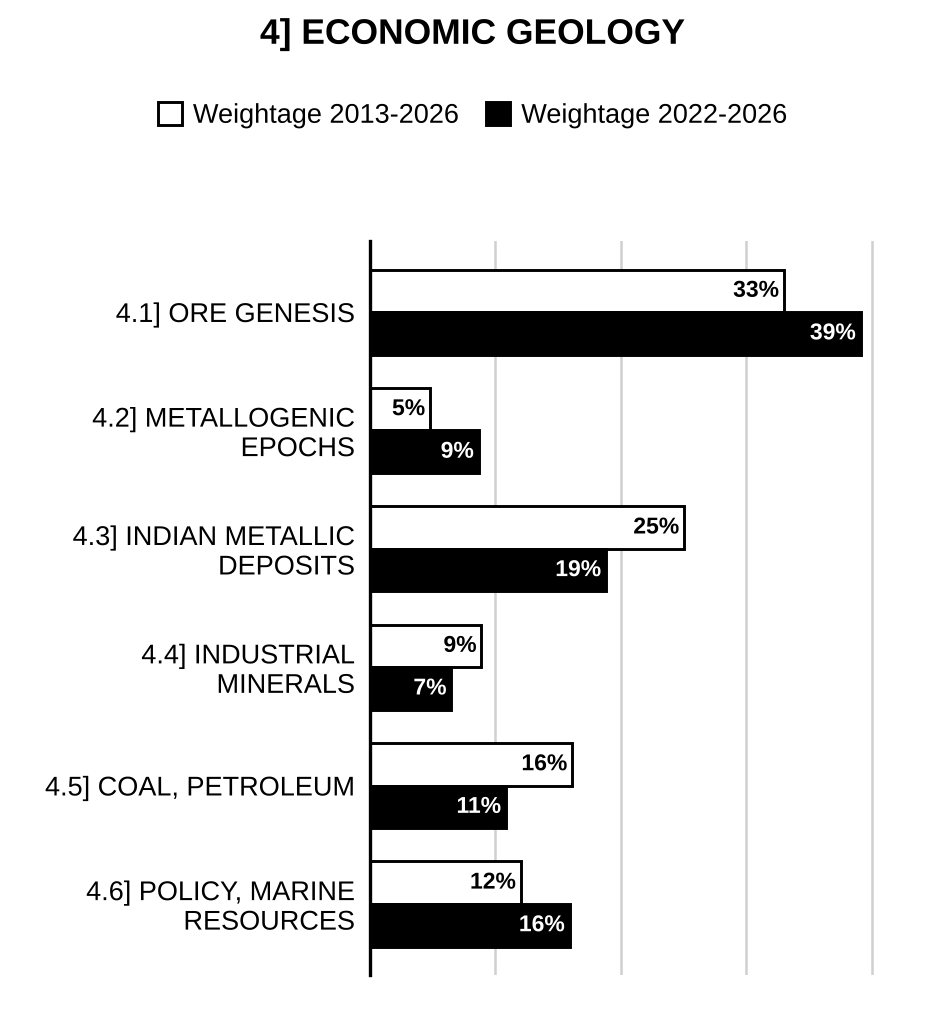
4.1] Ore genesis
50 questions
Explain the differences between ore, ore minerals and gangue, and discuss their significance in mineral processing. [2026/20m/6a]
How does the tenor of an ore influence its economic viability? What methods are used to determine it? [2026/15m/6b]
Give a brief account on the volcanogenic massive sulphide (VMS) deposit. Cite suitable Indian examples. [2025/20m/6c]
What are the Iron-Titanium oxides associated with igneous rocks? Add an account of their mineral associations and textures. [2024/10m/150w/5b]
Describe the classification of magmatic deposits and add a note on “late magmatic deposits”. [2024/20m/6c]
Describe the formation of replacement textures in ore minerals and give the criterion of their recognition. [2023/10m/150w/5b]
Discuss the late magmatic ore-forming processes. What are the salient field characters of such ore deposits? [2023/15m/6b]
Describe the origin of porphyry copper deposits. Give the geological setup of one porphyry copper deposit of India. [2023/15m/6c]
Explain the processes by which sediment hosted Pb-Zn deposits are formed. Describe the geological setting of Agucha and Zawar Pb-Zn deposits in the Aravalli craton. [2022/20m/6a]
Give the modern classification of mineral deposits and explain in brief the residual and mechanical concentration deposits with suitable examples. [2021/20m/6a]
Explain the processes of formation of syngenetic and epigenetic ore deposits with suitable examples. [2020/10m/5a]
Discuss the salient features of various types of lead-zinc ore deposits. Illustrate your answer with schematic diagrams to explain the process of ore formation. [2020/20m/6a]
Discuss various forms and structures associated with hydrothermal sulphide deposit. Comment upon sequence of mineral formation in Singhbhum sulphide deposit. [2019/10m/5a]
Calculate the wt. % of iron in the following minerals, and arrange these minerals in order of increasing iron content. (Atomic weight of Fe = 56, Cr = 52, Ti = 48 and O = 16) Ilmenite, magnetite, chromite, hematite. [2018/10m/5a]
Explain the hydrothermal process of ore formation. Draw neat sketches illustrating important types of hydrothermal deposits formed in sea floor. [2018/20m/6a]
What are stratiform and strata-bound deposits? Explain with suitable examples. [2017/10m/5a]
Write a detailed account on the geology and genesis of porphyry copper deposits. [2017/20m/6a]
Briefly discuss the different ore-forming processes in sedimentary environment. [2016/10m/5b]
Explain the difference between syngenetic and epigenetic deposits with neat sketches and suitable examples. [2015/10m/5a]
Which one of the two minerals, magnetite and hematite, contains more iron? Illustrate by calculating iron concentration (in wt. %) of magnetite and hematite. Atomic weight of Fe = 56, O = 16. [2015/10m/6a]
Explain the process of formation of magmatic sulphide deposit. What is the characteristic mineral assemblage of magmatic sulphide deposit? [2015/15m/6b]
Discuss role of Singhbhum Shear Zone as a guide to mineralization with special reference to ore-forming processes. [2014/15m/6b]
Describe the relationship between average crustal abundance of metals and their content in ore deposits. Add a brief note on tonnage, grade and cut-off grade of ore deposits. [2013/10m/5a]
Explain the ore forming processes that result in chromite and Ni-Cu sulphide deposits hosted by ultramafic rocks. [2013/15m/6a]
With schematic sketches, show and elucidate the zones of hydrothermal alteration in a porphyry copper deposit, emphasizing their mineralogy and temperature of alteration. Explain why the ore zone is localized at the boundary between two specific alteration zones. [2013/15m/6b]
Write on the geology and origin of stratiform and alpine-type chromite deposits in the world. [2012/12m/5a]
Discuss in brief the mode of occurrence and nature of chromite and PGE mineralization in the Bushveld igneous complex and in Sukinda chromite deposit. [2011/15m/6c]
What are the processes of ore formation? Discuss in detail about hydrothermal and supergene sulphide enrichment processes, citing Indian examples. [2011/30m/7a]
Discuss the ore textures and mineral paragenesis. [2011/10m/7d]
Compare the lithological associations of sedimentary and magmatic iron ore deposits. Name the locations of these two types of deposits found in India. Describe the geology, mineralogy and mode of formation of any important sedimentary iron ore deposit of India. [2010/30m/6a]
Distinguish between contact metamorphic and contact metasomatic ore deposits. Give Indian examples of such deposits. How does porphyry copper deposits form in nature. Add a note on Malanjkhand copper ore deposit. [2010/30m/7a]
Explain why ore deposits of Fe and Al are far more common in the rocks compared to those of Ag, Hg and Sb. Add brief notes on tonnage, grade and cut-off grade of an ore. [2009/20m/200w/5a]
Compare the processes that lead to formation of chromite and Ni-Cu sulfide ores in basic-ultra basic layered rocks. [2009/30m/6a]
With suitable chemical reactions, explain the mineralogical changes that take place, when a Cu sulfide ore body, containing pyrite, undergoes oxidation and supergene enrichment. [2009/30m/6b]
Enumerate the various natural sources of hydrothermal ore forming fluids and explain how most hydrothermal ore deposits owe their origin to multiple fluid sources. [2009/30m/7a]
Structural controls of ore localization. [2007/20m/200w/5a]
Explain with suitable illustrations, various Textures and Structures of ores (five each). [2007/30m/6a]
Formation of ore-deposits in magmatic concentration. [2006/30m/6a]
Salient features of stock work and massive sulphide deposits. [2005/20m/200w/5a]
Give an account of the Precambrian Iron Formation including their worldwide distribution and classification. [2005/60m/6]
In about 200 words each, write notes on any three of the following: Paragenesis and Zoning in ore deposits. [2004/20m/200w/5a]
Lindgren’s classification of Hydrothermal deposits and their salient characteristics. [2004/30m/6a]
In about 200 words each, write notes on any three of the following: Stratabound and stratiform deposits: characteristics and examples. [2003/20m/200w/5a]
Pyrometasomatic deposits: their genesis and general characteristics. [2003/30m/6a]
In about 200 words each, write notes on any three of the following: Controls of ore localisation. [2002/20m/200w/5a]
Structural controls in the formation of mineral deposits. [2001/30m/6a]
In about 200 words each, write notes on any three of the following: Skarns and related mineral deposits. [2000/20m/200w/5b]
Textures of magmatic ores. [1999/20m/200w/5b]
Placer deposits. [1998/20m/200w/5a]
Gangue minerals. [1998/20m/200w/5b]
4.2] Metallogenic epochs and provinces
8 questions
What do you understand by metallogenic epochs and provinces? Discuss any two major metallogenies in India. [2025/10m/150w/5a]
Describe the formation of Banded Iron Formation (BIF) during Precambrian metallogenic epoch. Write a note on the Indian BIF deposits. [2023/20m/6a]
What are the major changes in the process of formation of uranium deposits through geological time? [2022/10m/150w/5a]
Some ore deposit types have formed during specific geological periods. Explain with suitable examples the causes for time-bound nature of these deposits. [2018/10m/6c]
Briefly give your concepts on Metallogenic provinces and Metallogenic epochs. Give suitable examples. [2014/10m/5e]
Metallogenetic epochs and provinces. [2011/10m/5a]
In about 200 words each, write notes on any three of the following: Metallogenic epochs. [2001/20m/200w/5a]
Give an account of Metallogenetic Epochs. [1995/60m/6]
4.3] Indian metallic deposits
33 questions
Discuss the mode of occurrence, origin and distribution of gold deposits in India. [2025/10m/150w/5b]
Give an account of geology, mode of occurrence, genesis and distribution of Pb-Zn deposits of Aravalli region. [2025/15m/6a]
Give an account of the geology and the process of formation of aluminium mineral deposits of India. [2024/10m/150w/5a]
Describe the formation of Banded Iron Formation (BIF) during Precambrian metallogenic epoch. Write a note on the Indian BIF deposits. [2023/20m/6a]
Describe the geological setting of copper deposits in Singhbhum shear zone and Khetri copper belt. [2022/10m/150w/5b]
Explain the processes by which sediment hosted Pb-Zn deposits are formed. Describe the geological setting of Agucha and Zawar Pb-Zn deposits in the Aravalli craton. [2022/20m/6a]
Give the mode of occurrence, distribution and uses of manganese deposits of India. [2021/10m/6c]
Describe the geology of the East Coast Bauxite deposits of India. [2020/10m/5b]
Describe the geological characteristics of important chromite deposits from different parts of the Indian shield. [2020/20m/6b]
Discuss various forms and structures associated with hydrothermal sulphide deposit. Comment upon sequence of mineral formation in Singhbhum sulphide deposit. [2019/10m/5a]
Discuss distribution, mode of occurrence, mineralogy and genesis of Precambrian Iron ore deposits of India. [2019/20m/6a]
Describe the geological characteristics of well-known copper deposits from different cratons of the Indian shield. [2018/20m/6b]
Describe the geological characteristics of important types of manganese deposits in the Indian shield. [2017/10m/5b]
Describe the geological characteristics of any three important types of uranium deposits in India. Draw neat sketches illustrating the geological setting of these deposits. [2017/20m/6b]
Describe the distribution of gold deposits in India. [2016/10m/5d]
Give a brief description of mode of occurrence and distribution in India of Bauxite deposits. [2016/20m/8b]
What are the placer minerals produced from beach sands in India? Describe the properties and uses of any two of these minerals. [2015/10m/5b]
Describe the iron ore basins in Singhbhum craton and the characteristics of associated iron ore deposits. [2015/15m/8a]
“Gossans are the signboard of sulphide mineralization.” Justify the statement citing an example of Rajpur-Dariba areas of Rajasthan. [2014/15m/6a]
Discuss role of Singhbhum Shear Zone as a guide to mineralization with special reference to ore-forming processes. [2014/15m/6b]
Mark the location of following mineral and coal deposits in the outline map of India and write a brief description of each of these deposits: (i) Khetri copper belt, (ii) Hutti gold deposit, (iii) Jharia coal field, and (iv) Nellore mica belt.
[Figure: Small blank outline map of India in a rectangular frame (tick marks along the frame edges), showing only the national outline with Sri Lanka, the Andaman and Nicobar Islands and the Lakshadweep islands, and a short unlabelled scale bar at the lower left; no places, symbols or labels are marked on it] [2013/20m/6c]
Write on the genesis and occurrences of the following mineral deposits in India: (i) Sillimanite (ii) Baryte (iii) Mn-ores. [2012/30m/6a]
Mineralogy and genesis of uranium mineralization in India. [2011/10m/5c]
Discuss in brief the mode of occurrence and nature of chromite and PGE mineralization in the Bushveld igneous complex and in Sukinda chromite deposit. [2011/15m/6c]
Compare the lithological associations of sedimentary and magmatic iron ore deposits. Name the locations of these two types of deposits found in India. Describe the geology, mineralogy and mode of formation of any important sedimentary iron ore deposit of India. [2010/30m/6a]
Distinguish between contact metamorphic and contact metasomatic ore deposits. Give Indian examples of such deposits. How does porphyry copper deposits form in nature. Add a note on Malanjkhand copper ore deposit. [2010/30m/7a]
Write an account on Geology of Chromite deposits of SUKINDA, Orissa State. Add a note on their paragenesis. [2007/30m/6b]
Indian manganese deposits. [2005/20m/200w/5b]
Placer deposits of thorium in India: their geological setting and mode of occurrence. [2003/30m/6b]
Describe the mineralogy, geology and ore genesis of copper deposits of Khetri Mines. [2002/30m/7b]
Give a brief account of Copper deposits of India. [1997/60m/6]
Atomic minerals. [1996/20m/200w/5b]
Give an account of the chromite deposits of India. [1996/60m/6]

Preparing for Prelims too?
Our UPSC Prelims Topic-wise PYQ eBook covers every Prelims question with detailed explanations, so you can see exactly where UPSC asks from.
View the BookDownload Free Sample4.4] Industrial minerals of India
9 questions
What do you understand by the term ‘industrial minerals’? Give examples of any five industrial minerals, their sources, compositions and uses in the industry. [2023/15m/7c]
How are diamond bearing kimberlites formed? Write a note on Majhgawan kimberlite and Wajrakarur kimberlite field. [2022/15m/6b]
Discuss quality criteria used for limestone and gypsum in cement industry. Comment upon distribution of cement grade limestone in Vindhyan basin. [2019/10m/5b]
What is refractory material? Discuss geology, mode of occurrence and origin of refractory minerals of South India. [2019/20m/6b]
Describe mineralogy and genesis of rock phosphate or phosphorite deposits of India. Comment upon its grade used in the fertilizer industry. [2019/20m/7b]
What are the non-metallic minerals used in two different industries namely, Cement and Fertilizer? Comment upon mode of occurrence and their reserves in India. [2014/20m/7b]
Write on the genesis and occurrences of the following mineral deposits in India: (i) Sillimanite (ii) Baryte (iii) Mn-ores. [2012/30m/6a]
Name the minerals used as refractories in Industries and cite their respective occurrences in India. [2012/20m/8a]
Give an account of the mica deposits of India. [1998/60m/6]
4.5] Coal and petroleum in India
23 questions
Give the distribution of petroliferous basins of India. Discuss the geology of Cambay Basin. [2025/15m/6b]
Enumerate the sedimentary basins of India based on their petroleum prospects. [2022/15m/4c]
Describe the geological setting and distribution of Tertiary coal deposits in NE India and Lignite deposits in Tamil Nadu. [2022/15m/6c]
Describe the geological nature of coal deposits of Jharia (Jharkhand) and comment on their economic potential. [2021/10m/150w/5b]
Describe briefly the geology, structure and mode of occurrence of hydrocarbons in western oil fields of India. [2021/20m/7c]
What is coal bed methane? How is it exploited? [2020/10m/6c]
Give distribution of petroliferous basins in India. Discuss geology of oil-fields of Assam basin. [2019/10m/6c]
Describe the geology of Neyveli lignite deposit and the unique problem in mining of this deposit. [2018/10m/5b]
What are oil and gas windows? Explain with suitable diagram. [2017/10m/6c]
What is rank of coal? Discuss the general changes that coal may undergo during its increase in rank. [2016/10m/5c]
How oil reserves are formed and accumulated in nature? What are the different types of oil traps? Illustrate with neat diagrams. [2016/20m/6a]
Give a list of the major petroliferous basins of India. Describe the geology and hydrocarbon occurrence of Bombay High oilfield. [2015/15m/7a]
What are the sources for the formation of coal and petroleum deposits? Briefly discuss the process of coalification. [2013/10m/5b]
Mark the location of following mineral and coal deposits in the outline map of India and write a brief description of each of these deposits: (i) Khetri copper belt, (ii) Hutti gold deposit, (iii) Jharia coal field, and (iv) Nellore mica belt.
[Figure: Small blank outline map of India in a rectangular frame (tick marks along the frame edges), showing only the national outline with Sri Lanka, the Andaman and Nicobar Islands and the Lakshadweep islands, and a short unlabelled scale bar at the lower left; no places, symbols or labels are marked on it] [2013/20m/6c]
Discuss about source, origin and migration of petroleum. Comment upon various types of oil traps. [2011/15m/6a]
How oil and natural gas form in nature? What geologic factors make them an economically exploitable reserve. Briefly describe the hydrocarbon occurrences in the Bombay High. [2010/30m/6b]
In about 200 words each, write notes on any three of the following: Offshore petroleum and gas resource of India. [2006/20m/200w/5b]
Lower Gondwana coalfields of India; their geological setting and coal resources. [2004/30m/6b]
Describe briefly the geology and structure of the Bombay High Petroleum Resources. Comment on their economic importance. [2002/30m/6b]
Give an account of the petroleum deposits of western India with reference to their geological setting, mode of occurrence, nature of crude oil and their potentiality. [2000/60m/6]
Give an account of the coalfields of India, with special reference to coking and non-coking coals, their reserves and production in the country. [1999/60m/7]
Give an account of the oil-fields of India. [1998/60m/8]
Give a brief account of coal deposits of India. [1995/60m/8]
4.6] Mineral policy and marine resources
22 questions
How is the ‘Law of the Sea’ relevant to the management of marine mineral resources? [2026/10m/150w/5a]
Explain the various peculiarities inherent in the mineral industry. [2024/15m/6a]
What is mineral conservation? Explain how it can be achieved. [2024/15m/6b]
What are the different marine mineral resources? [2024/5m/7a(iii)]
Explain the process of manganese nodules formation and give their major occurrences in the world. [2023/10m/150w/5a]
Stating the premise of National Mineral Policy, give the outline of strategic, critical and essential minerals citing Indian examples. [2021/20m/6b]
Discuss various methods of conservation of mineral resources for achieving sustainable mineral development. [2020/10m/5c]
Describe the mineralogy, chemical composition and occurrences of manganese nodules in Indian Ocean. [2016/10m/5e]
Discuss briefly the ‘National Mineral Policy’. [2016/10m/7c]
Give an outline of the National Mineral Policy. Comment on conservation and utilization of mineral resources in India. [2014/20m/6c]
Enumerate the main factors of accretion of Mn-nodules on the ocean floor and their future mining possibilities. [2012/12m/5b]
Describe the mineralogy, microstructure and the genetic processes involved in the formation of manganese nodules in the present-day ocean. [2011/15m/6b]
Discuss about National Mineral Policy. [2011/10m/7b]
Discuss the conservation of mineral resources. [2011/10m/7c]
Sea-bed mineral resources and their mining. [2011/15m/8c]
Marine manganese nodules as a resource. [2006/30m/6b]
Conservation and utilisation of mineral resources. [2002/30m/6a]
In about 200 words each, write notes on any three of the following: Marine mineral resources. [2001/20m/200w/5b]
National Mineral Policy of India in relation to globalization and present world order. [2001/30m/6b]
In about 200 words each, write notes on any three of the following: Conservation of minerals. [2000/20m/200w/5c]
Discuss the strategic, critical and essential minerals of India, and the policy adopted for their conservation in the country. [1999/60m/6]
Strategic minerals. [1998/20m/200w/5c]

Strengthen your GS papers
Our UPSC Mains Topic-wise & Year-wise PYQ eBook (2013–2026) maps every GS question to the syllabus, so you know what UPSC asks and how often.
View the BookDownload Free Sample« Previous: Sedimentary Petrology | Next: Mining Geology »
Back to: Geology Optional PYQs – Topic-wise | Also see: Geology Optional year-wise question papers
Last updated: 31 October 2026