
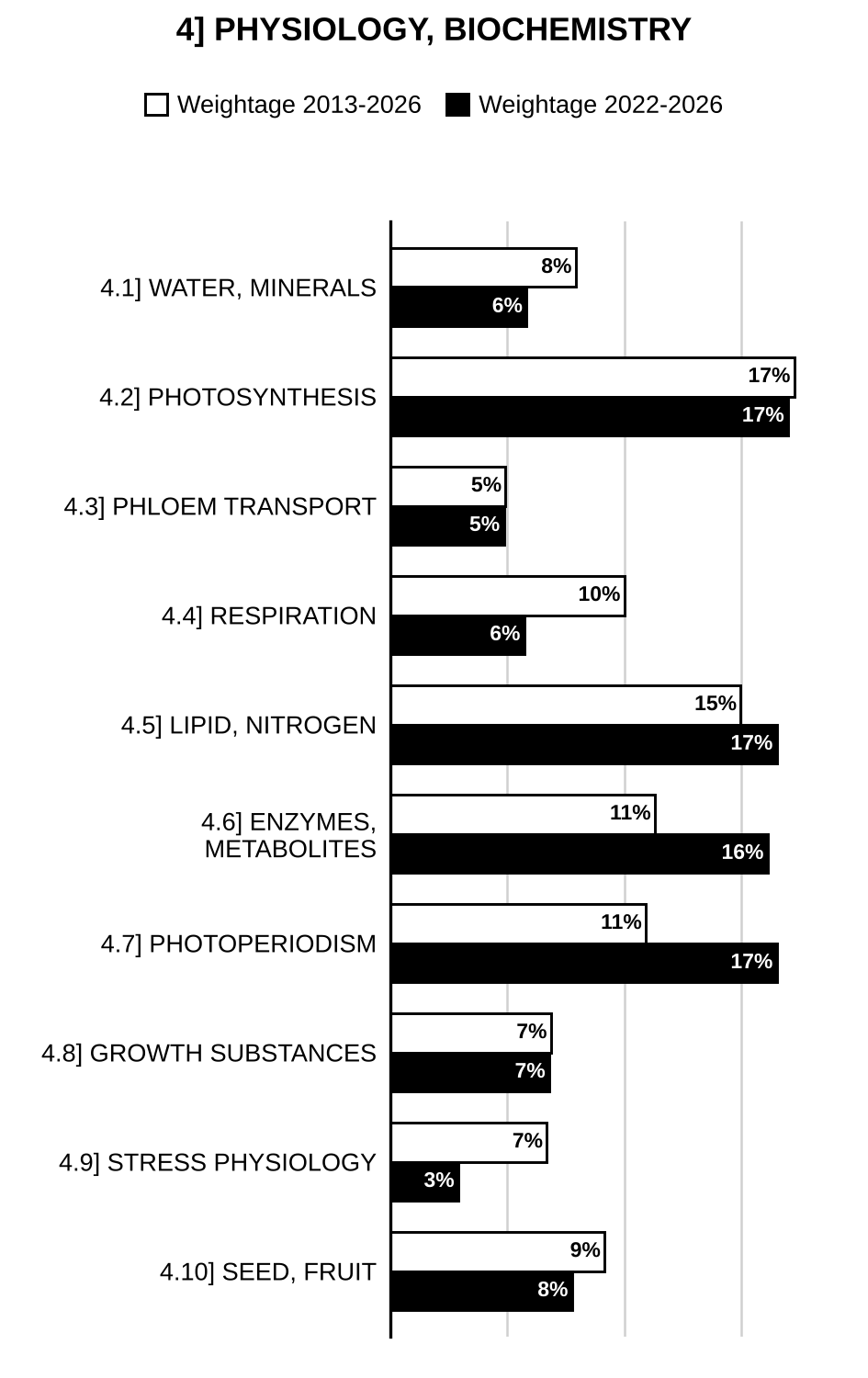
Here are all 206 Physiology and Biochemistry questions asked in UPSC Botany Optional Paper II from 1995 to 2026, arranged under the 10 topics of the official syllabus. Within each topic the latest questions come first.
Each question ends with a code such as [2024/15m/3b] – the year, the marks, the word limit (where UPSC set one) and the question number in the paper.
4.1] Water relations and mineral nutrition
22 questions
Explain what is secondary active transport. Discuss its importance in ion acquisition in plants. [2024/10m/150w/5a]
Biological significance of mineral elements in plants. [2023/10m/150w/5a]
Symptoms of mineral deficiencies. [2022/10m/150w/5a]
Discuss the processes of mineral nutrition and mineral deficiencies in dry land areas. [2019/10m/5e]
Illustrate your answer with suitable example, the mechanism by which movement of ions takes place across the cell membrane. [2019/15m/7b]
Water potential. [2018/10m/5a]
Describe the nature and importance of ion fluxes during stomatal movement. [2017/15m/6a]
What are the functions of the enzymes which need copper, zinc and molybdenum as their co-factors? [2016/15m/7a]
Enumerate the salient features of water relations in crop plants. [2015/15m/7a]
Zinc deficiency in crop plants. [2014/10m/5d]
What strategies are employed by plants for the uptake of iron under conditions of iron stress? [2011/15m/1a]
Calcium in plant growth. [2010/15m/150w/5c]
Stomatal movements. [2009/20m/200w/5b]
Discuss the role of any three trace elements in plant nutrition. Give their deficiency symptoms. [2006/20m/200w/5a]
What do you understand by mineral nutrition of crop plants? [2004/20m/7a]
Describe the role of nitrogen, phosphorus and potash on plant growth. [2004/40m/7b]
Role of mycorrhiza in tree nutrition. [2000/20m/8c]
Physiological role of essential elements in plants. [1999/20m/200w/1c]
Anti-transparent. [1998/20m/200w/5a]
What is transpiration? Discuss its importance to plant biology. Is there any difference between transpiration and evaporation? [1996/60m/4]
Explain the carrier concept of ion absorption. [1995/20m/200w/5a]
Discuss the role of trace elements in plant metabolism. [1995/30m/7b]
4.2] Photosynthesis
37 questions
Differentiate between photophosphorylation and oxidative phosphorylation. [2026/15m/6b]
Kranz anatomy and its significance. [2025/10m/150w/5b]
What are the different carbon fixation pathways in plants? Discuss in detail the CAM pathway and its role in stomatal activity. [2025/15m/7b]
Explain the compartmentation of biochemical reactions in photorespiration. Comment upon the significance of the process. [2024/20m/6a]
Describe the molecular organization of chloroplast ATP synthase. Explain its mechanism of action. [2024/15m/7b]
Photo-oxidation of water by photosystem II through oxygen-evolving complex. [2023/10m/150w/5b]
Photophosphorylation. [2022/10m/150w/5c]
Describe cycle of photosynthesis and differentiate amongst , and CAM plants. [2021/20m/6a]
Carboxylation and oxygenation compete to decrease the efficiency of photosynthesis. Discuss. [2020/15m/6a]
Illustrate the difference between and CAM pathways, giving suitable examples. Write a brief note on their importance. [2019/10m/5a]
(i) Difference between aerobic and anaerobic respiration as well as fermentation processes (ii) Photorespiration (iii) Chemo-osmotic theory and ATP synthesis. [2019/15m/6a]
What is Phosphorylation? Differentiate between photophosphorylation and oxidative phosphorylation. [2018/20m/6a]
Describe pathway of fixation. Discuss the advantages that the plants have over plants. [2018/20m/8a]
Comment on compartmentation of biochemical events in photorespiration. Add a note on the significance of photorespiration. [2017/20m/6b]
Describe the mechanism of fixation in CAM plants. [2015/15m/8a]
Describe the roles played by mesophyll cells and bundle sheath cells in pathway of fixation. [2014/20m/6b]
What would you conclude if:– A plant exhibits kranz anatomy. [2013/10m/5d]
How are these accomplished? Energy trapping. [2013/10m/8c]
What is characteristic pathway of carbon fixation in tropical grasses and what are the advantages of the pathway? [2012/12m/5c]
What is Rubisco, where is it located and what function does it serve? [2012/20m/6c]
How is light energy captured in green plants? [2012/15m/7d]
Photolysis of water. [2010/15m/150w/5b]
Crassulacean Acid Metabolism. [2009/20m/200w/5a]
Describe pathway of fixation. In what respects does it differ from the pathway? Mention the specialised anatomical features associated with photosynthesis. [2009/60m/8]
Describe the components of photosynthetic electron transport, with reference to the structure of thylakoid membranes. [2007/30m/6a]
Describe the photosynthetic carbon assimilation in and plants. [2006/20m/6a]
Explain the factors that affect photosynthesis. Define photosynthetic efficiency of crops. [2006/20m/6b]
Non-cyclic photophosphorylation. [2005/20m/200w/5a]
fixation in plants. [2003/20m/200w/5a]
Review the Crassulacean acid metabolism (CAM). In what significant way does CAM differ from metabolism? [2002/60m/6]
With the help of diagrams, bring out the differences in electron transport mechanism in cyclic and non-cyclic photophosphorylation and explain why the Latter is superior to the former. [2001/20m/200w/5a]
Compare and plants from the point of view of metabolic efficiency and total productivity. [2001/60m/8]
Bacterial photosynthesis. [2000/20m/200w/1b]
Photo-system-I and Photo-system-II. [1999/15m/3d]
CAM Pathway. [1998/20m/200w/1c]
“The cycle and cycle are temporally separated in CAM plants, whereas they are spatially separated in plants.” Explain. [1997/20m/200w/1c]
Describe the important characteristics of RUBISCO and PEP carboxylase. What is the importance of these enzymes? [1995/30m/7a]
4.3] Phloem transport
7 questions
Munch hypothesis. [2026/10m/150w/5a]
What is phloem? Describe the various hypotheses concerning transportation in phloem. [2022/15m/6c]
Metabolic energy requirement for uptake of sucrose in apoplastic pathway. [2020/10m/5b]
Phloem loading. [2018/10m/5c]
Distinguish between phloem loading and phloem unloading. [2016/15m/6b]
How are these accomplished? Transport of solutes in phanerophytes. [2013/10m/8a]
Discuss the dynamics of translocation of organic substances. [1997/20m/200w/5b]
4.4] Respiration and bioenergetics
22 questions
Differentiate between photophosphorylation and oxidative phosphorylation. [2026/15m/6b]
Describe the process of gluconeogenesis and its significance. [2024/7m/8a(ii)]
How is the transport of electrons and pumping of protons associated with ATP synthesis in mitochondria? Explain. [2023/15m/6b]
Cyanide-resistant respiration in plants. [2020/10m/5c]
How can the two laws of thermodynamics be combined to determine spontaneity of a reaction? Also derive a relationship between free energy exchange and equilibrium constant. [2020/15m/7a]
Illustrate with example the importance of energy transfer and energy conservation for plant growth and development. [2019/10m/5c]
(i) Difference between aerobic and anaerobic respiration as well as fermentation processes (ii) Photorespiration (iii) Chemo-osmotic theory and ATP synthesis. [2019/15m/6a]
Glycolysis. [2018/10m/5b]
What is Phosphorylation? Differentiate between photophosphorylation and oxidative phosphorylation. [2018/20m/6a]
Citric acid cycle is an amphibolic process. Discuss. [2017/10m/7b]
ATP synthase. [2015/10m/5a]
Describe different sub-mitochondrial complexes associated with electron transport chain of aerobic respiration. [2015/15m/6c]
Explain how proton-motive force drives the synthesis of ATP. [2014/15m/7b]
Explain the process of anaerobic glucose catabolism and mention the mode of ATP generation during the process. [2012/20m/6a]
Explain the mechanism of chemiosmotic generation of ATP. [2012/15m/7a]
Describe the mitochondrial electron transport chain and theories for ATP synthesis. [2009/30m/6a]
Explain the mechanisms of respiratory functions in plants. [2006/20m/200w/5b]
Describe the principle categories of enzymes involved in respiratory reactions. [2004/60m/6]
What is oxidative phosphorylation? What is its significance? [2002/20m/200w/5a]
Prosthetic groups of different enzymes in respiratory chain. [2000/20m/200w/1c]
TCA-an amphibole pathway. [1999/20m/200w/5a]
What is ‘Bioenergy’. Explain the energy cycle in the cells. What is the role of ATP in this cycle? [1999/60m/6]
4.5] Lipid and nitrogen metabolism
21 questions
Regulation of NIF genes. [2026/10m/150w/5e]
Explain the significance of Nod factors and the process of root nodule formation. [2026/10m/6a(i)]
Describe the process of amino acid biosynthesis in nitrogen metabolism. [2026/10m/6a(ii)]
What is biological nitrogen fixation? Explain the mechanism of symbiotic nitrogen fixation with examples. [2025/15m/6b]
Discuss what is GOGAT? Comment on its catalytic function. [2024/10m/150w/5b]
Explain the following:
(i) Nitrate and nitrite reduction in the leaves of higher plants. [2023/5m/7b(i)]
(ii) Protection of enzyme nitrogenase against oxygen and hydrogen damage. [2023/5m/7b(ii)]
How do the three stages in fatty acid oxidation converge to conserve energy as ATP? [2023/5m/8a(i)]
What is -oxidation? Describe various steps in fatty acid oxidation pathway involving saturated fatty acids. [2023/15m/8a(ii)]
What is biological nitrogen fixation? Describe root nodule formation and role of nitrogenase complex in fixing of nitrogen. [2021/15m/6c]
What is the importance of fatty acid synthase complex? Discuss the growth of fatty acyl chain through priming and elongation phases. [2020/20m/7c]
(i) Restriction endonuclease (ii) Role of glyoxysomes in conversion of fats into simpler molecules (iii) Name specific physiological responses on the basis of which IAA, and Kinetin can be identified. [2019/15m/6b]
-oxidation. [2017/10m/5a]
GS-GOGAT system. [2017/10m/5b]
Describe the role of glyoxysomes in conversion of fats into more mobile molecules. [2016/15m/6a]
Describe the process of biological nitrogen fixation with special emphasis on denitrogenase. [2015/20m/6a]
What are ‘symplasmids’? Mention their role in root nodulation and -fixation in the leguminous plants. [2014/15m/8b]
Does the process of nitrification synthesize ATP, and how is this energy conserved? [2014/15m/8c]
What makes the leguminous plants to grow under the nitrogen stress condition? [2012/12m/5d]
Nitrogenases. [2005/20m/200w/5b]
Give concise answers to the following: What is the function of leghemoglobin in symbiotic nitrogen fixation? [2002/20m/8c]
Describe the process of rhizobial infection and nodule development in a legume root. What is the function of leghaemoglobin in symbiotic nitrogen fixation? [1997/60m/6]

Preparing for Prelims too?
Our UPSC Prelims Topic-wise PYQ eBook covers every Prelims question with detailed explanations, so you can see exactly where UPSC asks from.
View the BookDownload Free Sample4.6] Enzymes and secondary metabolites
19 questions
Explain the factors affecting enzyme activity. [2026/10m/7a(i)]
Describe the mechanism of enzyme action. [2026/10m/7a(ii)]
What are allosteric enzymes? Explain in detail on the allosteric enzyme modulation. [2024/8m/8a(i)]
How can the reaction equilibria and reaction rates be explained by using free energy diagram in a simple enzymatic reaction? [2023/20m/7a]
Differentiate between enzymes and coenzymes and describe their mechanisms of action. [2022/20m/6a]
Define secondary metabolites. Discuss the importance of secondary metabolites to plants. [2022/15m/6b]
Alkaloids and their significance. [2021/10m/5a]
Define enzyme, prosthetic groups, coenzymes and isoenzymes. Discuss the mechanism of enzyme action. [2018/20m/7c]
Apoenzyme. [2016/10m/5a]
What are the functions of the enzymes which need copper, zinc and molybdenum as their co-factors? [2016/15m/7a]
Allosteric enzymes and Feedback control. [2016/10m/8c]
What are secondary metabolites? What is their use to the plants and to the human beings? [2013/20m/6a]
What is the chemical nature of saponins? How do saponins provide defence against fungal attack on plants? [2011/15m/4d]
Secondary metabolites and plant protection. [2010/15m/150w/5a]
How would you distinguish between enzymes and co-enzymes? [2010/15m/6a]
Co-enzymes. [2007/20m/200w/5a]
Describe the structural peculiarities of enzymes & explain their mode of action in metabolism, growth and development. [2001/20m/200w/5b]
Buffers. [2000/20m/200w/5b]
Differentiate between co-factors and co-enzymes. [1998/20m/200w/5b]
4.7] Photoreceptors, photoperiodism and plant movements
24 questions
Vernalization. [2025/10m/150w/5c]
Describe the various types of tropic movements in plants. Discuss their mechanism. [2025/15m/8c]
Describe the structure of phytochrome. Explain its mode of action in flowering plants. [2024/15m/6b]
Photoperiodic induction and the perception site of photoperiodic stimulus. [2023/10m/150w/5c]
What are nastic movements, their types and mechanism? Explain. [2023/15m/6a]
Define the terms photoperiodism and florigen. Describe the mechanism of response in short day and long day plants giving suitable examples. [2022/20m/8a]
Define Vernalization. Discuss its mechanism and importance. [2021/15m/6b]
What is Clock hypothesis? Justify the importance of main photoreceptor and photoperiodic induction in photoperiodism. [2020/20m/6c]
How do plants monitor day length? Discuss the various categories of plants based on their photoperiodic responses. What happens when the dark period is interrupted by night break and why? [2018/10m/6c]
What are the characteristics of phytochrome induced responses in flowering of higher plants? How do they control flowering? [2015/15m/7b]
What would you conclude if:– Saffron corms transplanted to Delhi in December 2010 did not flower in 2011 and 2012. [2013/10m/5c]
Present the current model for long distance transport of floral stimulus. [2011/15m/2d]
What evidences support starch-statolith hypothesis for gravitropism? [2011/15m/3d]
Explain photo-receptors and their role in regulation of plant growth. [2010/30m/7a]
Describe vernalization and its role in flowering. [2009/30m/6b]
Vernalization. [2007/20m/200w/5c]
Photoperiodism. [2004/20m/200w/5a]
What do you understand by vernalization? Discuss the factors that influence vernalization. [2003/40m/6a]
Describe the practical significance of vernalization. [2003/20m/6b]
Define phototropism. What pigment(s) function as the photoreceptor for phototropism? Give evidence to support your conclusion. [2002/20m/200w/5b]
Explain the concepts of photoperiodism and vernalization. What is meant by critical photochemical requirement for plant growth and development? In this background re-examine the photoperiodic classification of plants. [2001/60m/7]
Write a short account of photoperiodism in plants. [1997/20m/200w/5a]
What is vernalization? Explain its importance. [1995/20m/200w/5c]
Write critical notes on the following: (i) Water pollution and its control (ii) Red-Far Red interaction. [1995/30m/8a]
4.8] Growth substances and senescence
19 questions
What are phytohormones? Briefly discuss the role of auxin in plant growth and development. Explain its mechanism of action. [2025/15m/8b]
Define leaf senescence. Describe important physiological and biochemical changes taking place during this process. Comment upon the regulation of senescence by phytohormones. [2024/20m/7a]
Role of growth substances in agri-horticulture. [2021/10m/5b]
(i) Restriction endonuclease (ii) Role of glyoxysomes in conversion of fats into simpler molecules (iii) Name specific physiological responses on the basis of which IAA, and Kinetin can be identified. [2019/15m/6b]
Ethylene as a volatile hormone. [2016/10m/5b]
Senescence. [2015/10m/5b]
Apical dominance. [2014/10m/5a]
Differentiate between growth, development and differentiation and describe the factors that influence these processes. [2013/15m/7b]
Schematically present ethylene biosynthesis in plants. Describe/illustrate the ‘triple response’ due to ethylene. [2011/15m/5d]
Describe the role of growth regulators in sex expression of plants. [2010/15m/8b]
Leaf senescence. [2009/20m/200w/7a]
Physiological effects of ethylene in plants. [2009/20m/200w/7b]
Enumerate the applications of growth hormones in agri-horticulture, while commenting on their physiological basis. [2007/30m/7b]
Define auxins. Describe their physiological response in plants. [2005/60m/6]
What are cytokinins? Give an account of roles they play in plant growth and development. [2002/20m/200w/5c]
Discuss the genetic and physiological control of sex determination in plants. Is it possible to modify the genetically determined sex by physiological factors? Substantiate your answer. [2001/60m/3]
Ageing and senescence. [1999/20m/7a]
What are the growth substances? Explain their importance in agriculture. [1996/20m/200w/5d]
How was abscisic acid discovered? Discuss in detail the physiological role of abscisic acid. [1995/60m/6]
4.9] Stress physiology
15 questions
Heat Shock Proteins (HSP’s) [2026/10m/150w/5c]
Metallophytes and their practical importance. [2024/10m/150w/5d]
What is drought escape? Discuss different strategies adopted by plants for drought resistance. [2020/15m/6b]
Explain the approaches of Stress physiology in relation to salinity and metal stresses. Support your answer with examples. [2019/20m/8c]
Phytochelatins. [2017/10m/5c]
Soil salinity also restricts the growth of plants. [2016/10m/5c]
Mechanism of drought resistance. [2014/10m/5e]
Discuss how our understanding of stress physiology will help in mitigating problems expected to arise because of rapid changes in global environment. [2013/15m/7c]
Discuss the adaptive measures of plants in response to their exposure to water stress. [2007/30m/6b]
Write an account of the physiological changes that occur during high temperature stress. How plants have adopted physiologically for tolerance of high temperature stress? [2006/30m/7a]
Describe the effects of metal stress on plant growth and development. [2006/30m/7b]
What do you understand by abiotic stresses? [2003/20m/7a]
Describe in detail the mechanism of salt stress on plants. [2003/30m/7b]
Describe the effect of salt stress on plant growth. [2003/10m/7c]
Describe how plants may be injured by water stress. In what way are freezing stress and salt stress similar to water stress? [2002/60m/7]
4.10] Seed and fruit physiology
20 questions
Discuss the biochemical and physiological changes during the process of fruit ripening. [2026/15m/6c]
Describe seed dormancy and explain how is it getting regulated? [2026/8m/7c(i)]
Explain biochemical changes taking place during the seed germination. [2026/7m/7c(ii)]
Regulation of seed dormancy and germination by phytohormones. [2024/10m/150w/5c]
What are the different types and causes of seed dormancy? Describe various methods used to overcome it. Is it an ecological adaptation? Explain. [2021/20m/8a]
Climacteric fruits and their advantage to fruit growers. [2020/10m/5a]
What are the molecular basis and possible manipulations which may help fruit ripening? [2019/15m/7a]
Describe the physiological changes associated with the process of seed germination. [2017/20m/7a]
What is seed germination? Define normal and abnormal seedlings. [2014/15m/6a]
How are these accomplished? Overcoming seed dormancy. [2013/10m/8d]
Compare the pattern of and ethylene production in a climacteric fruit. [2011/15m/8d]
Differentiate between climacteric and non-climacteric fruits. [2010/15m/6b]
Explain the process of fruit ripening and its regulation. [2010/30m/6c]
What is dormancy? Where does it occur in plants? Describe various methods of breaking dormancy. [2007/30m/7a]
Fruit-ripening. [2005/20m/200w/5c]
Seed dormancy. [2004/20m/200w/5b]
Seed germination. [2003/20m/200w/5b]
Give concise answers to the following: Enumerate the causes of seed dormancy and suggest methods to overcome them. Comment on the probable selective advantages of seed dormancy in the course of evolution. [2001/20m/6b]
How is a seed attributed to be dormant? Give a test of seed viability. [1998/60m/6]
Write short notes on any four of the following: (i) Chemical mutagens (ii) Downs syndrome (iii) Seed dormancy (iv) Active and passive uptake of ions (v) Shifting cultivation. [1997/30m/4a]

Strengthen your GS papers
Our UPSC Mains Topic-wise & Year-wise PYQ eBook (2013–2026) maps every GS question to the syllabus, so you know what UPSC asks and how often.
View the BookDownload Free Sample« Previous: Plant Breeding, Biotechnology and Biostatistics | Next: Ecology and Plant Geography »
Back to: Botany Optional PYQs – Topic-wise | Also see: Botany Optional year-wise question papers
Last updated: 31 October 2026