
Here are all 172 Ecology and Plant Geography questions asked in UPSC Botany Optional Paper II from 1995 to 2026, arranged under the 8 topics of the official syllabus. Within each topic the latest questions come first.
Each question ends with a code such as [2024/15m/3b] – the year, the marks, the word limit (where UPSC set one) and the question number in the paper.
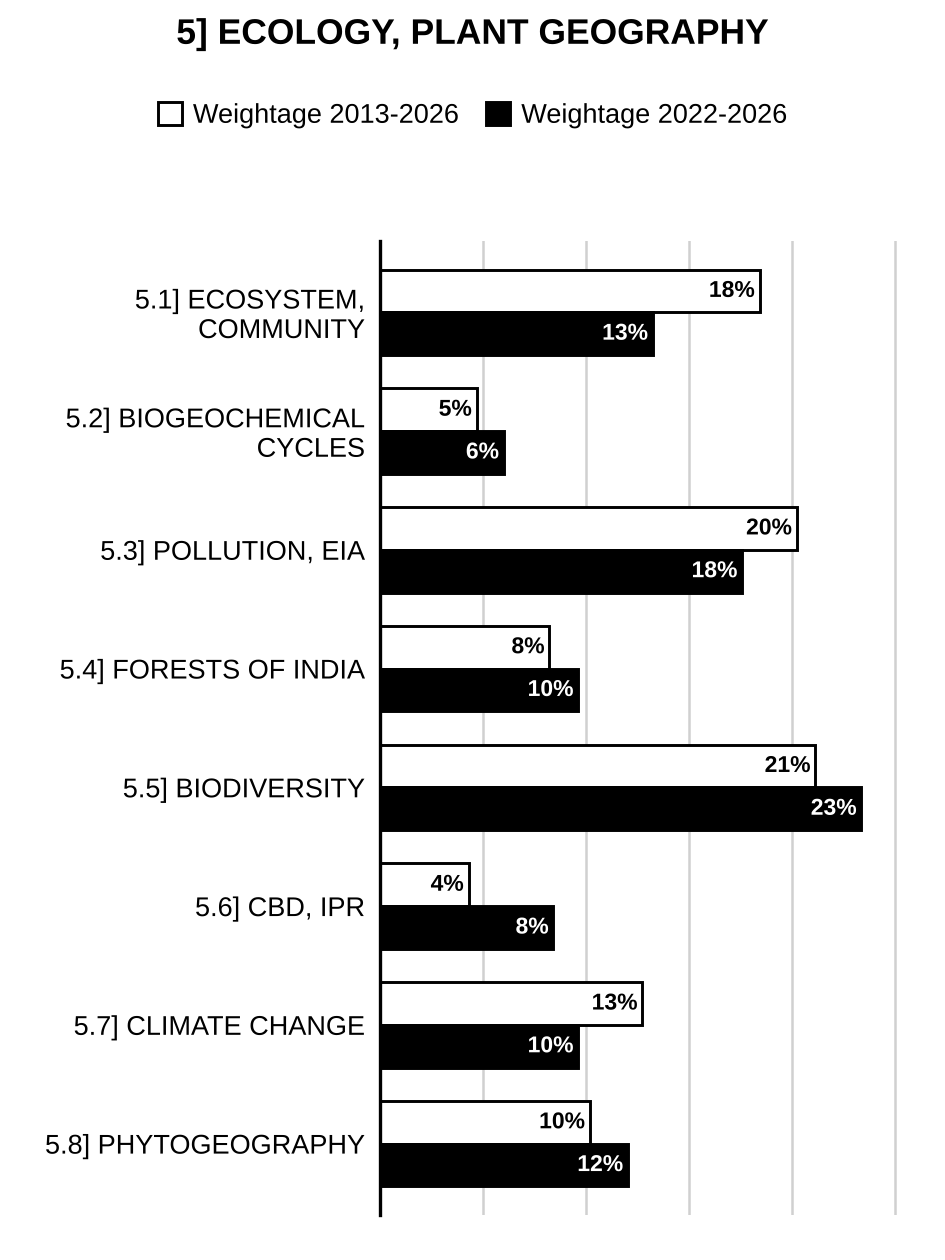
5.1] Ecosystem and community ecology
38 questions
Differentiate between mutualism and commensalism by citing two examples for each of them. [2024/15m/8c]
Role of light as a limiting factor in an ecosystem. [2023/10m/150w/5d]
Explain the transfer of energy between different trophic levels of an ecosystem. [2023/15m/8b]
Discuss the sequential steps in the process of primary autotrophic succession. What are the three popular theories that explain climax concept? [2022/15m/7b]
Give a brief account of ecological pyramids. Describe ecological factors and their significance in plants. [2021/15m/7c]
How is solar energy trapped, fixed and transformed in an aquatic food chain? [2020/15m/8a]
Eco-development sequence proceeds from a barren land to a climax and finally ends in a desert. Explain critically. [2020/20m/8c]
Explain with examples, in what way ecosystems and conservation help in the formation of a developed biosphere. [2019/20m/7c]
Discuss the concept and dynamics of a plant community. Illustrate with suitable examples. [2019/15m/8a]
Components of an ecosystem. [2018/10m/5e]
What is ecological succession? Discuss the various models describing the mechanism of succession. [2018/15m/7a]
Define plant community. Discuss the various analytical characters of plant community. [2018/15m/7b]
Biotic factors. [2017/10m/5d]
What is the concept of ecosystem? How does succession influence the diversity and stability of an ecosystem? [2017/15m/8b]
“The pyramid of energy always takes a true upright shape.” Why? [2016/10m/5e]
What is Niche overlap? Narrate the biogeographic classifications of India. [2016/20m/6c]
Define ecological succession. Describe the causes and basic types of ecological succession. [2016/20m/7c]
Explain eco-regulation. Justify plant appearances and disappearances leading to climatic climax. [2012/15m/8d]
Explain the concept of limiting factor in ecology. [2011/15m/2b]
Explain the quantitative characteristics of a plant community. [2011/15m/6a]
Progressive ecological efficiency. [2010/15m/150w/5e]
There are exceptions to the ecological pyramids. Explain. [2010/15m/7b]
‘Feedback loops’ are the regulatory mechanisms that determine whatever changes take place in the ecosystem. Explain. [2010/15m/8d]
Hydrosere. [2009/20m/200w/5c]
Ecological pyramids. [2009/20m/200w/7c]
Give an account of various ecological factors that influence plant community. [2007/30m/8a]
Define succession. Explain different stages of succession with illustrations. [2006/30m/8a]
Enumerate the structure and functions of an ecosystem. [2006/30m/8b]
What do you understand by eco-system? [2003/10m/8a]
How would you maintain an eco-system? [2003/50m/8b]
Give concise answers to the following: Explain why temperate forests and woodlands are less productive and diverse than tropical forests. [2002/20m/8a]
Explain the phenomena of food chain, biomagnifications and ecological pyramids in terms of maintaining ecological equilibrium or otherwise. [2001/20m/200w/5d]
Physical xerophytes and Physiological xerophytes. [1999/15m/3b]
Atmosphere is an essential life supporting system. [1999/20m/200w/5b]
An organism is a bundle of adaptation. [1999/20m/200w/5c]
Characteristics of desert plants. [1998/20m/7c]
Define succession and explain with the help of a suitable example. [1997/30m/7a]
Write a note on ecosystem under the following heads. (i) Components (ii) Energy flow (iii) Nutrient movement. [1997/30m/7b]
5.2] Biogeochemical cycles
10 questions
Biogeochemical cycle. [2026/10m/150w/5d]
Describe the movement of phosphorus through lithosphere, hydrosphere and biosphere. How human activities have impacted the phosphorus cycle in nature? [2022/15m/7c]
How do microbes help in chemical recycling in nature for a stable community climax? [2020/15m/8b]
What is sedimentary cycle? Explain the flow of an element showing sedimentary cycle through diagrammatic representation. What are the anthropogenic influences on such elemental cycle(s)? [2017/20m/7c]
Discuss the ecological significance of nitrifying and denitrifying bacteria associated with biogeochemical cycle. [2012/15m/7c]
Explain the role of surface run-off in nutrient budget of ecosystems. [2010/15m/7c]
Nitrogen cycle. [2007/20m/200w/5b]
Define biogeochemical cycles. Describe N-cycle. [2005/60m/7]
Give concise answers to the following: Give diagrammatic representations of any five biogeochemical cycles showing the direction of energy flow. [2001/20m/6c]
Explain the origin of nitrogenous compounds in the soil. [1996/20m/200w/1d]
5.3] Pollution and environmental management
31 questions
Explain the following:
(i) Acid rain [2026/5m/7b(i)]
(ii) Biocide as pollutant [2026/5m/7b(ii)]
(iii) Photochemical smog [2026/5m/7b(iii)]
Metallophytes and their practical importance. [2024/10m/150w/5d]
Discuss the causes, consequences and control of eutrophication. [2024/8m/7c(i)]
What is environmental management? Discuss various control measures to minimize environmental pollution. [2024/20m/8b]
What are the major gaseous pollutants and their sources? Explain the effects of air pollutants on human health. [2023/15m/8c]
Phytoremediation. [2022/10m/150w/5e]
Plant indicators. [2021/10m/5c]
What is bioremediation? How can plants be used to detoxify the heavy metal containing industrial effluents? [2020/15m/7b]
Name at least two plants known to be ‘plant indicators’ and explain their importance in relation to soil quality evaluation. [2019/10m/5b]
(i) Explain and justify with examples that recycling plays an important role in solid waste management. (ii) “In the present scenario, Global Warming and Climate Change are amongst the greatest threats for human society.” Justify the statement with examples. [2019/20m/6c]
What are the purposes and aims of Environmental Impact Assessment (EIA)? What are the guiding principles for an effective EIA process? Write the main steps of an idealized EIA. [2017/15m/6c]
Enumerate the effects of oil spillage and suggest the control and remedial measures of it. [2016/15m/7b]
Recycling is an integral part of solid waste management. [2016/10m/8a]
Biosafety and Bioremediation. [2016/10m/8d]
Discuss the principal systems of environmental pollution and the reasons thereof. [2015/15m/6b]
Discuss the various advantages and limitations of phytoremediation. [2015/20m/8c]
Explain how air and water pollution affect the agro-ecosystems. [2014/20m/8a]
What would you conclude if:– A previously lichen-rich area is now devoid of lichens. [2013/10m/5a]
What would you conclude if:– A pond is totally covered with Eichornia. [2013/10m/5e]
How are these accomplished? Proper planning before undertaking any developmental project to avoid its adverse impact on environment. [2013/10m/8b]
How are these accomplished? Control pollution by biotic means. [2013/10m/8e]
What is superbug? Describe its properties and possible role in bioremediation. [2012/12m/5a]
Explain salient features of “The Environment Protection Act” and mention how far it is effective in maintenance of the quality of environment. [2011/15m/4c]
What is eutrophication? What are its impacts on the ecosystem? [2011/15m/5b]
How would you measure the level of Air-Pollution? [2005/30m/8b]
Pollution control. [2004/20m/200w/5d]
Give concise answers to the following: Point out the various sources of environmental pollution and suggest suitable remedial measures. [2001/20m/6a]
Discuss the effect of cement dust pollution on the broad leaved species of forest trees. [2000/60m/7]
Photochemical smog. [1999/20m/200w/1b]
What is pollution? What are the types of pollution? What are the principal means to check pollution? [1996/60m/6]
Write critical notes on the following: (i) Water pollution and its control (ii) Red-Far Red interaction. [1995/30m/8a]
5.4] Forests of India
15 questions
Discuss on the present status of forest resources of India. Give the factors responsible for deforestation. [2026/15m/8c]
Describe the different forest types in India. Discuss in detail the crucial ecosystem services provided by these forests. [2025/15m/6c]
Forests are an important wealth of the country. [2023/10m/150w/5e]
What is social forestry? Explain its types and benefits. [2021/15m/7b]
Define natural forests and mention the name of the forest type covering the maximum area in India. Discuss the major forest types in India as described by Champion and Seth. [2018/15m/8c]
Distinguish between natural and social forests. Discuss in detail the various objectives of social forestry. [2015/20m/7c]
What is the difference between afforestation and reforestation? What are the gains and pitfalls of monoculture in forestation practices? [2013/15m/6c]
Explain the ecological significance of forests. [2011/15m/1d]
Give the basis of classification of Indian forests and give its outline. [2011/15m/8a]
Describe and distinguish afforestation, deforestation and social forestry. [2007/30m/8b]
Afforestation. [2005/20m/200w/5d]
What do you know about Social Forestry? [2005/30m/8a]
Social forestry. [2004/20m/200w/5c]
“Forests are an important natural resource and need to be conserved.” Discuss. [1997/30m/4b]
What are the forest types of India? Write the botanical names of 1. Redwood, 2. Hemp fibre, 3. Linseed, 4. Penicillium and 5. Rye. [1996/20m/200w/1c]

Preparing for Prelims too?
Our UPSC Prelims Topic-wise PYQ eBook covers every Prelims question with detailed explanations, so you can see exactly where UPSC asks from.
View the BookDownload Free Sample5.5] Biodiversity and conservation
37 questions
The IUCN Red List categories. [2025/10m/150w/5d]
Endemism. [2025/10m/150w/5e]
Define biodiversity. Explain the various ex situ and in situ methods of conserving biodiversity. [2025/20m/8a]
In present Indian scenario, explain the importance of biosphere reserves in bio-diversity conservation. [2024/7m/7c(ii)]
Why is the conservation of biodiversity important? Discuss the various steps adopted for it by our country. [2023/20m/6c]
Comment on the following:
(i) Biosphere reserves [2023/10m/7c(i)]
(ii) Red Data Book [2023/10m/7c(ii)]
Endangered Plant Species. [2022/10m/150w/5d]
IUCN Red List Categories. [2021/10m/5e]
What is unique of Indian plant biodiversity? Discuss briefly the threats and various conservation strategies. [2021/20m/7a]
Describe in detail the endemism highlighting its categories, causes of endemism and conservation priorities. [2021/15m/8c]
Explain with examples, in what way ecosystems and conservation help in the formation of a developed biosphere. [2019/20m/7c]
Explain the relevance and importance of the following: (i) Protected area network (ii) Invasive species (iii) Approaches for ‘Environmental Impact Assessment’ [2019/15m/8b]
What is red data book? Describe it. Discuss the various IUCN threat categories. [2018/20m/6b]
What is biodiversity? Discuss the major strategies for the conservation of biodiversity. [2018/15m/8b]
Biosphere reserve as a part of protected area network. [2017/10m/5e]
Conservation of biodiversity. [2015/10m/5c]
IUCN classification of extinction risks. [2014/10m/5b]
Define ‘biodiversity’ and discuss the measures to conserve it. [2014/15m/6c]
Describe the role of national and international organisations established for germplasm conservation. [2014/20m/7a]
What would you conclude if:– A species is added to the Red Data Book. [2013/10m/5b]
What are the different IUCN threat categories of biodiversity and their implications in conservation? [2012/20m/6b]
What is ‘hot spot’? Describe the hot spots of India, giving names of few important species. [2012/15m/8c]
Mention the ‘hot spots’ of India, and the reasons to recognise them as hot spots. [2010/15m/8c]
Red Data Book and its relevance to plant diversity. [2007/20m/200w/5d]
Discuss the strategies for conservation of endemic and endangered plants. [2006/20m/200w/5c]
What do you understand by conservation of biodiversity? [2004/20m/8a]
How is biodiversity conserved? [2004/40m/8b]
Conservation of biodiversity. [2003/20m/200w/5d]
Give concise answers to the following: How are endangered species listed in the Red Data Books? [2002/20m/8b]
The tropical countries are very rich in biodiversity as compared to the temperate countries. Substantiate the statement. Describe methods to conserve biodiversity. [2001/20m/200w/5c]
Endangered plant species. [2000/20m/8a]
Endemic plants. [2000/20m/8b]
Discuss the role of systematic and biosystematics in biodiversity inventorisation. Describe the parameters which are employed for estimation of biodiversity. [1998/60m/6]
Conservation of ecosystem. [1998/20m/7a]
Endangered plants. [1998/20m/7b]
What are biospheres? What are the commonest causes for endangering the survival of species? How are the endangered species conserved? [1996/20m/200w/5c]
What is the importance of conservation of germplasm? Briefly describe the methods used for conserving germplasm. [1995/20m/200w/5d]
5.6] CBD, farmers’ rights and IPR
4 questions
Give an account on farmers rights and intellectual property rights. [2026/15m/8b]
Describe the key goals of the convention on Biological Diversity. What steps have been taken in India to implement the provisions of CBD? [2022/20m/7a]
Can Intellectual Property Rights protect and safeguard farmers’ rights and interests? [2020/10m/5d]
Explain with example the impact of Intellectual Property Rights (IPR) and its global relevance with emphasis on Indian scenario. [2019/10m/5d]
5.7] Global change and sustainable development
23 questions
What are the causes and consequences of global warming and climate change? Explain the approaches to deal with global warming. [2025/15m/7c]
Invasive alien species and their impact on biodiversity. [2024/10m/150w/5e]
Explain how the different greenhouse gases contribute to the raising global temperature. Add a note on the adverse effects of global warming and how to mitigate. [2022/15m/8b]
Invasive species and their characteristics. [2021/10m/5d]
Describe the concept of sustainable development highlighting its objectives and importance. [2021/15m/8b]
What are the causes of the rise in mean atmospheric temperature and how will it influence the climate of a region? [2020/10m/5e]
(i) Explain and justify with examples that recycling plays an important role in solid waste management. (ii) “In the present scenario, Global Warming and Climate Change are amongst the greatest threats for human society.” Justify the statement with examples. [2019/20m/6c]
Explain the relevance and importance of the following: (i) Protected area network (ii) Invasive species (iii) Approaches for ‘Environmental Impact Assessment’ [2019/15m/8b]
Define sustainable development. How do global warming and climatic changes influence the endemic flora and fauna of a region? [2017/15m/8c]
OTEC. [2016/10m/8b]
Solar pond. [2016/10m/8e]
Species based mechanism of invasion. [2015/10m/5d]
Mainstream forms of renewable energy. [2015/10m/5e]
Give a brief note on the concept of sustainable development. [2014/15m/7c]
What are ozone-depleting substances and how they cause depletion of ozone layers in stratosphere? [2012/12m/5b]
Give a brief note on the concept of sustainable development. [2012/15m/8a]
CDM. [2010/15m/150w/5d]
Mention the attributes of a species to make it invasive. [2010/15m/8a]
Kyoto Protocol and CDM. [2009/20m/200w/5d]
Describe the causes and consequences of greenhouse effect. [2006/20m/200w/5d]
Global warming. [2003/20m/200w/5c]
Global warming. [2000/20m/200w/5d]
Greenhouse gases. [1998/20m/200w/1d]
5.8] Phytogeographical regions of India
14 questions
What is the basic concept of phytogeography? [2026/5m/8a(i)]
Give a detailed account on various phytogeographical regions of India. [2026/15m/8a(ii)]
Give a concise account on altitudinal zonation of vegetation with special reference to Himalayan Vegetation. [2024/15m/6c]
Describe the phytogeographical regions of India. What are the environmental factors that influence their species composition? [2022/15m/8c]
Name the phyto-geographical regions of India. Which are the dominant flora of the region representing the west coast of India from Kanyakumari to Satpura ranges in Gujarat? [2020/15m/4b]
Phytogeographical regions of India. [2018/10m/5d]
Taiga or Boreal forests. [2016/10m/5d]
What is Niche overlap? Narrate the biogeographic classifications of India. [2016/20m/6c]
Describe any four principal phytogeographical regions of India. [2015/15m/8b]
Describe various phytogeographical zones and their characteristics in India. Give further details of the zone which experiences high temperatures, restricted snowfall and high rainfall, and has adundance of Rhododendrons, Ferns, Orchids and Oaks. [2013/20m/7a]
Explain the Theory of Age and Area. [2011/15m/3b]
What is ‘Satpura hypothesis’? How does it explain discontinuous distribution of certain species? [2011/15m/7a]
What are biomes? Explain, with examples, how climate determines what biome occurs in a region. [2002/20m/200w/5d]
Name the various phytogeographical zones of India and give two examples of characteristic plants from each region. [1997/20m/200w/5c]

Strengthen your GS papers
Our UPSC Mains Topic-wise & Year-wise PYQ eBook (2013–2026) maps every GS question to the syllabus, so you know what UPSC asks and how often.
View the BookDownload Free Sample« Previous: Physiology and Biochemistry
Back to: Botany Optional PYQs – Topic-wise | Also see: Botany Optional year-wise question papers
Last updated: 31 October 2026