
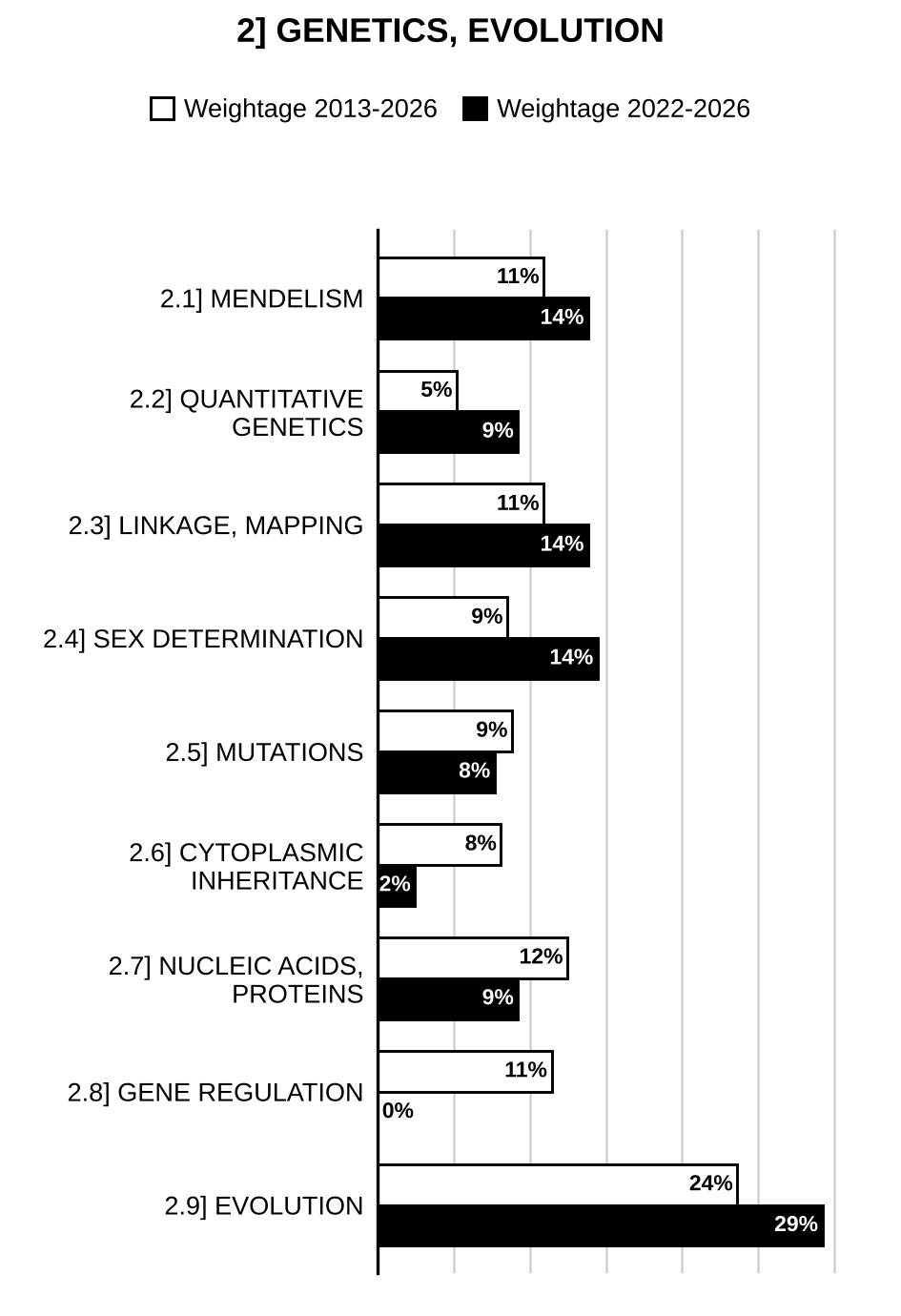
Here are all 152 Genetics, Molecular Biology and Evolution questions asked in UPSC Botany Optional Paper II from 1995 to 2026, arranged under the 9 topics of the official syllabus. Within each topic the latest questions come first.
Each question ends with a code such as [2024/15m/3b] – the year, the marks, the word limit (where UPSC set one) and the question number in the paper.
2.1] Mendelian genetics and gene interactions
12 questions
Epistasis. [2025/10m/150w/1b]
Explain with at least two examples what is incomplete dominance and polygenic inheritance and what happens as a result of these events? [2024/10m/150w/1b]
Explain multiple alleles and their characteristics. How are they different from pseudoalleles? [2023/15m/4b]
Explain the phenomenon of incomplete dominance and its significance. [2022/15m/3b]
Dark brown seed coat colour in Phaseolus is dominant over light brown colour. The following progenies were produced from the parents with known phenotypes but unknown genotypes in different experiments:
| Parents | Progenies: Dark brown [D. brown] | Progenies: Light brown [L. brown] | |
| (i) | L. brown × L. brown | 0 | 75 |
| (ii) | D. brown × L. brown | 90 | 0 |
| (iii) | D. brown × L. brown | 110 | 105 |
| (iv) | D. brown × D. brown | 72 | 27 |
| (v) | D. brown × D. brown | 60 | 0 |
Mention the genotype of each parent in five experiments by using the letter B for dark brown and b for light brown. [2019/10m/2a]
Gray seed colour in peas is dominant over the white. In the following experiments, parents with known phenotypes but unknown genotypes produced the following progeny:
| Parents | Progeny: Gray | Progeny: White | |
| (i) | Gray × White | 82 | 78 |
| (ii) | Gray × Gray | 118 | 39 |
| (iii) | White × White | 0 | 50 |
| (iv) | Gray × White | 74 | 0 |
| (v) | Gray × Gray | 90 | 0 |
Using the letter G for gray and g for white, give the genotype of each parent. [2018/10m/1b]
Explain the concept of multiple alleles with one example. [2018/10m/1c]
Self-incompatibility. [2015/10m/1e]
Giving reasons explain the following: In what way does Mendel’s law of inheritance (dominance) differ from incomplete dominance? [2014/10m/1a]
Giving reasons explain the consequences of:– Intra allelic recombination. [2013/10m/1c]
Why was Mendel fortunate in his choice of the pea plant as the experimental material? Why are Mendel’s laws important? [1997/20m/200w/1b]
Discuss the modern concept of gene. [1995/30m/3a]
2.2] Quantitative genetics
7 questions
Explain with at least two examples what is incomplete dominance and polygenic inheritance and what happens as a result of these events? [2024/10m/150w/1b]
Describe polygenic inheritance by giving suitable examples. [2023/15m/2b]
Multiple factor hypothesis. [2022/10m/150w/1b]
Write explanatory notes on the following: (i) Polygenic Inheritance (ii) Sex-linked Inheritance. [2019/20m/4c]
Explain with suitable examples the importance and significance of the following: (i) Quantitative genetics (ii) Linkage and crossing-over (iii) Molecular maps (iv) Sex-linked inheritance. [2017/20m/4a]
.
(i) Comment briefly on the contributions made by Herman Nilsson-Ehle. [2009/15m/4a(i)]
(ii) List the important statistical methods of studying association and relationship between two variables. [2009/15m/4a(ii)]
Quantitative inheritance. [2000/20m/3c]
2.3] Linkage and gene mapping
19 questions
Describe the phenomenon of linkage by giving suitable examples. Why is the linkage an exception to Mendel’s second law? [2025/15m/2b]
Discuss briefly different methods of gene mapping. How molecular maps are of help in evulating the gene function? [2024/20m/2b]
Crossing over and its significance. [2023/10m/150w/1d]
Explain coupling and repulsion hypothesis in linkage. Give a brief account of procedure used in preparing a chromosome map with the help of three-point test cross. [2021/15m/2b]
Briefly describe two theories of Chiasma formation. Discuss whether Chiasmata are the cause or consequence of crossing-over. [2020/15m/3a]
Explain with suitable examples the importance and significance of the following: (i) Quantitative genetics (ii) Linkage and crossing-over (iii) Molecular maps (iv) Sex-linked inheritance. [2017/20m/4a]
Factors affecting recombination frequencies. [2016/10m/1b]
Linkage. [2013/10m/4e]
What do you mean by site-specific recombination? Discuss the role of recombinase enzyme in this process. [2012/12m/1e]
Illustrate the fate of two homologous chromosomes that have undergone unilateral crossing-over. [2012/15m/4a]
Describe about the factors that affect the recombination frequencies. [2011/15m/1b]
Homologous and Heterologous recombinations. [2010/15m/3b]
Discuss the methods of gene mapping. [2007/30m/3a]
Explain linkage and crossing-over. Describe the methods of construction of gene maps. [2006/30m/2a]
Briefly review the methods adopted for determining distance between two genes on a chromosome. [2002/20m/200w/1d]
Give an account of linkage and crossing-over method for gene mapping. [2001/20m/200w/1b]
Linkage map and Linkage group. [1999/15m/3a]
Neurospora for genetic research. [1999/20m/7c]
Explain the term Crossing over and write a note on its significance. [1995/20m/200w/1d]
2.4] Sex determination and sex-linked inheritance
12 questions
Give a detailed account on sex linked inheritance? [2026/20m/2a]
Elucidate the molecular basis of sex determination in plants. Explain the role of homomorphic and heteromorphic sex chromosomes. [2025/20m/3a]
Discuss in brief the molecular basis of sex determination in plants. [2024/7m/3b(ii)]
Write explanatory notes on the following: (i) Polygenic Inheritance (ii) Sex-linked Inheritance. [2019/20m/4c]
Molecular basis of sex differentiation. [2017/10m/1b]
Citing a suitable example explain tripartite type of sex determination. [2013/15m/2b]
Describe the chromosomal basis of sex differentiation in plants. [2012/15m/3c]
Sex-linked inheritance. [2004/20m/200w/1b]
What determines a sex-linked trait? Give two examples. [2002/20m/200w/1b]
Discuss the genetic and physiological control of sex determination in plants. Is it possible to modify the genetically determined sex by physiological factors? Substantiate your answer. [2001/60m/3]
Molecular basis of sex determination. [2000/20m/3b]
Gynandromorphs and Intersexes. [1996/15m/3a]

Preparing for Prelims too?
Our UPSC Prelims Topic-wise PYQ eBook covers every Prelims question with detailed explanations, so you can see exactly where UPSC asks from.
View the BookDownload Free Sample2.5] Mutations
19 questions
Frame Shift mutation. [2026/10m/150w/1a]
Describe the role of Biochemical and Molecular basis of Mutation. [2026/15m/2c]
Role of mutations in plant evolution. [2017/10m/1c]
Chemical mutagens. [2016/10m/1e]
What is the biochemical and molecular basis of mutations? [2015/20m/4b]
Giving reasons explain the following: Application of radiomimetic chemicals. [2014/10m/1d]
With the help of any well established example explain how replacement of a purine by a pyrimidine can induce mutations. [2013/15m/3c]
How would you distinguish between reverse and suppressor mutations? [2012/12m/1b]
What are transposons and how do they cause mutations? [2012/20m/2b]
Spontaneous mutations. [2010/15m/150w/1b]
Transition and Transversion. [2010/15m/3d]
Tautomeric shifts and mutations. [2009/20m/200w/1b]
DNA damage and repair. [2006/20m/200w/1c]
What are mutations? Describe different types of mutations and add a note on chemical mutagens. [2006/30m/2b]
Spontaneous and induced mutations. [2002/20m/4b]
How does mutation contribute to organic evolution? What modifications in mutation theory of Hugo de Vries were found necessary to reach the present state of our knowledge? [1999/60m/2]
Write short notes on any four of the following: (i) Chemical mutagens (ii) Downs syndrome (iii) Seed dormancy (iv) Active and passive uptake of ions (v) Shifting cultivation. [1997/30m/4a]
Forward mutation and Frame-shift mutation. [1996/15m/3d]
What is mutation and how can it be induced? Write a note on mutation breeding with special reference to achievements made in India. [1995/60m/2]
2.6] Cytoplasmic inheritance
13 questions
Explain with example how male sterility is related to cytoplasmic inheritance? [2024/8m/3b(i)]
What are the characteristic features of Cytoplasmic inheritance? Describe the role of chloroplast and mitochondrial genes in this inheritance. [2021/15m/3b]
Citing example, discuss briefly the process of cytoplasmic inheritance and the genes involved. [2019/10m/1b]
(i) What are the genetic bases of male sterility? (ii) How can a protein solution be sterilized? [2017/15m/3b]
Citing suitable evidences, explain plastid inheritance in four o’clock plant. [2016/15m/3a]
Where are CMS genes located and how do these act? What are restorer genes? [2013/15m/3b]
Discuss how the discovery of infectious proteins brought a change in the concept of inheritance. [2012/15m/3d]
Organelle genomes. [2009/20m/200w/1a]
Discuss cytoplasmic inheritance. [2006/20m/4b]
What is Cytoplasmic inheritance? [2003/10m/3a]
Describe the Cytoplasmic-genetic male sterility. [2003/20m/3b]
Present an account of extra-chromosomal inheritance, and examine its significance with respect to growth and development of a plant. [2001/60m/2]
How would you determine whether a particular trait was inherited via the nucleus or as cytoplasmic particle? [1996/20m/200w/5b]
2.7] Nucleic acids and protein synthesis
22 questions
Explain the process of protein synthesis in plants and write a note on the structure and function of proteins. [2024/20m/3c]
Characteristics of triplet codon. [2023/10m/150w/1c]
Describe properties of genetic code and briefly explain Wobble hypothesis. [2021/20m/3a]
Why are overlapping genes important? Discuss. [2020/10m/1d]
Does Z-DNA play a regulatory role? Discuss critically. [2020/20m/3c]
Describe the process of DNA replication in eukaryotic organisms with required diagrams, mentioning the role of enzymes in the different steps involved. Comment on the dynamics of replication fork in eukaryotes. [2019/20m/2c]
Explain the role of transcription factors associated with transcription initiation, elongation and termination. How does Histone modification regulate chromatin accessibility? [2019/10m/3c]
Genetic code. [2015/10m/1c]
Give an experimental evidence to demonstrate that DNA is the genetic material. [2014/15m/4b]
Give an experimental evidence to demonstrate that DNA is a genetic material. [2012/12m/1d]
What is RNA splicing? Describe the known mechanism of RNA splicing for group-II introns. [2011/15m/6c]
How can you prove that DNA is a genetic material? Describe with a suitable example. [2011/15m/7c]
Exons and Introns. [2010/15m/3c]
Bidirectional synthesis of DNA in E. Coli. [2009/20m/200w/1c]
Describe the principles of protein biosynthesis. [2007/30m/2b]
Explain the mechanism of DNA replication. [2006/20m/4a]
Describe properties of Genetic Code. [2005/30m/3a]
Discuss the synthesis of nucleic acids and proteins. [2004/60m/3]
Transcription and translation. [2002/20m/4a]
New genetic code. [1999/20m/7d]
Discuss in brief the structure of DNA and compare it with that of RNA. [1998/30m/4a]
Deoxyribonucleic acid (DNA) and Ribonucleic acid (RNA) [1996/15m/3c]
2.8] Gene regulation
20 questions
Gene silencing. [2021/10m/1d]
Give an account of Operon model for regulation of gene activity. [2021/15m/4b]
What is Antisense RNA? Explain its applications and describe the catalytic activity of RNA. [2020/15m/3b]
Does Z-DNA play a regulatory role? Discuss critically. [2020/20m/3c]
How does silencing of the genes occur in eukaryotic genome and what are the implications of gene silencing? [2019/10m/1d]
Explain the role of transcription factors associated with transcription initiation, elongation and termination. How does Histone modification regulate chromatin accessibility? [2019/10m/3c]
Describe with suitable diagram, the lac operon of bacterium E. Coli. Discuss the control mechanism of the operon which produces the enzymes necessary for catabolizing the lactose. [2018/20m/4b]
Explain the significance and importance of the following with at least one example: (i) Gene silencing (ii) Multigene families (iii) Transgenic crops and their future. [2017/15m/3c]
When the glucose-grown cells of ‘E. Coli’ are transferred to the medium containing lactose, what will be the fate of ‘Lac Operon’? [2014/15m/3a]
“Genes do not arise de novo.” Keeping in view this fact describe the phenomena that must have helped in increasing the number of genes during evolution. [2013/20m/3a]
Compare the gene expression of lac operon in the presence and absence of its functional regulatory gene. [2012/15m/3b]
Explain antisense RNA technology with an example. Highlight its applications. [2011/15m/1c]
How can you identify the multigene families? Discuss the significance of identical or non-identical genes of multigene families. [2011/15m/2c]
Discuss the mechanism of the regulation of gene activity in lactose operon with reference to -galactosidase activity. [2011/15m/3c]
Explain how the chromatin modification leads to genome expression. [2011/15m/5c]
Negative and positive gene regulation. [2010/15m/3a]
Describe in brief the regulation of gene expression in eukaryotes. [2006/20m/4c]
Enzyme repression and induction. [2000/20m/200w/5a]
Discuss the operon concept of gene action. [1997/60m/2]
What do you know about the molecular aspects of enzyme synthesis and its regulation? [1996/20m/200w/5a]
2.9] Evolution
28 questions
Describe the various evidences supporting organic evolution. [2026/15m/4c]
What is organic evolution? Discuss in detail the indirect evidences of organic evolution with suitable examples. [2025/20m/4a]
Discuss with one example the role of RNA in the origin and evolution of life. [2024/10m/150w/1d]
Briefly discuss various theories of organic evolution. Support the answer with a suitable example and evidence. [2024/15m/4c]
Describe the theory of natural selection and its significance. [2023/20m/3c]
What is organic evolution? Highlight the mechanisms governing organic evolution. [2022/15m/3a]
What is Antisense RNA? Explain its applications and describe the catalytic activity of RNA. [2020/15m/3b]
Why is RNA considered as the first living molecule? Discuss its role in the origin of life. [2018/10m/1d]
Explain the synthetic theory of organic evolution. [2018/10m/3b(i)]
Role of mutations in plant evolution. [2017/10m/1c]
Define vertical and lateral transfer of genes. Explain their importance with at least one example of each. [2017/20m/3a]
Discuss briefly the evidence of organic evolution. [2015/15m/2b]
What is the role of RNA in the origin and evolution of living organisms? [2015/20m/3b]
What makes the ribosomal RNA gene (rRNA) suitable for phylogenetic studies? [2014/15m/3c]
Biological species concept. [2014/10m/5c]
“Genes do not arise de novo.” Keeping in view this fact describe the phenomena that must have helped in increasing the number of genes during evolution. [2013/20m/3a]
Neo-darwinism. [2013/10m/4b]
What is ‘RNA world’ and what makes it to be considered as the precursors for the origin and evolution of cellular life? [2012/12m/1a]
Describe the role of RNA in origin and evolution. [2005/30m/3b]
Evolution. [2003/20m/200w/1a]
Critically examine the following alternatives and substantiate with reasons which of the two is preferable: Role of RNA in origin and evolution of life on earth versus extra-terrestrial origin and evolution of life. [2001/20m/4a]
Give evidences in support of organic evolution. Discuss its mechanism and theories in brief. [2000/60m/6]
How does mutation contribute to organic evolution? What modifications in mutation theory of Hugo de Vries were found necessary to reach the present state of our knowledge? [1999/60m/2]
What is population? Discuss the genetic forces that disturb the genetic equilibrium and modify the gene frequencies in population. [1999/60m/4]
What do you understand by the term allopatry and sympatry? How are they connected with speciation? [1998/30m/4b]
Write an account of polyploidy and its role in evolution. [1997/30m/3a]
In modern concept of evolution, natural selection and mutation are not alternative but complementary processes – Explain. [1996/20m/200w/1b]
Origin of life. [1995/20m/4c]

Strengthen your GS papers
Our UPSC Mains Topic-wise & Year-wise PYQ eBook (2013–2026) maps every GS question to the syllabus, so you know what UPSC asks and how often.
View the BookDownload Free Sample« Previous: Cell Biology | Next: Plant Breeding, Biotechnology and Biostatistics »
Back to: Botany Optional PYQs – Topic-wise | Also see: Botany Optional year-wise question papers
Last updated: 31 October 2026