
Here are all 212 Cryptogams questions asked in UPSC Botany Optional Paper I from 1995 to 2026, arranged under the 5 topics of the official syllabus. Within each topic the latest questions come first.
Each question ends with a code such as [2024/15m/3b] – the year, the marks, the word limit (where UPSC set one) and the question number in the paper.
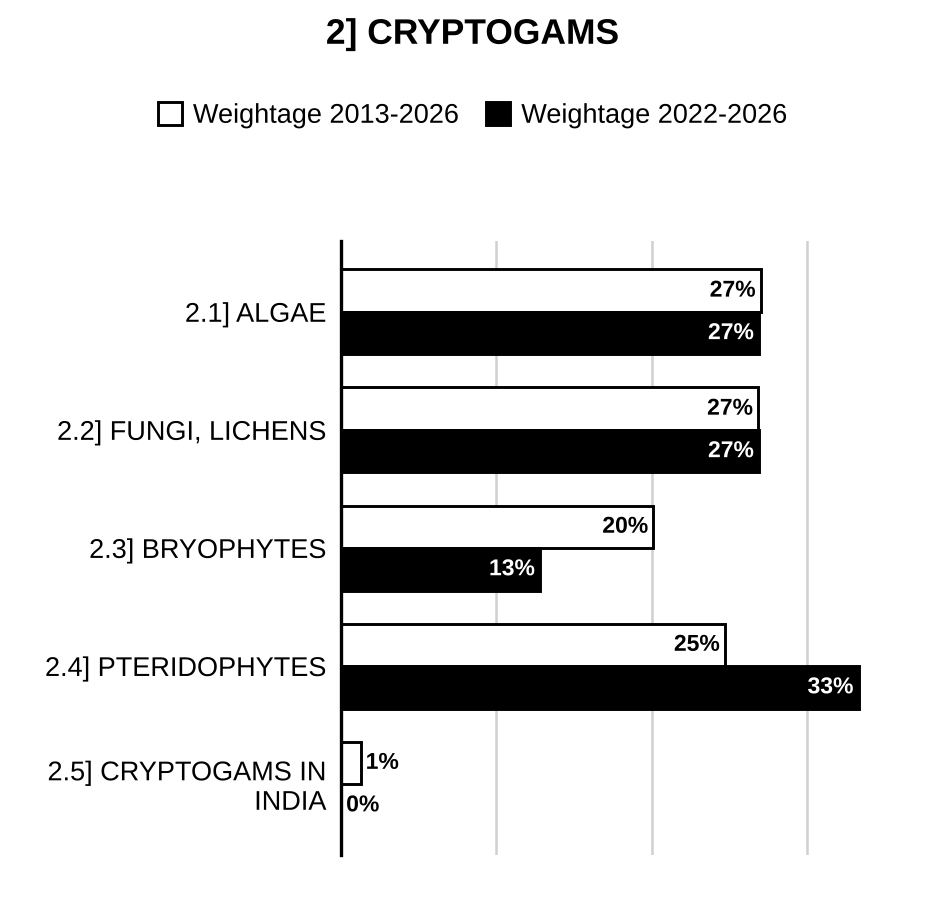
2.1] Algae
57 questions
Blue-green algae are also considered as bacteria. Discuss their major similarities with bacteria. [2026/10m/150w/1a]
Describe the salient features and economic importance of Laminariales. [2026/15m/2b]
How does heterocyst differ from vegetative cell? Mention the factors controlling its formation and add a note on functions of heterocysts. [2025/10m/150w/1b]
Describe the ranges of thallus organization in the members of Chlorophyceae. [2025/15m/3b]
Enumerate the beneficial and harmful effects of algae. Add a note on their commercial cultivation. [2024/20m/3a]
State the distinguishing features of Cyanophyceae. Discuss the phylogeny and affinities of Cyanophyceae with other groups. [2023/10m/150w/1c]
What is chloroplast? Describe the fine structure of chloroplast in Chlorophyceae. [2022/10m/150w/1d]
Give an elaborate account of the use of algae in food and fuel production. [2022/15m/3b]
Explain evolution of sex in algae with suitable examples. [2021/20m/2b]
Explain with the help of schematic diagrams haplontic, diplontic, isomorphic, heteromorphic and triphasic types of life cycles in algae. Give an example of each type. [2021/20m/4a]
Heterotrichous habit in algae. [2020/10m/150w/1c]
Discuss post fertilization changes with suitable diagrams in Polysiphonia. [2020/15m/3c]
Compare the thallus forms of brown and green algae. [2019/15m/3c]
Spermocarp and Cystocarp. [2018/10m/150w/1d]
Phycobiliproteins. [2017/10m/150w/1b]
Describe the diplobiontic life cycle of Polysiphonia. [2017/15m/2b]
Ultrastructure of flagella in Algae. [2016/10m/150w/1b]
Describe the characteristic features of Cyanobacteria and mention its role in nitrogen fixation. [2016/15m/2b]
Algae as bioindicators. [2015/10m/150w/1b]
Describe the range of vegetative structures with suitable diagrams in volvocales and their phylogenetic relationships. [2015/20m/2a]
Reproductory organs in Chara. [2014/10m/150w/1c]
Give an account of pigments in Algae. [2014/15m/2b]
Draw well labelled diagrams of the following: V.S. of sporophyte of Polysiphonia. [2014/12.5m/3c]
Different types of life cycles found in algae. [2013/10m/150w/1c]
Give an illustrated account of range of thallus structure in algae. [2012/15m/2c]
Draw well labelled diagrams of the following: Sex organs of Chara. [2011/15m/3c]
Compare the nature of photosynthetic pigments and carbohydrate reserves in Euglenophyta, Bacillariophyta and Phaeophyta. [2009/20m/200w/1d]
Thallus organisation in Chlorophyceae. [2009/20m/200w/4c]
Describe ultrastructure of flagella in Algae. [2007/20m/200w/1b]
Algae as a food, feed and medicine. [2007/20m/2a]
Reproductive stages in Oedogonium. [2007/20m/3a]
How do the following differ from each other: Fungal hyphae and Algal filament. [2007/20m/4a]
Give an account of algae in food industry. [2005/20m/200w/1b]
Monoecious coenobium of Volvox. [2005/20m/4a]
Differentiate between bacteria and cyanobacteria. [2004/20m/200w/1a]
Give an account of algae in industry. [2004/20m/200w/1b]
Classify algae according to V. J. Chapman. Give characters of each class. [2003/20m/200w/1b]
Reproductive structure of Chara. [2003/20m/4a]
Describe the ultra structure and role of heterocyst in blue-green algae. [2002/20m/200w/1c]
Discuss the role of pigmentation and reserved food in the classification of algae. [2001/20m/200w/1b]
What is heterotrichous habit in Algae? Discuss its role in the evolution of terrestrial habit. [2001/60m/4]
Describe the life cycle of Polysiphonia in detail. [2000/60m/3]
With the help of suitable diagrams describe in detail the reproductive organs found in Batrachospermum. Comment on the life cycle. How does the life cycle of Batrachospermum differ from that of Polysiphonia? [1999/20m/200w/1c]
Classification of the class Phaeophyceae is based on various kinds of life cycles. Discuss. Make graphic representation of all types of life cycles. [1999/60m/2]
Carpogonium and Archegonium. [1999/20m/4a]
Desmids and Diatoms. [1999/20m/4c]
Despite their similarities with other bacteria, Cyanophyceae share several morphological, biochemical and biological characters with Rhodophyceae. Enumerate these characters and discuss the significance of this similarity. [1998/20m/200w/1d]
Sexual reproduction in Cystopus as well as Vaucheria is oogamous, yet there are differences in detail. With brief description and appropriate diagrams bring out the differences and also comment upon the mode of nutrition of the two thallophytes. [1998/60m/2]
Describe the characters which indicate that blue-green algae are primitive and ancient members of plant kingdom. [1997/20m/200w/1a]
Describe the reproductive structure in Ectocarpus. [1997/20m/200w/1d]
Describe sexual reproduction in Oedogonium. [1997/15m/3b]
Write short notes on (i) Gemma Cup (ii) Endothecium (iii) Carposporophyte (iv) Apothecium. [1997/20m/4c]
Describe the development of cystocarp in Rhodophyceae. [1996/20m/200w/1c]
Describe the life cycle of a blue green algae and discuss its role in nitrogen economy of the soil. Why it is otherwise called as cyanobacterium? [1996/20m/3a]
Discuss the salient features in the life cycle of Coleochaete and their evolutionary significance. [1996/20m/4a]
Write short notes on the following: (i) Apothecium (ii) Elater (iii) Oogonial conceptacle of Fucus (iv) Azolla. [1996/20m/4c]
Describe the alternation of generations in Ectocarpus. [1995/20m/3c]
2.2] Fungi and lichens
50 questions
Enumerate the types of fruiting bodies of Ascomycota and Basidiomycota. Write the various steps of ascus formation in Ascomycetous members with suitable illustrations. [2025/20m/2a]
Describe the five distinct stages in the life cycle of Puccinia graminis with suitable diagrams. [2024/20m/2a]
What are myxomycetes? Outline the life cycle of a typical myxomycete. Mention its protozoa-like and fungus-like characters. [2024/15m/4c]
What is parasexuality in fungi? Explain the mechanism of parasexual cycle. What are the applications of parasexuality? [2023/10m/150w/1b]
What is lichen? With suitable diagrams, describe its types and structure. Write a note on the economic importance of lichens. [2023/20m/2a]
What is dikaryotization in fungi? Describe different methods of dikaryotization in basidiomycetes. How does dikaryotization in ascomycetes differ from basidiomycetes? [2022/20m/3a]
Describe the structure and functions of cyphellae and cephalodia in lichens. [2021/10m/150w/1a]
Explain the structure of sporangiophore and dehiscence of sporangium of Rhizopus. [2021/10m/150w/1c]
Structure and reproduction of lichens. [2020/10m/150w/1b]
Describe the life cycle of Puccinia graminis tritici with suitable sketch. [2020/20m/2a]
What are the characteristic features, means of reproduction and economic importance of Ascomycetes? [2019/20m/2a]
Structure and importance of Lichens. [2018/10m/150w/1e]
Parasexuality in Fungi. [2017/10m/150w/1a]
Tetrapolar Heterothallism. [2017/10m/150w/1c]
Salient features of Lichens. [2017/10m/150w/1d]
Physiological relationship of two partners in Lichens. [2016/10m/150w/1e]
Trace the transition from multisporangia to conidia in Mucorales with illustrations and suitable examples. [2016/15m/3b]
Evolution of sexual reproduction in fungi. [2015/10m/150w/1e]
Draw well labelled diagram of the T.S. of Teleutosorus of Puccinia and give a brief description of the same. [2015/15m/3a]
Give an account of sexual fruiting bodies in Ascomycetes. [2015/15m/4b]
Fructifications in Fungi. [2014/10m/150w/1b]
Draw well labelled diagrams of the following: V.S. of apothecium of Peziza. [2014/12.5m/3d]
With the help of suitable diagrams, describe the life cycle of a heteroecious rust. [2013/18m/2a]
Bipolar and Tetrapolar heterothallism in fungi. [2012/12m/150w/1a]
Give an account of Ascus development in fungi with suitable examples. [2012/15m/2b]
Lichens in environment. [2011/10m/1b]
Parasexuality. [2011/10m/1f]
Citing suitable examples, explain the following: How are moulds both a bane and boon for human beings? [2011/20m/2b]
Draw well labelled diagrams of the following: Cleistothecia of Erysiphe and Phyllactinia. [2011/15m/3d]
Give an account of Heterothallism in fungi. [2010/15m/150w/1a]
Discuss ecological significance of Lichens. [2010/20m/2a]
Distinguish clearly between Keratinophilic and Thermophilic fungi. [2010/20m/2b]
Five different types of spores are produced by the rust fungi. Mention their names and their salient points of distinction from each other. [2010/15m/4c]
Compare the methods of asexual and sexual reproduction in Zygomycota, Ascomycota and Basidiomycota. [2009/20m/200w/1c]
Fructifications in cup-fungi. [2009/20m/200w/3b]
Enumerate economic uses of fungi in India. [2007/20m/200w/1d]
Asexual reproduction in Aspergillus. [2007/20m/3b]
How do the following differ from each other: Fungal hyphae and Algal filament. [2007/20m/4a]
Briefly discuss the phyletic position of photobionts. [2006/20m/200w/1b]
Characteristic features of Pythium. [2005/20m/2c]
Description of, conidia formation in Aspergillus. [2005/20m/4b]
Describe in detail the types of Ascocarps (Fruit bodies) in Ascomycotina and how they help in classification. [2004/20m/2c]
With the help of suitable [?] describe the life cycle of Aspergillus and discuss the economic importance of this genus. [2003/60m/2]
Describe the mode of sexual reproduction in yeast. [2001/30m/2a]
Describe the life cycle of Penicillium. [2000/20m/200w/1d]
With the help of diagrams only describe the life history of Puccinia. [1999/30m/3b]
Sexual reproduction in Cystopus as well as Vaucheria is oogamous, yet there are differences in detail. With brief description and appropriate diagrams bring out the differences and also comment upon the mode of nutrition of the two thallophytes. [1998/60m/2]
Describe the various types of fruiting bodies in Ascomycetes. [1997/20m/200w/1c]
Describe the steps of dikaryotization [?] and development of basidium in Basidiomycetes. [1996/20m/4b]
Write short notes on the following: (i) Apothecium (ii) Elater (iii) Oogonial conceptacle of Fucus (iv) Azolla. [1996/20m/4c]

Preparing for Prelims too?
Our UPSC Prelims Topic-wise PYQ eBook covers every Prelims question with detailed explanations, so you can see exactly where UPSC asks from.
View the BookDownload Free Sample2.3] Bryophytes
50 questions
What are the major characteristics of Anthocerotopsida? Describe the gametophytic and sporophytic generations of Anthoceros. [2026/20m/2a]
Discuss how progressive sterilization of sporogenous tissue occurs in bryophytes, with suitable diagrams and examples. [2025/20m/3a]
Mention ecological and economic significance of bryophytes. [2024/10m/150w/1c]
Give the general characteristics of bryophytes. Enlist the resemblances and differences of bryophytes with pteridophytes. [2021/10m/3c]
Elaters and their significance. [2020/10m/150w/1d]
Draw a well labelled longitudinal sectional view of the structure of mature sporogonium of Anthoceros. [2020/10m/150w/1e]
Alternation of heteromorphic generations in Bryophytes. [2019/10m/150w/1d]
Draw a well labelled longitudinal sectional view of the structure of capsule of Funaria. [2019/10m/150w/1e]
Peristome. [2017/10m/150w/1e]
Make a comparison of Hepaticopsida, Anthocerotopsida and Bryopsida classes of Bryophyta with special reference to sporophytes only. [2017/15m/3b]
Discuss the evolution of Sporophyte in Bryophytes. [2016/20m/3a]
Draw well labelled diagram of the L.S. of Anthoceros sporophyte. Discuss the evolutionary significance of Anthoceros also. [2015/15m/2c]
Describe the method of vegetative reproduction in Bryophytes. [2015/10m/4c]
With the help of suitable diagrams describe the evolution of sporophyte in Bryophytes. [2014/20m/2a]
Draw well labelled diagrams of the following: Male thallus with antheridiophore of Marchantia. [2014/12.5m/3a]
Draw well-labelled diagrams of the following: LS of antheridiophore of Funaria. [2013/12.5m/3a]
Draw well-labelled diagrams of the following: LS of sporophyte of Anthoceros. [2013/12.5m/3b]
Draw well-labelled diagrams of the following: Female thallus with archegoniophore of Marchantia. [2013/12.5m/3d]
Elaters. [2012/12m/150w/1d]
Draw well labelled diagrams of the following: L.S. of sporophyte of Riccia. [2012/15m/3a]
Draw well labelled diagrams of the following: L.S. of sporophyte of Funaria. [2012/15m/3b]
Draw well labelled diagrams of the following: L.S. capsule of Funaria. [2011/15m/3b]
Discuss the role of amphibious plants in the evolution of land plants. [2011/15m/4a]
Differentiate the archegonium of Funaria from that of Anthoceros. [2010/20m/4a]
Heterotrichous habit of growth in moss protonema. [2009/20m/200w/2a]
Differences between hydroids and leptoids. [2009/20m/200w/2b]
Structure of chloronema and caulonema cells in mosses. [2009/20m/200w/2c]
How do the following differ from each other: Sporophytes of Anthoceros and Funaria. [2007/20m/4b]
Highlight the uniqueness of the cell structure of Anthoceros. [2006/20m/200w/1c]
Write about Bryophytes as indicators of mineral enrichment. [2005/20m/200w/1d]
Range of thallus organization in Marchantiales. [2005/20m/2a]
Draw well labeled diagram of V.T.s. thallus of Anthoceros passing through Androecia (no description). [2005/20m/3c]
Mention the indirect uses of Bryophytes. [2004/20m/200w/1d]
Evolution of Sporophyte in Bryophytes. [2004/20m/3c]
Vegetative reproduction in Bryophytes. [2003/20m/4b]
Describe the economic importance of bryophytes giving suitable examples. [2002/20m/200w/1d]
What is apogamy? Describe the structure and arrangement of sex organs in bryophytes with the help of suitable diagrams. [2002/60m/3]
Discuss the evolutionary trends of sporophytes in Bryophytes. [2001/60m/3]
With the help of suitable diagram describe the saprophyte of Funaria. [2000/20m/200w/1c]
Differentiate between the spore bearing organs of Anthoceros and Polytrichum. Draw neat labelled diagrams. [1999/20m/200w/1d]
Carpogonium and Archegonium. [1999/20m/4a]
Liverworts and Mosses. [1999/20m/4d]
Bryophytes function as “indicator plants” and as “element indicators”. Justify. [1998/20m/200w/1a]
Explain why Anthocerotae is considered a synthetic group. [1998/30m/4a]
What is retrogressive origin of Saprophytes in Bryophytes? [1997/20m/200w/1b]
Describe the leaf structure of Polytrichum. [1997/15m/3d]
Write short notes on (i) Gemma Cup (ii) Endothecium (iii) Carposporophyte (iv) Apothecium. [1997/20m/4c]
Trace the evolutionary trends in the gametophytes in bryophytes. [1996/20m/200w/1d]
With examples discuss how progressive sterilization of sporogenous tissue occurs in bryophytes. [1995/20m/200w/1d]
Describe the life history of Sphagnum. [1995/20m/4a]
2.4] Pteridophytes
50 questions
Compare the sporophyte of Psilotum and Equisetum. [2026/15m/4c]
How many types of gametophytes are found in Lycopodium? Why is it difficult to collect such prothalli in nature? [2025/10m/150w/1a]
What are eusporangiate and leptosporangiate sporangia? Classify the sori based on the mode of development of sporangia in ferns, with suitable illustrations. [2025/15m/4b]
Draw the life cycles of a homosporous and a heterosporous pteridophyte. How do they differ? Which is more evolved and why? [2024/15m/3b]
Illustrate the plant body of Psilotum. Add a note on the primitive characters of Psilotum which indicate its close relation to extinct group Psilotales. [2024/15m/4b]
What is stele? Give an illustrated account of various types of steles observed in pteridophytes. [2023/15m/4c]
Describe the structure of strobilus of Equisetum with the help of a well-labelled diagram. [2022/10m/150w/1c]
Describe the development of male and female gametophytes of Marsilea. [2022/15m/3c]
Write a detailed account of homospory, anisospory, incipient heterospory and heterospory. Elaborate on the evolution from homospory to heterospory in relation to geological time. [2022/20m/6a]
Describe stelar diversity in vascular cryptogams along with its evolutionary importance. [2021/20m/4b]
Give an illustrated account of various types of stelar structures seen in Pteridophytes. [2020/15m/2b]
Compare and contrast the sporocarp of Marsilea and Salvinia. [2020/15m/3b]
What are the critical features of heterospory and seed habit in pteridophytes. [2019/15m/2c]
Comment on the structure and ecological and physiological importance of leaf of Azolla. [2019/15m/3b]
Comment on morphological nature of sporocarp in Marsilea. [2018/15m/2c]
Describe the evolution of Stellar System in Pteridophyta with proper diagrams. [2017/20m/4b]
Write down the characters of pteridophytes resembling bryophytes and gymnosperms. [2016/15m/2c]
Draw well labelled diagrams of the following: V.L.S. of Marsilea sporocarp. [2014/12.5m/3b]
Types of protosteles. [2013/10m/150w/1d]
Draw well-labelled diagrams of the following: Section through a sorus of fern. [2013/12.5m/3c]
Draw well labelled diagrams of the following: L.S. of strobilus of Selaginella. [2012/15m/3c]
Draw well labelled diagrams of the following: H.L.S. of Marsilea sporocarp. [2012/15m/3d]
Eusporangiate and Leptosporangiate ferns. [2012/12m/4d]
Draw well labelled diagrams of the following: L.S. cone of Selaginella. [2011/15m/3a]
Giving suitable reasons, describe inter-alia evolutionary status of Psilotum, Selaginella and Marsilea. [2011/15m/4d]
Comment on Heterospory in Pteridophytes and its evolutionary significance. [2010/15m/150w/1c]
Draw labelled diagrams of transverse and longitudinal sections of sporocarp of Marsilea. [2010/20m/2c]
Write a note on Psilotum as a living fossil. [2010/20m/3c]
Describe and draw labelled diagrams of steles in pteridophytes with examples. [2007/20m/200w/1c]
How do the following differ from each other: Prothalli of Selaginella and Nephrolepis. [2007/20m/4c]
Draw neat and well-labelled diagrams to show: L.S. sporocarp of Marsilea. [2006/20m/4c]
Evolution of seed habit in Pteridophytes. [2005/20m/2b]
Write a critical note on male gametophyte of Selaginella. [2005/20m/3a]
Differentiate between homospory and heterospory. [2004/20m/2a]
Give an account of Rhynia. [2004/20m/2b]
Sporocarp of Marsilea. [2004/20m/3a]
Discuss evolution of steles in Pteridophytes. [2003/20m/200w/1c]
What is heterospory? Discuss seed habit in pteridophytes giving suitable examples. [2002/20m/200w/1b]
Describe the structure and evolutionary significance of Rhynia. [2001/20m/200w/1d]
Describe the sexual reproduction in Equisetum. [2000/20m/200w/1a]
Write an account of different types of steles found in pteridophytes with the help of suitable diagrams. Arrange these steles in an evolutionary sequence. [1999/20m/200w/1b]
External morphology of Psilotum and Equisetum. [1999/20m/4b]
Why is Dryopteris called walking fern? Why are Azolla and Marsilea lumped with other ferns in the order Filicales? [1998/20m/200w/1b]
Describe different types of vascular steles in Lycopodium. [1997/15m/3a]
Describe the structure of Psilotum. [1997/20m/4a]
Describe Puri and Garg’s theory of morphological nature of Marsilea sporocarp. [1997/20m/4b]
Describe the structure and discuss the morphological nature of the spike of Ophioglossum. [1996/20m/3c]
Discuss the significance of heterospory seen in Selaginella. [1995/20m/200w/1b]
Describe the morphological nature of the sporocarp of Marsilea. [1995/20m/3b]
Write notes on the following: (i) Mycotoxins (ii) Megasporophyll of Isoetes (iii) Reproductive structures of Chara (iv) Heterothallism in Fungi. [1995/20m/4c]
2.5] Cryptogams in India
5 questions
Give an account of distribution and economic importance of Bryophytes in India. [2018/15m/4a]
Cryptogams. [2011/10m/1e]
Distribution of bryophytes and pteridophytes in deciduous and evergreen forests in India. [2007/20m/2b]
How do the following differ from each other: Cryptogams from Archegoniates. [2006/20m/2b]
How do the following differ from each other: Sporophyte from Gametophyte (in lower organisms) [2006/20m/2c]

Strengthen your GS papers
Our UPSC Mains Topic-wise & Year-wise PYQ eBook (2013–2026) maps every GS question to the syllabus, so you know what UPSC asks and how often.
View the BookDownload Free Sample« Previous: Microbiology and Plant Pathology | Next: Phanerogams »
Back to: Botany Optional PYQs – Topic-wise | Also see: Botany Optional year-wise question papers
Last updated: 31 October 2026