
Here are all 97 Developmental Biology questions asked in UPSC Zoology Optional Paper II from 2004 to 2026, arranged under the 6 topics of the official syllabus. Within each topic the latest questions come first.
Each question ends with a code such as [2024/15m/3b] – the year, the marks, the word limit (where UPSC set one) and the question number in the paper.
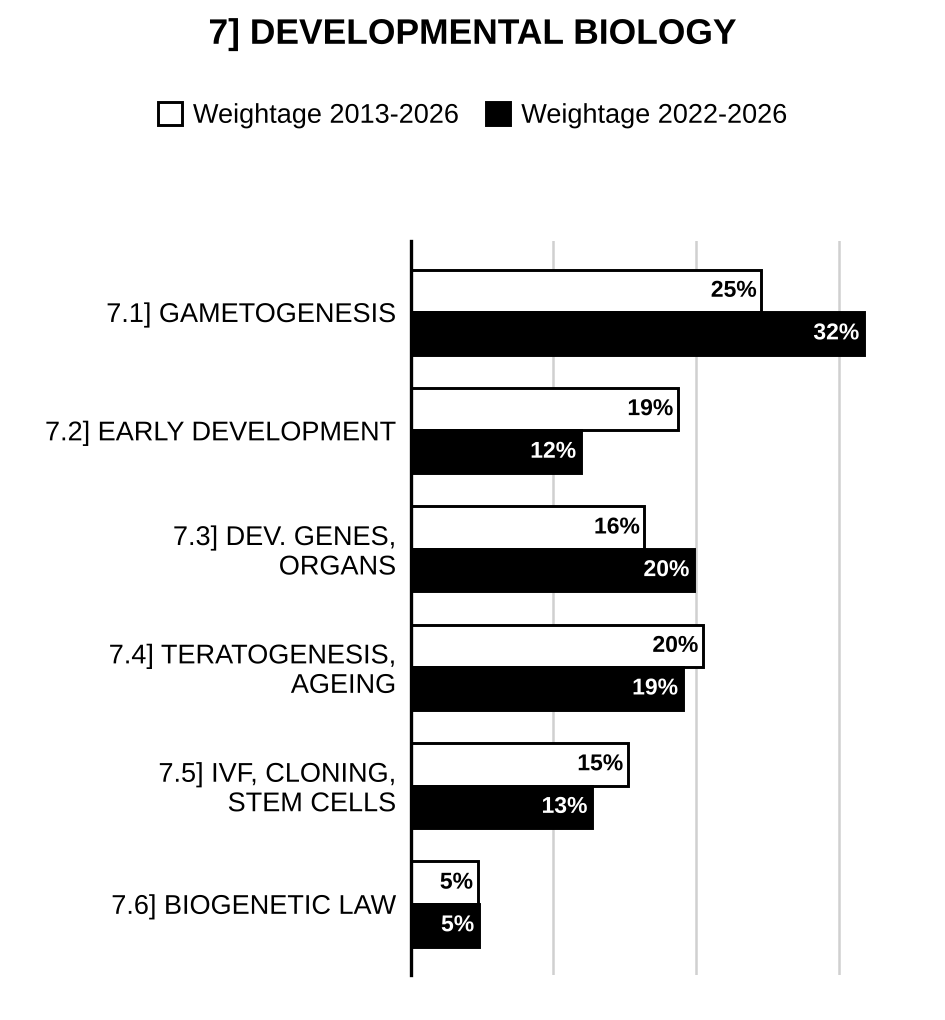
7.1] Gametogenesis and fertilization
19 questions
Sperm capacitation during fertilization. [2026/10m/150w/5e]
Block to polyspermy. [2025/10m/150w/5a]
Describe the stages of fertilization in chick with diagram. [2025/20m/8a]
Describe the process of spermatogenesis. Add a note on the role of Golgi bodies in the formation of acrosome. [2024/20m/7a]
Write a note on acrosome reaction during fertilization. [2023/10m/150w/5c]
Write in detail three phases of oogenesis in human females. [2023/15m/7c]
Explain the mechanism of spermatogenesis in mammals with suitable diagram. [2022/15m/8b]
What is sperm capacitation? Describe the method of mammalian sperm capacitation in vitro. [2021/10m/150w/5e]
What is primordial germ cell? With the help of suitable diagram, discuss the process of oogenesis. [2021/15m/8c]
“Calcium is an initiator of cortical granules reaction.” Explain. [2020/10m/5e]
Explain in detail about the events involved in the transformation of spermatid into sperm. Comment on why you consider these changes as essential. [2018/15m/4b]
Describe the role of fertilizin and anti-fertilizin interactions during fertilization. [2018/10m/5b]
Explain the process of oögenesis. Discuss the importance of meiotic arrest during oögenesis. [2017/15m/6c]
What is the composition of semen? Explain briefly about in vitro and in vivo capacitation of mammalian sperm. [2016/15m/8c]
Describe the role of neuro-endocrine factors and Sertoli cell secretions on spermatogenic functions of human seminiferous tubules. [2013/20m/6c]
Differentiate between the mechanism of capacitational changes in the mammalian sperm under in vitro and in vivo conditions. How are these sperms stored and used in artificial insemination and in vitro fertilization? [2012/15m/1d]
Give the chemical composition of mammalian semen (use humans as example). How does seminal fluid contribute to sperm survival, capacitation and acquisition of fertilizing ability? [2012/15m/5a]
Explain the changes undergone by sperm in the female reproductive tract of mammals. [2010/18m/8a]
Oogenesis in a mammal. [2009/20m/200w/8b]
7.2] Early development and morphogenesis
19 questions
Explain the concept of body axis formation during embryonic development with suitable example. [2026/15m/6c]
Fate map of frog embryo. [2025/10m/150w/5b]
What are homeotic genes? Explain their role in body axis formation in chick. [2025/15m/7c]
(i) Gastrulation in frog (ii) Biogenetic law. [2024/10m/150w/5d]
What are morphogens? Describe the cellular differentiation during morphogenesis. [2021/20m/8a]
Illustrate the process of development during gastrulation in a chick embryo. [2019/15m/8c]
With particular reference to Gradient theory, describe how polarity is established during embryonic development. Comment on its significance. [2018/15m/6c]
What are fate maps? Describe the methods of fate maps construction with reference to frog or chick. [2018/15m/7c]
What is a morphogen? Explain its role in embryonic development. [2017/10m/5b]
What is an ‘Organiser’? Explain the role of Organiser in axis formation in amphibians. [2017/20m/7a]
Explain the fate map of frog with a neat labelled diagram. Write a note on its contribution in understanding cell lineage and development process. [2016/20m/7b]
Describe the process of formation of three germinal layers. Draw sequential diagrams and narratives to show formation of eye in frog or chick. [2014/15m/6b]
What are morphogens? How do they function during various stages of morphogenesis (use frog/chick as an example)? [2012/20m/4b]
Construct and compare the ‘fate maps’ of gastrula of frog and chick. Tabulate the tissues/organs that differentiate and develop from the three germinal layers. [2011/20m/2b]
Grey crescent. [2010/15m/150w/5e]
Gastrula formation. [2006/15m/8a]
Determinate and indeterminate cleavages. [2006/15m/8c]
What are fate maps? Give methods of drawing them. Describe the fate maps of chick embryo. [2005/60m/8]
Primitive streak. [2004/15m/8a]
7.3] Developmental genes and organogenesis
18 questions
Significance of placenta in maintaining the pregnancy in human females. [2026/10m/150w/5d]
Diagrammatically describe the steps of development of heart in mammals. [2025/15m/6c]
What are homeotic genes? Explain their role in body axis formation in chick. [2025/15m/7c]
(i) Stem cells (ii) Types of placenta among mammals. [2024/10m/150w/5e]
Describe the organogenesis of eye. [2024/15m/8c]
Describe the structure and functions of mammalian placenta. [2022/10m/150w/5b]
Give an account of the morphological and histological types of placenta. Add a note on the physiological function of mammalian placenta. [2018/15m/8c]
What are homeotic genes? Explain with the help of suitable examples. [2017/10m/5e]
Explain the term and structural details of placenta in a eutherian mammal. Add a note on its significant role in pregnancy. [2016/15m/6c]
Describe the process of formation of three germinal layers. Draw sequential diagrams and narratives to show formation of eye in frog or chick. [2014/15m/6b]
What is Hox gene? Give the properties of Hox Gene and its cluster. What role do they play in humans? [2013/10m/5c]
Using villi as the basis of classification, describe the various types of placenta in eutherian mammals. Add a note on placental hormones and their role in pregnancy and birth. [2013/20m/7b]
Trace the development of heart from the primordial cells during development of chick. [2011/15m/5c]
Write a note on homeotic genes in the control of early development. [2010/24m/8c]
Importance of placenta. [2006/20m/5c]
Invasiveness of placenta. [2005/20m/5a]
Give short descriptions of any three of the following: Organogenesis in the frog embryo. [2004/20m/5c]
Indeciduate Placenta. [2004/15m/8b]

Preparing for Prelims too?
Our UPSC Prelims Topic-wise PYQ eBook covers every Prelims question with detailed explanations, so you can see exactly where UPSC asks from.
View the BookDownload Free Sample7.4] Cell interactions, teratogenesis and metamorphosis
22 questions
Define teratogenesis. Illustrate how teratogens interfere with early embryonic development. [2026/15m/7c]
What do you mean by teratogenesis? Explain the genetic and induced teratogenesis. [2024/15m/6c]
Explain neoteny phenomenon taking suitable example. How is it different from paedogenesis? [2023/15m/8c]
Describe the hormonal regulation of metamorphosis in amphibians. [2022/15m/8c]
What are gap junction proteins? Discuss the roles of connexins in cellular interaction. [2021/15m/8b]
What is metamorphosis? Explain the role of thyroxine in the regulation of amphibian metamorphosis. [2020/15m/7c]
Define programmed cell death. Explain the molecular mechanism and significance of apoptosis during early embryonic development. [2020/20m/8a]
Give an account of the impact of drugs on teratogenesis. [2018/15m/7b]
What is neoteny? How does it occur? Explain this phenomenon with suitable examples. [2016/10m/5e]
What is metamorphosis? Differentiate between retrogressive and progressive metamorphosis, with figures and examples. How are they regulated? [2015/15m/6b]
Give evidence in favour of mitochondrial theory of aging. What are its limitations? [2014/10m/5d]
What is paedomorphosis? How does it differ from Neoteny? Add a note on its significance in evolution of Homo sapiens. [2014/15m/7a]
With suitable illustrations delineate the role of triiodothyronine and tetraiodothyronine in amphibian metamorphosis. [2013/10m/5e]
Discuss the interactive role of thyroxine and prolactin during various phases of growth and differentiation in amphibian metamorphosis. [2012/20m/6a]
Enumerate the factors responsible for cell senescence and death. [2012/20m/7a]
With suitable examples, compare genetic and induced teratogenesis. [2011/20m/7b]
Define teratogenesis and write a note on “Thalidomide Syndrome”. [2010/18m/8b]
Explain the process of cellular aging and cell death. [2009/30m/7a]
Regeneration. [2007/20m/5c]
Teratogenesis. [2007/20m/5d]
Ageing. [2006/15m/8d]
Give short descriptions of any three of the following: Regeneration. [2004/20m/5d]
7.5] IVF, cloning and stem cells
14 questions
(i) Stem cells (ii) Types of placenta among mammals. [2024/10m/150w/5e]
Describe various techniques of in vitro fertilization. [2023/15m/6c]
What is stem cell? Discuss the types of stem cells and their application in therapeutic uses in human. [2022/20m/8a]
What are embryonic stem cells? Discuss the isolation, differentiation and therapeutic applications of embryonic stem cells. [2020/15m/6c]
Give a brief account of in vitro fertilization (IVF) techniques used for mammals. [2019/20m/8a]
What are stem cells? Discuss their sources, types and applications in human welfare. [2017/15m/8c]
Enumerate the clinical applications of stem cells. [2016/10m/5d]
Differentiate between totipotent and multipotent cells with suitable examples. Explain the use of stem cells in human diseases. [2015/20m/7b]
What is I.V.F.? Make a flow chart of steps in I.V.F. Add a note on its applications. [2014/10m/5c]
Differentiate between the mechanism of capacitational changes in the mammalian sperm under in vitro and in vivo conditions. How are these sperms stored and used in artificial insemination and in vitro fertilization? [2012/15m/1d]
Write the sequence of stages for production of clonal and non-clonal embryos by in vitro fertilisation (IVF) for transfer in recipient female(s)/surrogate(s). [2011/20m/3b]
Identify the resources and techniques for procuring and maintaining stem cells, and their cell lines in culture. Add a note on their biomedical applications. [2011/20m/4c]
Types of stem cells and their applications. [2009/20m/5b]
In vitro fertilization. [2005/20m/5d]
7.6] Biogenetic law
5 questions
(i) Gastrulation in frog (ii) Biogenetic law. [2024/10m/150w/5d]
Define biogenetic law. Write the characteristics of Haeckel’s theory of recapitulation. [2022/10m/150w/5e]
Ontogeny recapitulates phylogeny. [2019/10m/5e]
Haeckel propounded the concept (law), “Ontogeny recapitulates phylogeny”. Give evidence and examples that negates it or favours it. [2014/15m/8a]
Bear’s law. [2006/15m/8b]

Strengthen your GS papers
Our UPSC Mains Topic-wise & Year-wise PYQ eBook (2013–2026) maps every GS question to the syllabus, so you know what UPSC asks and how often.
View the BookDownload Free Sample« Previous: Physiology (with Special Reference to Mammals) | Next: Other Questions »
Back to: Zoology Optional PYQs – Topic-wise | Also see: Zoology Optional year-wise question papers
Last updated: 31 October 2026