
Here are all 275 Non-Chordata and Chordata questions asked in UPSC Zoology Optional Paper I from 2004 to 2026, arranged under the 17 topics of the official syllabus. Within each topic the latest questions come first.
Each question ends with a code such as [2024/15m/3b] – the year, the marks, the word limit (where UPSC set one) and the question number in the paper.
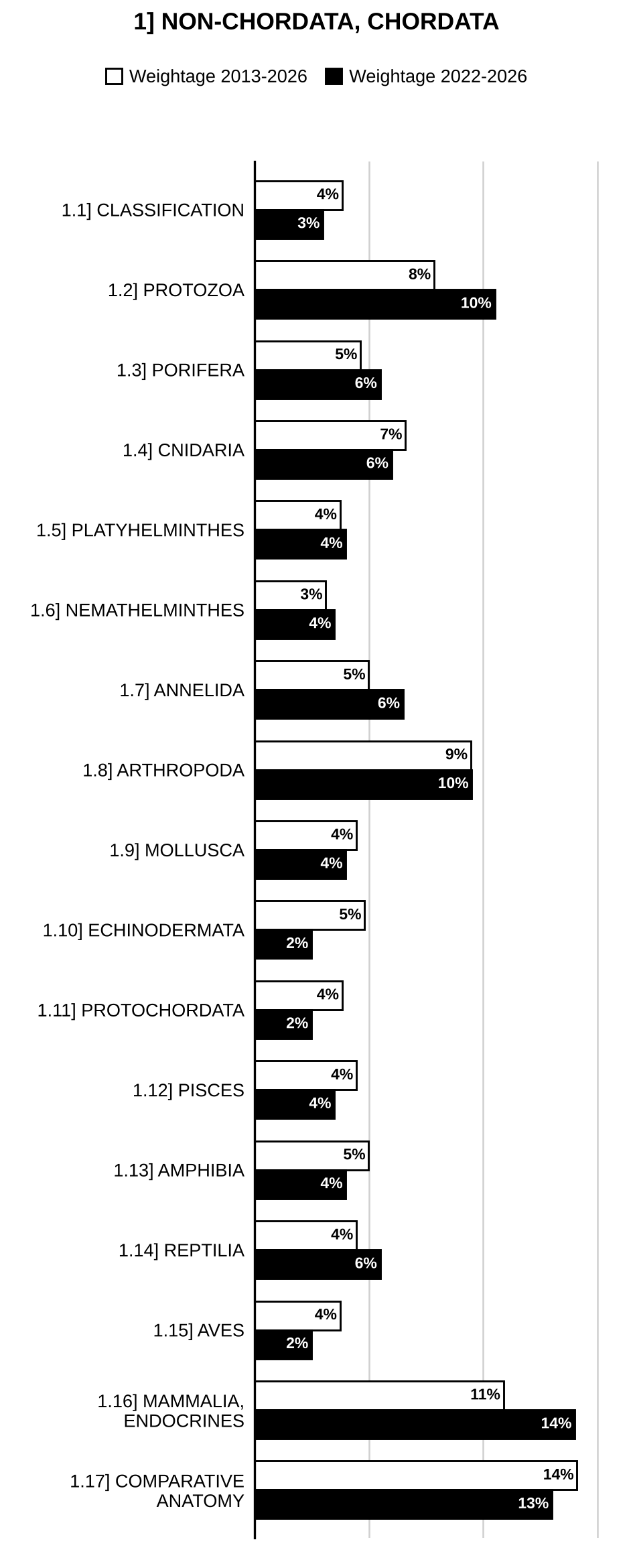
1.1] Classification and relationships of phyla
20 questions
Concept and organization of Coelom. [2024/10m/150w/1a]
Evolutionary status of Onychophora. [2023/10m/150w/1c]
What is meant by symmetry? Write about different types of symmetry in animals. [2022/10m/150w/1b]
Protostomes and Deuterostomes. [2018/10m/150w/1a]
Peripatus. [2018/10m/150w/1b]
Differentiate between major and minor phyla. Describe the salient features of any one minor phylum. [2017/10m/150w/1a]
What are Bilateria? Explain the theories of origin of Bilateria. [2017/15m/2c]
Define coelome. Write the general features and examples of an acoelomate, a pseudocoelomate and a coelomate animal. [2016/15m/4c]
What are minor phyla? Enlist minor phyla with suitable examples. [2015/10m/150w/1a]
“Balanoglossus is the forerunner of chordates”–Justify the statement. [2014/15m/2a]
Compare the tornaria larva of Balanoglossus with bipinnaria larva of echinoderm. Give reasons for including Hemichordata as a distinct phylum of invertebrates. [2012/30m/3b]
What was the need to create Parazoa against Porifera when the latter existed? [2011/15m/150w/1a]
Differentiate between open and closed circulatory systems. [2011/30m/4a]
Symmetry in non-chordates. [2009/20m/200w/1a]
Affinities and systematic position of Balanoglossus. [2009/20m/200w/2c]
Various types of symmetry found in animal kingdom, with suitable examples. [2007/20m/200w/1a]
Explain the status of Protista and parazoa giving their characteristics with suitable example. [2007/60m/2]
Characteristics of Acoelomata and Coelomata with suitable examples and well-labelled diagrams. [2006/20m/200w/1a]
Describe the salient features of phylum Hemichordata. Classify the phylum up to classes giving their characteristics and suitable examples. [2006/60m/2]
Protista and Parazoa and their status. [2004/20m/200w/1a]
1.2] Protozoa
17 questions
Explain different ways of locomotion in Protozoa citing suitable examples. [2026/15m/3b]
Discuss the various modes of nutrition in protozoa. [2025/15m/3c]
Hepatic Schizogony. [2024/10m/150w/1d]
Define Autogamy. Explain the mechanism of autogamy in Paramecium. Also give its significance. [2024/15m/2b]
Erythrocytic schizogony. [2023/10m/150w/1a]
Define conjugation. Explain the mechanism of conjugation in Paramecium. Also give its significance. [2023/20m/2a]
Explain asexual and sexual modes of reproduction in Paramecium. [2022/20m/2a]
Give an illustrated account of life cycle of Leishmania. [2021/15m/4c]
Gamontogamy in Monocystis. [2020/10m/150w/1a]
Give an account of Nutrition in Protozoa. [2019/20m/2a]
Give an illustrated account of the life cycle of Plasmodium vivax. [2018/15m/3c]
Give an account of Conjugation in Paramecium and its significance. [2016/10m/150w/1d]
Give an account of Asexual and sexual life phases of Plasmodium vivax in their hosts. [2016/20m/4a]
Give an account of locomotion in Protozoa indicating locomotor organelle with suitable examples. [2015/15m/2a]
Describe the organs and mode of locomotion in Paramoecium. [2014/10m/150w/1a]
Provide diagrammatic representation of the stages of conjugation in Paramoecium and comment on its autogamy. [2011/15m/150w/1b]
Reproduction in protozoa. [2005/20m/200w/1c]
1.3] Porifera
11 questions
Structure of gemmules in Porifera and their importance. [2026/10m/150w/1a]
Give an illustrated account of reproduction in sponges. [2025/15m/2b]
What are the skeletal elements of sponges? Describe the structure and types of various skeletal elements found in sponges. [2023/15m/4c]
Describe different types of canal system found in porifera. Also mention their functions. [2022/15m/3b]
Write notes in about 150 words each for Q. Nos. 1(a) to 1(d) and answer Q. No. 1(e): Canal system in sponges. [2021/10m/150w/1a]
Skeleton in sponges. [2020/10m/150w/1b]
General characters and classification of Porifera. [2019/10m/150w/1a]
Explain various types of canal systems in Porifera. Also give their importance. [2016/20m/2a]
Give an elaborate account of canal system in Porifera and discuss the taxonomic importance of spicules. [2013/25m/3b]
Enumerate various stages of sexual reproduction in Sycon. Provide diagrammatic representation in support of your answer. [2010/30m/2a]
Canal system in Porifera. [2006/20m/200w/1c]
1.4] Cnidaria
17 questions
Metagenesis. [2025/10m/150w/1a]
What are coral reefs? Describe the different theories of coral reef formation. [2024/15m/3b]
What is Polymorphism? Explain it with respect to life cycle of Obelia. [2024/15m/4b]
Statocyst of medusa. [2023/10m/150w/1b]
“Cnidoblasts as defensive organs in coelenterates”. Justify. [2022/10m/150w/1d]
Write notes in about 150 words each for Q. Nos. 1(a) to 1(d) and answer Q. No. 1(e): Nematocysts of Aurelia. [2021/10m/150w/1b]
What is alternation of generations? Illustrate this phenomenon with life history of Obelia. [2021/15m/2b]
Describe different kinds of coral reefs on the basis of their formation. [2020/10m/150w/1c]
Metagenesis – Does it differ from alternation of generations? [2019/10m/150w/1b]
With the help of labelled diagrams only, explain the structure and different stages of the life cycle of Obelia (no description is required). With reference to Obelia, also explain the polymorphism and the status of metagenesis. [2018/15m/4c]
Give the structure of cnidoblast, the defensive organ in Cnidaria. Also, describe its mechanism of action. [2017/15m/2b]
What are corals and coral reefs? Describe different types of coral reefs and their formation indicating different theories. [2015/15m/2b]
Give an account of the structure of cnidoblast and various types of nematocysts of Hydra. [2014/10m/150w/1b]
Give an account of coral reefs, their constituent compartments and significance. [2013/25m/4a]
What are coral reefs? Enlist their geographical distribution, types and threats being faced by them. [2010/20m/200w/1a]
Life history of Obelia. [2009/20m/200w/1b]
Give a detailed account of Polymorphism in Coelenterates. Add a note on Metagenesis. [2005/60m/3]
1.5] Platyhelminthes
8 questions
Explain the general features, life cycle and pathogenicity of Fasciola. [2024/20m/2a]
Explain the general features, life cycle and pathogenicity of Taenia. [2023/20m/3a]
With the help of labelled diagrams only, explain the different larval stages in the life cycle of Fasciola hepatica (No description is required). [2020/15m/3c]
Parasitic adaptations in Platyhelminthes. [2019/10m/150w/1c]
Give general characters of phylum platyhelminthes. Classify it giving the main features and examples of each class. [2016/15m/2b]
Describe the life cycle of Taenia solium through a labelled diagram only and discuss its parasitic adaptations. [2013/25m/4b]
Fasciola, Taenia and Ascaris are adapted to parasitic mode of life. Define the convergent and divergent strategies employed by these parasites for successful existence and propagation. [2012/20m/4a]
Describe the morphological features of Fasciola hepatica. Write an account of its life history in detail with a note on mode of infection. [2004/60m/3]
1.6] Nemathelminthes
8 questions
Describe the general features and life cycle of Ascaris. [2023/15m/4b]
Explain habitat, habits, general features and life cycle of Wuchereria. [2022/20m/3a]
Give an account of the structure and life cycle of Wucheraria bancrofti. Add a note on the pathogenecity and control of the disease caused by this parasite. [2018/15m/2b]
Draw a transverse sectional diagram of female Ascaris and label it. [2014/10m/150w/1c]
What is Parasitism? Give an account of the life cycle of Wucheraria bancrofti and add a note on the pathogenicity and control of the disease caused by this parasite. [2014/15m/2b]
What is filariasis? Discuss the structure and life-history of filarial worm. Highlight its pathogenic aspects and preventive measures. [2013/25m/7b]
Fasciola, Taenia and Ascaris are adapted to parasitic mode of life. Define the convergent and divergent strategies employed by these parasites for successful existence and propagation. [2012/20m/4a]
What are the various hosts in which Wuchereria bancrofti completes its life cycle? Describe various stages of its life cycle along with the diagram. [2010/30m/2b]
1.7] Annelida
12 questions
Write peculiar characters of phylum Annelida. Classify this phylum into different classes and mention features of each class with examples. [2026/20m/2a]
Describe the general features and life history of Nereis. [2026/15m/3c]
Describe the different stages of life cycle of Pheretima with the help of suitable diagrams. [2025/15m/3b]
Describe the different stages of life cycle of leech with the help of suitable diagram. [2023/15m/2b]
Write notes in about 150 words each for Q. Nos. 1(a) to 1(d) and answer Q. No. 1(e): Trochophore larva and its evolutionary significance. [2021/10m/150w/1c]
Define nephridium. Describe the various types of nephridia found in Pheretima. [2021/15m/3b]
With the help of suitable diagrams, describe the different stages of life cycle of Nereis. [2020/15m/2b]
Describe the external features of Nereis. What is Heteronereis and how does it differ from Nereis? Comment upon Metamerism in Annelida. [2019/15m/3b]
Polychaetes exhibit different modes of life adapted to habitats. Elaborate the statement. [2015/10m/150w/1e]
Describe locomotion in Hirudinaria. [2013/10m/150w/1c]
What is metamerism? Describe its importance in invertebrates. [2009/30m/3b]
Describe the salient features of phylum Annelida. Classify the phylum upto orders – giving their characteristics and suitable examples. [2004/60m/2]
1.8] Arthropoda
29 questions
Describe the general features, distribution and social organization in honey bees. [2026/15m/4c]
Book lungs. [2025/10m/150w/1b]
Describe the general features, distribution and social organization in termites. [2025/15m/2c]
Metamorphosis in Insects. [2024/10m/150w/1b]
Describe the different larval forms of Crustaceans with suitable diagrams. [2024/20m/3a]
Describe the respiratory organs and mechanism of respiration in cockroach. [2023/15m/2c]
Structure of visual organs of cockroach. [2022/10m/150w/1a]
What is metamorphosis? Describe the hormonal regulation of metamorphosis in insects. [2021/20m/2a]
With the help of labelled diagrams, describe the mouth parts of house-fly, butter-fly and honey bee. [2020/20m/2a]
Write an account on the Social Behaviour in Apis and Termites. [2019/20m/3a]
Give an illustrated account of different types of mouth parts in insects and write a note on their functional significance. [2018/20m/4a]
Explain the types of metamorphosis in insects and their hormonal regulation. [2017/10m/150w/1c]
Give an account of larval forms in Crustacea with examples and diagrams. Also write a note on the significance of larvae. [2017/20m/2a]
Give an account of Social behavior in Termites. [2016/15m/2c]
Apis is known for social behaviour. Discuss. [2015/10m/150w/1d]
Discuss parasitism in ‘Copepoda’. Comment on structural peculiarities of parasitic copepods. [2015/15m/3a]
Differentiate the structural variation of mouthparts in Insecta diagrammatically and label them. [2014/10m/150w/1e]
Draw a labelled diagram of alimentary canal and salivary apparatus in Periplaneta americana. [2013/10m/150w/1d]
Draw labelled sketches of Alima and Phyllosoma larvae. Identify the neuroendocrine factors that cause metamorphic changes in them. [2012/12m/150w/1a]
Give an illustrated account of interaction of neuroendocrine secretions in promoting metamorphosis in an orthopteran and a lepidopteran insect. Mention the type of metamorphosis that these insects undergo. [2012/20m/2a]
Compare the social organization of termites and honeybees. [2012/12m/150w/5e]
Describe the great departures shown by parasitic forms from the diagnostic features of free living forms among Copepoda. [2011/30m/2a]
Give the salient features of Apterygota and Pterygota. [2011/30m/2c]
Give a brief account of social organisations and determination of ‘castes’ in termites. [2010/20m/6b]
Parasitism in Crustacea. [2009/20m/200w/2b]
Social behaviour of Apis. [2009/20m/200w/4c]
Explain the metamorphosis in insects and its hormonal regulation. [2007/60m/3]
Write a detailed account of modification of mouthparts in insects and support your answer with well-labelled diagrams. [2006/60m/3]
Metamorphosis in insects. [2004/15m/8c]

Preparing for Prelims too?
Our UPSC Prelims Topic-wise PYQ eBook covers every Prelims question with detailed explanations, so you can see exactly where UPSC asks from.
View the BookDownload Free Sample1.9] Mollusca
13 questions
Mention the structure of respiratory organs in Lamellidens and explain the mechanism of respiration in them. [2026/15m/2b]
Torsion and detorsion in gastropods. [2025/10m/150w/1d]
Describe the respiratory organs and mechanism of respiration in Sepia. [2024/15m/4c]
Describe the respiratory organs and mechanism of respiration in Pila. [2021/15m/3c]
Describe the respiratory organs and mechanism of respiration in Unio. [2020/15m/4b]
What do you understand about Torsion and Detorsion in Mollusca? Elucidate. [2019/15m/2b]
Discuss respiration in Mollusca indicating suitable examples. [2017/15m/4b]
Explain phenomenon of Torsion and detorsion in gastropods and also write their significance. [2016/10m/150w/1a]
Describe “Torsion and Detorsion” in Gastropoda. Add a note on the significance of this phenomenon. [2014/15m/3a]
What is torsion? How does it occur in certain gastropods? Give an illustrated account of torsion and detorsion in this molluscan class. [2012/20m/2b]
Explain the structure and functions of respiratory organ of Lamellidens branchiata. [2010/30m/2c]
Describe torsion and detorsion in Mollusca. [2009/30m/3a]
Torsion in gastropoda. [2007/20m/200w/1c]
1.10] Echinodermata
14 questions
Locomotion in echinoderms. [2026/10m/150w/1d]
Describe the perivisceral coelom and endoskeleton of Asterias. [2023/15m/3c]
With the help of labelled diagrams, give an account of the larvae found in Asteroidea, Ophiuroidea and Holothuroidea. [2020/15m/2c]
Water Vascular System in Asterias. [2019/10m/150w/1d]
Describe different larval forms of Echinoderms and comment on their evolutionary significance. [2018/20m/3a]
Give an account of mutable connective tissue. [2016/10m/150w/1c]
Draw labelled diagrams of basic echinoderm larval forms and describe their evolutionary importance. [2016/20m/3a]
Give an illustrated account of the reproductive system, life history and development of Asterias. [2015/15m/3b]
Make a labelled diagrammatic representation of the basic forms and diversities in Echinoderm larvae and describe their evolutionary significance. [2014/20m/2c]
Compare the tornaria larva of Balanoglossus with bipinnaria larva of echinoderm. Give reasons for including Hemichordata as a distinct phylum of invertebrates. [2012/30m/3b]
Describe the structure and function of water-vascular system in echinoderms. [2011/30m/2b]
What is mutable connective tissue? Describe the various functions it serves and the mechanism of its working. [2011/30m/3a]
Enlist and draw the diagrams of various larval forms of Echinoderms and describe their evolutionary significance. [2010/20m/200w/1c]
Pedicellariae of echinoderms. [2004/20m/200w/1c]
1.11] Protochordata
10 questions
Retrogressive metamorphosis in Herdmania. [2026/10m/150w/1c]
Describe habitat, habits and general features of Herdmania. Write a note on its development. [2022/15m/4c]
Describe habitat, habits and life history of Branchiostoma. [2021/15m/4b]
What is retrogressive metamorphosis? Give an illustrated account of this phenomenon in Herdmania. Also write a note on its affinities. [2018/15m/2c]
Explain primitive, degenerate and advanced characters of Branchiostoma. Comment on its systematic position. [2017/15m/4c]
‘Herdmania is a primitive and degenerate descendent of ancestral chordates’. Explain. [2015/10m/150w/1c]
“Balanoglossus is the forerunner of chordates”–Justify the statement. [2014/15m/2a]
What do you mean by Retrogressive metamorphosis? Give an illustrated account of the Gonads, developmental sequences and metamorphosis in Herdmania. [2014/20m/4a]
Draw a well-labelled schematic diagram of the feeding current through the gut of Branchiostoma, and comment on the mechanism of feeding and digestion. [2011/15m/150w/1d]
What is retrogressive metamorphosis? Provide an illustrated account of reproduction in Herdmania. [2010/30m/3a]
1.12] Pisces
12 questions
Explain types of fins in fishes and their role in locomotion. [2026/20m/4a]
Explain the types and significance of migration in fishes. [2025/15m/4c]
Describe various accessory respiratory organs of fishes with examples. [2020/20m/4a]
Define Migration and describe various types of Migration in Fishes with suitable examples. Comment upon its significance. [2019/15m/3c]
Some fishes can breathe air. Elaborate. [2017/10m/150w/1b]
Define migration and its causes. Discuss the migration of Anadromous and Catadromous fishes. [2016/10m/150w/1b]
Give an account of locomotion in Pisces indicating the role of muscles and fins. How do some fish fly? Comment. [2015/20m/3c]
Differentiate the basic characters of cartilaginous and Bony fishes with relevant diagrams. [2014/15m/3c]
Define Migration. Add a detailed account of migration in fishes with relevant examples. [2011/30m/4b]
Draw a well labelled diagram of respiratory system of Scoliodon and explain the mechanism of respiration. [2010/30m/3b]
Migration of fishes. [2009/20m/200w/4b]
What is meant by migration? Write a detailed account of migration in fishes and its importance. [2006/60m/4]
1.13] Amphibia
12 questions
Paedomorphosis. [2025/10m/150w/1c]
Describe the mechanism of parental care in amphibians with suitable examples. [2025/20m/3a]
Neoteny. [2023/10m/150w/1d]
Write notes in about 150 words each for Q. Nos. 1(a) to 1(d) and answer Q. No. 1(e): Origin of tetrapods. [2021/10m/150w/1d]
Explain origin of Amphibia and classify Amphibia up to sub class with characters and examples. [2020/15m/3b]
Define parental care. Give an illustrated account of parental care in Amphibia. [2019/15m/4b]
Paedomorphosis. [2018/10m/150w/1c]
Discuss the origin of Tetrapods. [2017/10m/150w/1e]
Explain parental care in amphibians and its significance. [2016/15m/4b]
Write an account of parental care in Amphibia. [2013/25m/2b]
Parental care in Amphibia. [2009/20m/200w/4a]
Paedomorphosis in amphibians. [2004/20m/200w/1d]
1.14] Reptilia
12 questions
Mechanism of parental care in reptiles. [2026/10m/150w/1e]
Give an illustrated account of skull types in reptiles. [2025/15m/4b]
Evolutionary status of Sphenodon. [2022/10m/150w/1e]
Give an account of the origin as well as adaptive radiation of reptiles. [2022/20m/4a]
Describe the distribution, habits and habitat of Rhynchocephalia. Write a note on crocodilian and lacertilian characters of Sphenodon. [2020/20m/3a]
Give an account on Types of Skulls in Reptilia with the help of relevant diagrams. [2019/15m/2c]
Status of Sphenodon. [2018/10m/150w/1d]
‘Sphenodon is the most primitive and crocodilians are most advanced of all living Reptiles’. Discuss the statement. [2015/15m/4a]
Describe the different types of skulls in Reptilia with the help of labelled diagrams. [2014/10m/150w/1d]
Differentiate among anapsid, diapsid and synapsid reptiles. Give examples. [2012/20m/4b]
Compare the skull of Rhynchocephalia with that of Crocodilia. [2011/15m/150w/1c]
Characteristics of Rhynchocephalia and Crocodila. [2005/20m/200w/1a]
1.15] Aves
12 questions
Discuss various flight adaptations in birds. [2026/15m/2c]
Migration in birds. [2023/10m/150w/1e]
Flight adaptations in birds. [2020/10m/150w/1e]
Connecting link between Reptiles and Aves. [2019/10m/150w/1e]
Give an account of Migration in birds. Add a note on the problems faced by them during migration. [2018/15m/4b]
Give an elaborate account of various flight adaptations in birds. [2017/20m/3a]
What is Jatinga bird mystry? Is it related with bird migration? Explain. [2015/10m/150w/1b]
Give an elaborate account on the Migration of Birds. Add a note on the problems faced by them during migration. [2014/15m/4c]
“Birds are glorified reptiles.” Justify the statement. [2012/12m/150w/1e]
Flightless birds. [2009/20m/200w/2a]
Flight adaptations in birds. [2006/20m/200w/1d]
Discuss the morphological, anatomical & physiological flight adaptations in bird. [2005/20m/200w/1d]
1.16] Mammalia
33 questions
Structure and functions of parathyroid gland. [2026/10m/150w/1b]
Describe the functions of various gonadal hormones in humans. [2026/15m/4b]
Draw a well-labelled diagram of testis and ovary in mammals, and discuss the functions of their hormones. [2025/20m/4a]
Thyroid gland and its functions. [2024/10m/150w/1c]
Aquatic mammals and their adaptations. [2024/10m/150w/1e]
Give an illustrated account of origin of mammals. [2023/15m/3b]
Draw a well-labelled diagram of adrenal gland and discuss the functions of its hormones. [2023/20m/4a]
Structure and functions of endocrine pancreas. [2022/10m/150w/1c]
Write general features of egg laying mammals, pouched mammals and aquatic mammals. [2022/15m/2b]
Describe general structure of a mammalian tooth. Also, classify mammalian teeth based on their shape, attachment and succession. [2022/15m/4b]
What is hypothalamo-pituitary axis? Draw a well-labelled diagram of pituitary gland and describe the functions of its hormones. [2021/20m/3a]
Write a note on general characters of Prototheria. [2020/10m/150w/1d]
Describe the Dentition in Mammals along with relevant diagrams. [2019/20m/4a]
General characters of Cetaceans and Primates. [2018/10m/150w/1e]
Explain HPA axis. Draw a transverse section of the Adrenal gland and describe the functions of its different hormones. [2018/15m/3b]
Give general features and examples of egg-laying mammals and pouched mammals. [2017/10m/150w/1d]
Explain various types of dentition in mammals. [2017/15m/3b]
Give an account of calcium homeostasis in mammals. [2016/10m/150w/1e]
Describe various hormones secreted by Pituitary gland and their role in humans. Also explain feedback mechanisms of hormonal regulation. [2016/15m/3c]
Give an account of fresh water, egg laying and pouched mammals with suitable examples. [2015/15m/4b]
Describe the functional anatomy of neuro-endocrine inter-relationship in mammalian hypophysis. Name hypothalamic and hypophyseal hormones in the tabular form showing their functional relationship. With the help of the diagram only, explain feedback mechanism in the HPG axis. [2013/25m/2a]
What are the evidences against the traditional concept that pituitary gland is the ‘master of endocrine orchestra’? Highlight the current concept on this endocrine gland. [2012/12m/150w/1d]
Draw a labelled diagram of hypothalamohypophyseal ovarian axis, and comment on the following: (i) Effect of photoperiod (ii) Role of hormones in ovarian cycle (iii) Feedback regulation of hormonal cycle. [2012/30m/3a]
Differentiate between structure and functions of parathyroid hormone and thyroid gland hormones. [2012/20m/4c]
Tabulate the differences among prototherians, metatherians and eutherians with suitable examples. [2012/15m/8c]
Describe the role of liver and endocrine pancreas in blood-glucose regulation. [2012/15m/8d]
Give an account on dentition in mammals. [2010/30m/4a]
General features of Monotremata. [2009/20m/200w/1c]
Structure and function of thyroid gland along with its regulation. [2007/20m/200w/1d]
Draw well labeled diagram of transverse section of mammalian testis and ovary. Describe the function of Male and female sex hormones (Testosterone and estrogen) [2007/60m/4]
Describe the diagnostic characteristics of class mammalia. Classify it upto sub-classes giving the contrasting features of each with suitable examples. [2005/60m/2]
Describe the structure and adrenal cortex and medulla. Mention the hormones secreted by them and their regulatory influences. Add a note on the mechanism(s) of control of cortical and medullary hormones. [2005/60m/4]
What are the endocrine glands? Write a detailed account of the structure and hormone’s of mammalian pituitary gland. Discuss ‘why the pituitary gland is not a master of endocrine orchestra now: [2004/60m/4]
1.17] Comparative anatomy of vertebrates
35 questions
Give a comparative account of aortic arches in vertebrates. [2026/20m/3a]
Draw a well-labelled diagram of human eye and write its functions. [2025/10m/150w/1e]
Describe the comparative anatomy of digestive system in vertebrates. [2025/20m/2a]
Compare and contrast Telencephalon of the brain in Vertebrates. [2024/15m/2c]
Describe the evolution of kidney in relation to its function as an excretory organ. [2024/15m/3c]
Give an illustrated account of integument and its derivatives in vertebrates with suitable diagrams. [2024/20m/4a]
Describe different types of scales in fishes with suitable diagrams. [2022/15m/2c]
Draw a suitable diagram and explain the structure of human eye. [2022/15m/3c]
Write notes in about 150 words each for Q. Nos. 1(a) to 1(d) and answer Q. No. 1(e): Draw a well-labelled diagram of avian brain. [2021/10m/150w/1e]
Describe the structure and functions of internal ear in mammals. [2021/15m/2c]
Define double circulation. Give a comparative account of heart in reptiles, birds and mammals. [2021/20m/4a]
Give an account of aortic arches in reptiles, birds and mammals. [2020/15m/4c]
Describe urinogenital system in both the sexes of Amniotes with the help of diagrams only (No description is required). [2019/15m/4c]
Describe the Integumentary derivatives in Mammals along with labelled diagrams. [2018/20m/2a]
Describe the roles of three eye layers in vision in humans. [2017/15m/3c]
Give an account of evolution of aortic arches in reptiles, birds and mammals. [2017/20m/4a]
Describe with the help of a suitable diagram, the major structures in the mammalian ear involved in hearing and balance. [2016/15m/3b]
Enumerate functions and main components of endoskeleton of vertebrates. Give an account of types of jaw suspensoria in vertebrates with suitable diagrams. [2015/20m/2c]
Give an account of gills and accessory respiratory organs in vertebrates with suitable examples. [2015/20m/4c]
With the help of labelled diagrams describe the embryonic disposition and modification of aortic arches in different vertebrates. [2014/20m/3b]
Describe the Integumentary derivatives in Mammals along with labelled diagrams. [2014/15m/4b]
Comment on the evolutionary change in the proportion of limbic system versus cerebral hemisphere in vertebrates. [2013/10m/150w/1a]
Describe hyoid apparatus in Frog or Necturus. [2013/10m/150w/1e]
Through a comparative chart, give an account of accessory sex glands in the male vertebrate animal types such as dogfish, frog, lizard, pigeon and rabbit. [2013/25m/3a]
Compare the structure and function of uricotelic and ureotelic kidney with suitable examples and diagrams. [2012/12m/150w/1b]
Enumerate the anatomical and physiological changes that occur in a venous heart during vertebrate evolution leading to emergence of heart with separate chambers for arterial and venous blood and a pacesetter mechanism. [2012/20m/2c]
With the help of a well-labelled diagram (ventral aspect), describe the heart of rabbit showing major blood vessels. Add a note on the mechanism of circulation through the heart. [2011/30m/3b]
Draw well labelled diagrams only of male urinogenital system of Labeo and frog. [2010/20m/200w/1b]
Draw a well labelled diagram of the internal ear of rabbit. Comment upon the functions of each part. [2010/20m/200w/1d]
Enlist any five hard derivatives of vertebrate integumentary system. Give an account on various types of horns and antlers in mammals giving examples and diagrams. [2010/30m/4b]
Digital tips in vertebrates. [2009/20m/200w/1d]
Comparison of alimentary canal of frog and rabbit. [2007/20m/200w/1b]
Integuments and its derivatives in vertebrates. [2006/20m/200w/1b]
Illustrated account of the types of kidneys of vertebrates. [2005/20m/200w/1b]
Comparison of hearts of pigeon and rabbit. [2004/20m/200w/1b]

Strengthen your GS papers
Our UPSC Mains Topic-wise & Year-wise PYQ eBook (2013–2026) maps every GS question to the syllabus, so you know what UPSC asks and how often.
View the BookDownload Free SampleNext: Ecology »
Back to: Zoology Optional PYQs – Topic-wise | Also see: Zoology Optional year-wise question papers
Last updated: 31 October 2026