
Here are all 59 Delocalised Covalent Bonding questions asked in UPSC Chemistry Optional Paper II from 2000 to 2026, arranged under the 2 topics of the official syllabus. Within each topic the latest questions come first.
Each question ends with a code such as [2024/15m/3b] – the year, the marks, the word limit (where UPSC set one) and the question number in the paper.
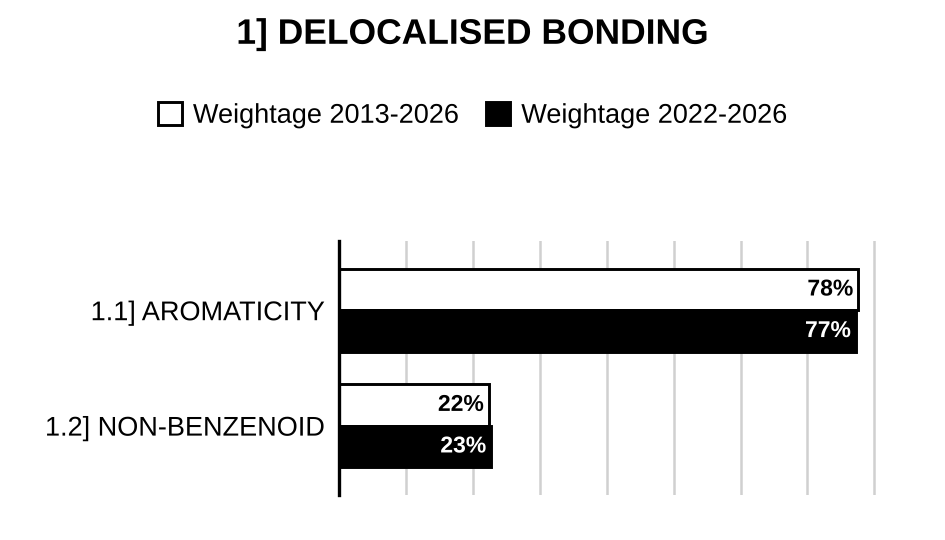
1.1] Aromaticity, anti-aromaticity and annulenes
42 questions
Draw the structures of three possible geometrical isomers of [10] annulene and explain the aromaticity. [2026/5m/1a(i)]
(i) Tropolone is aromatic, but fulvene is non-aromatic. Why? (ii) Explain with example pseudo-aromaticity. [2025/10m/1a]
Classify the following as aromatic, nonaromatic or antiaromatic: (1) Azulene (2) Pyridine (3) Sydnone (4) Cyclooctatetraene (5) Cyclopentadienyl cation. [2024/5m/1a(i)]
Though the following compound contains a keto group, it does not undergo nucleophilic addition reactions. Explain:
[Figure: Diphenylcyclopropenone: cyclopropenone (three-membered ring with C=O at the apex carbon) bearing Ph on each of the two doubly bonded ring carbons] [2024/5m/1a(ii)]
value of cyclopentadiene is almost similar to water. Explain. [2023/5m/1a(i)]
Rate of hydrogen exchange reaction in the above compound (A) is 6000 times faster than that of (B). Explain.
[Figure: (A) cyclopropyl phenyl ketone: a cyclopropane ring attached to C=O carbon bearing Ph (c-C3H5–CO–Ph); (B) cyclopropenyl phenyl ketone: a cyclopropene ring (C=C double bond on the ring edge opposite the attachment carbon, i.e. cycloprop-2-en-1-yl) attached at its sp3 carbon to C=O bearing Ph] [2023/5m/1a(ii)]
Based on Hückel rule, predict the above compounds as aromatic, antiaromatic, and nonaromatic.
[Figure: (A) cyclopenta-1,3-diene (five-membered ring, two C=C, one CH2); (B) 1-methyl-1H-borole: five-membered ring with two C=C and a B atom bearing CH3; (C) 1-methyl-1H-phosphole: five-membered ring with two C=C and a P atom bearing CH3] [2023/5m/2a(i)]
Ionization of 3,4-dichloro-1,2,3,4-tetramethylcyclobutene in at −75 °C produces a reaction intermediate of its own kind. Predict the intermediate and comment on its stability and aromaticity. [2022/10m/1a]
(i) Write the structure of the reaction product between 3-chlorocyclopropene and . What is the unique feature of this product in NMR spectrum? (ii) Which one of the above compounds is more acidic and why? (iii) Predict the aromaticity of tropolones and sydnones.
[Figure: (ii) A = indene (benzene fused to a cyclopentadiene ring, CH2 in the five-membered ring); B = cyclopentadiene] [2021/15m/3b]
Generally alkyl halides are soluble in non-polar solvents and insoluble in water but cycloheptatrienyl bromide is insoluble in non-polar solvents but readily soluble in water. Explain this unusual behaviour of cycloheptatrienyl bromide. [2020/10m/1a]
Is [14] annulene aromatic according to Hückel rule? Justify your answer. [2019/10m/1a]
How is sydnone different from imidazole? Imidazole upon reaction with an acid gives two products. Comment on the aromaticity of the products. [2019/15m/4a]
Draw the π-molecular orbital energy level diagram for the following: (i) Benzene (ii) Cyclobutadiene (iii) Cyclopentadienyl anion. [2018/10m/1a]
(i) Account for the fact that compound is almost as strong an acid as :
[Figure: Compound A: squaric acid (3,4-dihydroxycyclobut-3-ene-1,2-dione): four-membered ring with two adjacent C=O groups and the other two carbons, joined by a C=C double bond, each bearing OH]
(ii) What happens when trans-2-butene is reacted with in presence of anhydrous ? [2018/10m/1c]
Classify the following examples as aromatic, anti-aromatic or non-aromatic. Write their structures also: (i) Tetrahydrofuran (ii) Cyclooctatrienyl dianion (iii) Azulene (iv) Tropolone. [2018/10m/7a]
Classify the following examples into aromatic, anti-aromatic and non-aromatic. Justify your answer.
[Figure: Five structures: (i) styrene (vinylbenzene: benzene ring with a –CH=CH2 group); (ii) cyclooctatetraene (eight-membered ring with four alternating C=C); (iii) azulene (seven-membered ring fused to a five-membered ring, drawn with alternating double bonds); (iv) cyclopropenyl anion (three-membered ring with one C=C and a negative charge on the third carbon); (v) pyrrole (five-membered ring with N–H at the top and two C=C)] [2017/10m/1a]
Out of 3,5-dimethyl-4-nitrophenol and 2,6-dimethyl-4-nitrophenol, which one is more acidic and why? [2017/10m/2b]
Classify the following as aromatic, non-aromatic and anti-aromatic. Give reasons:
[Figure: (i) 4H-pyran (six-membered ring with O at the bottom, two C=C adjacent to O and a CH2 at the top); (ii) cycloheptatriene (seven-membered ring with three C=C and one CH2 at the top); (iii) cyclopentadienyl anion (five-membered ring with two C=C and a negative charge on the fifth carbon at the bottom); (iv) cyclobutadiene (four-membered ring with two C=C); (v) tropylium cation (seven-membered ring with three C=C and a positive charge on the top carbon)] [2016/10m/4b]
Identify the compound from each of the following pairs, which exhibits aromatic character:
[Figure: Pair I: cyclopentadienyl anion (five-membered ring with two C=C and a negative charge on the fifth carbon) & cyclopentadienyl cation (same ring with a positive charge on the fifth carbon); Pair II: cycloheptatrienyl anion (seven-membered ring with three C=C and a negative charge on the seventh carbon) & cycloheptatrienyl (tropylium) cation (same ring with a positive charge on the seventh carbon)] [2015/10m/1a]
Which one of following ions is expected to be aromatic? Explain the reason. Draw additional resonance structures for the aromatic ion.
[Figure: Two ions: (1) cycloheptatrienyl cation (tropylium): seven-membered ring with three C=C double bonds and ⊕ on the remaining carbon; (2) cycloheptatrienyl anion: seven-membered ring with three C=C double bonds and ⊖ with a lone pair (two dots) on the remaining carbon] [2014/10m/1a]
(i) Which molecule can follow electrophilic substitution?
[Figure: Two structures, labelled I and II, joined by “or”: I = cyclooctatetraene drawn as an eight-membered ring of CH units with four alternating C=C double bonds (each carbon bearing one H); II = [18]annulene drawn as an 18-membered ring with nine alternating C=C double bonds, twelve H atoms pointing outwards and six H atoms pointing into the ring]
(ii) 1,5-cyclooctadiene is treated with I-Cl. What is the structure of the product? [2012/12m/1a]
(i) Acetaldehyde is treated with excess formaldehyde in presence of and the reaction produces a solid organic compound. What is the structure of solid organic compound? (ii) Which one of these two compounds (I and II) has aromaticity?
[Figure: I = a 14-membered monocyclic carbon ring containing six conjugated C=C double bonds and one C≡C triple bond (a didehydro[14]annulene: the triple bond lies in a linear C–C≡C–C segment at the bottom of the ring); “and” II = cycl[3.3.3]azine: a central N atom common to three fused six-membered rings (tricyclic, 12 C + N), the peripheral ring carbons bearing alternating C=C double bonds] [2012/12m/1c]
Dihydropentalene () is treated with two moles of n-butyl lithium and it produces a white crystalline compound A. NMR spectrum of A is as follows: a doublet 4.98 J = 3 Hz b triplet 5.73 J = 3 Hz and peak ratio of a : b = 2 : 1. What is the structure of A? [2012/20m/4c]
One of the following hydrocarbons is much more acidic than the other two. Justify your answer considering the stability of their conjugate bases.
[Figure: three five-membered-ring hydrocarbons. (A) a fulvene: ring C1 carries an isopropyl group (single bond to ), ring double bonds C1=C2 and C3=C4, ring C5 carries an exocyclic =CH2 (1-isopropyl-5-methylenecyclopenta-1,3-diene). (B) ring C1 carries an exocyclic =C(CH3)2 (isopropylidene), ring double bond C2=C3, C4 carries an exocyclic =CH2, C5 is a ring CH2 (3-methylene-5-isopropylidenecyclopentene). (C) 6,6-dimethylfulvene: ring C1 carries an exocyclic =C(CH3)2, ring double bonds C2=C3 and C4=C5] [2011/20m/2b]
Whether the following compound is aromatic, non-aromatic or antiaromatic. Justify.
[Figure: 1,6-methano[10]annulene (bicyclo[4.4.1]undeca-1,3,5,7,9-pentaene): a naphthalene-shaped ten-carbon perimeter with alternating double bonds, the two central (bridgehead) carbons spanned by a one-carbon bridge drawn above the ring] [2010/10m/1a]
Draw the structures of [6], [10], [12] and [14] annulenes and discuss their aromaticity. [2010/15m/4b]
How the aromaticity of a molecule can be judged from NMR spectrum? Which thermodynamic data is concrete evidence? [2008/20m/1b(i)]
Indicate which of the following compounds is aromatic, non-aromatic and anti-aromatic in character and give explanation for your answer.
[Figure: (i) a benzene ring fused on two adjacent sides to two cyclopentane rings (hexahydro-as-indacene); (ii) cyclopentadienone (five-membered ring with C=O and two C=C; the ring bond between the two upper carbons is not visible in the print); (iii) cyclopropenyl anion (three-membered ring with one C=C and a ⊖ charge on the third carbon); (iv) pentalene (two fused five-membered rings with C=C bonds); (v) 2,7-dihydroxytropone (seven-membered ring with C=O, the two ring carbons flanking the carbonyl bearing OH, and three ring C=C)] [2007/20m/1a]
Explain why 1-hydroxybenzene exists entirely in the enolic form whereas 2-hydroxypyridine exists very largely in the ketonic form i.e., the lactam form,. [2007/20m/1b(i)]
Identify an aromatic compound from amongst the following. Enumerate the properties of the compound selected by you that would suggest aromatic character. What makes a compound anti-aromatic?
[Figure: (i) cyclooctatetraene; (ii) cyclopropenyl anion (three-membered ring with one C=C and a ⊖ charge on the apex carbon); (iii) 4H-pyran (six-membered ring with ring O and two C=C, the carbon opposite O saturated); (iv) thiophene] [2006/20m/1b]
Explain the observed of the following compounds:
| Compound | |
| [?] | |
[2006/20m/1d]
Compound given below dissolves in acetone to form a brightly coloured solution whereas in ether, it remains colourless. The proton NMR at room temperature shows a broad signal at δ 1.88 which on cooling to -50 °C resolves into two signals at δ 2.07 (6H) and δ 1.29 (3H). Explain.
[Figure: 2,3-dimethylcycloprop-2-en-1-yl group ( on each double-bond carbon) attached through its sp3 carbon to a carbon bearing two CN groups and a 4-nitrophenyl group: ] [2006/20m/5a]
Explain the mentioned pKa of the following compounds:
[Figure: Three amines with their pKa values: (i) quinuclidine (1-azabicyclo[2.2.2]octane, N at a bridgehead), pKa 10.58; (ii) the benzo-fused analogue in which one bridge of quinuclidine is a benzene ring, i.e. the bridgehead N is bonded directly to an aromatic carbon of a fused benzene ring (tricyclic, N in a bicyclo[2.2.2] cage), 7.79; (iii) N,N-dimethylaniline (), 5.06] [2005/20m/1b]
How do you explain the concepts of aromaticity, anti-aromaticity and homo-aromaticity? [2005/0m/4d(i)]
Which of the following compounds are aromatic and why?
[Figure: A = cycloheptatrienyl anion (seven-membered ring with three C=C and a ⊖ charge on the sp3 carbon); B = cyclooctatetraene; C = tropone (cyclohepta-2,4,6-trien-1-one); D = pentalene (two fused five-membered rings, four C=C); E = azulene (fused five- and seven-membered rings)] [2005/25m/4d(ii)]
(i) 1, 3, 5-cycloheptatriene (not an aromatic compound) reacts with a molecule of bromine to afford a compound having melting point 203°C (decomposition) and is insoluble in nonpolar organic solvents but soluble in water. Write and support the structure of the product and rationalize its formation. (ii) Account for the following observations in case of and which are the first and second dissociation constants of the dicarboxylic acids (I) and (II)
[Figure: (I) maleic acid (cis-butenedioic acid: both COOH groups on the same side of the C=C); (II) fumaric acid (trans-butenedioic acid: HOOC and COOH on opposite sides of the C=C)]
of (I) > of (II) where of (I) < (II) [2004/20m/1a]
Phenanthrene is a tricyclic aromatic hydrocarbon, the structure of which is depicted below It undergoes addition reactions at 9, 10 double bond which is not a characteristic reaction of aromatic compound. Explain the behaviour of this compound by drawing its various canonical forms.
[Figure: phenanthrene (Kekulé structure), with the C9=C10 double bond of the central ring labelled 9 and 10] [2004/20m/1b]
(i) Which of the following compounds are aromatic? Give reasons to justify your answer: (ii) On the basis of modern concept of aromaticity how will you explain azulene as blue and shows dipole, moment of 0.8 D whereas its isomer naphthalene is colourless and has no dipole moment?
[Figure: (i) six structures: I – a 1,2-dithiole ring (five-membered ring S–S with one ring C=C) whose ring carbon next to S carries an exocyclic C=CH–CH=S chain, the terminal S drawn next to (not bonded to) the ring S (thiathiophthene-type, “S–S···S”); II – four-membered ring (rectangle) with one C=C (top side) and a ⊕ charge on each of the two lower carbons (cyclobutadiene dication); III – eight-membered ring with three C=C drawn and two ⊖ charges on adjacent lower carbons (cyclooctatetraene dianion); IV – peri-fused tricyclic hydrocarbon (phenalene skeleton: three six-membered rings sharing a central carbon) with six C=C drawn around the periphery; V – mesoionic sydnone: five-membered ring R–N(+)–CH=C(–O⊖)–O–N, i.e. R on N-3, CH (C-4), C-5 bearing , ring O-1 and N-2, with a dashed circle containing “+” in the ring; VI – naphthalene skeleton with one ring benzenoid and the other ring having only one further C=C, i.e. 1,2-dihydronaphthalene [?]] [2003/20m/1a]
Which of the following compounds are aromatic? Give reasons to justify your answer.
[Figure: I = [10]annulene, all double bonds cis (“cis, cis, cis, cis, cis”); II = [10]annulene with one internal H (“trans, cis, cis, cis, cis”); III = [10]annulene with two internal H drawn as two fused-looking rings (“trans, cis, trans, cis, cis”); IV = 1,6-methano[10]annulene (bicyclic ten-carbon perimeter bridged by CH2); V = monocyclic polyene ring containing one ring O (oxonin, ring size as drawn [?]); VI = monocyclic polyene ring containing one ring BH (boronin, ring size as drawn [?])] [2001/20m/1a(i)]
pKa of cycloheptatriene is about 39 but that of cyclopentadiene is 16. Explain. [2001/20m/1a(ii)]
The triene (A) can be readily deprotonated twice with a base to give a stable dianion (B). In contrast to this, the neutral analogue (C) is quite unstable. Explain it.
[Figure: A = dihydropentalene (two fused five-membered rings with C=C double bonds, two sp3 CH2 carbons) –→ B = pentalene dianion (same bicyclic skeleton, fully unsaturated, charge 2− marked); C = pentalene (bicyclo[3.3.0]octa-tetraene, neutral)] [2001/20m/1a(iii)]
State the criteria of aromaticity. Decide whether each of the following compounds is aromatic. (i) Pyrrole (ii) 1,3,5-Hexatriene (iii) 1,3,5-Cyclo-heptatriene (iv) 18-Annulene. [2000/20m/1a]

Preparing for Prelims too?
Our UPSC Prelims Topic-wise PYQ eBook covers every Prelims question with detailed explanations, so you can see exactly where UPSC asks from.
View the BookDownload Free Sample1.2] Non-benzenoid aromatic systems
17 questions
Explain the aromaticity of sydnone and tropolone. [2026/5m/1a(ii)]
(i) Tropolone is aromatic, but fulvene is non-aromatic. Why? (ii) Explain with example pseudo-aromaticity. [2025/10m/1a]
Classify the following as aromatic, nonaromatic or antiaromatic: (1) Azulene (2) Pyridine (3) Sydnone (4) Cyclooctatetraene (5) Cyclopentadienyl cation. [2024/5m/1a(i)]
(i) Write the structure of the reaction product between 3-chlorocyclopropene and . What is the unique feature of this product in NMR spectrum? (ii) Which one of the above compounds is more acidic and why? (iii) Predict the aromaticity of tropolones and sydnones.
[Figure: (ii) A = indene (benzene fused to a cyclopentadiene ring, CH2 in the five-membered ring); B = cyclopentadiene] [2021/15m/3b]
How is sydnone different from imidazole? Imidazole upon reaction with an acid gives two products. Comment on the aromaticity of the products. [2019/15m/4a]
Classify the following examples as aromatic, anti-aromatic or non-aromatic. Write their structures also: (i) Tetrahydrofuran (ii) Cyclooctatrienyl dianion (iii) Azulene (iv) Tropolone. [2018/10m/7a]
Write the resonating structures of azulene and explain why it exhibits dipole moment (~ 1.0 D). [2016/10m/1a]
Tropolone [structure] has following characteristics: (i) Has high dipole moment (3.71 D). (ii) Follows Reimer – Tiemann reaction. (iii) Couples with diazonium ions. (iv) Follows nitration with dilute . What class of compounds does tropolone resemble? Is it stable in acid or basic medium? Explain.
[Figure: The structure after ‘Tropolone’: seven-membered ring with C=O and an adjacent C–OH and three ring C=C double bonds (2-hydroxycyclohepta-2,4,6-trien-1-one)] [2012/12m/5a]
Which one of the following compounds is more basic? Explain with reason.
[Figure: (I) a fulvene: cyclopenta-1,3-diene ring whose C5 carries an exocyclic C=C to a carbon bearing and Ph, i.e. 6-(dimethylamino)-6-phenylfulvene; (II) the seven-membered analogue: cyclohepta-1,3,5-triene ring whose C7 carries an exocyclic C=C to a carbon bearing and Ph, i.e. 8-(dimethylamino)-8-phenylheptafulvene] [2011/10m/1a]
Azulene possesses dipole moment 1.0 D and electrophilic substitution in it occurs at the position-1 of the five membered ring. Provide explanation. [2011/20m/2a]
Write the resonance structures of the following: Explain its aromaticity in nitration reaction.
[Figure: 3-phenylsydnone drawn as a five-membered ring: bonded to CH and double-bonded to N; CH=C; the C bears (exocyclic) and is bonded to ring O; ring O bonded to the N (sequence back to )] [2010/15m/3c]
(i) What kind of substitution on benzene ring stabilizes the phenyl carbanion and where is it most effective? Explain mechanistically. (ii) Which has higher dipole moment between and and why?
[Figure: (ii) first compound: sesquifulvalene — a cyclopentadiene ring (two ring C=C) joined by an exocyclic C=C to a cycloheptatriene ring (three ring C=C), i.e. cyclopentadienylidene=cycloheptatrienylidene; “and”; second compound: 6,6-dimethylfulvene — cyclopentadiene ring with exocyclic ] [2009/20m/1b]
Which of the following compounds are aromatic and why?
[Figure: A = cycloheptatrienyl anion (seven-membered ring with three C=C and a ⊖ charge on the sp3 carbon); B = cyclooctatetraene; C = tropone (cyclohepta-2,4,6-trien-1-one); D = pentalene (two fused five-membered rings, four C=C); E = azulene (fused five- and seven-membered rings)] [2005/25m/4d(ii)]
(i) Which of the following compounds are aromatic? Give reasons to justify your answer: (ii) On the basis of modern concept of aromaticity how will you explain azulene as blue and shows dipole, moment of 0.8 D whereas its isomer naphthalene is colourless and has no dipole moment?
[Figure: (i) six structures: I – a 1,2-dithiole ring (five-membered ring S–S with one ring C=C) whose ring carbon next to S carries an exocyclic C=CH–CH=S chain, the terminal S drawn next to (not bonded to) the ring S (thiathiophthene-type, “S–S···S”); II – four-membered ring (rectangle) with one C=C (top side) and a ⊕ charge on each of the two lower carbons (cyclobutadiene dication); III – eight-membered ring with three C=C drawn and two ⊖ charges on adjacent lower carbons (cyclooctatetraene dianion); IV – peri-fused tricyclic hydrocarbon (phenalene skeleton: three six-membered rings sharing a central carbon) with six C=C drawn around the periphery; V – mesoionic sydnone: five-membered ring R–N(+)–CH=C(–O⊖)–O–N, i.e. R on N-3, CH (C-4), C-5 bearing , ring O-1 and N-2, with a dashed circle containing “+” in the ring; VI – naphthalene skeleton with one ring benzenoid and the other ring having only one further C=C, i.e. 1,2-dihydronaphthalene [?]] [2003/20m/1a]
Predict which of the following compounds would be aromatic? Explain the basis of your prediction in minimum possible words.
[Figure: Eight structures numbered 1–8 (drawing of low quality): 1 = cyclopropene with an exocyclic C=CH2 (methylenecyclopropene); 2 = two cyclopropene rings joined by an exocyclic C=C double bond (triafulvalene, bi(cyclopropenylidene)); 3 = cyclopentadiene with exocyclic =CH2 (fulvene); 4 = cyclopropene ring joined by an exocyclic C=C to a cyclopentadiene ring (calicene, triapentafulvalene); 5 = two cyclopentadiene rings sharing one sp3 spiro carbon (spiro[4.4]nona-1,3,6,8-tetraene); 6 = cycloheptatriene with exocyclic =CH2 (heptafulvene); 7 = cyclopentadiene ring joined by an exocyclic C=C to a cycloheptatriene ring (sesquifulvalene, pentaheptafulvalene); 8 = cycloheptatriene ring joined by an exocyclic C=C to a second ring drawn as a cyclic polyene (heptafulvalene) [?]] [2002/20m/1a(i)]
The value of the barrier of rotation for the marked bond in A is only about 14 Kcal/mole. What could be the reason for this low value of barrier of rotation in this molecule?
[Figure: Molecule A (drawing almost illegible in the source): a cyclic polyene ring (cyclopentadiene or cycloheptatriene ring [?]) joined through the marked exocyclic C=C double bond to a six-membered cross-conjugated ring bearing a para C=O group (a quinone-methide/fulvene-type push–pull system) [?]] [2002/20m/1a(ii)]
Explain the aromatic properties of tropolones. Give one synthesis of β-tropolone. [2000/15m/3a]

Strengthen your GS papers
Our UPSC Mains Topic-wise & Year-wise PYQ eBook (2013–2026) maps every GS question to the syllabus, so you know what UPSC asks and how often.
View the BookDownload Free Sample« Previous: General Chemistry of ‘f’ Block Element | Next: Reaction Mechanisms »
Back to: Chemistry Optional PYQs – Topic-wise
Last updated: 30 October 2026